Journey Around The Globe
ready for the next destination
Day trip to former capitals of Lithuania – Karnave and Trakai
KARNAVE and TRAKAI, LITHUANIA: Visiting Karnave and Trakai was a tempting day-trip for us during our trip to Vilnius, Lithuania. Both of the towns were so close to Vilnius that we decided to get out of the capital for a day and enjoy some suburbs time.
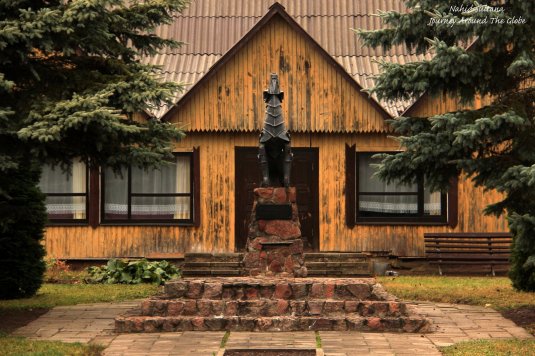
- A howling iron wolf – an official symbol of Lithuania
Karnave is about 35 km NW of Vilnius. This was the first capital of Lithuania. It was a trading city back then. But unfortunately the city was badly destroyed by the Germans crusaders and then Lithuanians themselves (to defend) in the 14th century and was never rebuilt. Now it’s enlisted in UNESCO World Heritage Site.
Trakai was Lithuania’s former medieval capital when Grand Duke Gediminas moved it from Karnave sometime during 14th century. It was first mentioned in the history in 1337. This small town is well known for its many different inhabitants like Lithuanians, Jews, Poles, Russians, Tatars, and Lithuanian Karaim (an intriguing Turkish speaking offshoot of the large Judaic Karaim movement who arrived in the town at the end of the 14th century and who are currently on the border of extinction). The city is about 28 km from Vilnius and is a lake district with 5 beautiful water bodies. I am happy that we took this tour…makes a perfect full or half a day trip if you are in Vilnius.
Thanks to our hotel who helped us to book this trip through a company, called Vilnius City Tour (vilniuscitytour.com). It was a private tour just by ourselves along with a driver and a great guide, Asta. We were picked up from our hotel around 9am. After visiting Karnave, Trakai, and some portion of Vilnius old town, we were brought back to hotel around 6pm. It cost us about $400 (290 euros or 1000 LTL) for our family of 4 (2 kids: 7 and 3 years old). Lunch wasn’t included here but we didn’t have to pay any entrance fees in anywhere.
TIME of TRAVEL: We visited Lithuania at the beginning of November 2013. It was not-so-great day when we took this trip. It was very cold and definitely cloudy at the beginning. Up to Karnave, the weather was fine…just had to deal with the cold. But when we were in Trakai, it started raining. But we still managed to visit the Trakai’s castle but if the weather permitted we would have had great time by the lake too.
OUR HOTEL: We stayed in Hotel Atrium in old town of Vilnius. Please check the “Our Hotel” section in my page on Vilnius under Lithuania.
EATING and SHOPPING: I didn’t find many shops or restaurants in Karnave but Trakai was a good place for some local souvenir hunt. Along the side of Lake Galve where Trakai Island Castle is located, there are lots of outdoor vendors who were selling variety of different trinkets. There were many cafes and restaurants by the lake too. We had lunch in a lake-view restaurant, called Bona Pizzeria…enjoyed the stunning view of the castle from our table as well as good food. They had pizza and pasta for the kids and soups, salads, and some Lithuanian dishes for our adult taste buds.
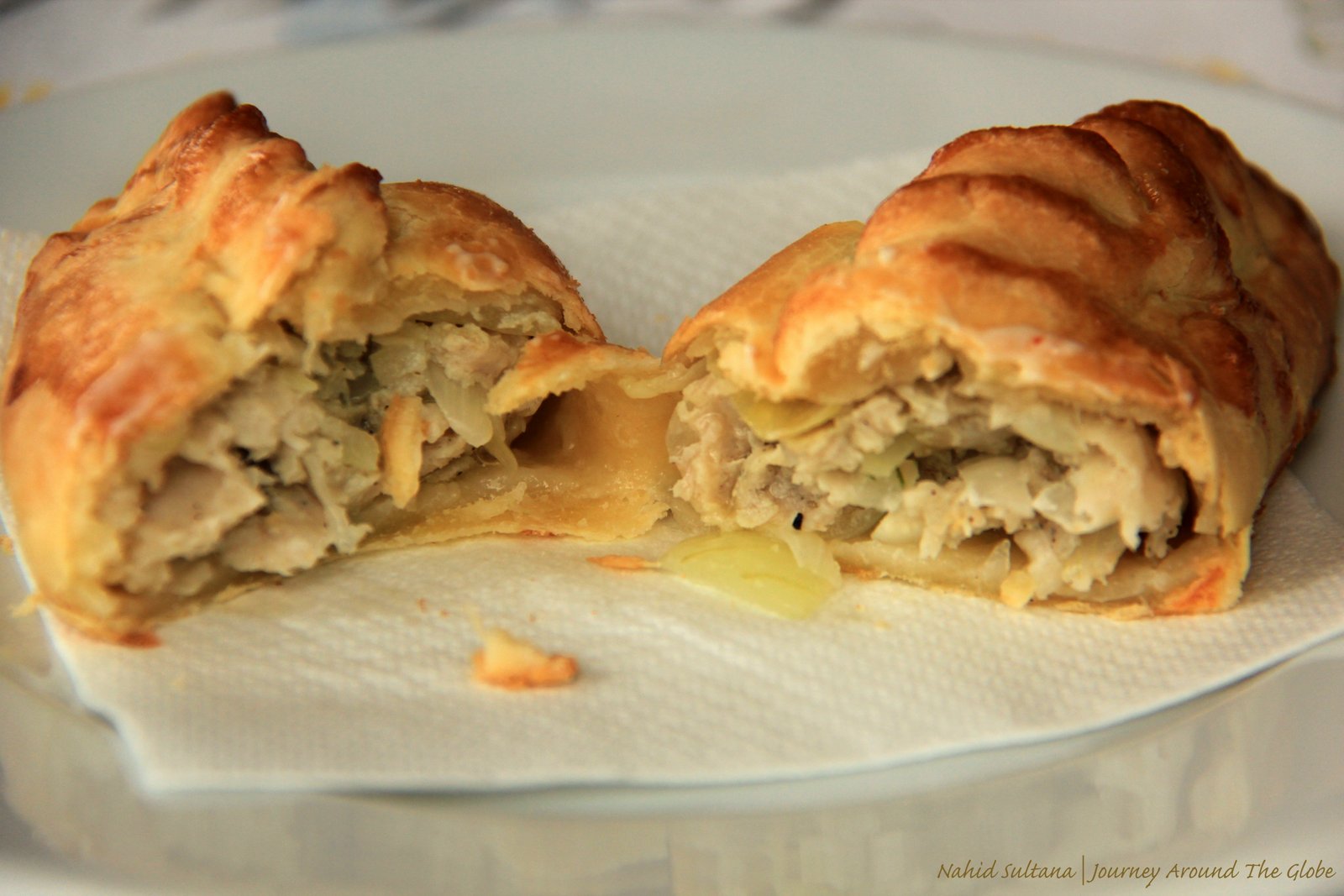
One thing that you just have to try in Trakai is kibinai. It’s a meat pastry which is Karaim (a minority tribe in Trakai) specialty. You can find kibinai in Vilnius or other towns in Lithuania, but Trakai is the where you can find it in its best form.
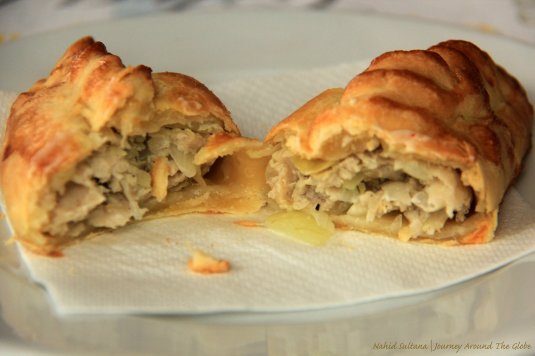
- Kibinai – meat pastry, a specialty of Trakai
PLACES WE’VE VISITED: This was a day trip we took from Vilnius. First we were taken to Karnave and spent about couple hours there. Then our guide took us to Trakai. Here we spent about few hours too including lunch. We were done with these two places about 3pm. Our last destination was Vilnius where she showed some sites that we didn’t cover on our own. Please visit my page on Vilnius to see all the places we’ve visited there.
1) KARNAVE: As I mentioned before this was Lithuania’s first capital and a very historic place. It was very quiet that day, I think we were the only tourists there and it was the weather to blame. Overall, there aren’t much to do or even see in Karnave, at least not around this time of the year.
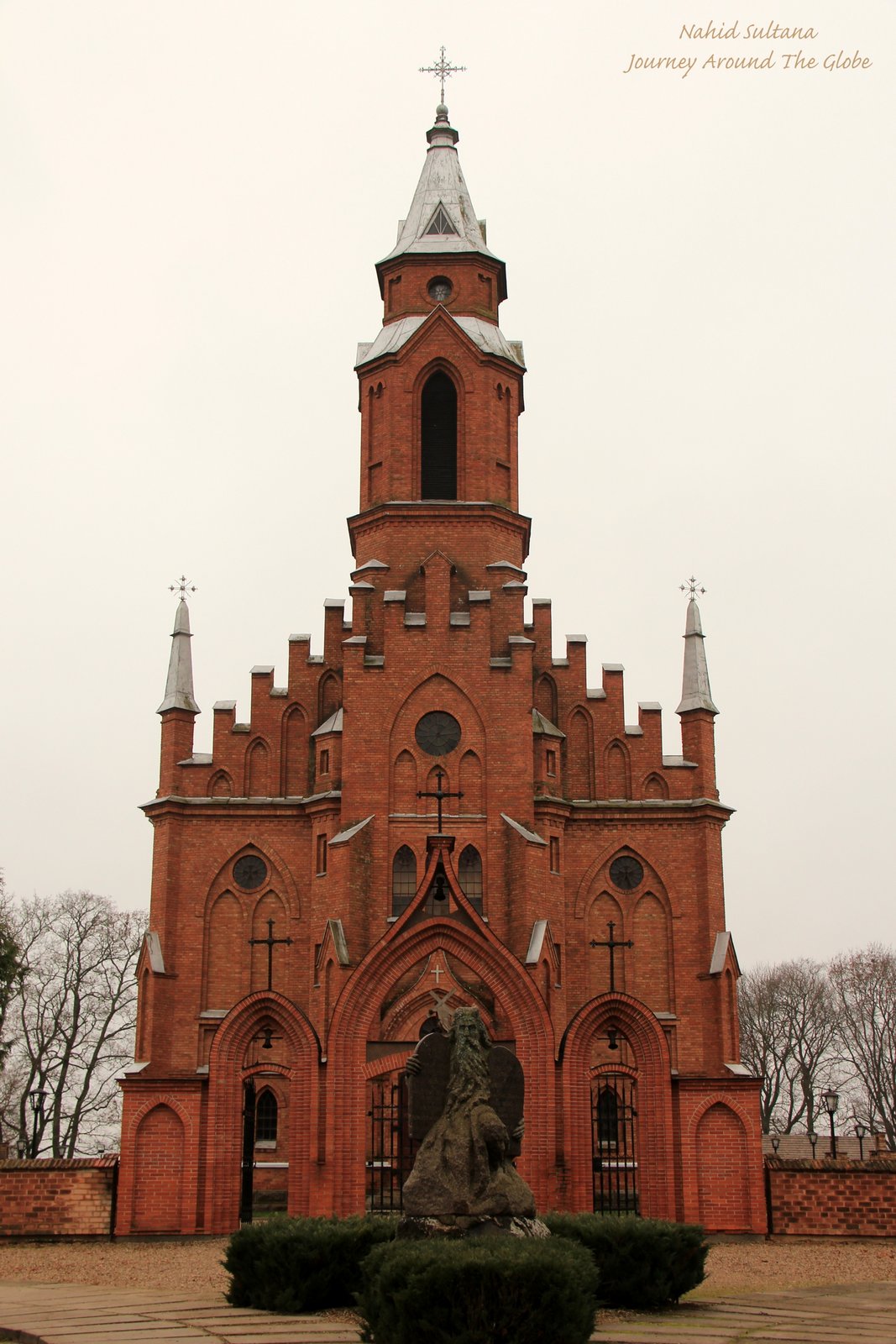
Church of Saint Mary of Scapular was built in 1920. We didn’t go inside the church but our guide did take us to a gated area where church Father lives to show us a memorial for Jerusalem and a man-made lake in the shape of Lithuania’s map. At one side of the church, there are some ruins of an early church (mainly some bricks/stones where the original nave used to be) from few centuries ago in the 15th century.
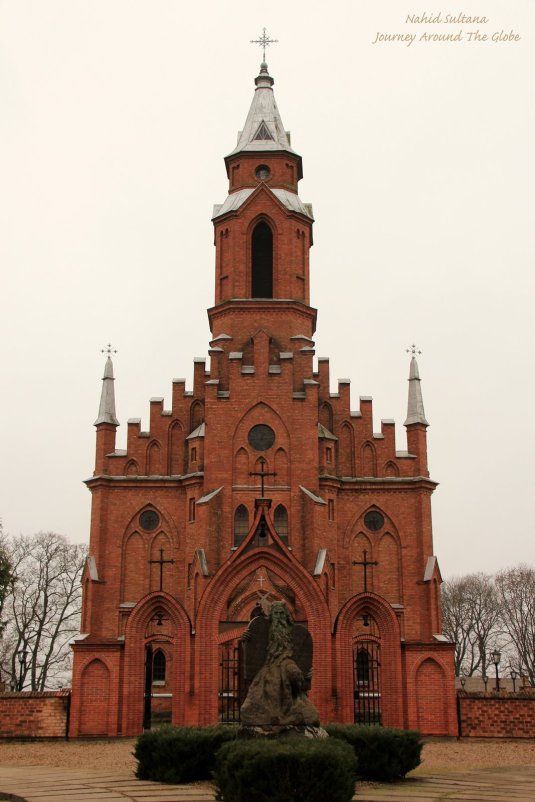
- Church of Saint Mary of Scapular in Karnave, Lithuania
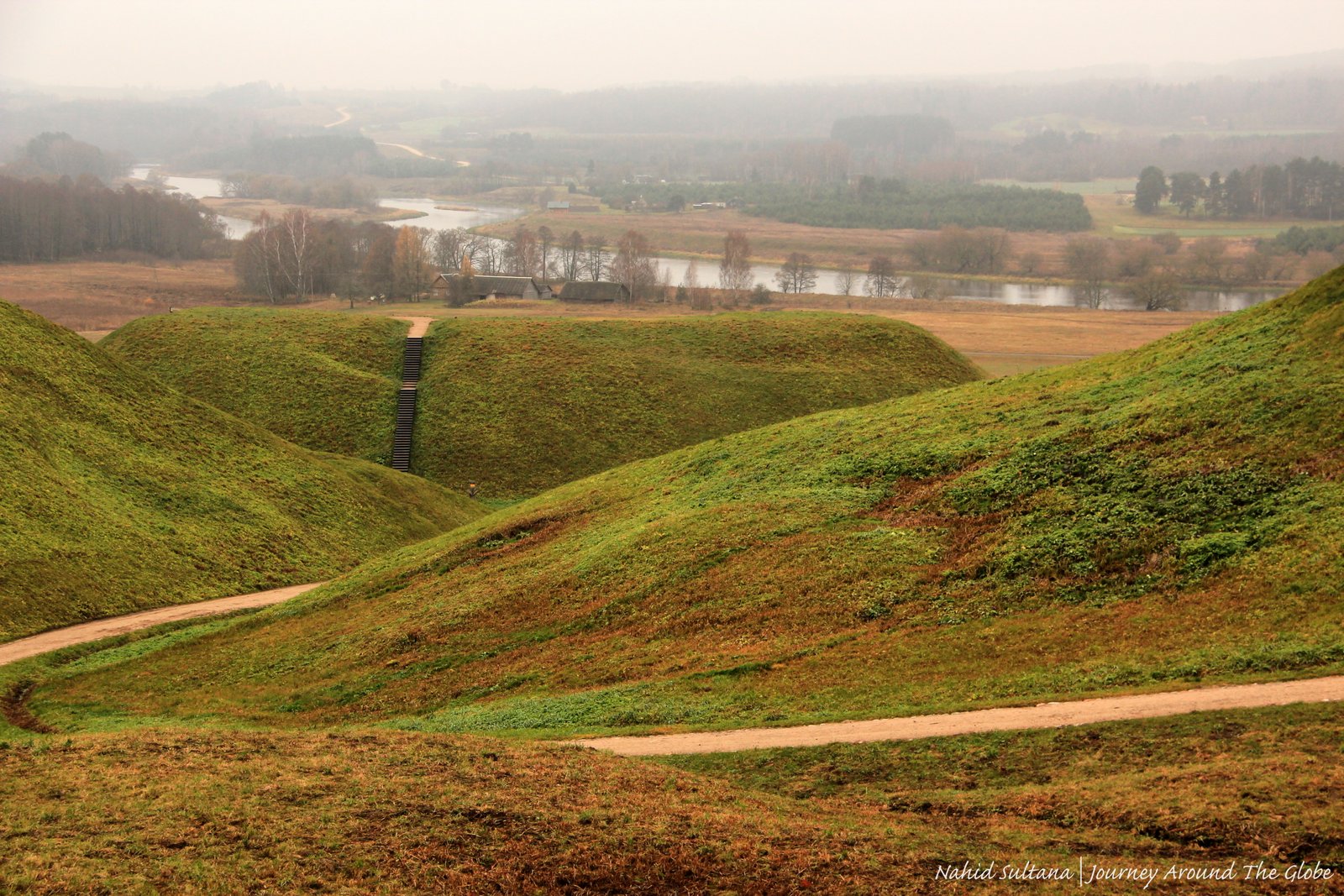
You can see River Neris flowing at a distance when standing behind the church and in front of the mounds. It’s a beautiful valley and very historic place for this country. As we were standing behind the church and facing the mounds and River Neris, left mound, called Mindaugas Mound, was where Lithuania’s first and last king, King Mindaugas was crowned. Out of total 5 original mounds, you can see 4 of them. We climbed on two mounds and let me tell you, view from there is just too pretty. During summer, big festivals and events take place on these mounds.
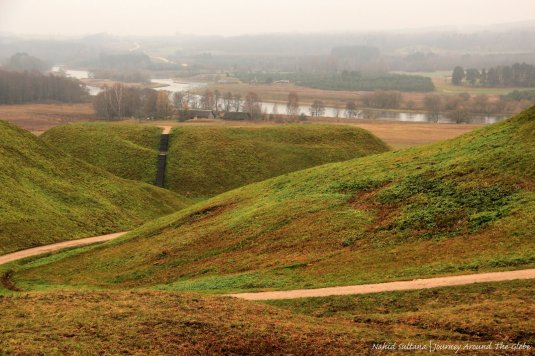
- Historic mounds of Karnave in Lithuania
We were done with Karnave in about less than 2 hours, then headed towards Trakai.
2) TRAKAI: From Karnave to Trakai the distance is about 25 km. This is mainly a lake resort area and a perfect holiday place during summer. It started raining when we got off the coach in Trakai and walking towards the castle. But I could imagine how beautiful it probably looks in the summer months. I am sure visitors at that time can enjoy the waterscape and expanse of lakes everywhere in Trakai.
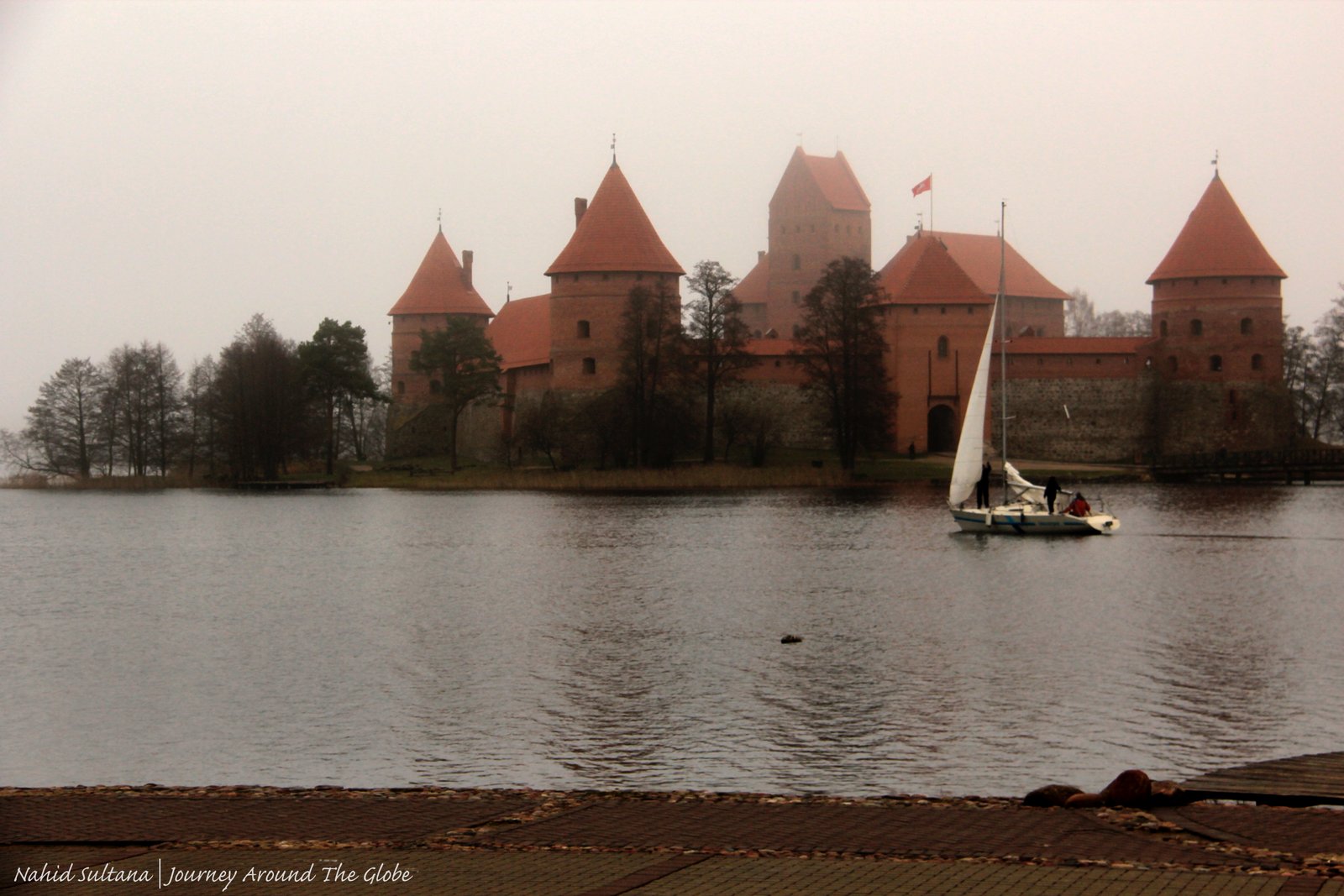
The main attraction of Trakai other than the lakes is Trakai Island Castle which was the residence of Vytotus the Great. This grand and romantic castle ruins of Trakai attract major tourists in Lithuania. Sitting quietly on Lake Galve, construction of this Gothic masterpiece started in the 14th century. The castle was damaged and eventually abandoned in 1655 after a war with Muscovy. Ironically, it was during the Soviet occupation of Lithuania that the castle was eventually restored to its former glory.
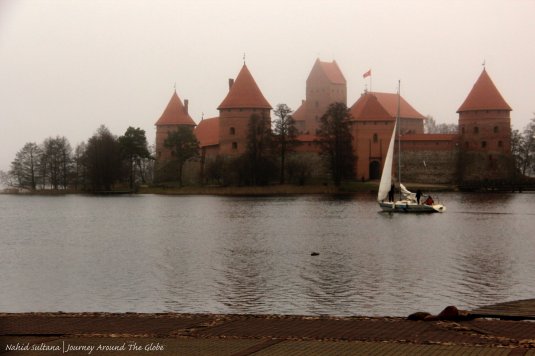
- Trakai Island Castle on Lake Galve in Lithuania
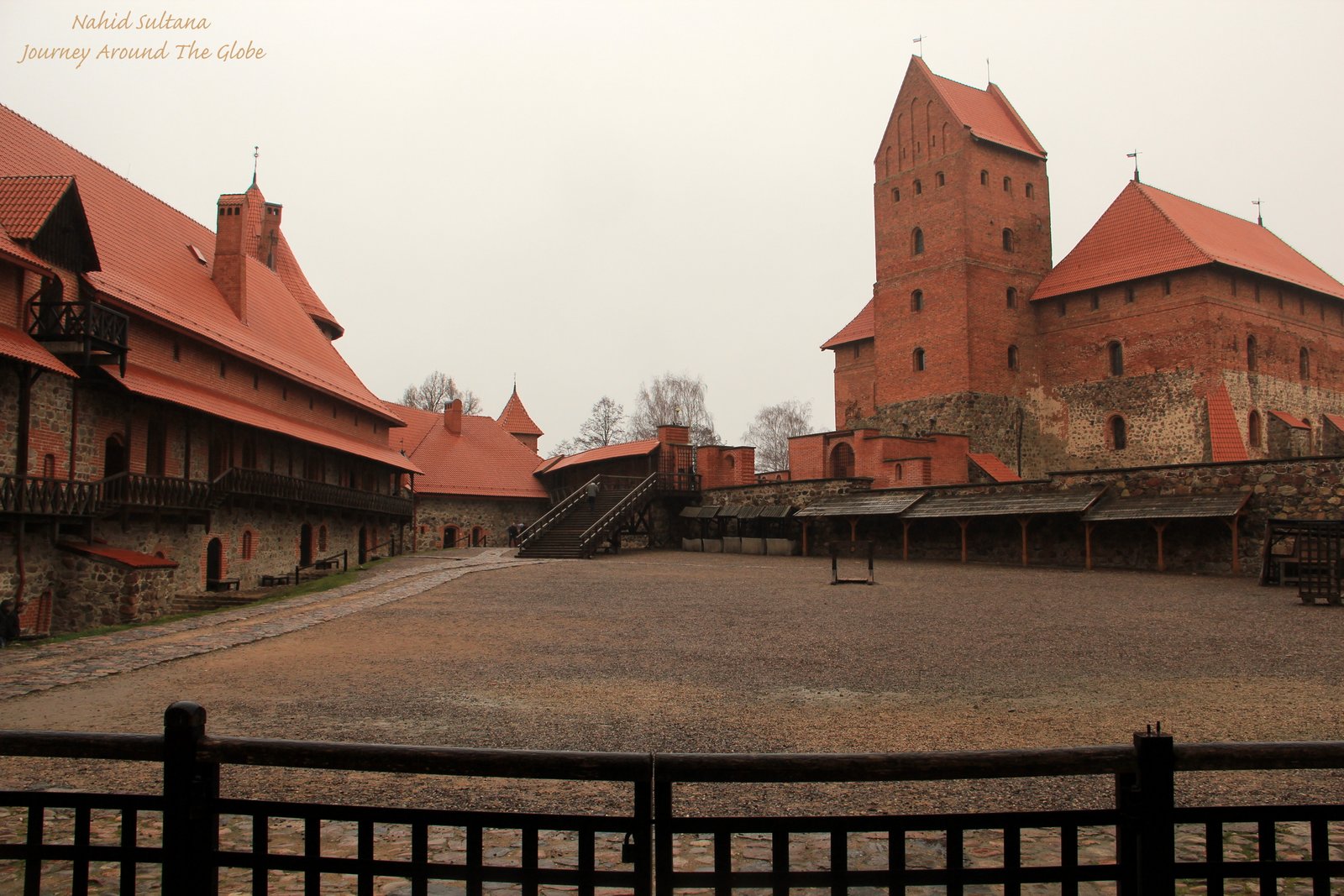
We crossed a footbridge and walked little more to reach the main entrance to the castle. Two main structures of this castles are the defensive outer and the Ducal Palace. Upon entering to the main front courtyard, you can see beautiful fortress of red bricks in all three sides. Trakai History Museum is spread around the castle and linked via many arrays of wooden steps and dark spiral staircases. Soldiers’ barracks, Great Hall, and other small rooms are filled with some original furniture, decors, ceramics, potteries, and etc. Though Trakai Island Castle looks more like a fortress than a palace, there are bedrooms of kings and queens that you can visit.
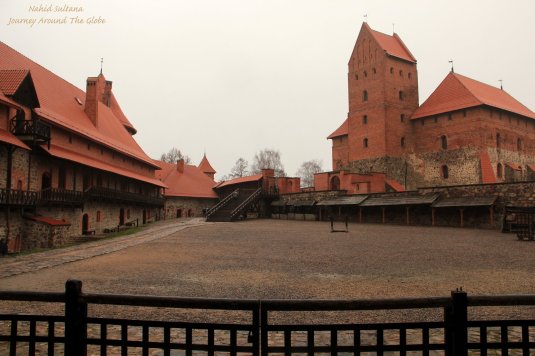
- Inside Trakai Island Castle in Lithuania
A collection of items were dug up in the vicinity of the castle, such as a huge collection of coins. Some explanations in the castle are in English, but mostly they are in Lithuanian and Russian.
Related articles
- Bloody history and current look of Vilnius, Lithuania (journeyaroundtheglobe.com)
- Day 33: Vilnius, Lithuania (philsworldconquest.wordpress.com)
- Day 32: Suwalki, Poland to Vilnius, Lithuania (philsworldconquest.wordpress.com)
- Trakai, Old Town and ‘Traditional Lithuanian Drinking’ (muchadoabouttaylor.wordpress.com)
- Bloody history and current look of Vilnius, Lithuania (topsvetaine.wordpress.com)
- Top 5 Night life Spots in Vilnius, Lithuania (missurasa.wordpress.com)
- Vilnius valdo! (eacleary.wordpress.com)
- Tourist Numb, History-Seeped: Vilnius, Lithuania (topsvetaine.wordpress.com)
Share this:

Bloody history and current look of Vilnius, Lithuania
VILNIUS, LITHUANIA: Vilnius is the capital of Lithuania and definitely one of the most vibrant and unique cities of former Soviet Union. Historically, it was formed in 1236 by Lithuania’s first and last king, King Mindaugas.
Lithuania has about less than 3 million people, among which mostly are Catholics. Their language roots back to Baltic tribes and interestingly very similar to Sanskrit. But locals speak very good English and most of the older generations speak Russian too.
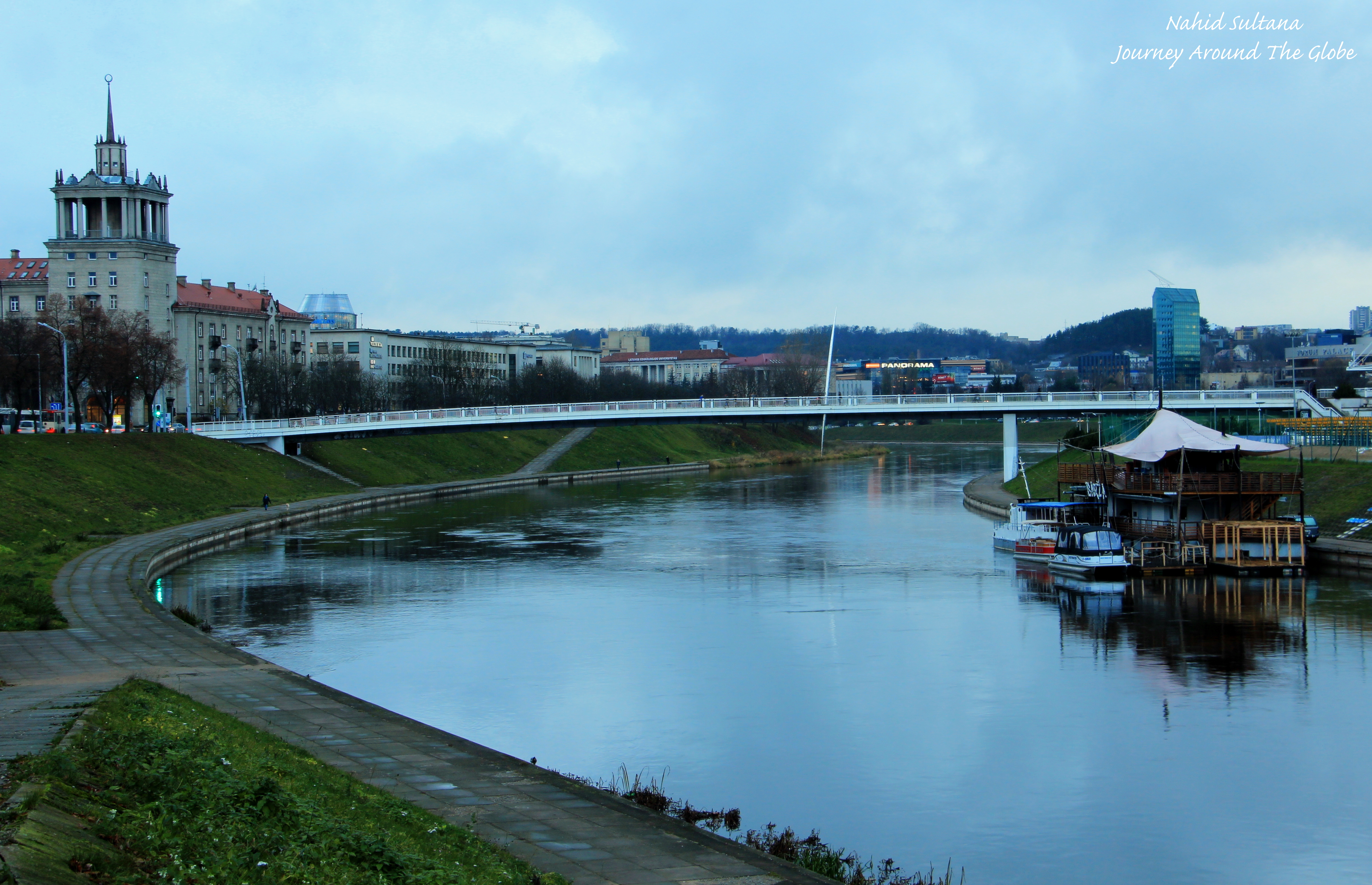
- Vilnius, Lithuania by River Neris
The years 1940 to 1941 reflect a very difficult and tragic period in the history of Lithuania. The country’s future was decided by other states when it was occupied in June of 1940 by the Soviets, and later annexed. Sovietisation and the brutal persecution of its citizens began. Over 30,000 people were persecuted under the first Soviet occupation (from June 1940 to June 1941). These persecutions and deportations of Lithuanians were only the beginning of the story of brutality and loss that lasted half a century. This experience is still alive in the memories of people of that generation, and to others through the stories of grandparents or parents. It has affected their fates and the fates of succeeding generations.
Deportations, the mass evictions of people from their places of residence to the remotest regions of the Soviet Union, were one of the most brutal measures taken by the Soviet regime against civilians. Entire families, parents, grand-parents children, newborns, and the sick were secretly, usually in the dead of nights, carried away in cattle cars.
The armed resistance by partisans between 1944 and 1953 took the lives of over 20,000 people. More than half of them perished fighting for freedom between 1944 and 1945. Most of the fighters who died were younger than 21. Even their deaths were brutally displayed in the public. In order to frighten civilians, the bodies of partisans were laid out in town squares, yards, and farmers’ markets.
Vilnius reminded me little bit of St. Petersburg. Old town of Vilnius is very nice and is enlisted as UNESCO World Heritage Site. Look for howling iron wolf in many places of Vilnius that depicts Gediminas’ (Grand Duke of Lithuania) prophetic dream. There at total of 52 churches in Vilnius, some…may be most of them date back to the medieval ages. But interestingly religious wise Lithuania was originally a pagan country and was the last country in Europe to accept Christianity.
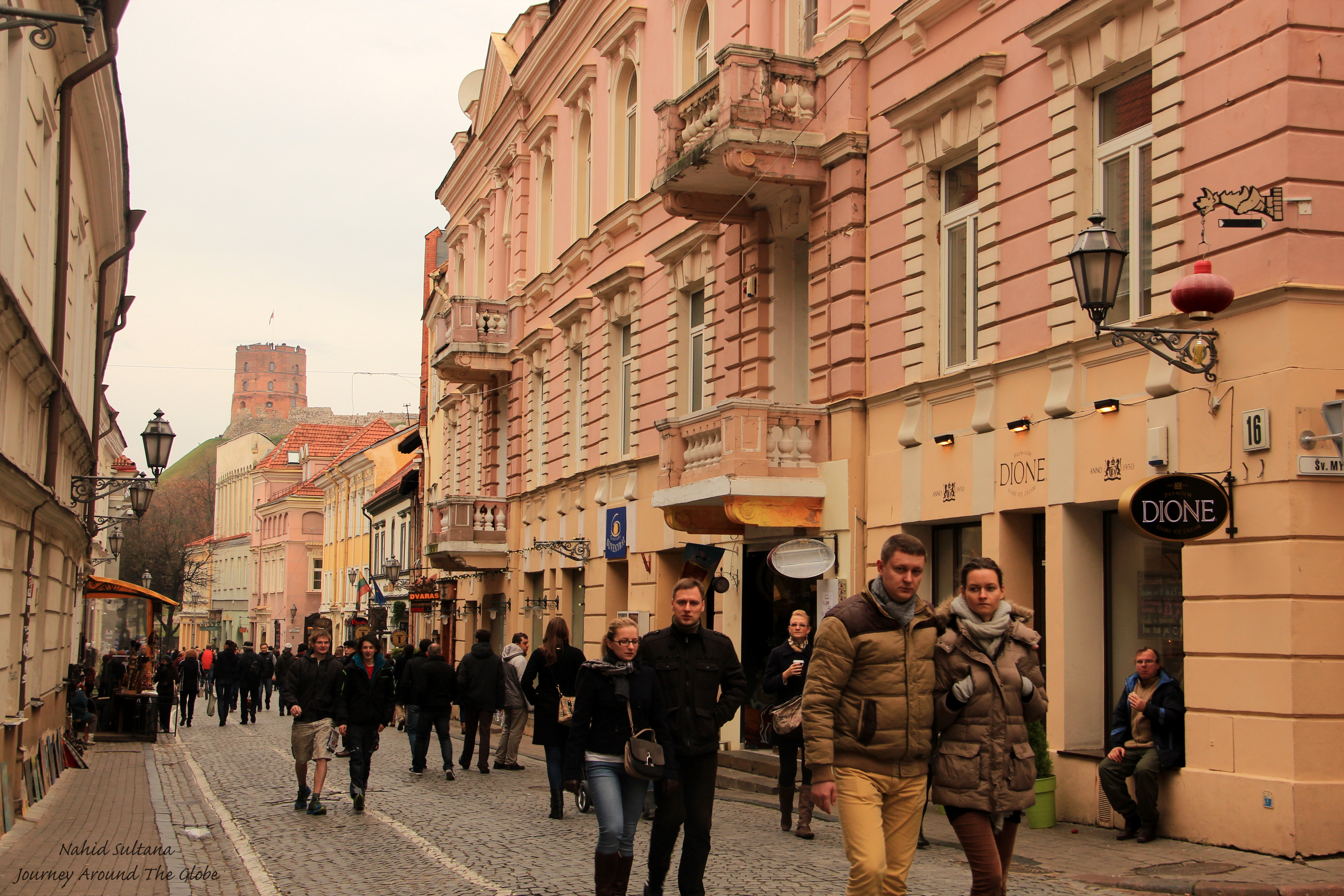
- Old town of Vilnius, Tower of Gediminas Castle in the back
TIME of TRAVEL: It was the first week of November 2013 when we visited Vilnius. Eastern Europe can get really cold and chilly around this time of the year but we were very well prepared. The temperature was around early 40s during the day and mid 30s around the evening. We got a little bit of drizzle here and there but no major rain or snow.
OUR HOTEL: We stayed in Atrium in the old town of Vilnius which was only a few steps from Cathedral Square and right in the middle of the shopping district. It was a gorgeous hotel with nice breakfast and free Wi-Fi in our room. The only thing I didn’t like about this hotel was that it didn’t have any elevator. The staffs were helpful giving us different options of making day-trips to nearby sites of Vilnius. Vilnius’s only Argentinean restaurant “El Gaucho Sano” is in this hotel where we had our last dinner…very fancy and truly good food. The location was also a plus point for this hotel, since we were within walking distance from all the main attractions of the city including St. Anne’s Church, Town Hall Square, and the overall old town pedestrian zone. The hotel is surrounded by many restaurants from fast food to authentic local Lithuanian kitchens. Also, many souvenirs shops and other boutique stores were very close by.
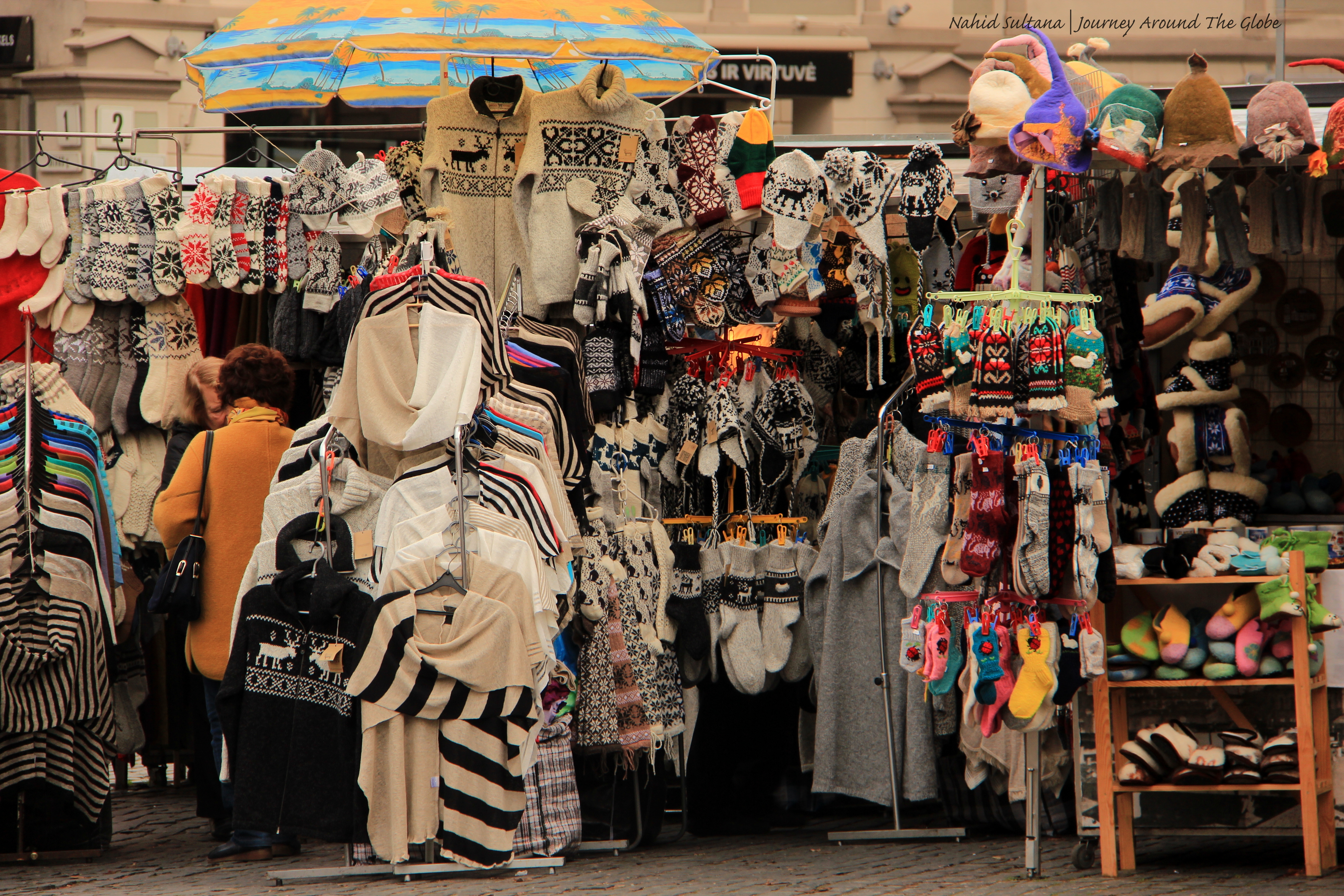
EATING and SHOPPING: Like Riga, Vilnius is an amber city too. There countless amber stores in the old town. Most of the decent stores will give you their authentication certificate with the jewelries or decors you buy. Many Russian influenced souvenirs are very common here, like Russian dolls, lacquered boxes. Many squares have local hand-craft vendors in the weekend.
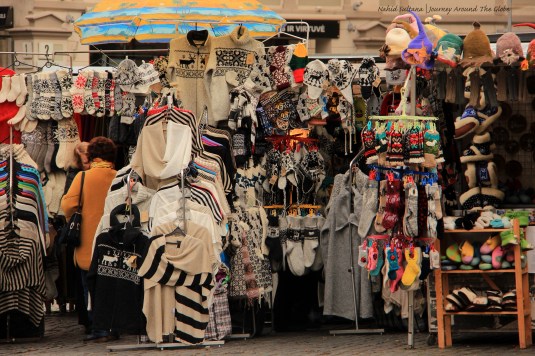
- Some Lithuanian souvenirs in Vilnius stores
Our first dinner in Vilnius was in Forto Dvaras on Pillies Street, very close to Cathedral Square. Seemed like all the locals knew about this restaurant. It indeed offers some great local dishes with reasonable prices. We mostly tried some local Lithuanian dishes, like cheese dumplings, potato pancakes (Lithuanians eat lots and lots of potatoes). The building itself is a historic place with underground sitting arrangements. Cili Pica is a chain restaurant where we had 2 of our meals in Vilnius. You can find them almost in every neighborhood in old town. They have a nice combination of pasta, variety of pizzas, salads, soups, and some Lithuanian dishes. The price is very reasonable and the menu is very kids friendly. We also ate in Charlie’s Pizza on Pillies Street couple times. They mostly have lots of different types of pizzas, soups, salads, and some Lithuanian dishes. If you get a chance try their unique black breads…either in breakfast or with soup.
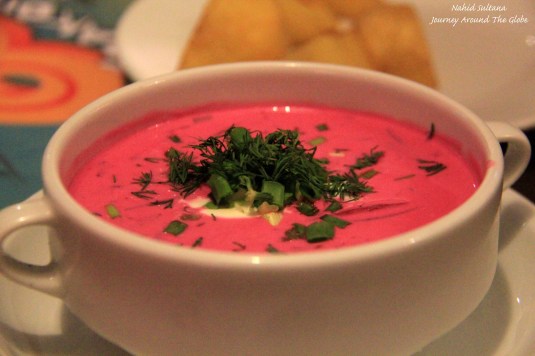
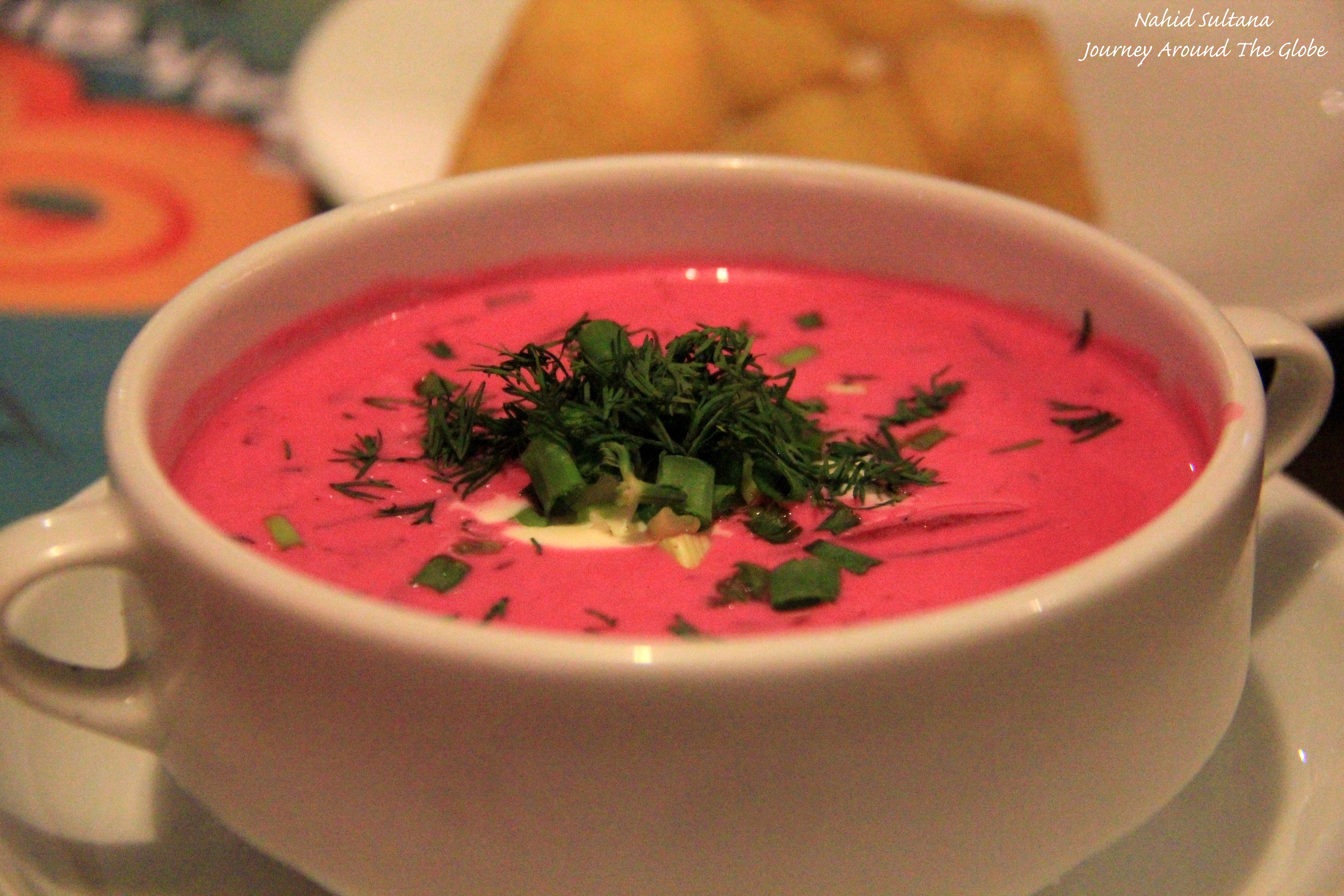
- Cold beetroot soup…a very famous Lithuanian dish
PLACES WE’E VISITED: We spent 2 full days in Vilnius and 1 day outside the city in Karnave and Trakai visiting the oldest capitals of the country. There are plenty of museums in Vilnius if they interest you. The old town of Vilnius is big, bigger than many other European cities we’ve visited, but everything can be cover on foot. Notice the Green Bridge on River Neris which is the oldest bridge of Vilnius dating back to 1536. The Town Hall Square is a very lively place here which once used to be the main market square during the middle age.
1) CATHEDRAL SQUARE and VILNIUS CATHEDRAL: Cathedral Square is a big place and a historic place of this country.
Vilnius Cathedral is Lithuania’s most important sanctuary since its construction started in 1387. The cathedral changed its appearance many times with each new century. The present classical form of Gothic elements is from the 18th century. The exterior statues were added in the 19th century. Many biblical paintings are on display here, carvings on the ceiling are very beautiful too. The altar is simple with few columns.
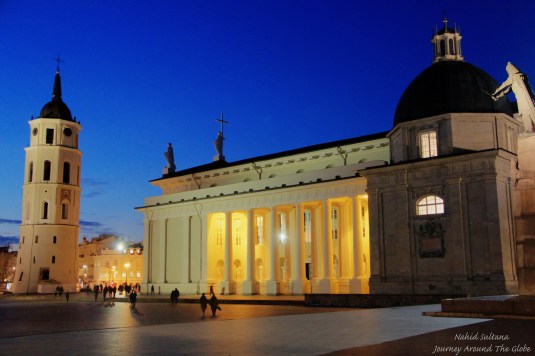
- Vilnius Cathedral after dark, standing there since the 14th century, Vilnius, Lithuania
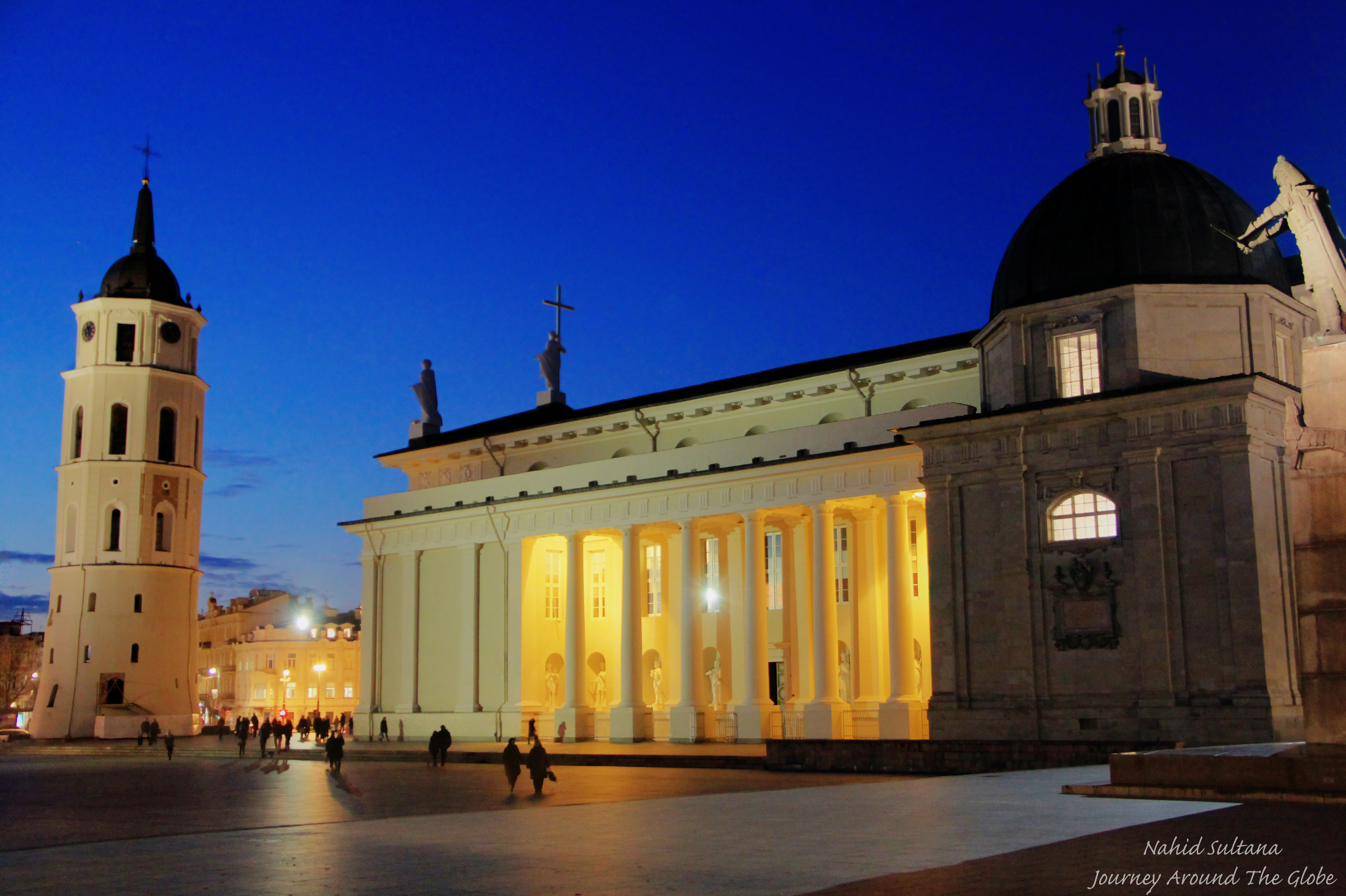
The most decorative part here is Baroque style St. Casimir’s Chapel (saint patron of Lithuania). His tomb along with other remains is kept here. This chapel is considered as one of the country’s national treasures. Although we didn’t go there, crypt beneath the church contains the remains of Lithuanian rulers and bishops. The 3 statues of St. Stanislaus, Helena, and Casimir on the roof supposedly represent Poland, Russia, and Lithuania. Belfry (57m) outside the church was built in 1522 on one of the 14th century towers of the Lower Castle.
It is free to enter the cathedral and located at the bottom of Gediminas Castle.
2) KGB MUSEUM: Also known as Museum of Genocide Victims, KGB Museum is a unique and moving museum and a must-see in Vilnius, even if you are not the museum type person. This is one of a kind place in the Baltic region. The museum is set up in the former KBG headquarters and prisons where Soviet crimes were planned and committed in the course of 50 years. Nazi Gestapo and the KGB occupied this building at different times of the 20th century. Genocide of the population was planned here. Citizens of Lithuania were imprisoned, interrogated, tortured, and killed here in a mass level. Visitors can learn about the most tragic period in Lithuanian history in exhibitions in prison cells, the execution cell, and the rooms of the KGB officers. The exhibitions deal with the painful and dramatic times of this country including the loss of independence, brutal reprisals at the hands of the Soviet regime, and the bitter fight for the reestablishment of independence.
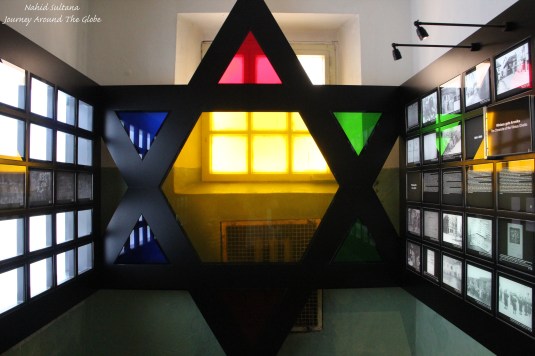
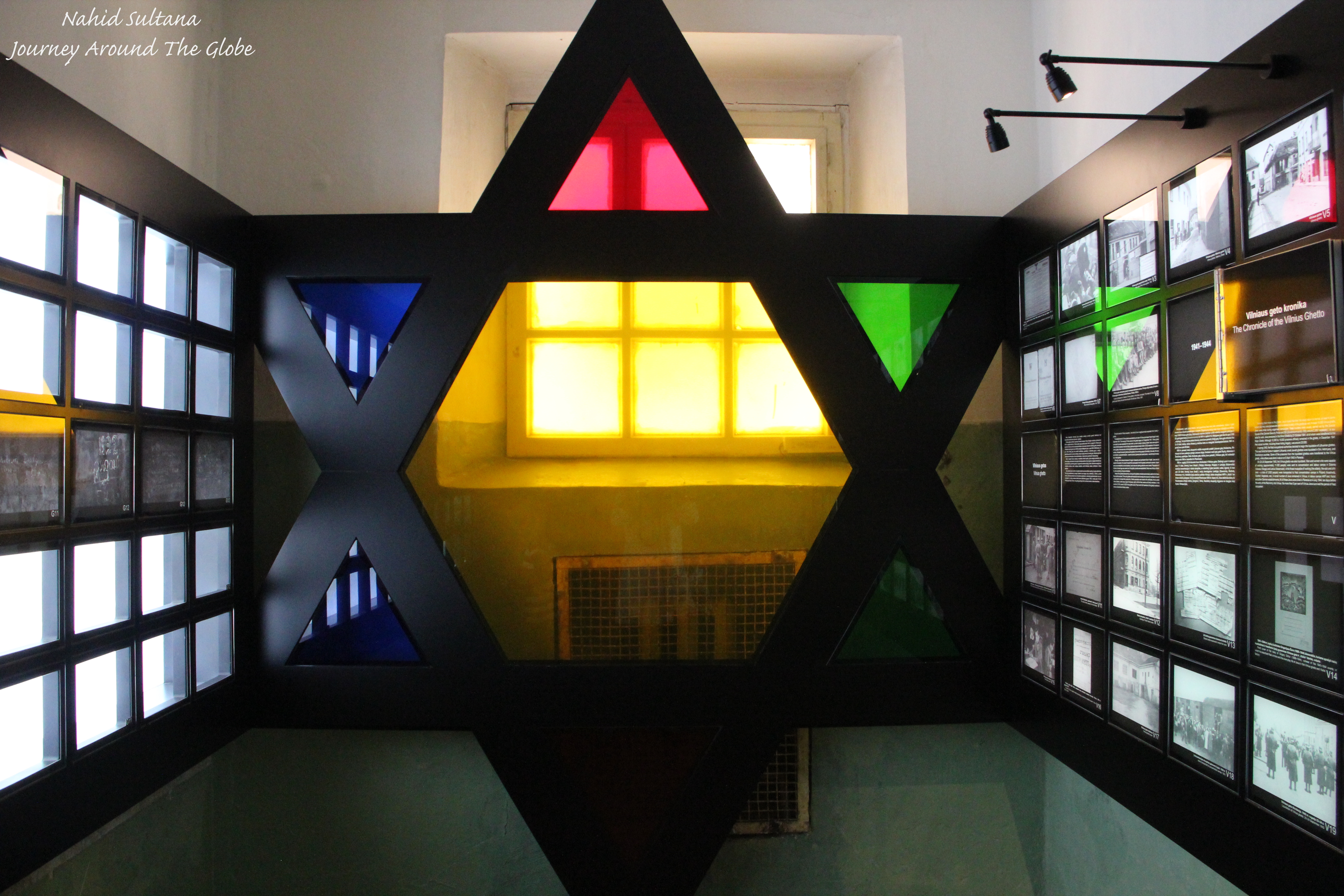
- Inside KGB Museum where many Jews were persecuted by Nazis during WWII, Vilnius, Lithuania
The museum is housed in a 19th century neo-Classical mansion previously used as a court building. The main façade with a front entrance faces Gediminas Avenue. Throughout the Soviet era (1940 to 1941 and 1945 to 1991) the building was occupied by the Soviet repressive institutions such as the NKVD-NKGB-MGB-KGB while during the period 1941 to 1944, the Nazi Gestapo reigned in the building. Out of this building came the evil thoughts for the extermination of residents and persecution of many people. The bottom bricks on the exterior of this museum have the names of those who were believed to be executed inside this building.
The basement of the building served as a prison for the Nazis while the Soviets used it as a prison with an execution chamber inside. From autumn 1942, the building houses the Special Squad of the German Security Police and SD which carried out mass massacres in the forest of Paneriai (just outside of Vilnius) of Jews, communists, Soviet activists and members of the resistance movement. The stones outside the building bear the names of the freedom fighters killed from 1944 to 1947. Other than the museum, the building also houses Genocide and Resistance Research Centre of Lithuania and the Lithuanian Special Archives where the former KGB archive documents are stored.
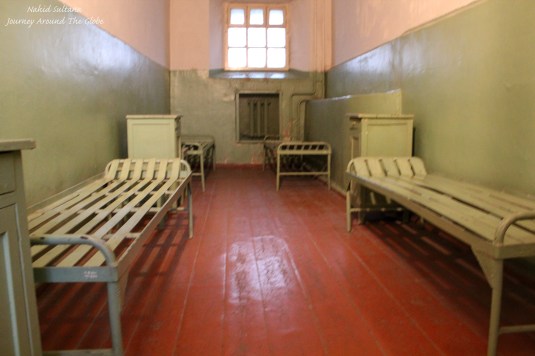
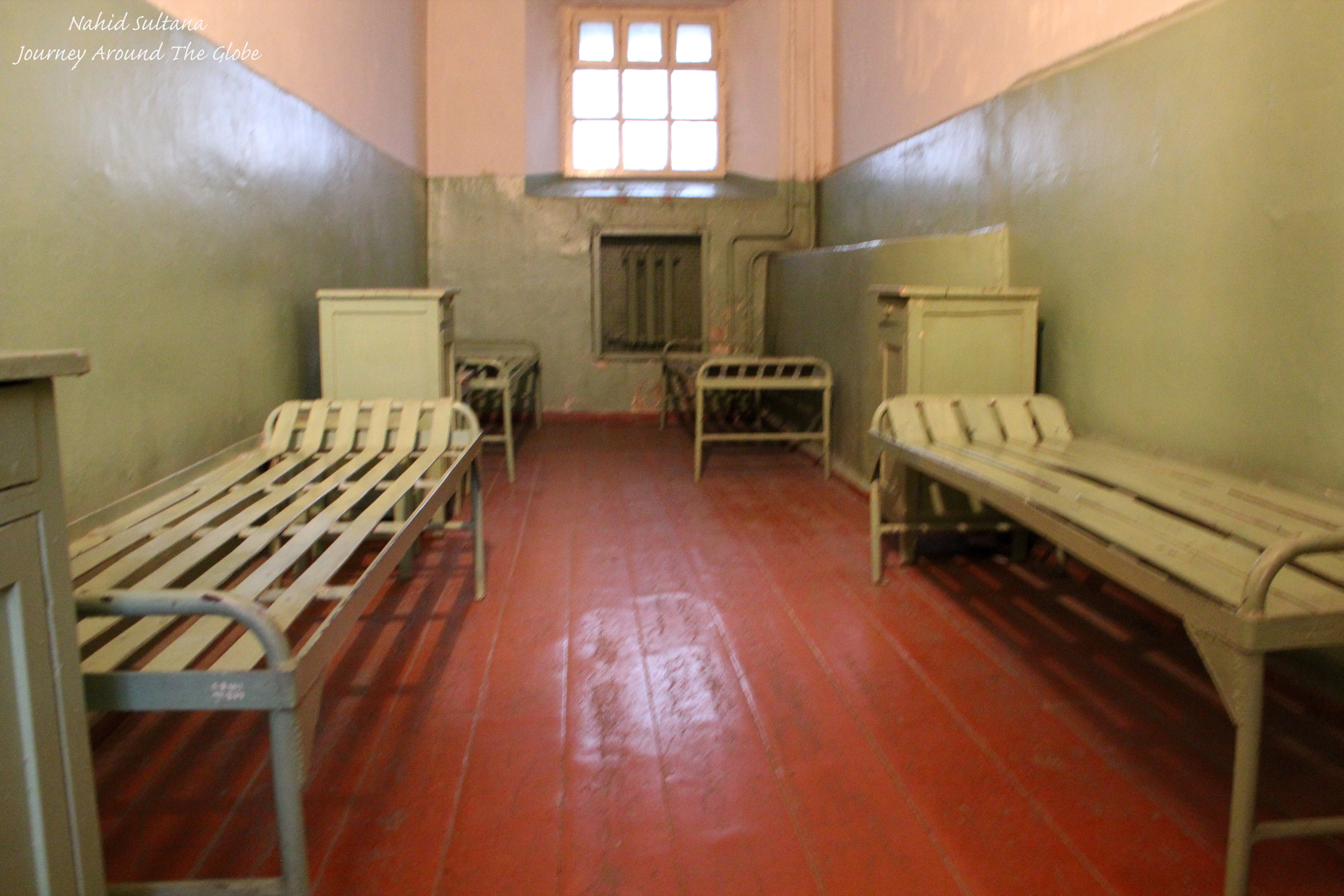
- A prisoner’s cell in the basement of KGB Museum in Vilnius, Lithuania
The main part of the exposition is on the top floor which houses material about anti-Soviet and anti-Nazi resistance and information about the participants in the fights for freedom and genocide victims. Here, visitors can see furniture from the 40s, things used by NKGB-MGB officers, the inventory of the desk, and the interiors details are shown here, with materials from the period 1939 to 1941. Also the pictures and stories of civilians who were deported from their homelands to the remotest areas of Soviet Union are in display here. The documentary materials displayed acquaints visitors with the procedures of organizing and carrying out deportations, the legal status and living conditions of the deportees, and statistical documents about the deportations. Documentary and feature films, and photographs of burial grounds in Siberia, supplement the factual information, and show the fate and misery of the people who suffered humiliation and injustice.
It is situated in the very heart of Vilnius about less than a mile from Cathedral Square, took us about 20 minutes to walk there. The museum is open Wednesday to Saturday from 10 – 6, Sunday from 10 – 5, and closed on Mondays and Tuesdays. Ticket is 6 LTL per person, 8 LTL if you want to include an audio guide, and 5 LTL for camera pass.
3) GEDIMINAS CASTLE and TOWER: Also known as Upper Castle, this castle is considered as a symbol of Vilnius. The castle and its tower are located on the 48-meter high hill and were named after the city’s founder Gediminas, the Grand Duke of Lithuania. Built at the beginning of the 14th century, and replacing an earlier wooden one, it withstood the attacks of the Crusaders. At the beginning of the 15th century, it was rebuilt strengthened, and along with the Lower Castle, composed a powerful defensive complex. After damage caused by the war with Moscow in 1655, the castle lost its importance and was not rebuilt. After WWII, the best surviving tower in the upper castle, Gediminas Tower, was restored and now houses a museum and an observation platform that offers visitors an impressive panoramic view.
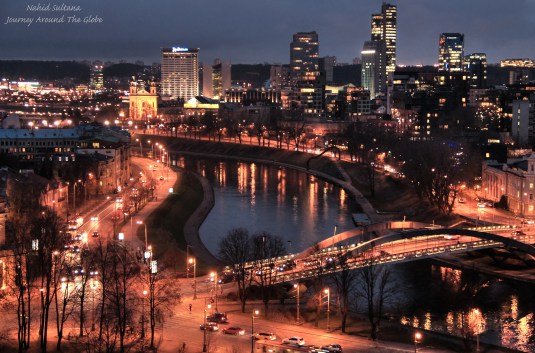
- Vilnius after dark, a stunning view from Gediminas Castle
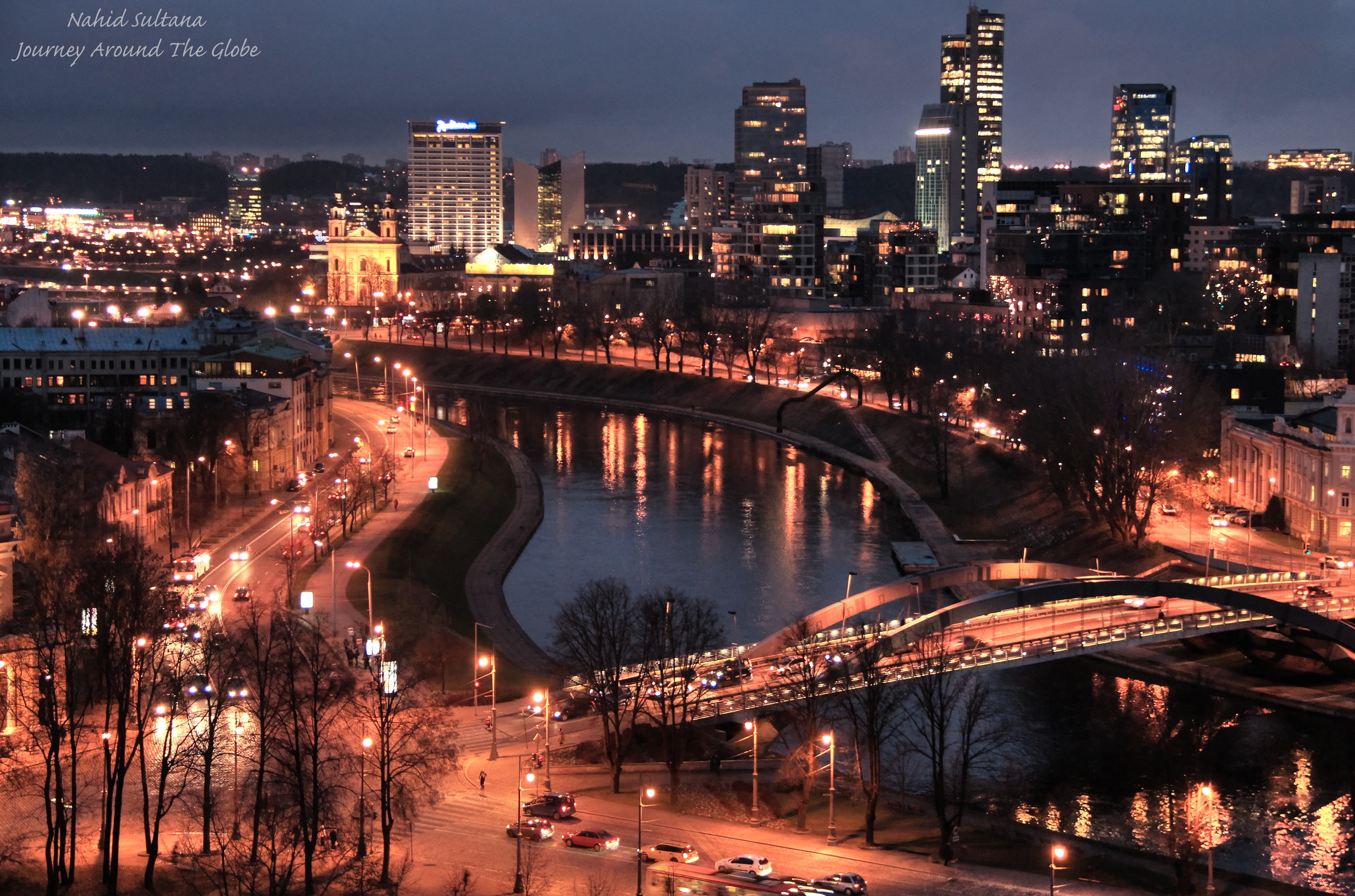
Gediminas Castle offers best view of Vilnius. We went there after dark and enjoyed stunning views of old town and new town. Also River Neris and bridges on it look fantastic from here. We didn’t go inside the museum or tower as it was closed by then.
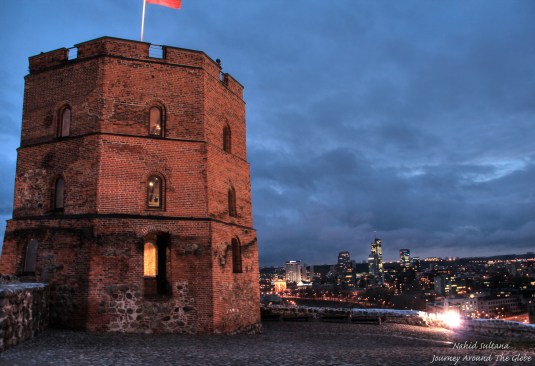
- Gediminas Tower in Upper Castle in Vilnius, Lithuania
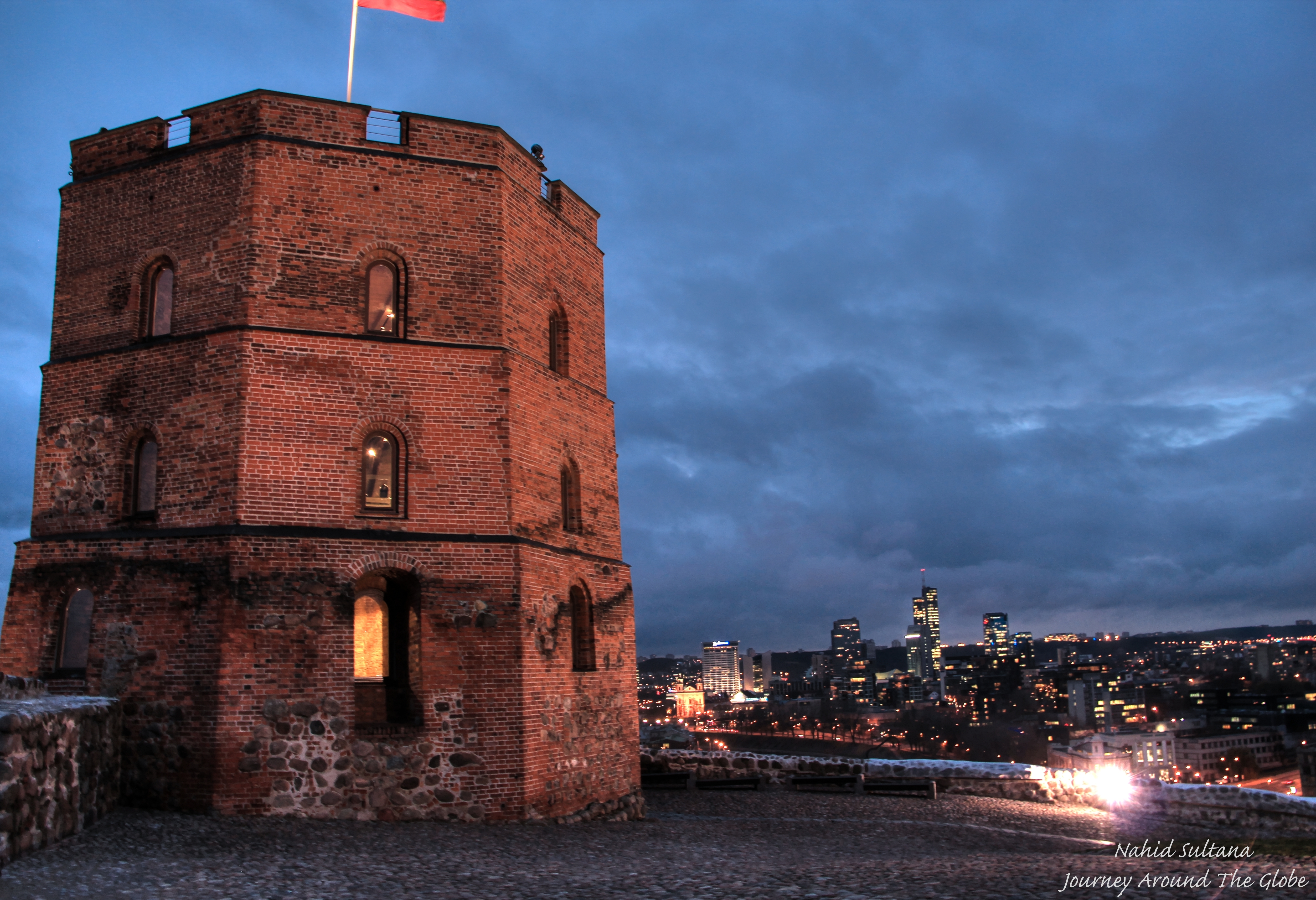
Funicular to the castle is open in May – September from 10 to7 daily and October – April from 10 to 5 daily. You can also walk up the castle from either Cathedral Square or by the river Vilnia. Ticket price is 3 LTL for round trip and 2 LTL for one way ticket. The castle hill opens at 7am and is visitors can stay there until 9pm.
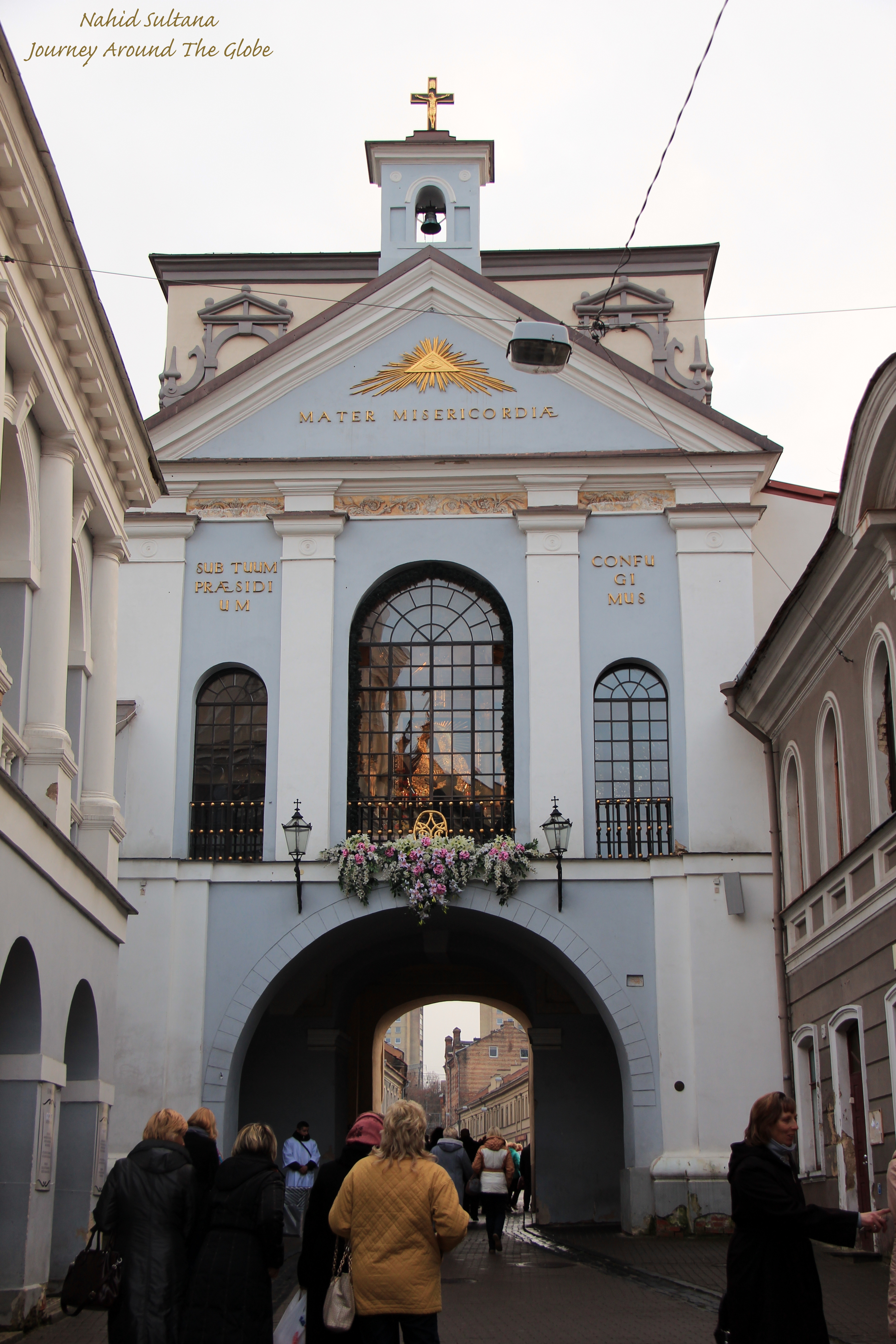
4) THE GATE of DAWN: The Gates of Dawn, the only one of ten original defense wall gates remaining, was built in 1514. After the reconstruction of 1829 the Chapel acquired the features of late Classicism. The Chapel in the Gates of Dawn houses a gold image of The Blessed Virgin Mary, Mother of Mercy, which was placed above the gate to protect the city. The chapel is very small but beautiful, it can get crowded since many worshippers go there to for prayers. Free to enter and is located very close to city’s town hall.
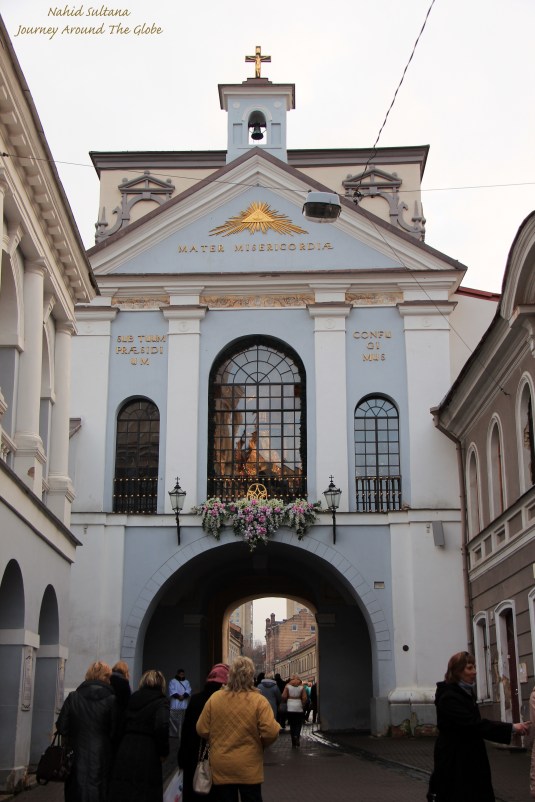
- The Gate of Dawn in Vilnius, Lithuania
5) CHURCH of ST. PETER and PAUL: This is considered as the pearl of Lithuanian Baroque and the most splendid example of the style. Exterior of this church was built around 1668 – 1674, and the interior took another 30 years. The interior of the church is famous for its exceptional baroque sculpture works where one can see about 2,000 stucco moldings representing miscellaneous religious and mythological scenes. The founder of the church Grand hetman M. K. Pacas was an Italian noble man who settled in Lithuania and wanted to build his own church. The coat of arms of the Pacas family can be seen above the entrance. Two Italian architects created a harmonious synthesis of architecture, sculpture, and art: about 2000 figures are arranged according to the principle of the world as a theater. Behind the altar is a picture of Saints Peter and Paul by the famous artists P. Smuglevicius. Many war memorial/depiction can be seen since it was built after a war. Look up to the elegantly decorated and detailed carved dome and some 17th century frescoes on the walls. Painting in the altar depicts Peter and Paul saying goodbye to each other with 4 evangelists: Luke, Mathew, Mark, and John.
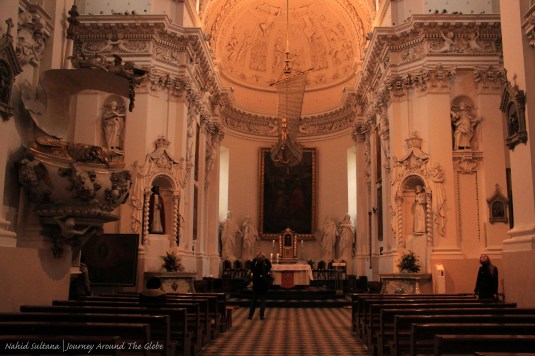
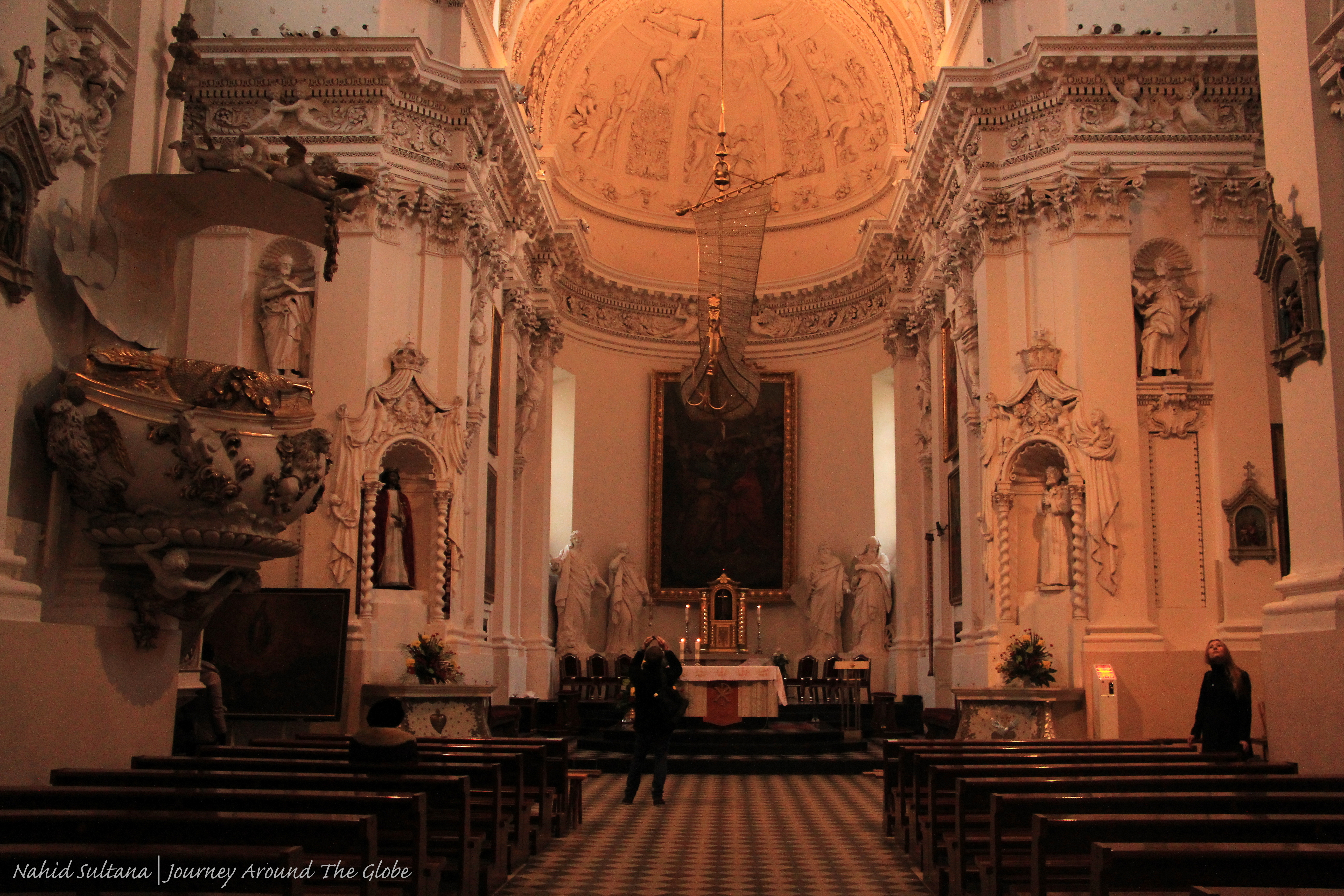
- Inside Church of St. Peter and Paul in Vilnius, Lithuania…a masterpiece of Lithuanian Baroque
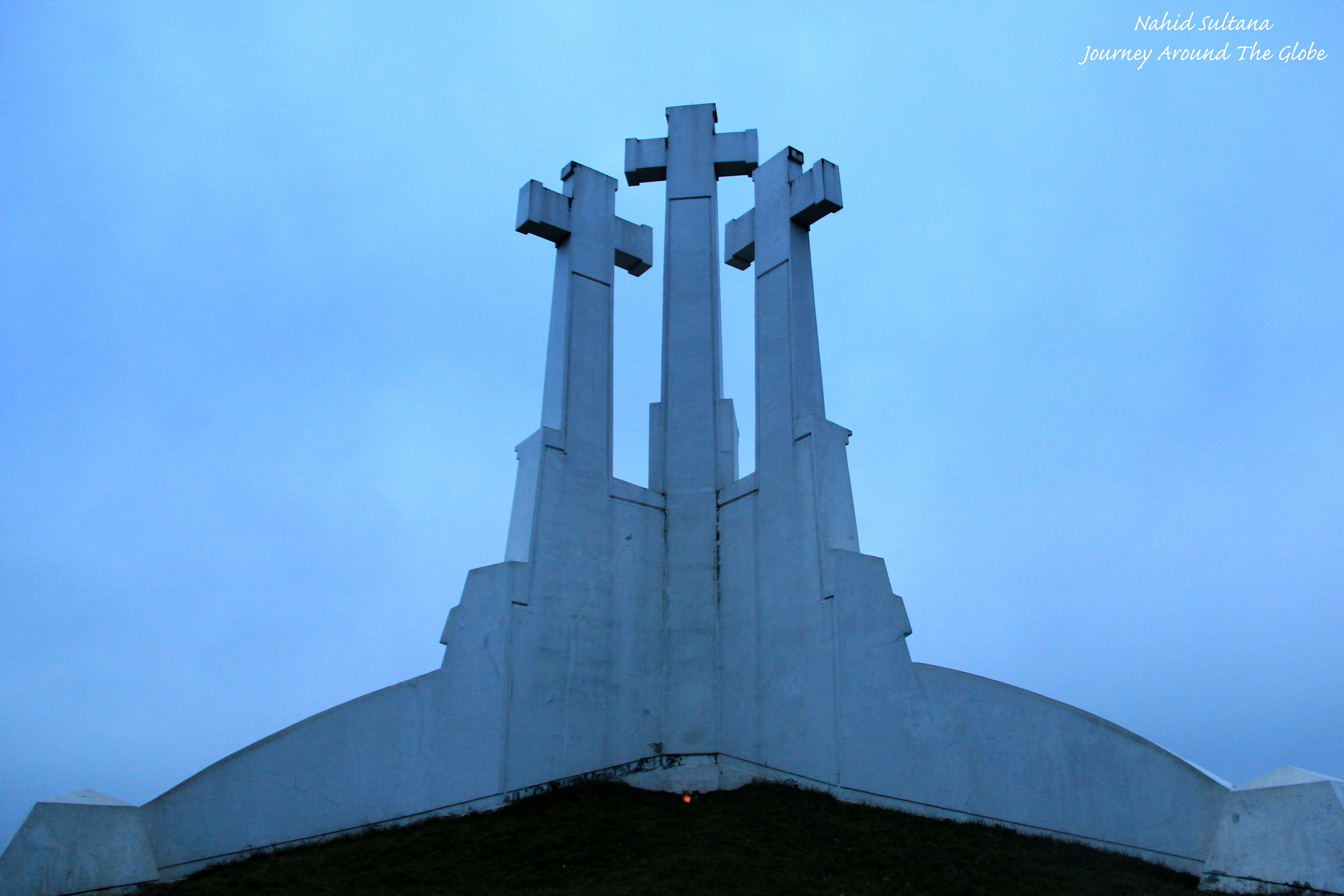
6) HILL of THREE CROSSES: 165 meters above sea level, this hill is one of the symbols of the importance of Christianity in Lithuania and Lithuania’s mourning and hope. Three white crosses were erected to commemorate 7 Polish Franciscan monks, who, according to a legend, came as missionaries and were tortured and martyred by pagans on this site and were thrown in River Vilnia. The first wooden crosses of Holy Trinity were built in 1613, and later renovated, but removed by the Russian administration after the revolt of 1863. A concrete monument was built in 1916. The Soviet authorities destroyed the crosses with explosives in 1950, but after it was rebuilt in 1988 they have been standing in their original place, imprinted in the silhouette of Vilnius as symbols of Christianity of Lithuania.
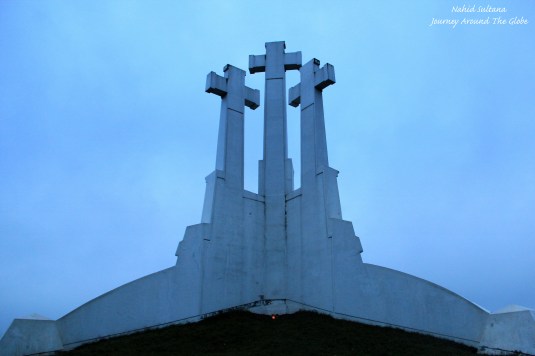
- Hill of Three Crosses in Vilnius, Lithuania
An excellent view of old town is also to be found at this spot. You can also see Gediminas Castle along with a beautiful panoramic view of the old town from up here. The entrance is free.
7) PRESIDENTIAL PALACE: This is the official residence of the President of Lithuania. This building is in the central part of the former Governor’s Palace. The first palace here was built in the 15th century and was used as the Vilnius bishops’ residence until the last division of the Polish-Lithuanian state in 1795. In the 19th century it was visited by many distinguished personalities, such as Napoleon Bonaparte and M. Kutuzov. Now it’s an Empire style building having impressive and decorated colonnades on the both sides of the palace. Although we didn’t go inside since it was already end of the day, the interiors are supposed to be very beautiful. The president’s office is the on the right side of the palace.
8) VILNIUS UNIVERSITY: The University was established in 1579 representing different architectural styles: Gothic, Renaissance, Baroque, and Classicism. It consists of 13 enclosed courtyards. St. Johns Church (14th – 18th century) and the highest viewing point of the old town – 68 meters high campanile. This is one of the oldest and biggest universities in Easter Europe. The university has the oldest library of the country. Visitors have to pay 5 LTL to go to the front courtyard.
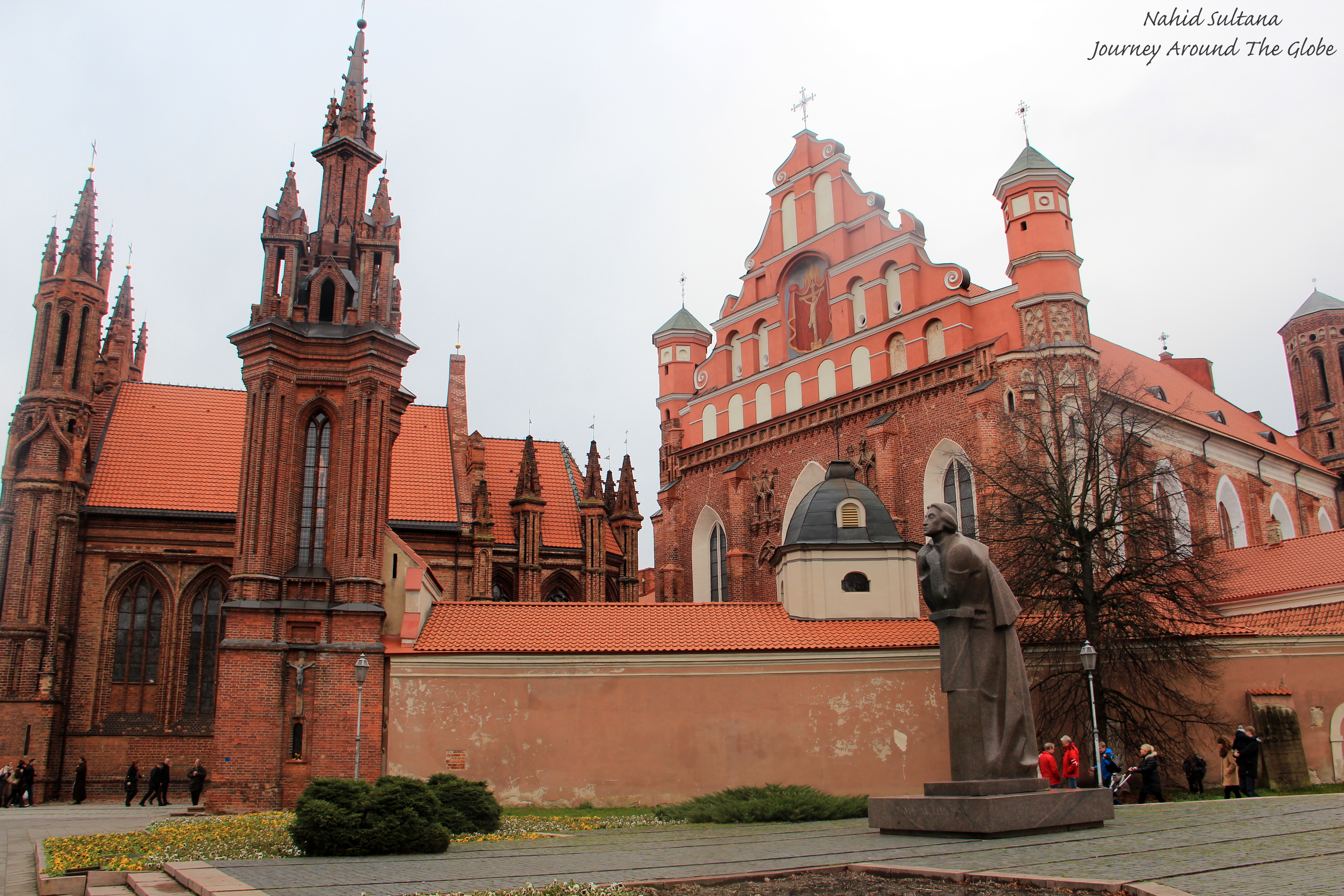
9) ST. ANNE’S CHURCH: This church was built at the turn of the 15th-16th century and is the most fascinating and prominent late Gothic building in Lithuania. This is one of the oldest churches in Vilnius. It was built from 33 types of simple clay bricks. It is a small church but so beautiful that Napoleon wanted to take it on his palm and bring it to Paris. There is a statue of a famous Polish poet (Adam Mickiewicz) beside the church who was a student and then teacher at Vilnius University. There is no entrance fee and it’s located before entering Uzupis District.
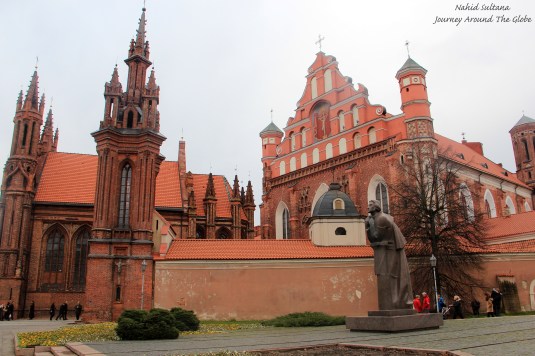
- St. Anne’s Church and Bernardine Church near Uzupis District in Vilnius, Lithuania
10) AMBER MUSEUMS and GALLERY: The museum and gallery were established in a Baroque style house of the 17th century. The cellar keeps a valuable archeological finding: well-preserved kilns dating back of the end of the 15th-16th century. Museum houses exhibition about history of amber origin, differences in form, size, and color.
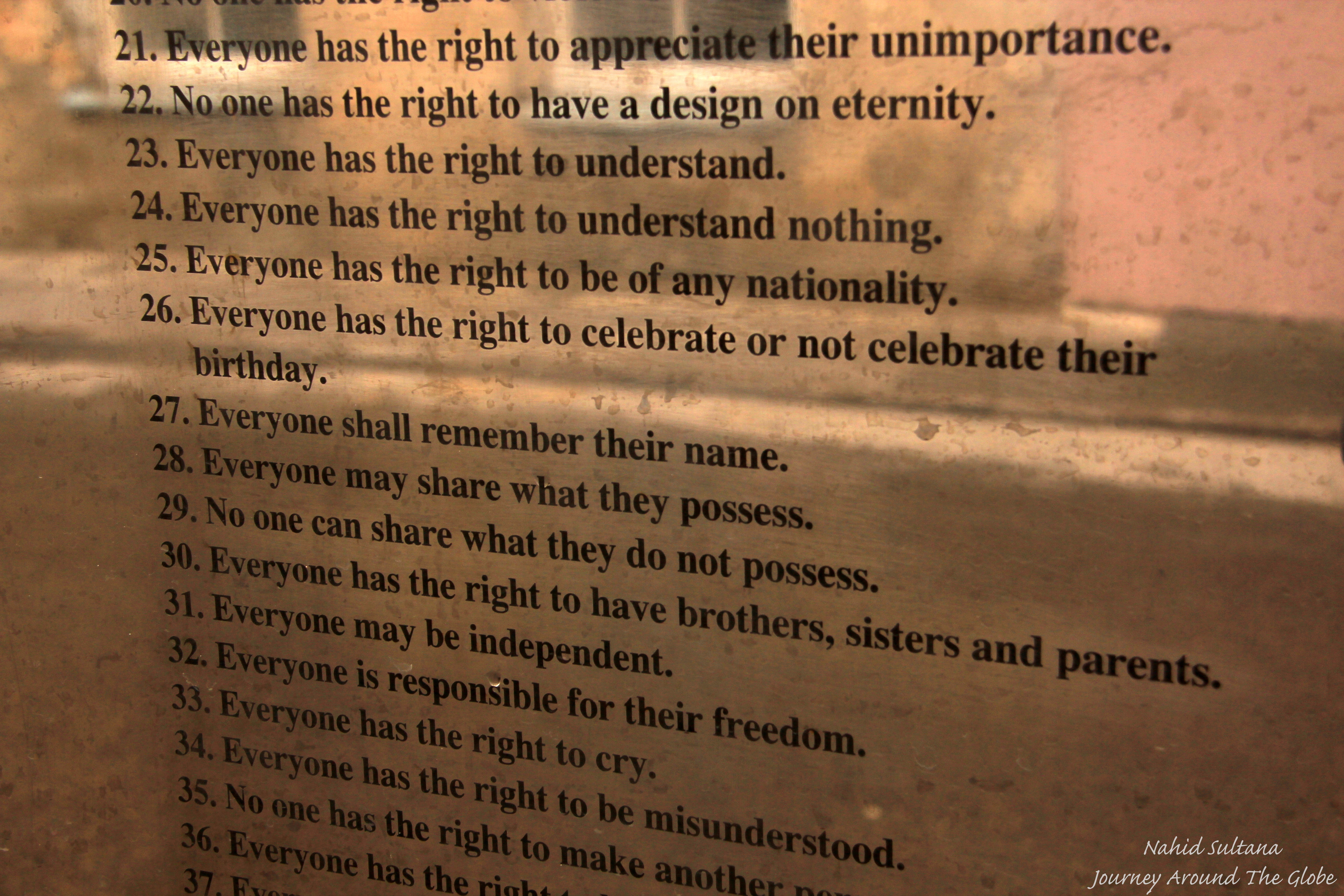
11) UZUPIS DISTRICT or UZUPIS REPUBLIC: Uzupis is a unique state within a state by River Vilnia in the old town – it has its own president, anthem, constitution, flag, and guardian – the bronze Uzupis Angel (look for the big statue of an angel standing over an egg and blowing trumpet). The constitution of the Republic of Uzupis is available in many languages for public viewing at the beginning of Paupio Street. We’ve heard that on the April Fools’ Day mock border polices actually stamp tourists’ passports for fun.
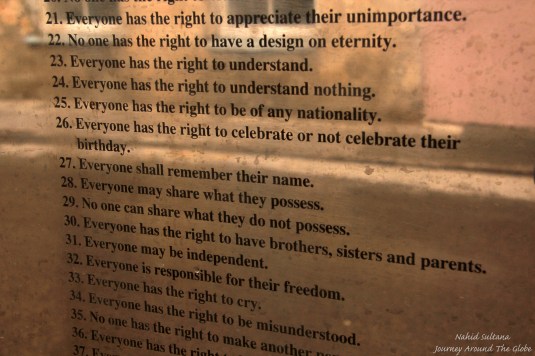
- A small portion of Uzupis District’s constitution in Vilnius, Lithuania
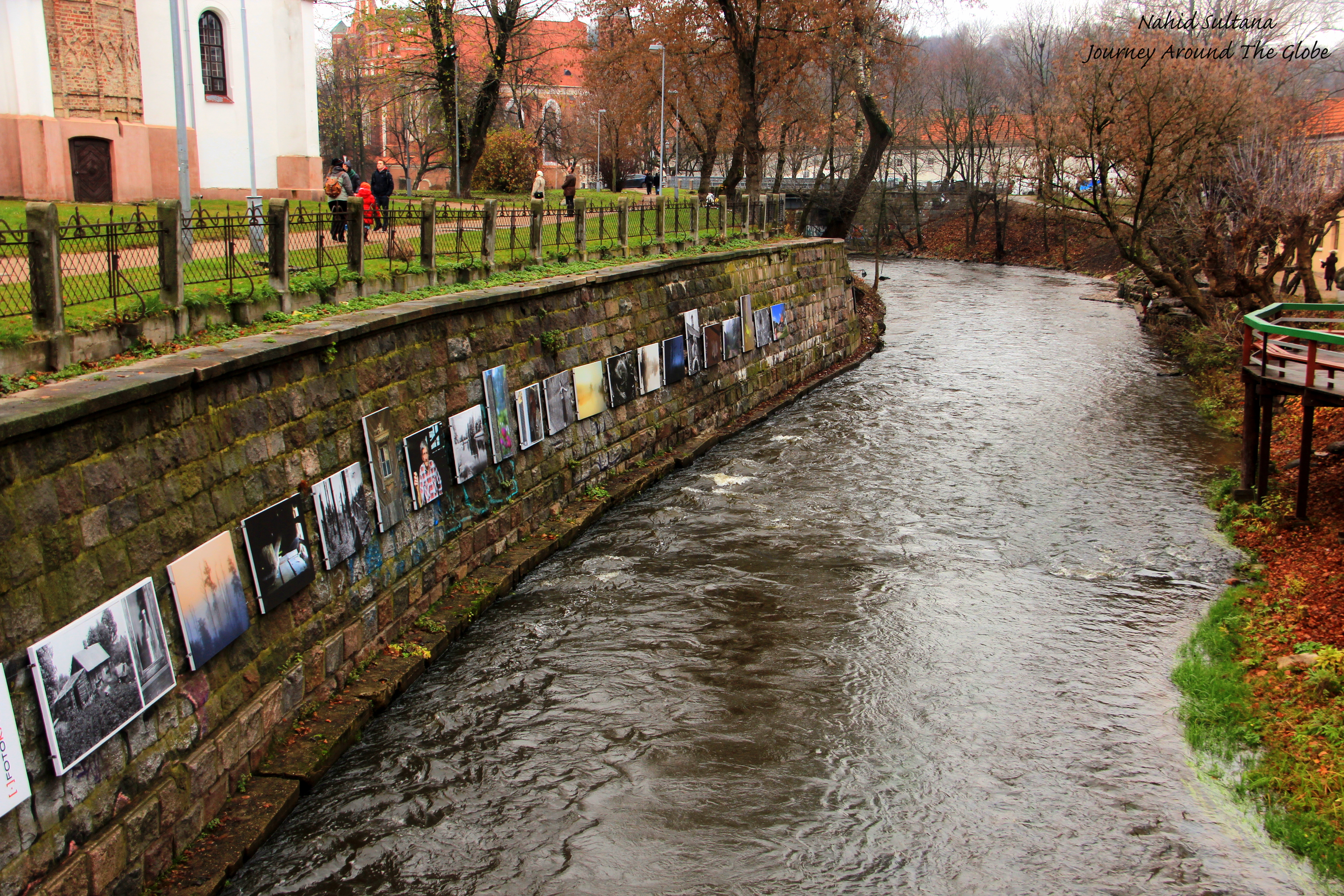
Historically this place used to be occupied by artists, painters, and…poors. Now city’s mayor lives in Uzupis District and many other rich families. This is a hub for many art galleries. Walk by the river to see some sculptures and creative art works on the street. Overall, this is a very nice place.
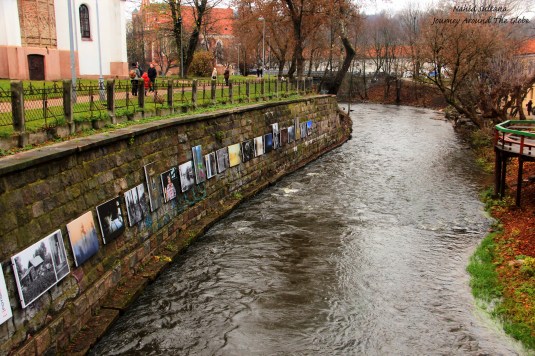
- Uzupis District in Vilnius, Lithuania…beautiful located by River Vilnia
12) ST. FRANCIS OF ASSISI CHURCH (BERNARDINE CHURCH): This Roman Catholic Church was built at the end of the 15th century and is one of the largest sacred Gothic buildings in the country. The church is said to have the oldest crucifix in the country from the 15th century. Brick exterior and wooden interior of this church is small but worth visiting.
There was a service going on when we went there, could only peeked from outside the glass door. Bernardine Church is located right behind St. Anne. Church is open from until 7pm every day and there free to enter.
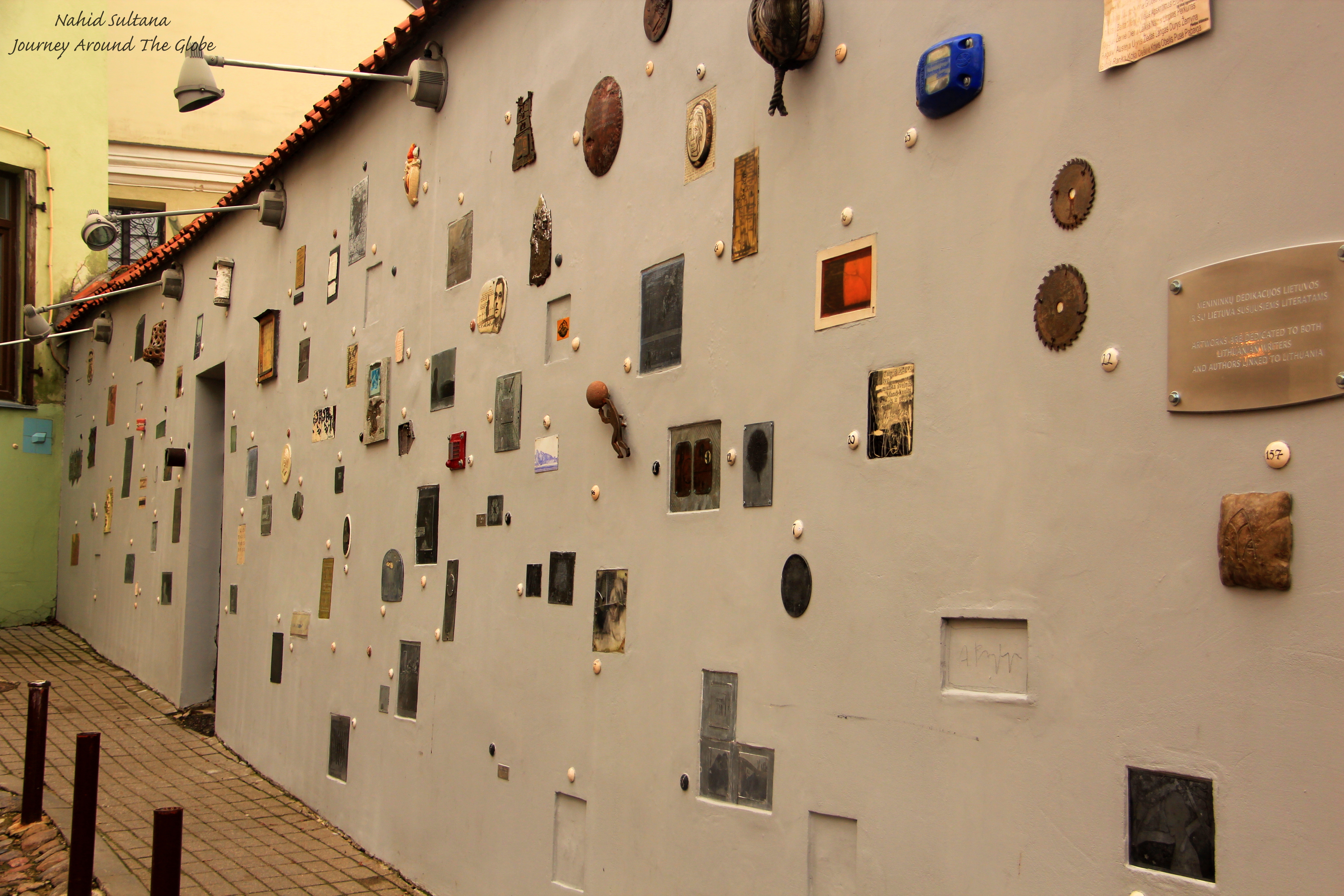
13) LITERATU STREET: It is thought that this street was named “Literatu” only at the second half of 19th century in the honor of the poet Adam Mickiewicz who lived here. This is a small stretch of street with many artistic objects mounted on the wall mainly created between 2010 and 2012. This wall was solemnly opened in the street where painters and other field artists created outdoor proof techniques like plates or small objects made of ceramics, sculptures, metal, wood, glass, etc, in the color of litterateurs.
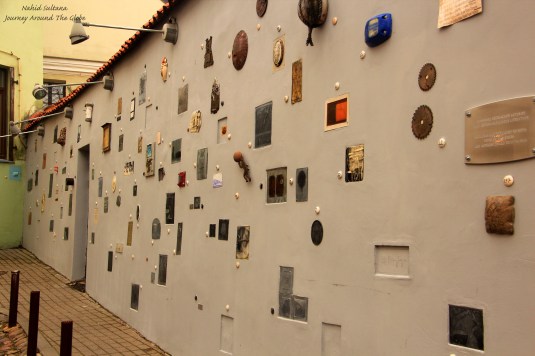
- A wall in Literatu Street in Vilnius, Lithuania, decorated with many artworks
14) RUSSIAN ORTHODOX CHURCH of ST. NICHOLAS: In 1514 a Gothic church with elements of the Byzantine style was erected on top of another old church that was burnt down previously. During it reconstruction after the fire of 1748, its architecture was changed: the pediment, the facades, and the heightened tower became Baroque. In the 19th century the church acquired its present Byzantine appearance. The chapel inside contains a mosaic of St. Michael the Archangel, created at the Art Academy in St. Petersburg. Despite the reconstructions, the building has preserved many authentic Gothic elements and some valuable pieces of Byzantine art.
It’s located very close to Town Hall. Inside and outside of this church are both beautiful. It’s small but has a gorgeous altar inside and many golden crosses outside on its domes.
15) ST. CASIMIR (JESUIT) CHURCH: St. Casimir is the patron saint of Lithuania. This is the first and one of the finest Baroque churches in Vilnius built by the Jesuits. The cornerstone, dragged by some 700 people, was laid in 1604. The building suffered a great deal from wars and fires. In the 18th century, the collapsed dome was replaced by a new one with a crown, and the interior was decorated with 13 Late Baroque altars, most of which were destroyed by Napoleon’s army. In 1868 it was adapted for the Russian Orthodox Church: the towers were lowered and topped with onion-shaped helmets, and the Baroque frescoes and sculptures were demolished. After WWII the church was turned into the Museum of Atheism and in 1991 returned to the Jesuits.
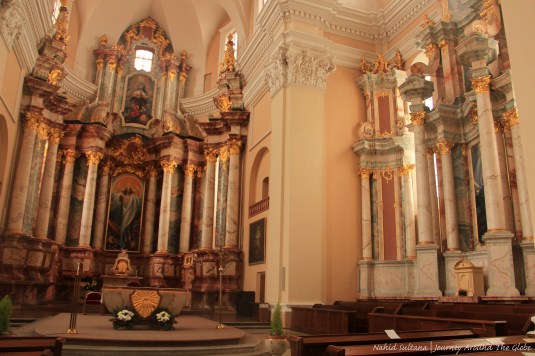
- St. Casimir Church in Vilnius
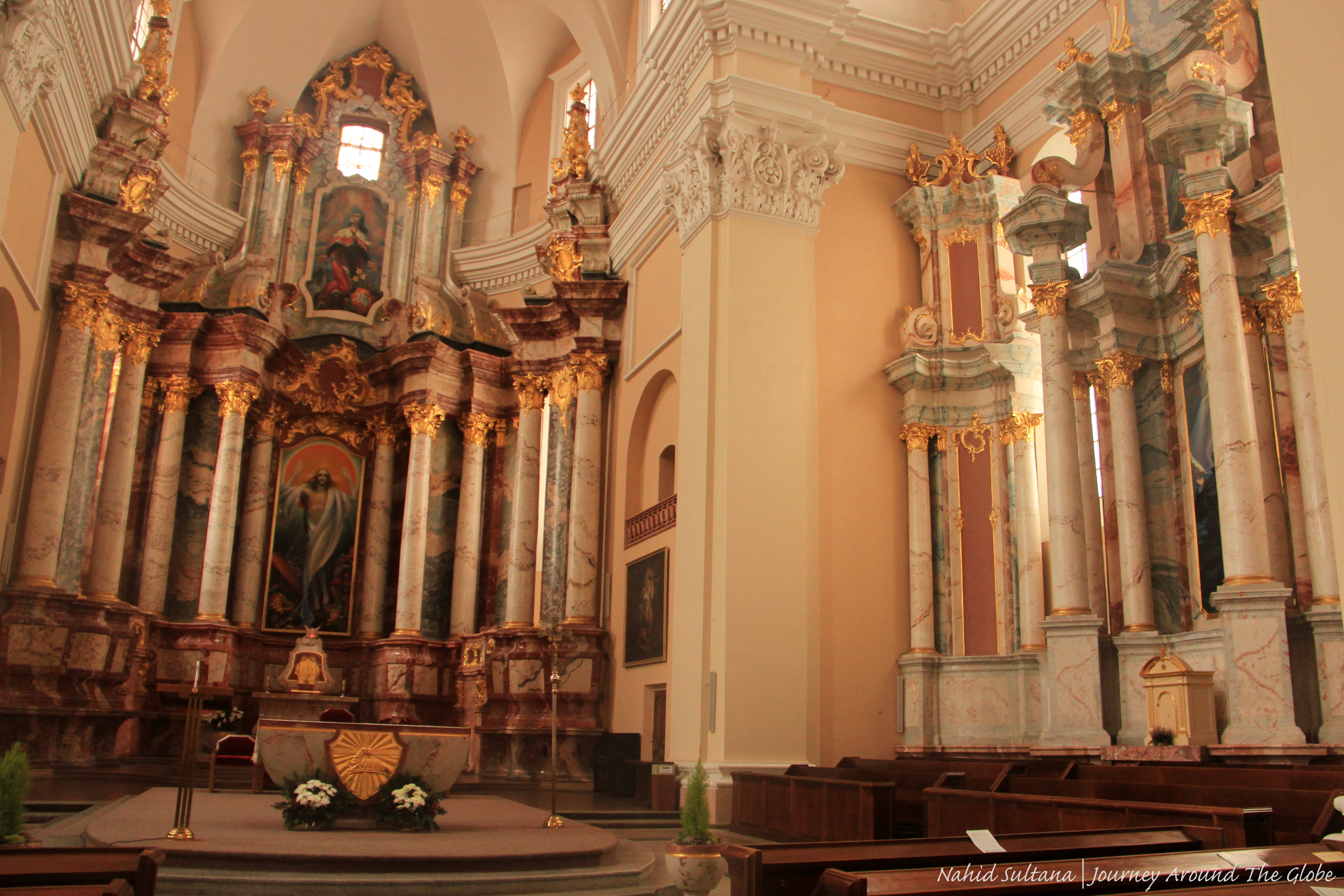
The majestic cupola of 40 meters rises where the central nave and transept meet. 17 meters in diameter, it is topped on the outside by the crown of the grand duke of Lithuania. It’s elegantly decorated red and white altar with marble columns and high dome make it a really beautiful church to visit.
The church is open on weekdays from 4:30-6:30 and on Sundays from 8:30 to 2pm. It is free to enter and located near Town Hall.
16) VILNIUS JEWISH GHETTO: Here is a brief history on the two ghettos of Vilnius, collected from the information board:
“The Vilnius Ghetto was established on 6 September 1941 on the initiative of Vilnius City Commissioner Hans Hingst. Up to the end of October 1941, there were two ghettos in Vilnius – Large (about 30,000 prisoners) and Small (9000 – 11000 prisoners). Most of the Jews imprisoned in the Large Ghetto were qualified specialists and skilled workers, while the Small Ghetto was the ghetto of the incapacitated (the elderly, frail, and sick). By the end of 1941, German and Lithuanian police units and SD special squad had killed about 30,000 Vilnius Jews in Paneriai Forest, located outside the city. During the mass killing actions, all the residents of the Small Ghetto were killed and this ghetto ceased to exist.
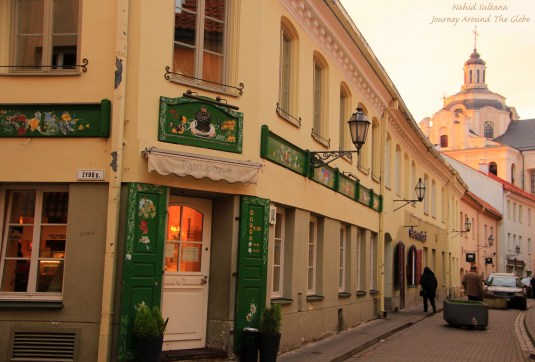
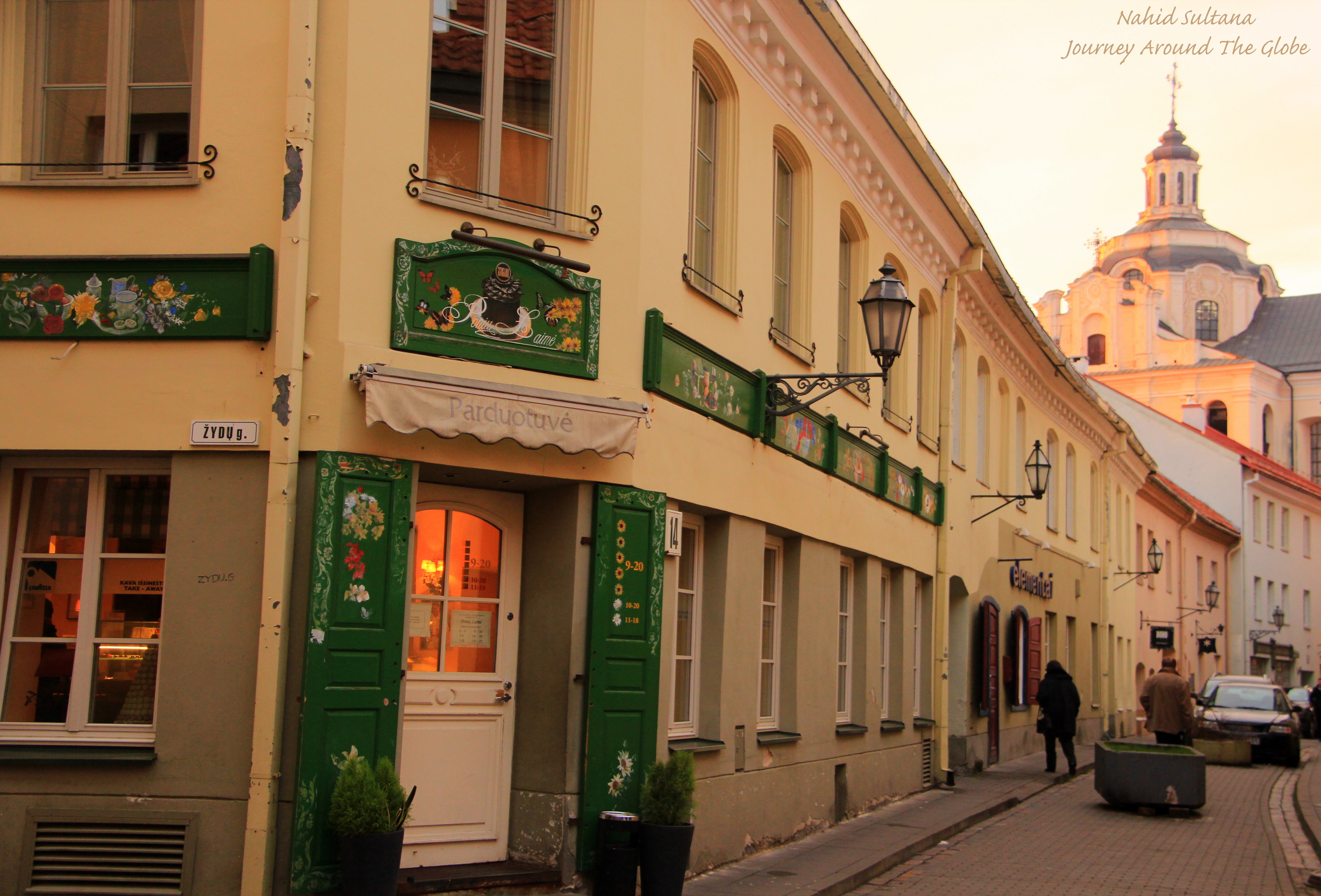
- Present look of what once used to be a Jewish Ghetto before WWII in Vilnius, Lithuania
During the period of December 1941 – March 1943 there were no mass killings of ghetto prisoners as the demand for labor force in the German war economy increased. During this period the ghetto became a kind of “state within a state”, with its own government, police, various workshops, forms of spiritual and cultural life and institutions…
On 23 – 24 September 1943, the occupational authorities liquidated the ghetto. About 14,000 Vilnius Ghetto prisoners were deported to labor and concentration camps in Estonia, Latvia, and other countries. Around 2000 – 3000 Jews still worked at various institutions in Vilnius, which were important to Germans. In early July 1944, with the Red Army approaching Vilnius, however, the last remaining Jews in Vilnius were killed. Only about 2000 – 3000 Vilnius Jews of 58,000 survived the Nazi occupation.”
We entered the former ghetto from Stikllu Gatve from the Town Hall Square. There is nothing much to do or see here except for going back in time and try to feel the situation of the victims here from 1941 1944. There are some beautifully designed buildings, high-class hotels, exquisite shops, and cafés here. The whole neighborhood is very calm and quiet.
Related articles
- Make a wish (fractionsoftheworld.wordpress.com)
Share this:

Magical Efteling in The Netherlands
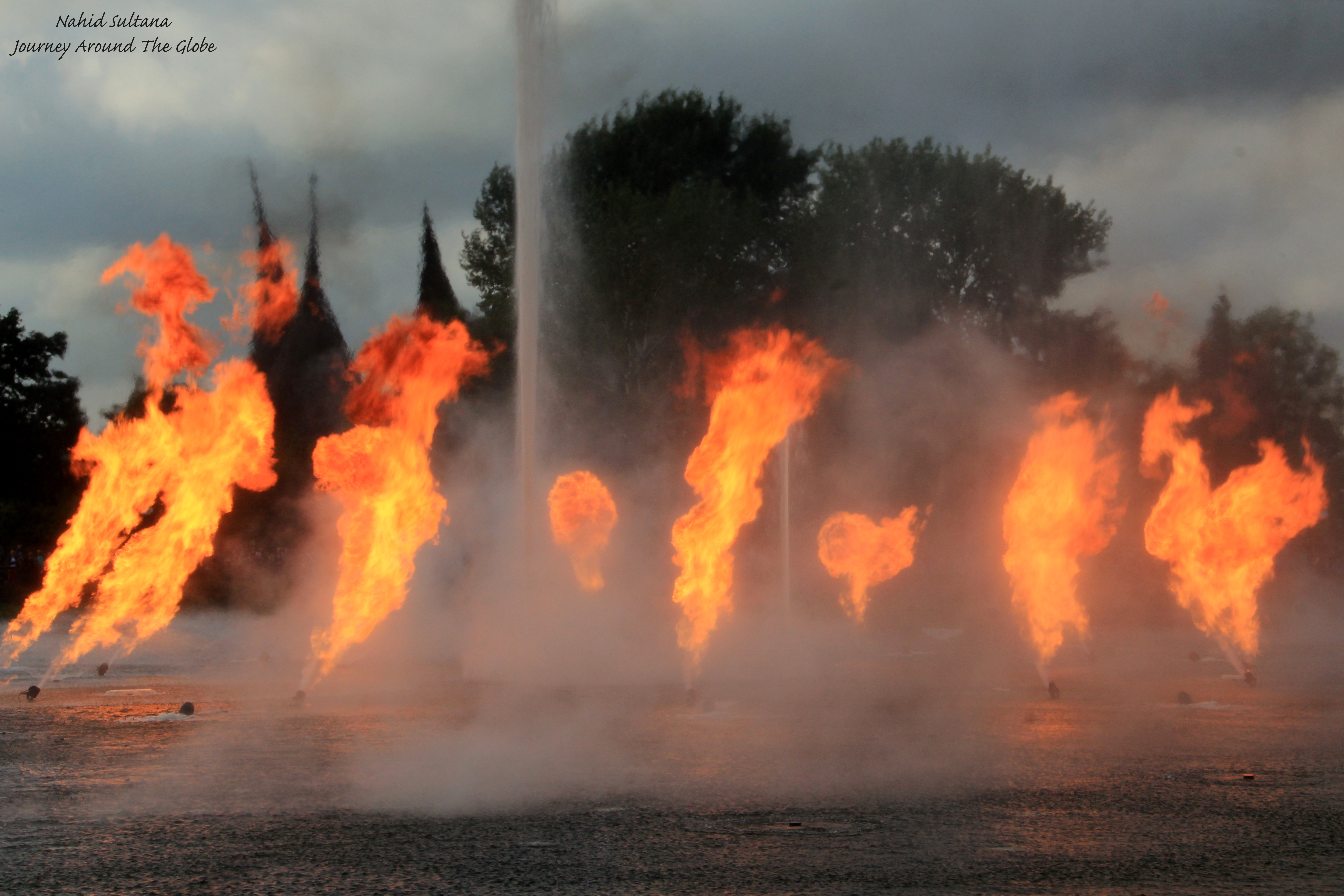
EFTELING, THE NETHERLANDS: Efteling is one of the oldest theme parks in the world and one of the biggest in Europe which is located in Kaatsheuvel in The Netherlands. The whole park is themed around legends, fairy-tales, magical stories, and folklores. We took our girls there in September of 2013 for some summer fun before their school started and spent a whole day there. You can find rides for different ages, scenes from many folklore stories like Hansel and Gretel, The Red Dancing Shoes, Cinderella, Rapunzel, Gnome houses, and many more. I have been to many theme parks in the USA but this one is really makes you feel like you are in a fairy-tale story book. The park dresses up differently in different seasons, winter is probably one of the best time to see its fabulous lighting and decorations. The day we went there was also a water, fire, lighting, and music show on its lake near the entrance right before the closing time…which was fabulous.
It was about little more than hour drive from Tervuren, Belgium. The ticket 40 euros per person plus the parking. But parking is not a problem here. There are couple hotels inside the park and of course many cafes, restaurants, and snack bars.
Enjoy these picture from our trip to Efteling. But if you have time and kids be sure to visit this place in The Netherlands and be mesmerize as soon as you enter Efteling’s world.
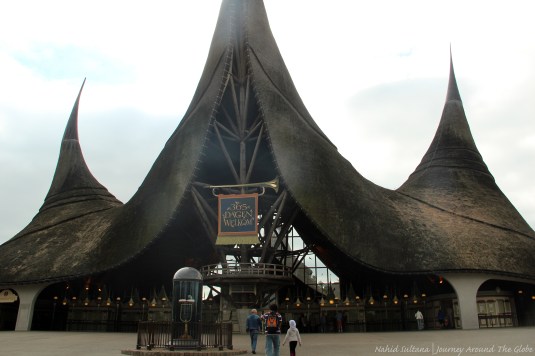
- The grand entrance to Efteling
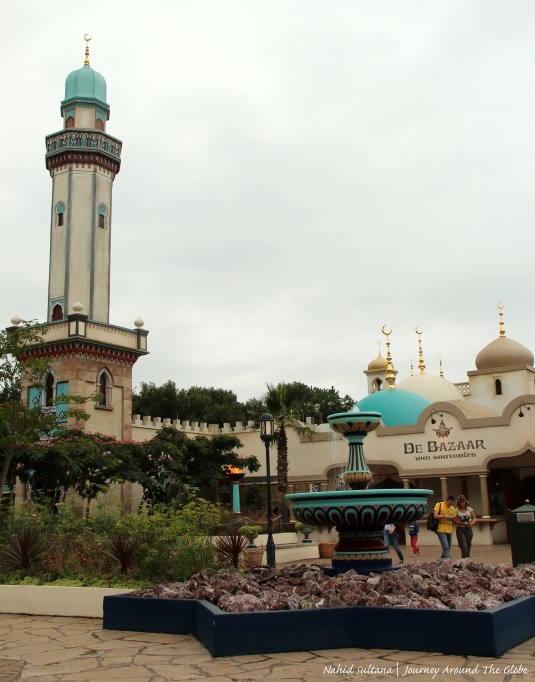
- “De Bazar” section of Efteling
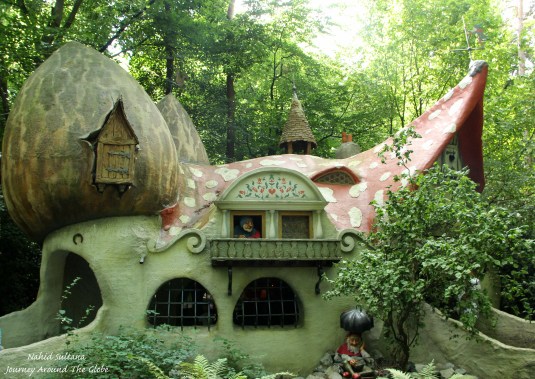
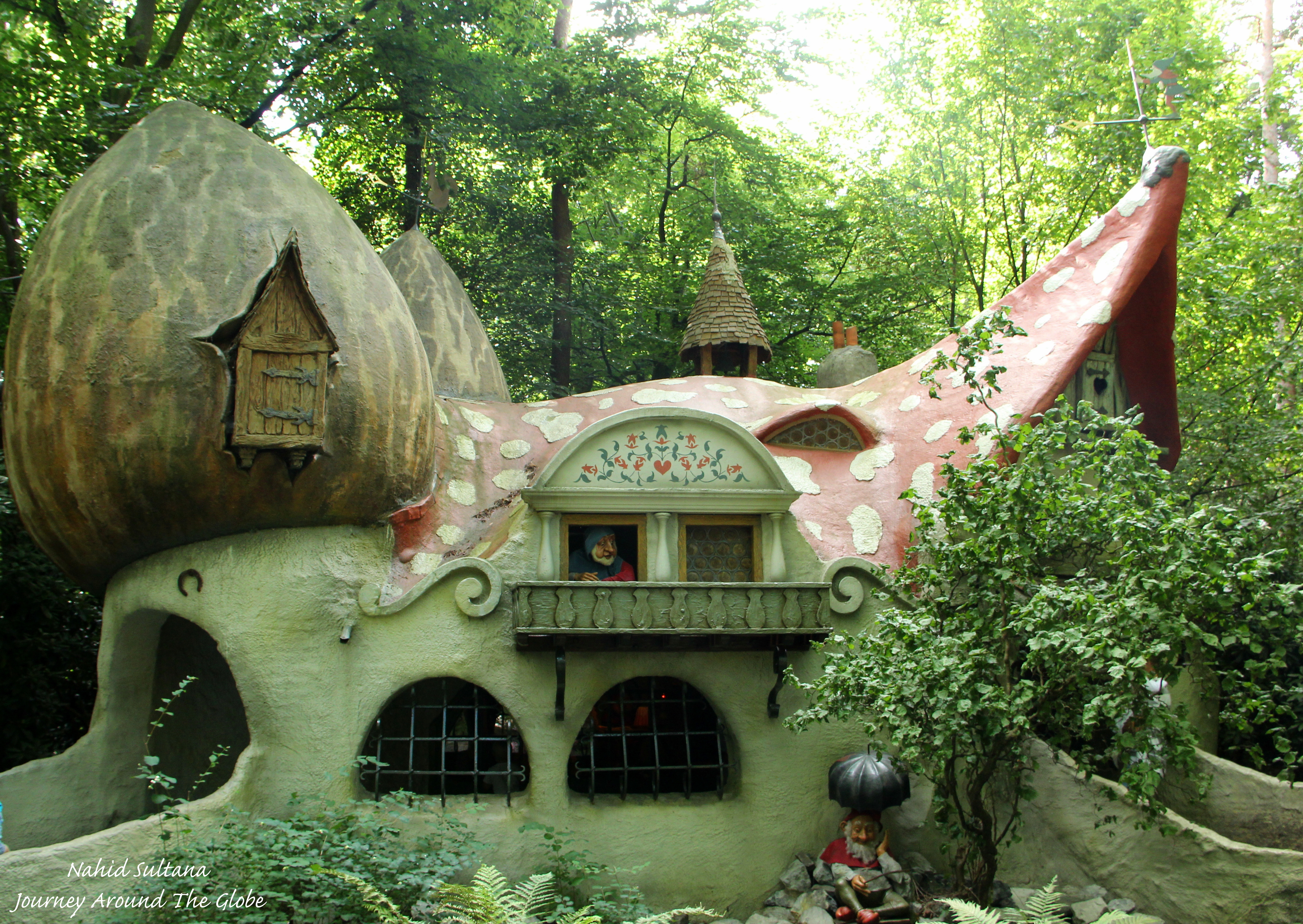
- A gnome’s house in Efteling
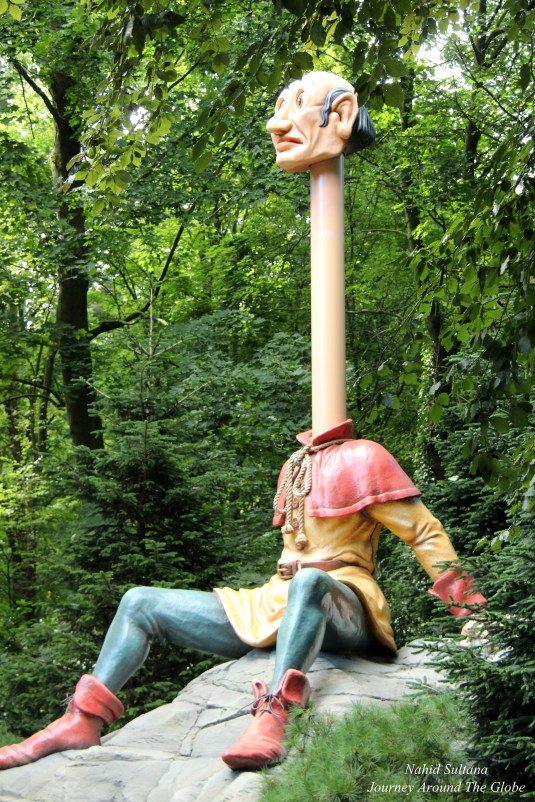
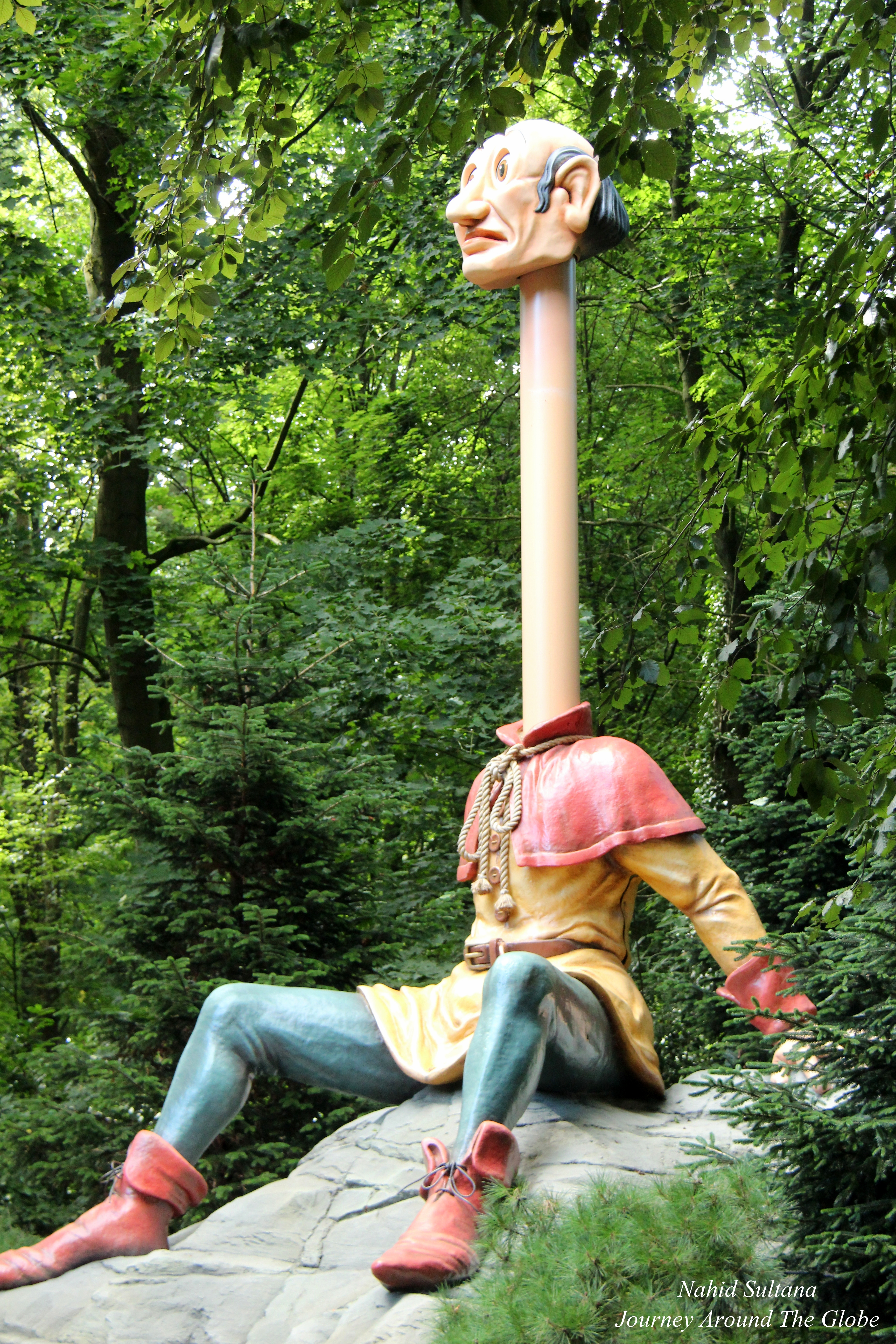
- “The Long Neck“
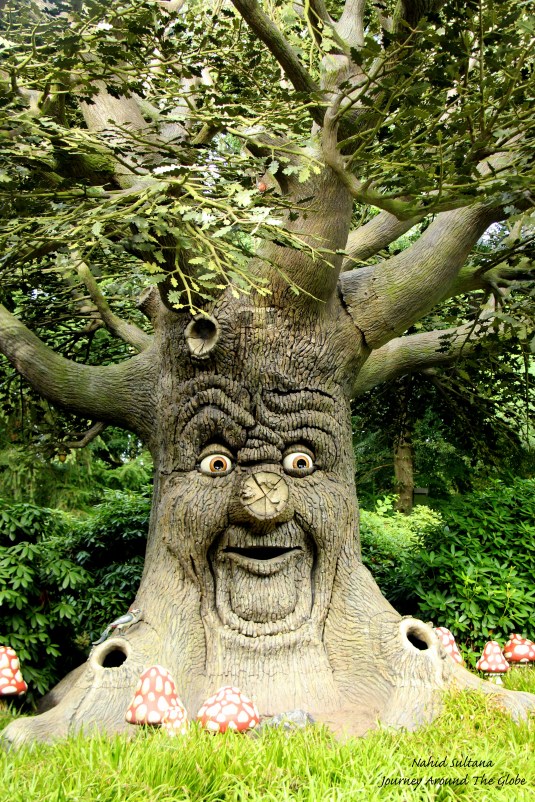
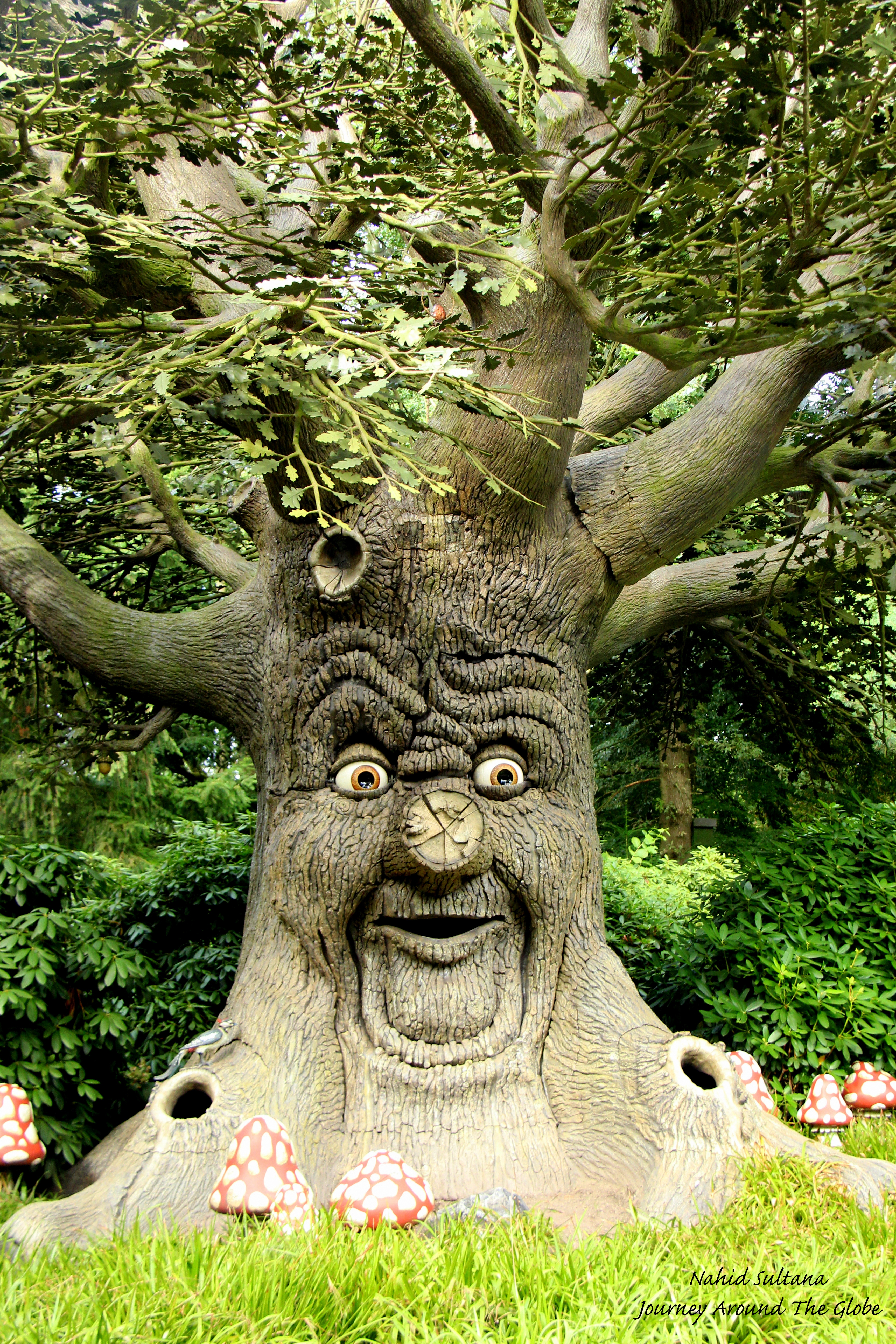
- A talking tree in Efteling
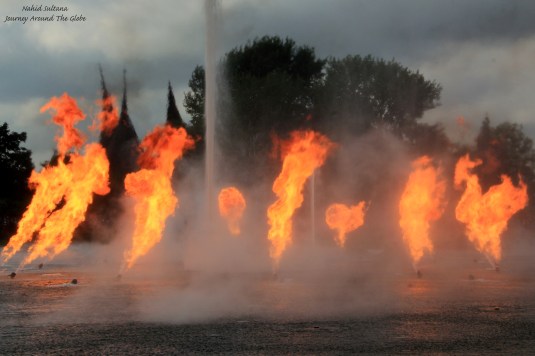
- Fire and water show near the entrance at the end of the day in Efteling
Related articles
- On My Travels – The Netherlands (thewanderingbookworm.wordpress.com)
- Inq 3 synthesis (rolleraj.wordpress.com)
- Inq 3 first annotation (rolleraj.wordpress.com)
- The loveliness of learners and how angry schools can make me (saysomethingin.wordpress.com)
Share this:

Spell of Santorini
SANTORINI, GREECE: Santorini, official name Thira, was in my bucket list for a long…long time. It’s one of the most beautiful and photogenic islands in the world and a real romantic place for honeymooners. If its stunning geography doesn’t attract you, then many of its naturally fantastic beaches will, or its frightening history of volcanic lava and earthquake will, or its blue and white villages will, or may be its unique sunset will, or the way white-washed buildings look like they are stacked on top of each other on the cliffs will. I can name lots of things about this island that will attract everyone with different interests…but you have to visit to feel.
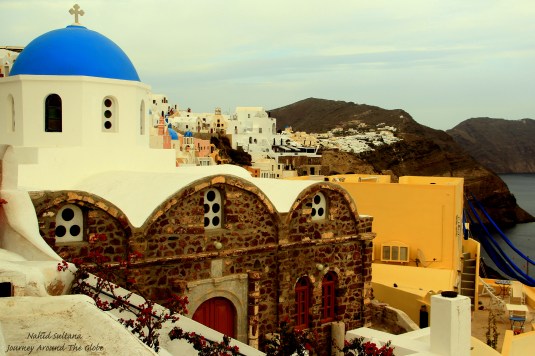
- Santorini – one of the most beautiful islands in Greece
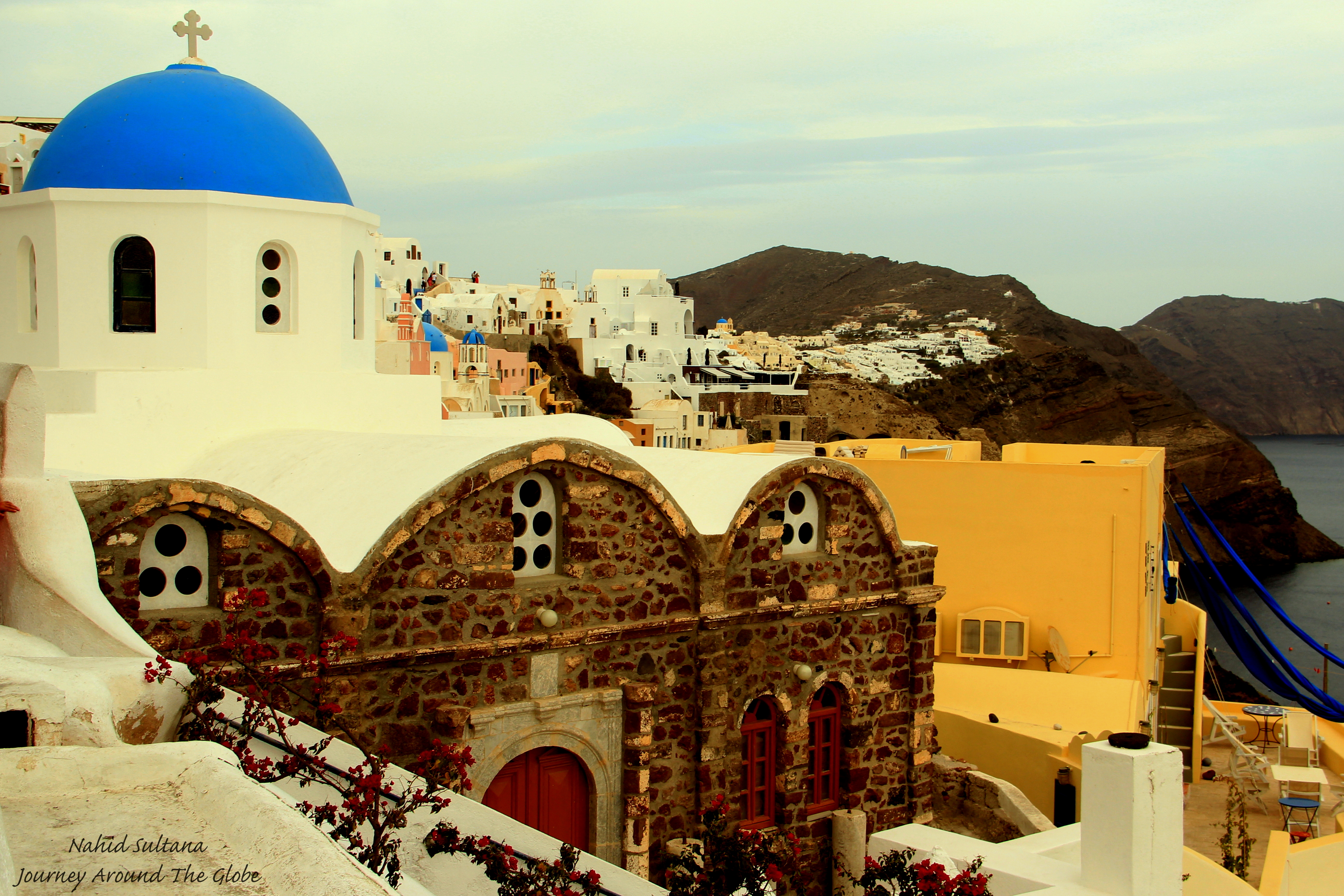
As for me, I loved hopping from one village to the other and be amazed with history. Santorini is a crescent-shaped skinny island. The villages are very spread out depending on where you are going. But do get out of the tourist sections to enjoy true beauty. You will see fun-loving young Greeks, villagers, and fishermen…that’s what I cherish the most from this trip.
What makes Santorini different from other islands of the Cyclades is that it was built on thick lava of volcano which rose from the molten core of the earth. But the contrast of the deep blue sea with red, brown, and black colors of the land, the depth and clarity of the horizon sweeps away the nightmarish birth of this island. Overall, it’s wild and imposing natural beauty cannot be found anywhere else.
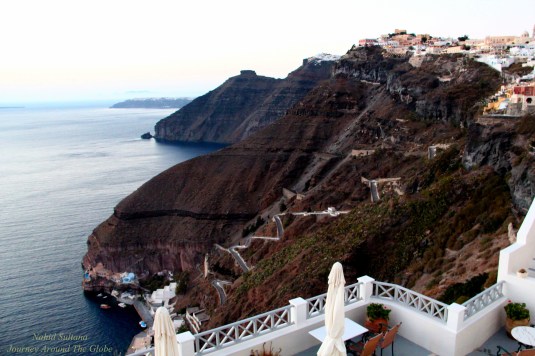
- The rugged terrain of Santorini
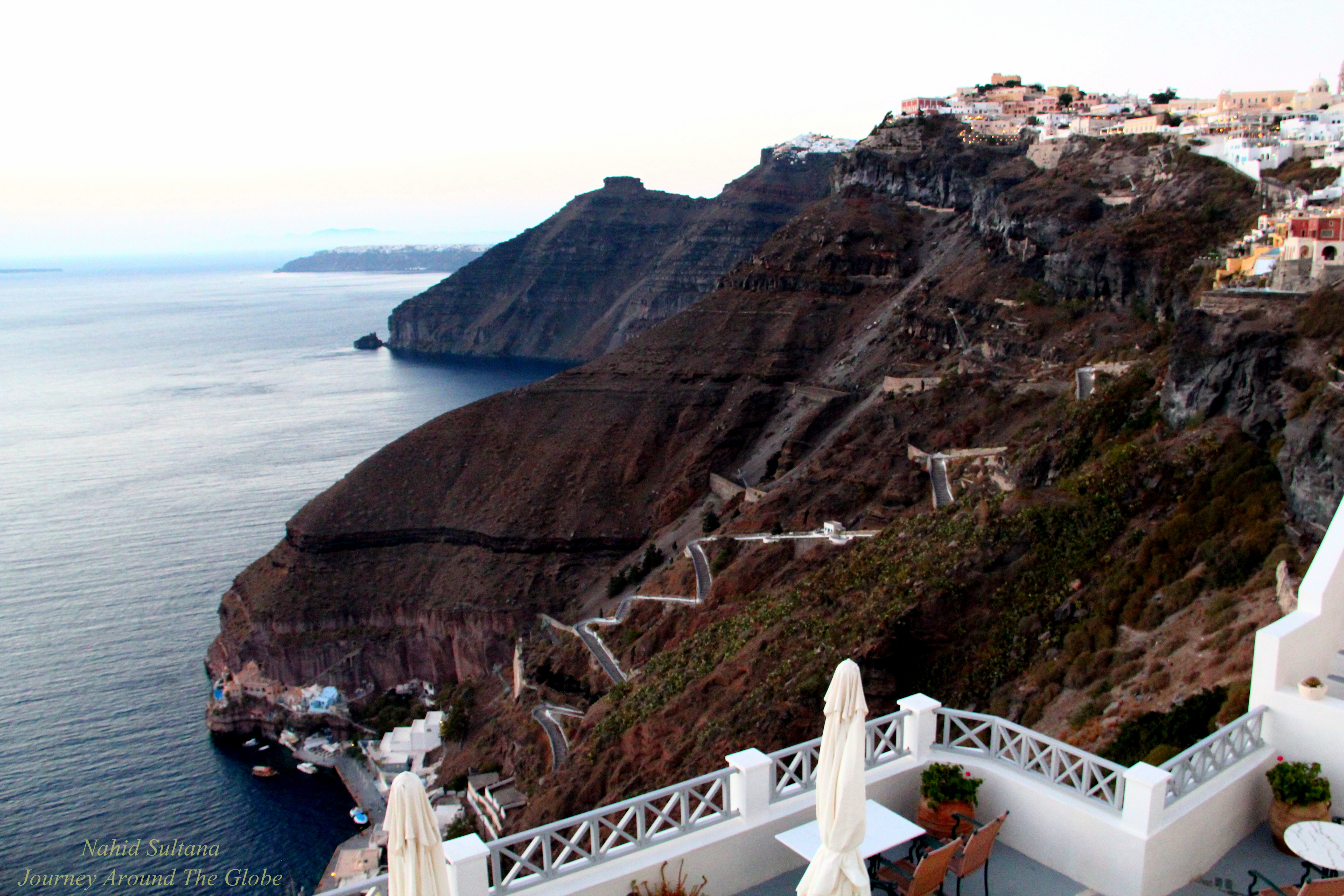
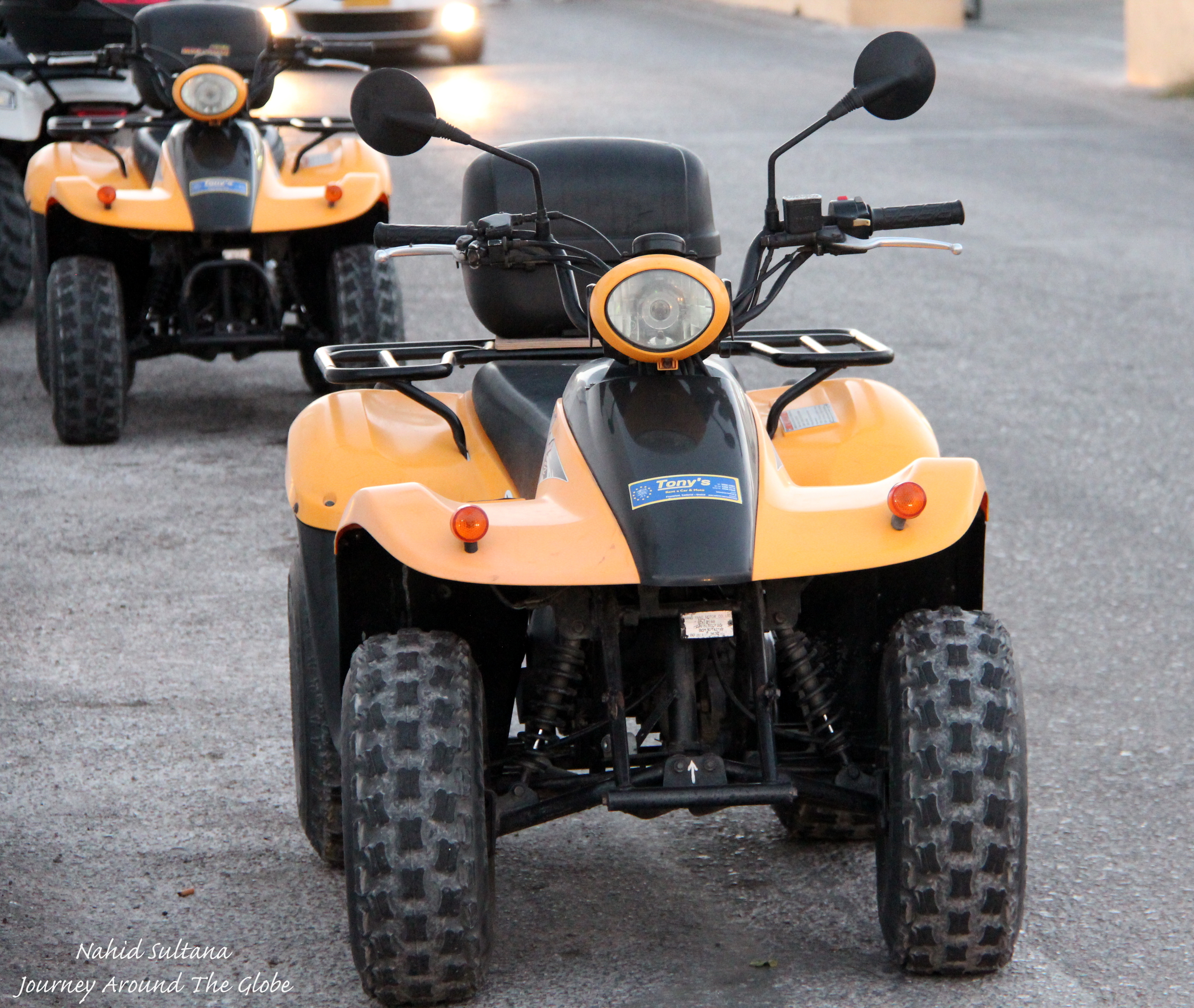
To get around the island, ATV is probably the best way, although I saw many people riding on rented cars. But be careful of crazy drivers and parking can be a problem if you rent cars, especially in Fira or Oia. I mainly rode on public buses to all my sites. But be careful, they look like tourist coach buses and don’t have a STOP button and sometimes don’t stop at all if no people are getting on. I told the ticket master on my 2nd morning that I wanted to get off at Firostefani but he forgot to tell the driver and I ended up in Fira along with another British lady who also wanted to get off at Firostefani. Also it’s a bit inconvenient but every public bus stops at Fira whenever you go to. It costs from 1.60 euros to 2.20 euros depending on where you are going to. From Oia to Fira there is a hiking trail that you can take to go parallel to the cliffs and the sea. I didn’t dare to take this trip since I knew I am not fit enough for this and I didn’t want to waste time just walking. I wanted to explore different traditional settlements. But to enjoy the island to the fullest, be ready to climb up and down lots of narrow stairs…otherwise you won’t feel the vibe.
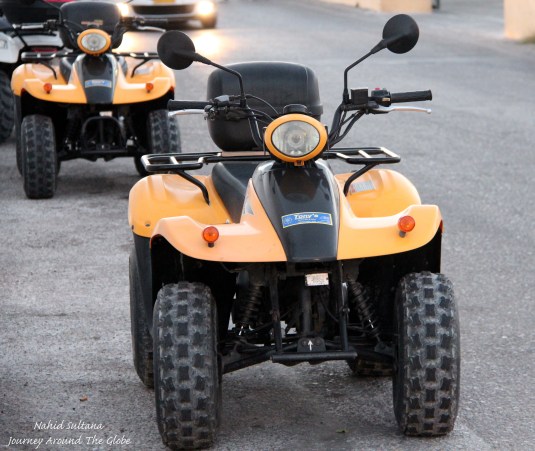
- ATV – the best way to get around the island
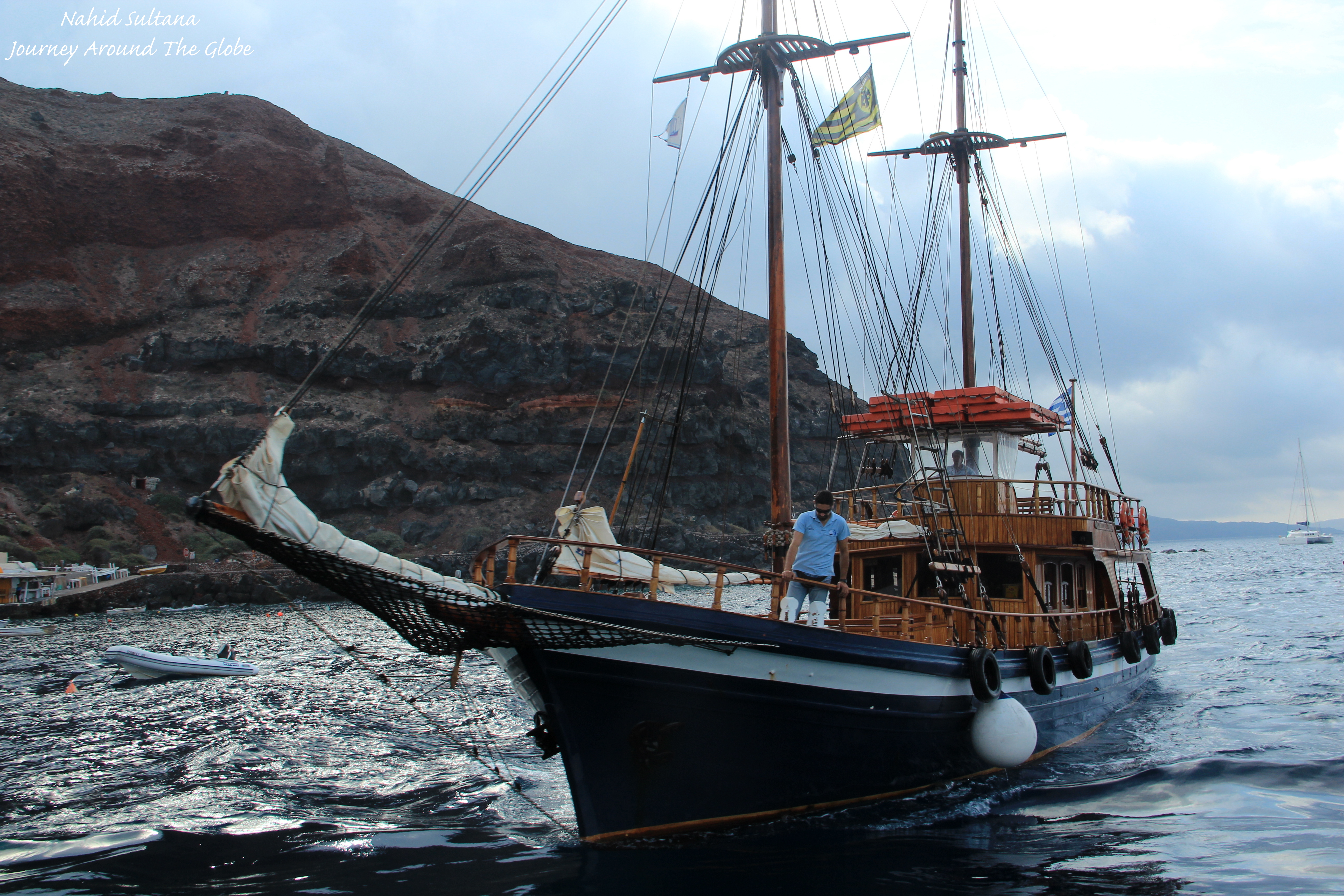
I booked a boat excursion (see below) 2 days before the trip. It was 30 euros for a 5.30 hours of guided tour (lunch not included) and started at 10am. I was picked up from my hotel around 9:20 and was taken to Ammoudi Bay in a mini-bus. From Ammoudi Bay we were taken to Fira Old Port to pick up more people. Our first destination was to Nea Kameni, then to Palea Kameni, and then Thirassia before dropping us back to Ammoudi Bay. I am glad I took this trip to see the volcanic islands up-close and smell its sulfuric air. This is one trip that shouldn’t be missed to get a different perspective of the island.
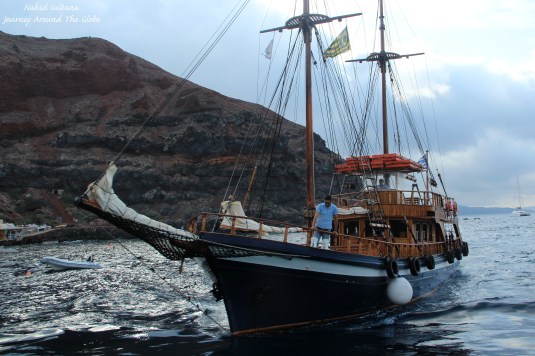
- Our boat that took us to the other islands
TIME of TRAVEL: It was in mid-October 2013 when I flew to Santorini. The island definitely slows down after October. You won’t see crazy amount of tourists like during summer months. Water was still warm for those who are interested in going to beach and enjoy water. Unfortunately, I got rain on my last evening there, hence, missed a chance of watching sunset over dinner. Other than that the temperature was around early 80s during daytime. But I wouldn’t recommend to go there after October because then many shops and hotels close down for winter and the buses are not that frequent either.
MY HOTEL: I stayed at Laokasti Villas and Restaurant in Oia, Santorini. Although Fira is closer to the airport, it is touristier than Oia. I wanted to stay in Oia, not only because I can see the best sunset only from steps away from my hotel, but also it’s quieter and cozier than Fira.
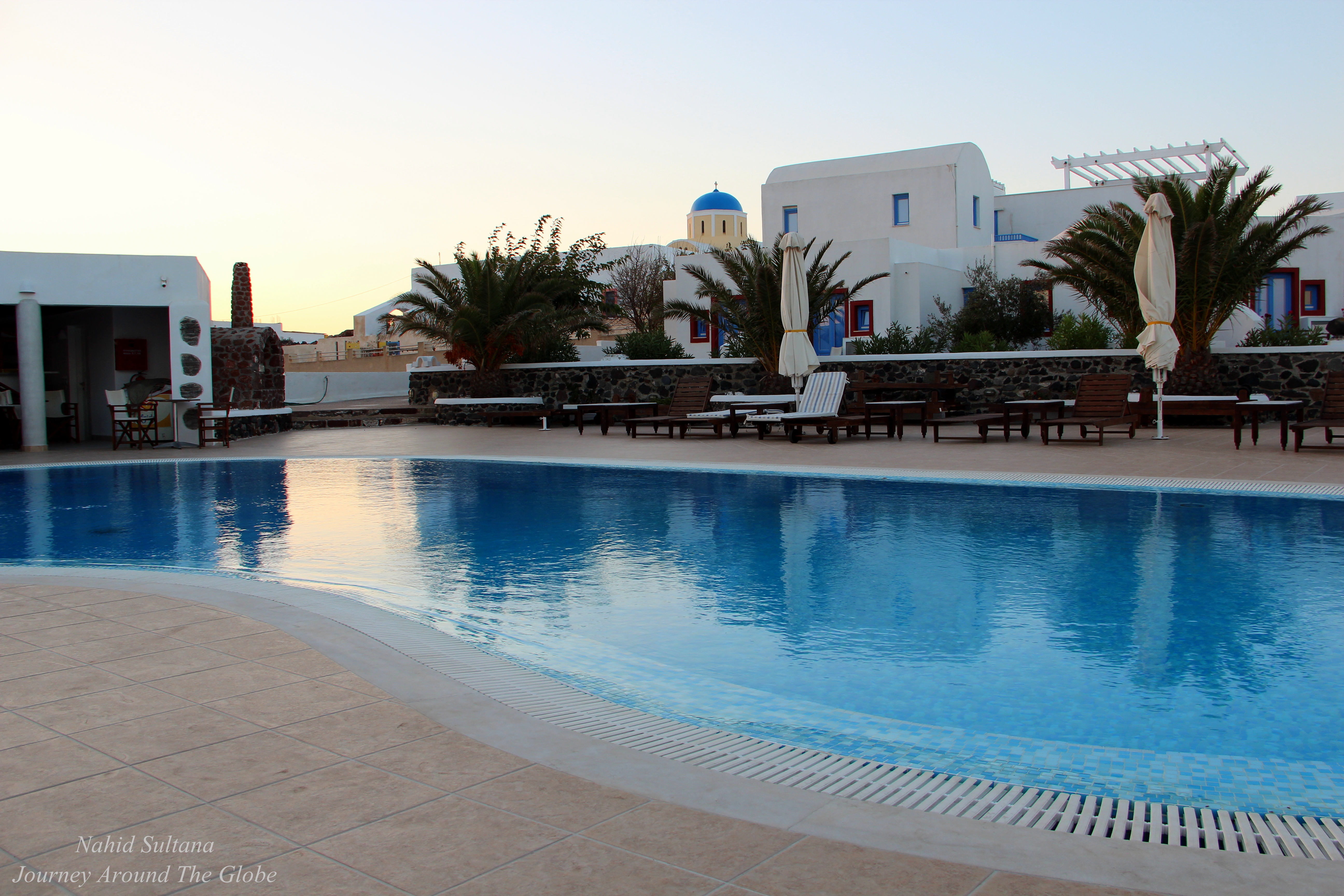
This hotel had free breakfast, although I didn’t wake up a single morning to eat. I decided to catch up on my sleep after spending a whole sleepless night in Athens airport before catching a 5:30am flight to Santorini. It also had free Wi-Fi which was lousy but worked once in a while. The best part was that I had a partial ocean-view room with a little porch. The swimming pool was fantastic also and some of the rooms had the pool view. Also, you can order an in-room massage service here…very cool I thought. I booked my boat tour thru the hotel and also my airport pick-up/drop-off…they were very helpful and efficient every time.
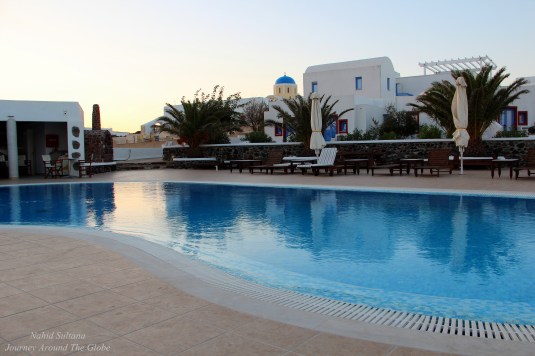
- Swimming pool in my hotel, Laokasti Villas, in Oia, Santorini
I had a small kitchenette in my room with nice clean linens and a small red bathroom. The location was very nice for me because bus stand and Oia pedestrian zone were both right across the street. There were also couple small restaurants and supermarkets near this place…overall, I loved it and I would recommend it to anyone going to Santorini.
EATING and SHOPPING: Santorini has plenty of options when it comes to satisfying your taste and hunger. For any meals, snacks, or drinks Fira and Oia probably have more options, but not necessarily the best ones. Most of the villages and all the beaches have restaurants that will offer you view of the caldera, blue sea, and the islands nearby. Do expect higher prices from restaurants with sunset or caldera view…but it’s all worth it. If you are looking for the best sea-food restaurants, go down to Ammoudi Bay from Oia and there you will see many fish taverns. Beaches like Perissa or Kamari also has some great fish places. Tomato balls or croquettes are something unique of Santorini and should be tried even if you don’t like deep-fried stuff. I used to have them almost for all my meal as side…try it with taztziki sauce…yummy. Other than that most of the traditional Greek places have Greek salad, Greek style spaghetti (with capers and feta cheese), pizza, gyros, kebabs, moussaka, souvlaki, Greek omelet with feta cheese, olives, and kataifi…a sweet dessert with honey and nuts. Oh, and don’t forget to try local tomatoes…they are full with flavors, best ones I’ve tried so far.
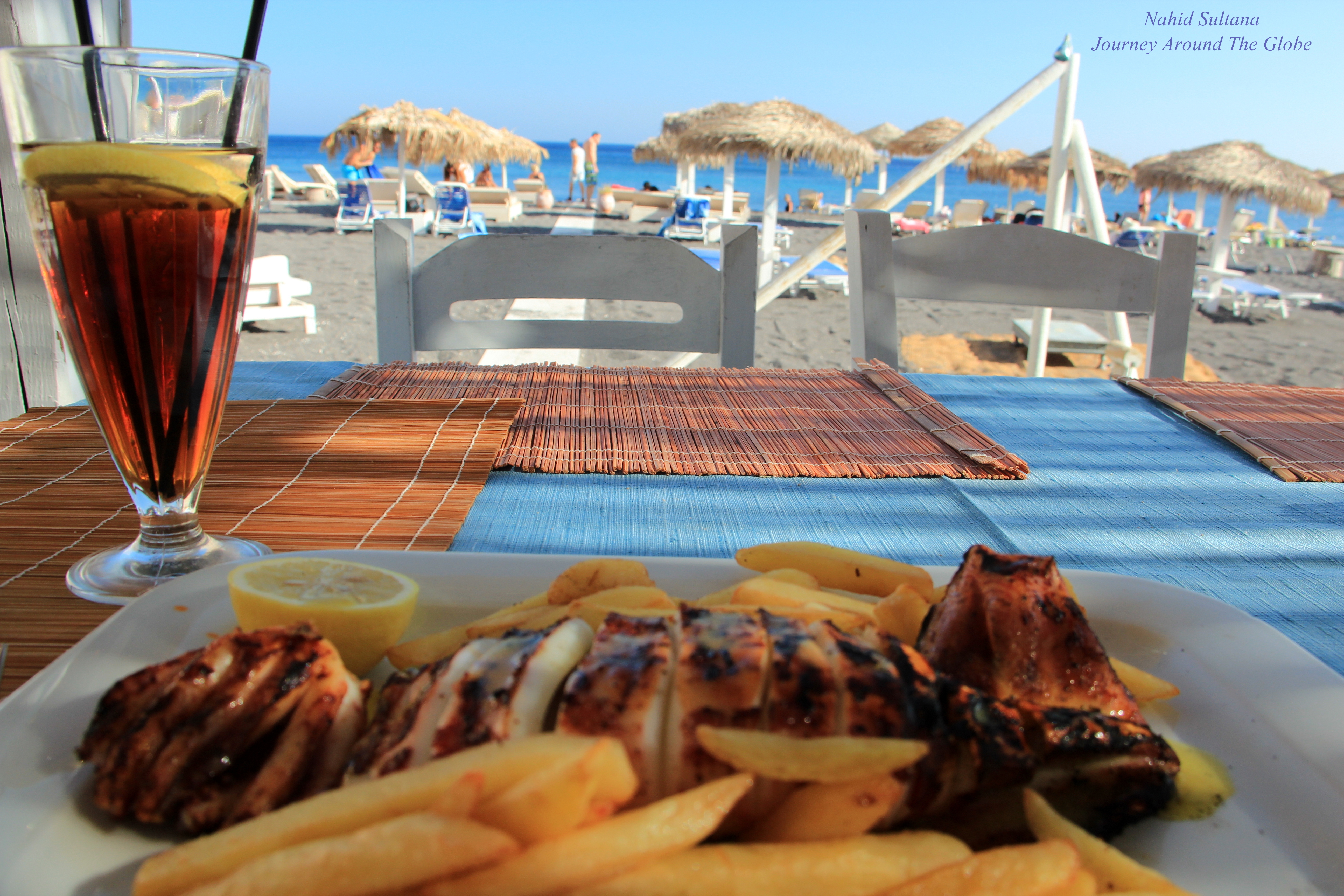
My first lunch was at Demilmar in Perissa Beach. I must say I loved my relaxed meal with a memorable ocean view and its sweet sound. They had traditional Greek dishes like moussaka, souvlaki, fresh seafood, as well as burgers, pizza, and pasta. I had grilled calamari…fantabulous. 2nd day I had my lunch in Fira in a restaurant on the shopping district, can’t really remember the name. Really enjoyed my Greek spaghetti with capers and feta cheese while enjoying the fresh ocean breeze and looking at the volcanic island in front of me.
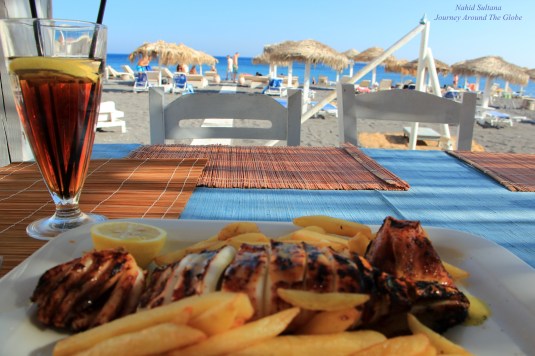
- My lunch, grilled calamari in Perissa Beach
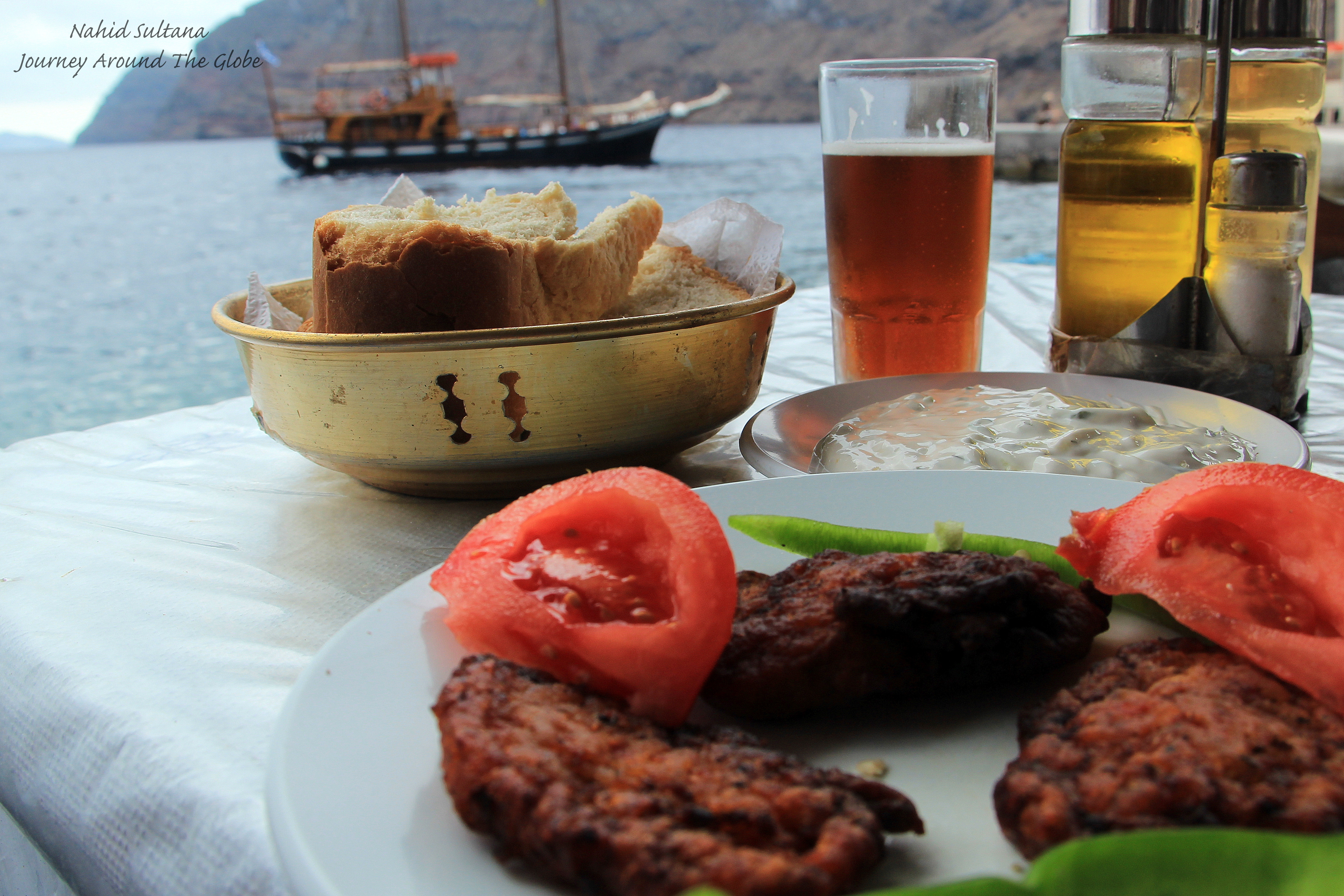
When I went for boat tour, we had lunch in Thirassia. Tomato croquettes with taztziki sauce and bread was awesome while looking at water glimmering as the sun was shining on it.
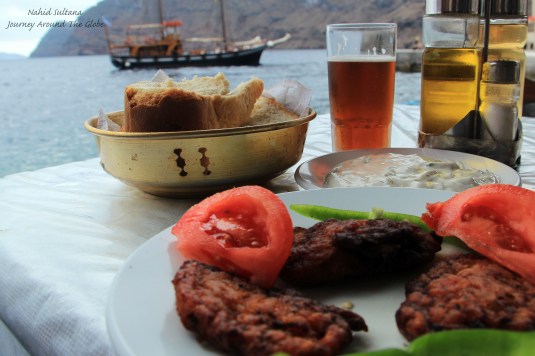
- Lunch in Thirassia – fried tomato balls
Last dinner I did was in Oia, called Floga, a restaurant that was recommended by my hotel (another recommendation was “Thalami”). They are both located on the main shopping district of Oia. It was raining badly on my last night of Santorini. Floga usually has a nice view of volcano and offers beautiful sunset view too, but for the rain we were inside the plastic shade and couldn’t see much of the surroundings. I was in the mood for some seafood that night, wish I could go down to Ammoudi Bay for that but the rain didn’t let me. Either way, Floga has some very good dishes along with some traditional Greek cuisine with some pricey tags.
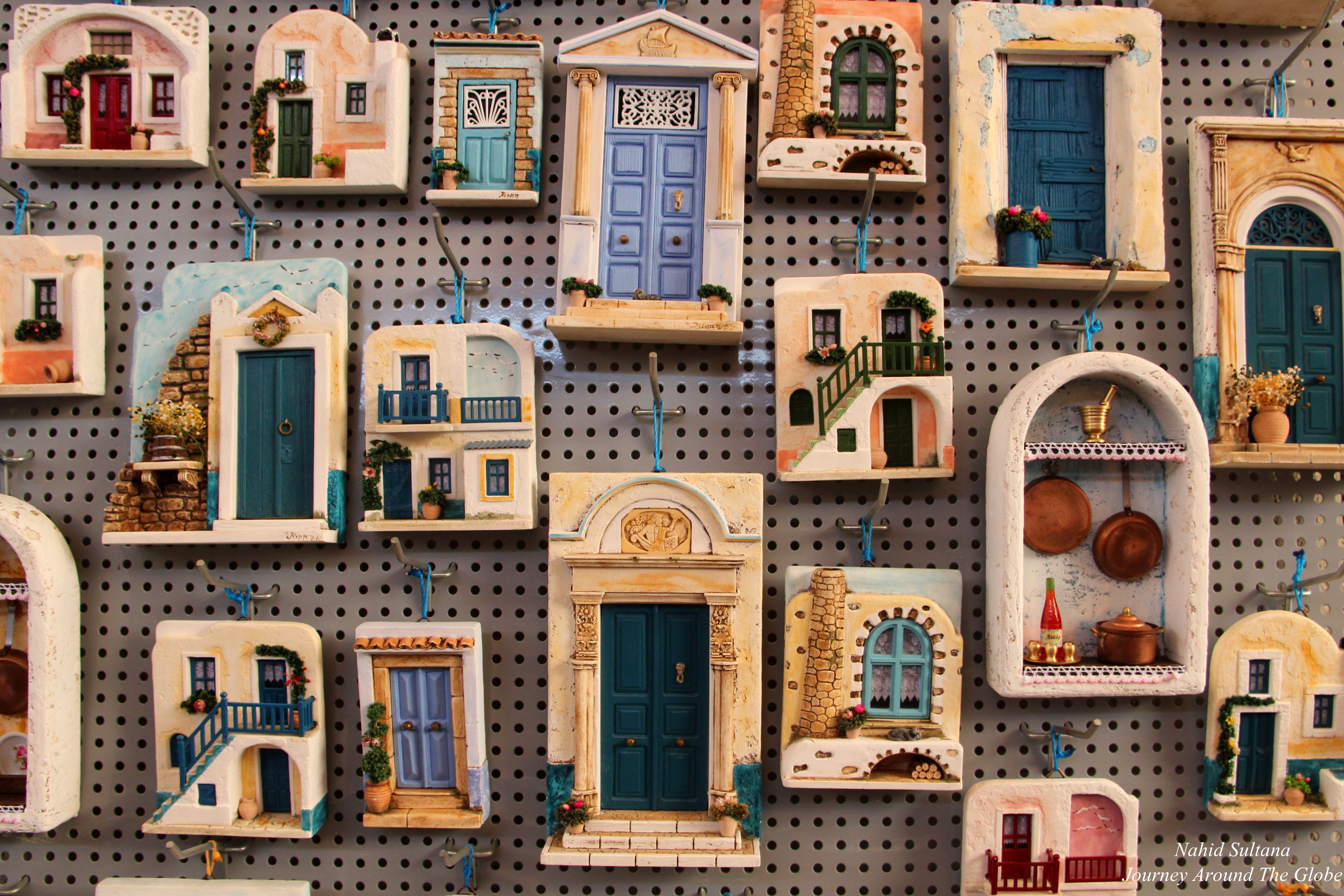
Greek olives (especially Kalamata olives), stuffed donkeys, Greek pottery, olive oil, Greek delights, embroidered laces, decors or jewelry made from lava rocks, miniature Cyclades houses, and Santorini paintings just some of many things the island can offer you to take back from here as gifts or memoirs. If your pocket is really heavy then buying Greek gold can make sense. I got myself a lava rock man for 12 euros, a miniature house, and some jewelries. If I had some room in my luggage I would have put some packaged olives there too.
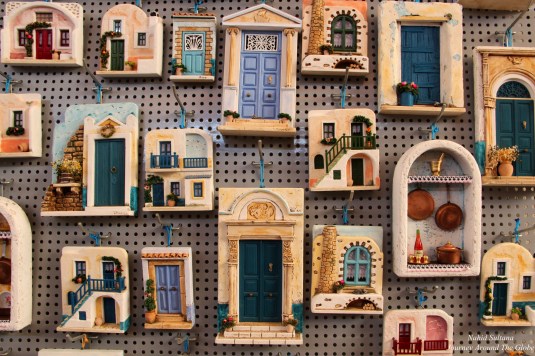
- Beautiful Santorini doors in a souvenir shop in Fira
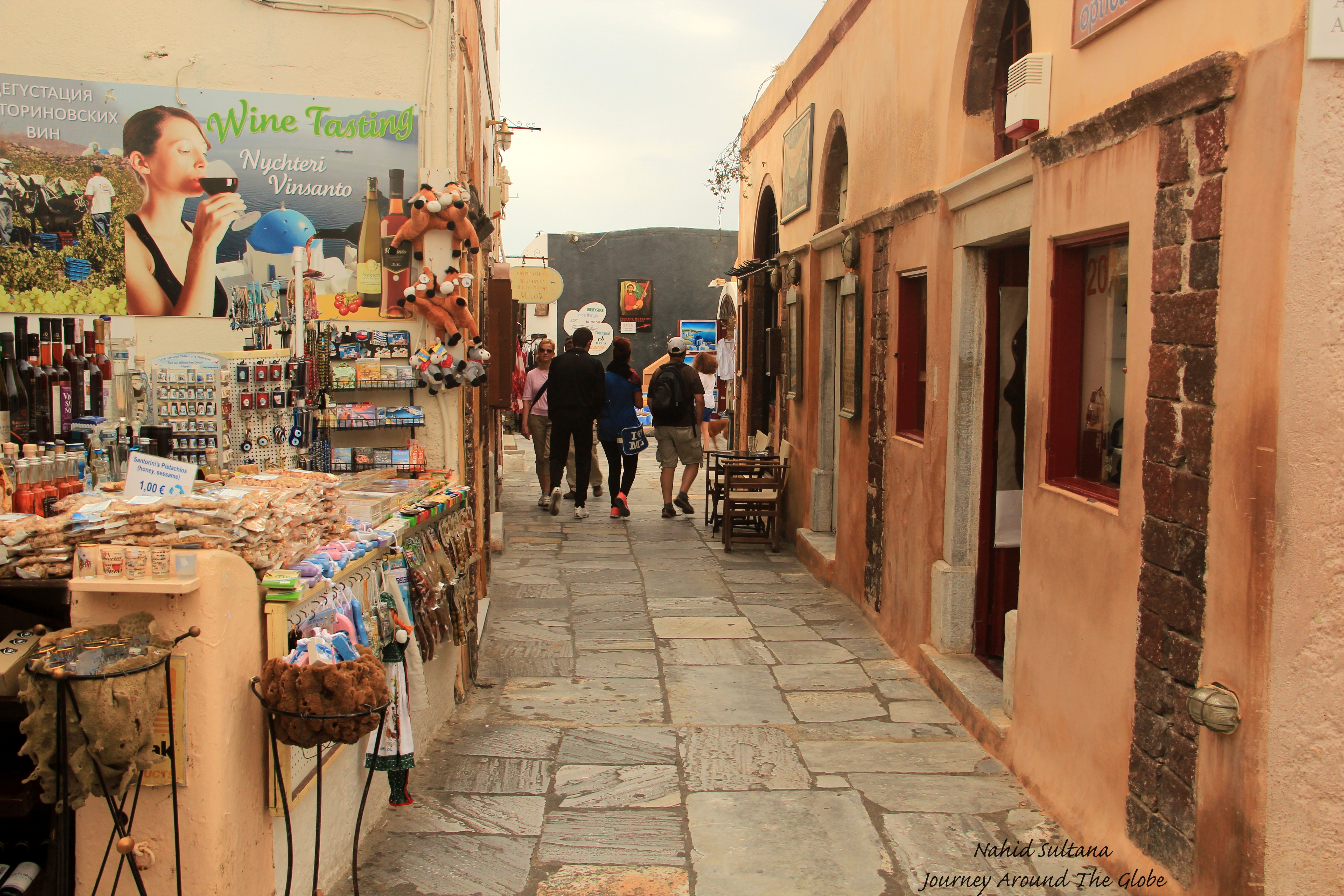
Most of the villages have many shops and unique stores. Fira and Oia have the most interesting places for shopping. Even if you don’t want to go for those expensive stuff, it’s nice to just walk pass these shops and entertain your eyes. Ohhhh, another thing I wanted to try for a long time and finally did was fish-pedicure. It was in Fira (there was also one in Oia). For 10 euros, you can soak your feet in a tank with 200 fishies. It was ticklish at first but those hungry fishes loved the dead skins from my toes 😉
- Shopping district of Oia, Santorini
PLACES I’VE VISITED: You don’t really need a walking-map in Santorini. Although the island is not marked very well, half the fun is getting lost in white-washed alleys and climbing up and down the stairs near the cliffs.
If I had one or two more days, maybe I would have gone to Akrotiri and Ancient Thira– where you can see a stunning collection of ruins from ancient settlements of Santorini, Kamari Beach, Red Beach, Village of Finikia, and Village of Emporio. Finikia and Emporio are, I think, more like Megalochori with traditional buildings and small settlements.
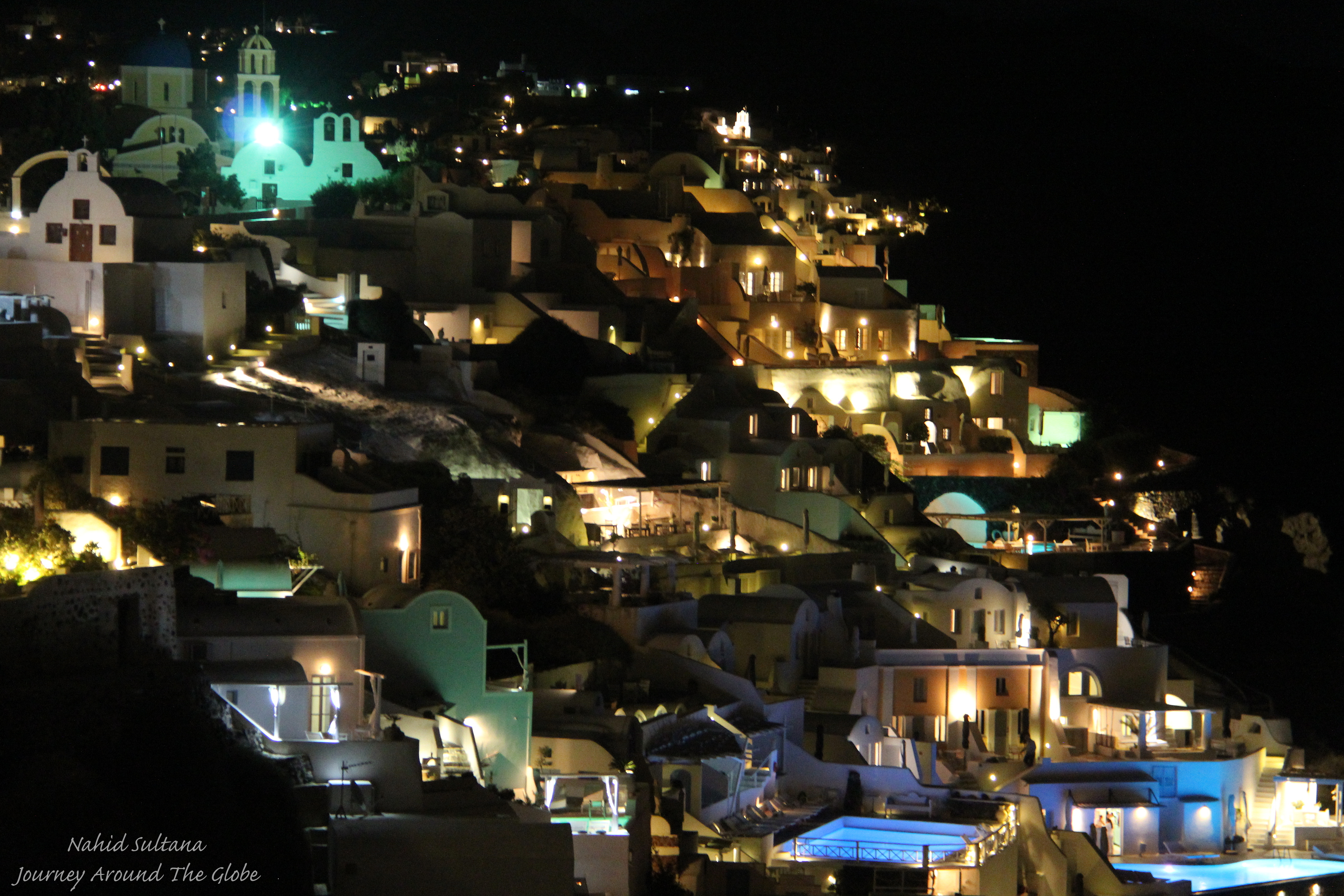
- Oia at night
1) MEGALOCHORI: This is the first village I explored on this island and I instantly fell in love with it. About 20 minutes of bus ride from Fira, Megalochori (pronounced as Megalo-hori) is a small but stunning village of Santorini. Walking through the white-washed walls, gazing at Cycladic domed churches, peeking through those traditional blue and white houses, and the listening to the quietness of this typical Greek village made me feel really lucky that I decided to come here first. If you want to have some romantic time on this island, Megalochori has some nice cafes, restaurants, boutique stores, and picture perfect village neighborhoods that will stay in your heart forever.
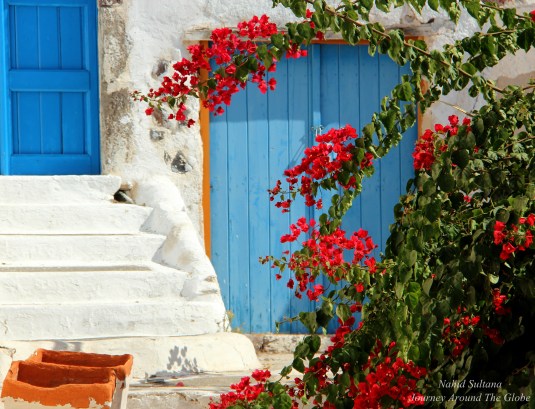
- A typical blue-white house in Megalochori, Santorini
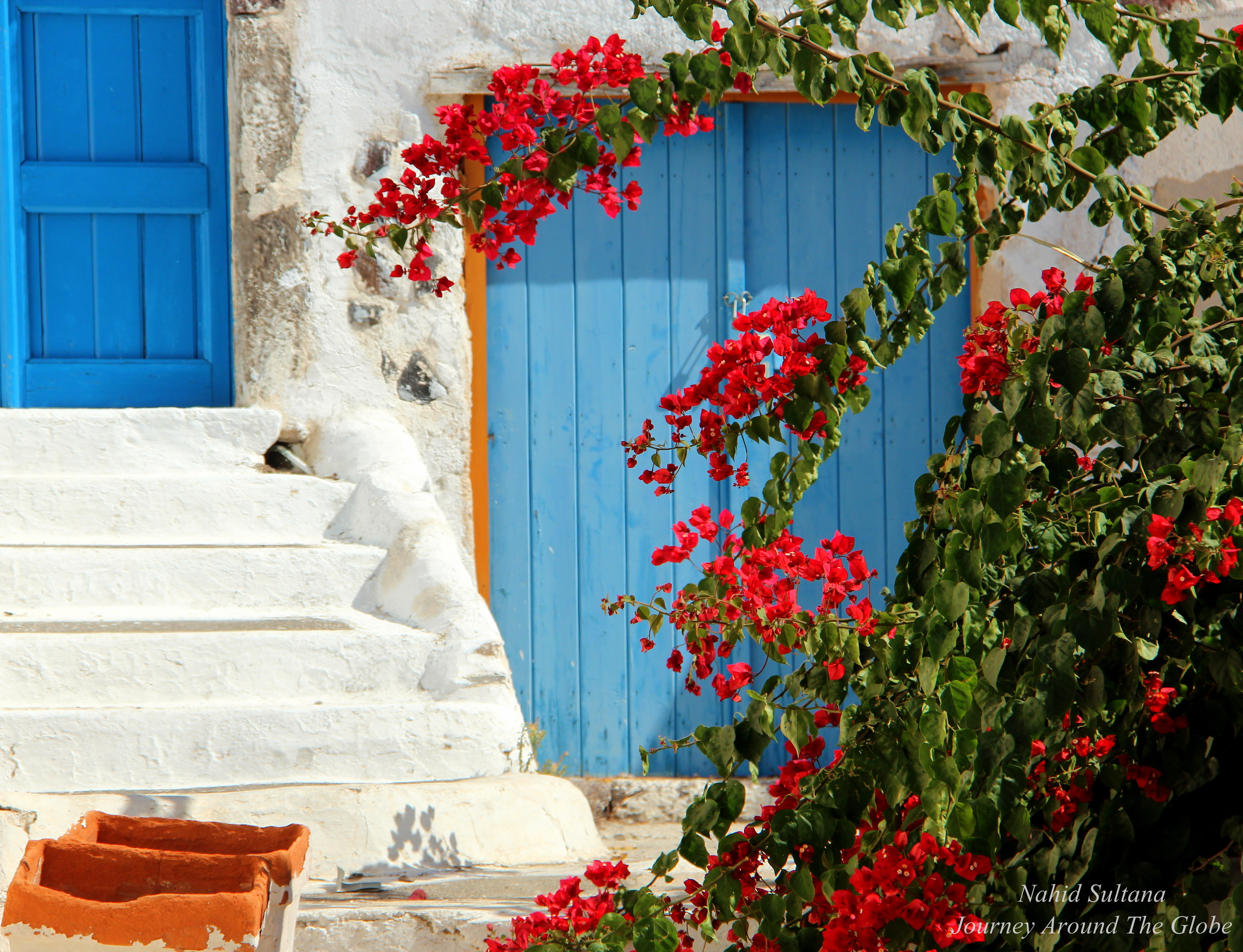
I spent about 45 minutes here just strolling thru the small streets. Just follow the sign “Traditional Settlement” to start your tour after you get off the bus and you will be glad that you visited this place during your stay in Santorini.
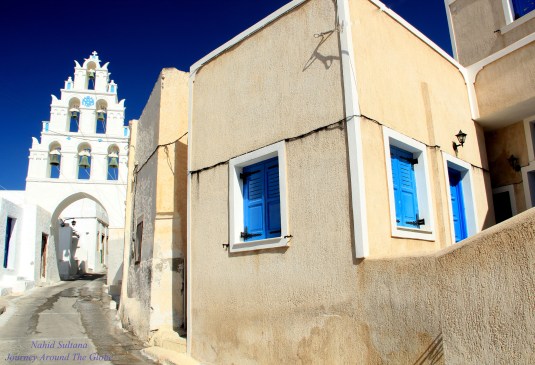
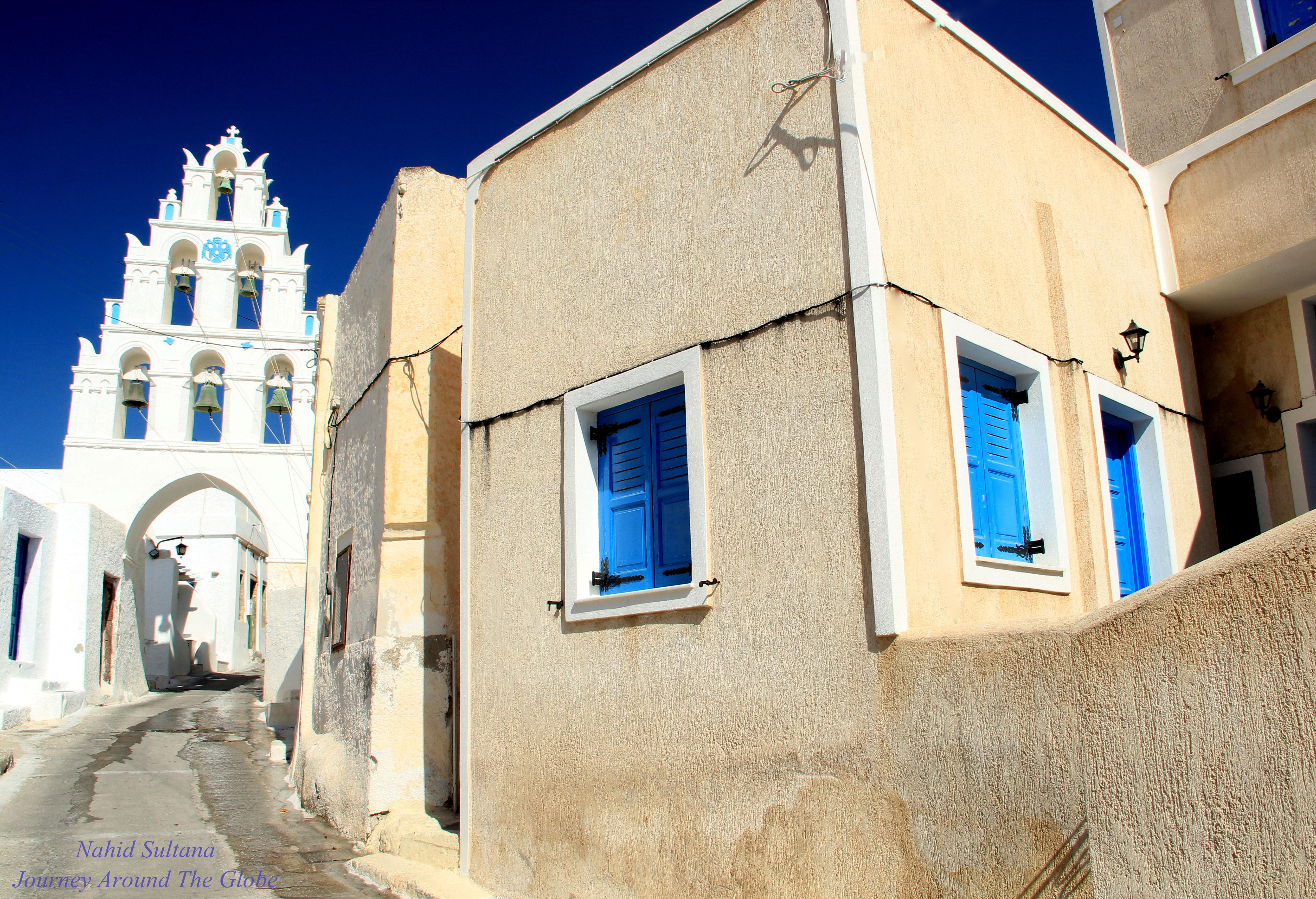
- Bell Tower of Church of Virgin Mary in Megalochori, Santorini
2) PERISSA BEACH (BLACK SAND BEACH): From Megalochori, I took a bus to go to Perissa Beach which took about 45 minutes of driving thru barren lands and stretchy zigzag mountains. Look out the windows…you will get a different feeling of the island.
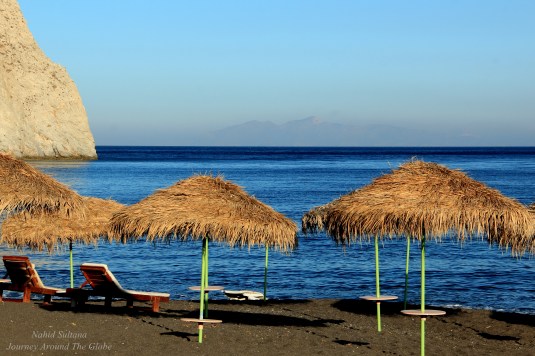
- Perissa Beach – the best one in Santorini
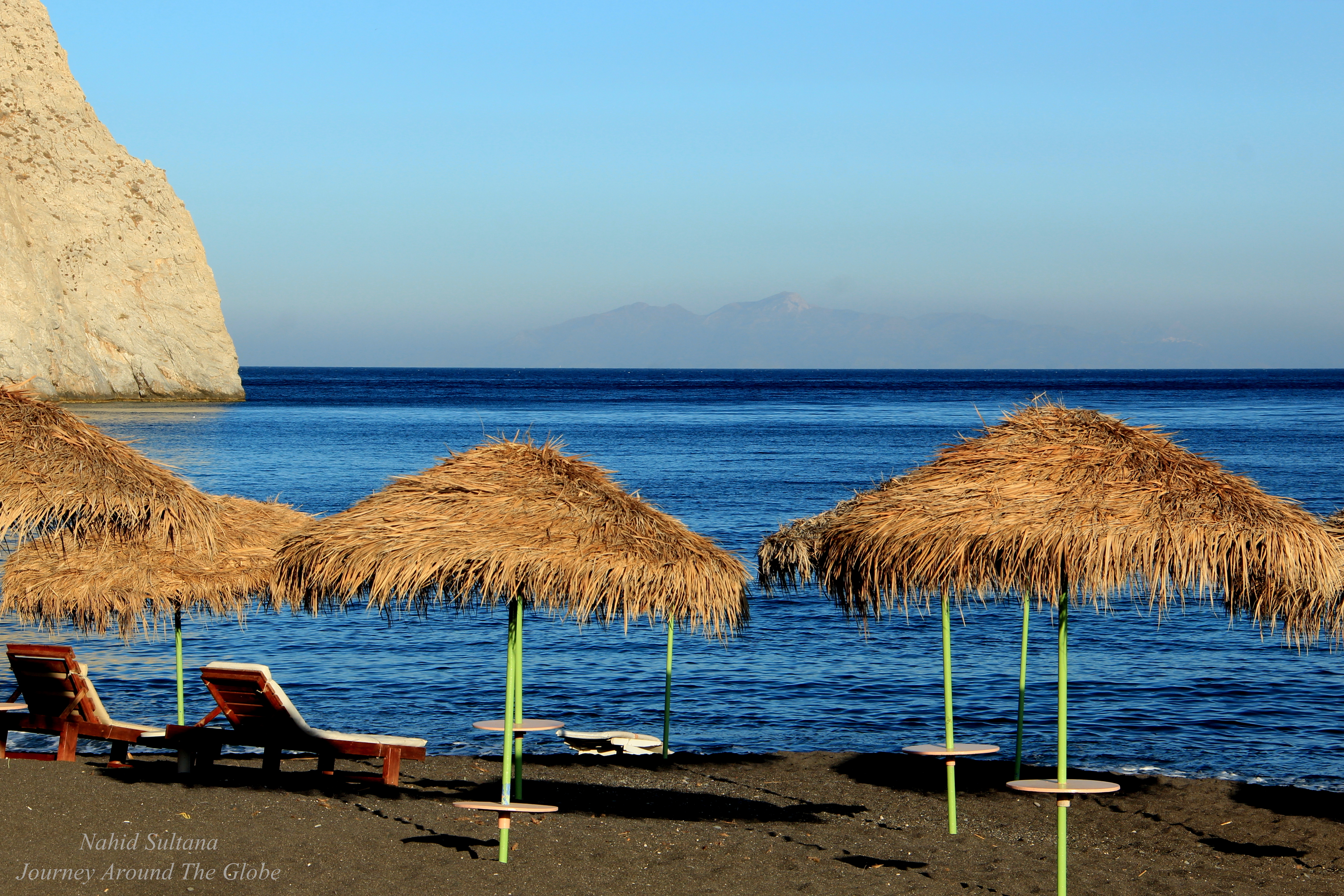
I was starving as soon as I got off the bus and had to satisfy my hunger first. After lunch, I spent plenty of time just walking by the beach and going to some nearby shops. As they say, Perissa is the most scenic and best beach in Santorini, that’s why I picked only this one among many others to spend my late afternoon time. This is the black sandy beach. Few people were swimming and sun-bathing in the perfect weather of October. Good thing it wasn’t that crowded. While you are enjoying the weather and the sea, don’t forget to look back at tall, dark, and handsome mountain, Mesa Vuono…the tallest one of Santorini. Overall, this was my ultimate place to relax under the sun and experience a nice islandic scene.
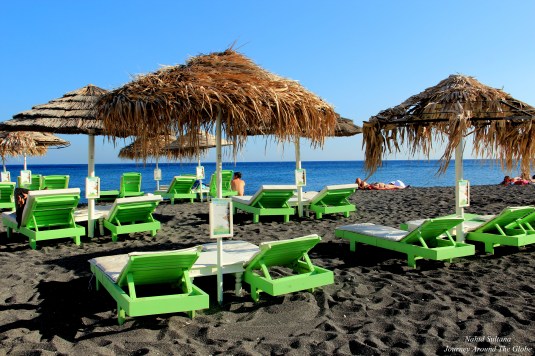
- Perissa Beach, Santorini
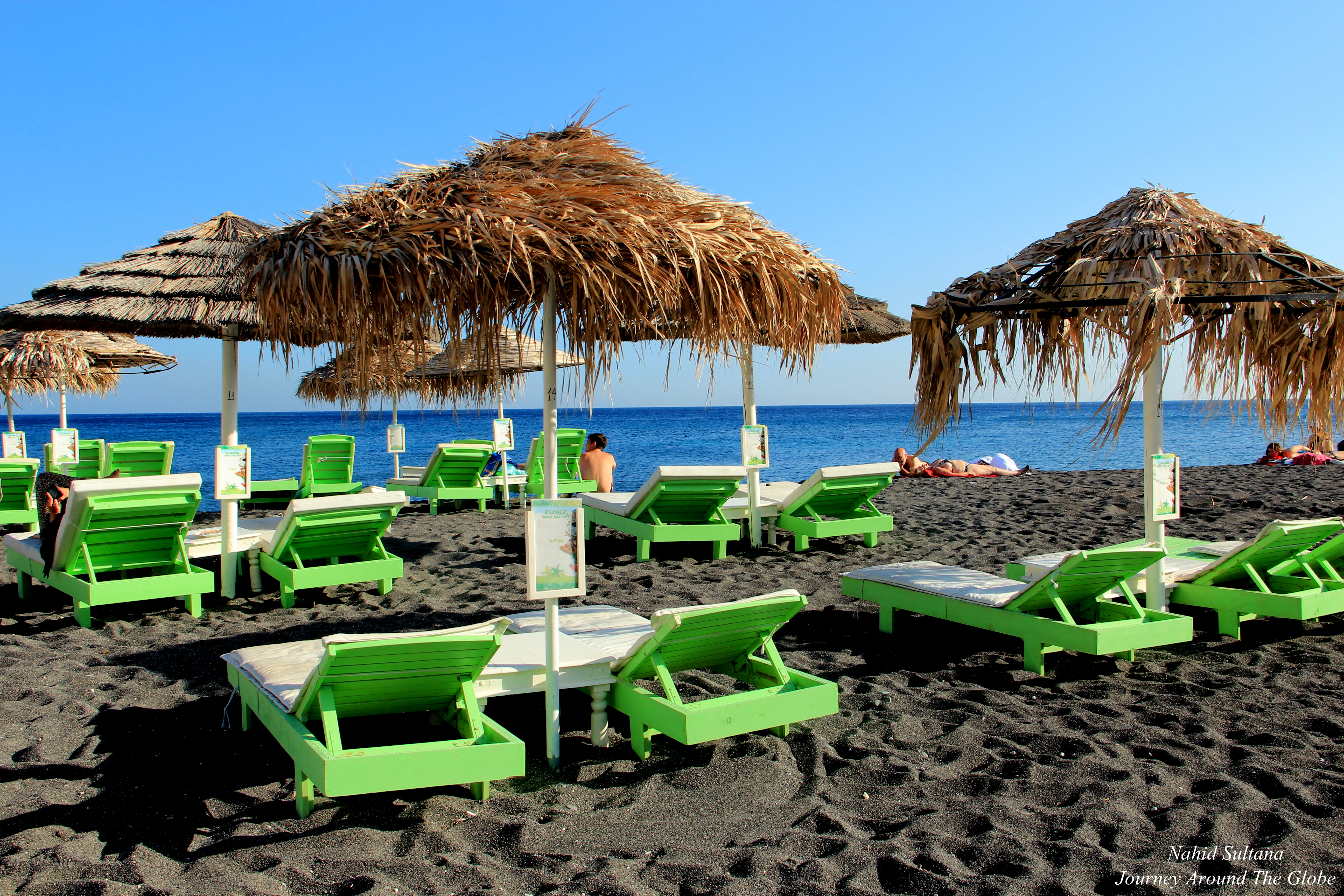
Perissa Beach is about an hour on bus if you are coming from Fira. During off-season, like in October, the bus runs only once an hour…so plan accordingly.
3) FIRA: Fira was my last stop of day 1 in Santorini and I ended up coming back to this town few times more in the next 2 days. It’s the capital of Santorini and the touristiest town of it. It is probably livelier than Oia but definitely louder and overcrowded too. If you are into night life, than Fira has more clubs and bars than any other places in the island.
- Fira after dark
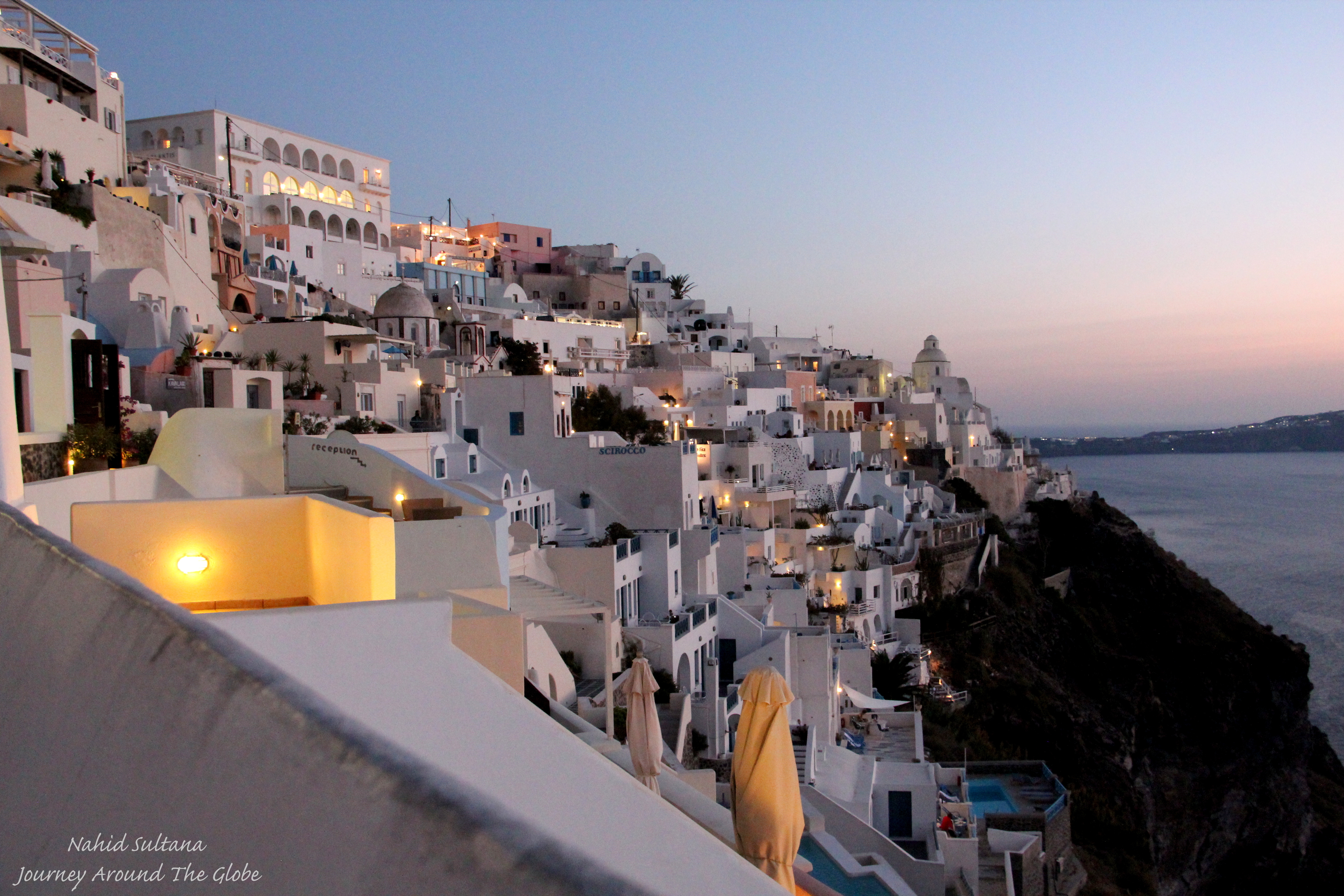
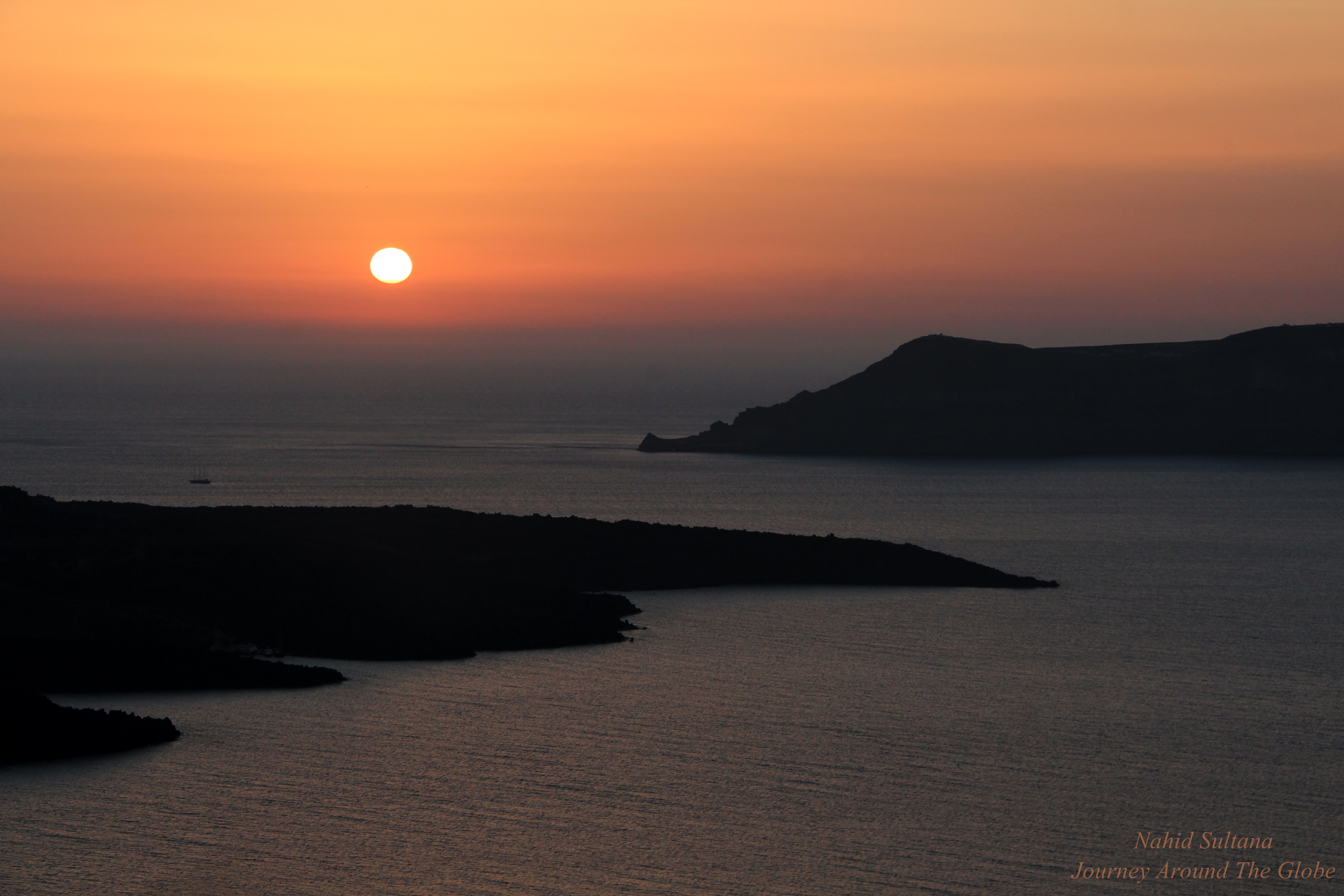
The tourist part of Fira is smaller than you can think. There isn’t a lot to do here other than visiting some museums, churches, and of course enjoying some best cliff-perched town views. Strolling through its shopping district and gazing at overpriced jewelries, clothing, and art studios were fun for me. Walk on small streets, sit down in cafes with view of caldera and volcano islands or just go crazy in those unique shops. One of the best things to do here is watch sunset from any street or over a nice dinner. On the first day I kind of hurried to go near Hotel Atlantis from where you can experience sun going down behind the volcano islands…simply incredible.
- Sunset in Fira, Santorini
I took a small street near Hotel Atlantis down the cliff and started walking without really knowing where I will end up at. But this was the best way to get some views of the caldera itself. Here you can walk along the cliff and parallel to the sea to see some colorful stunning hotels and resorts with blue serene swimming pools looking over their big brother – the Aegean Sea.
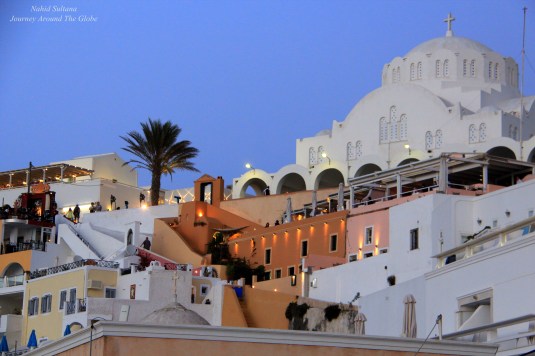
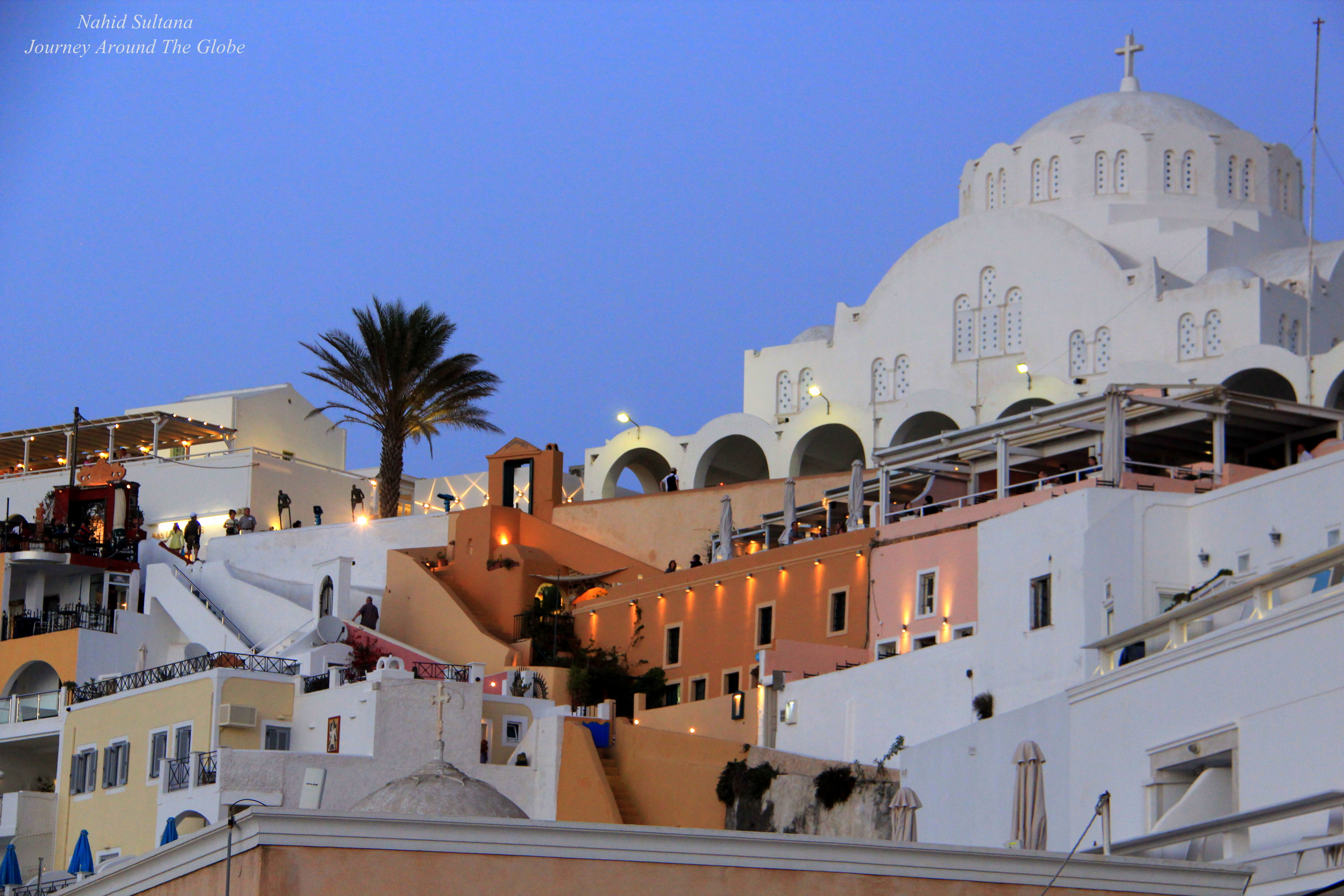
- Fira with Cathedral Church of Candlemas of the Lord on the right side
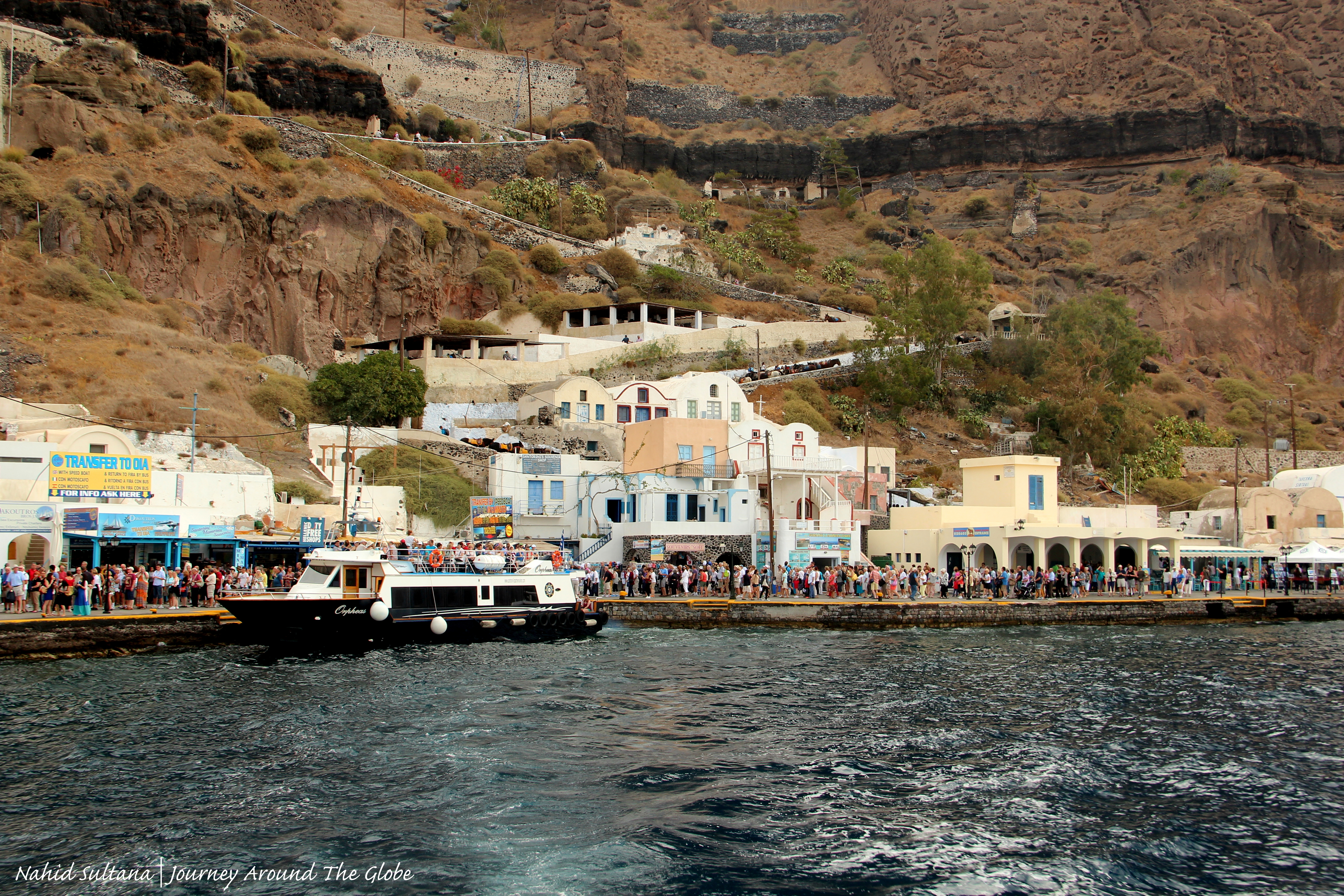
Although I didn’t do it, I saw many people lining up to catch a cable car to go down to Fira Old Port. If you have energy, maybe it’s best to walk some 600 steps or just take an unforgettable donkey ride either way. Walking to Old Port should be half the fun but have to be careful of donkey poo and its smell. There’s nothing much to do there unless enjoying the harbor and taking some pictures from sea-level. It does get really busy when passengers from cruise liners disembark from ships.
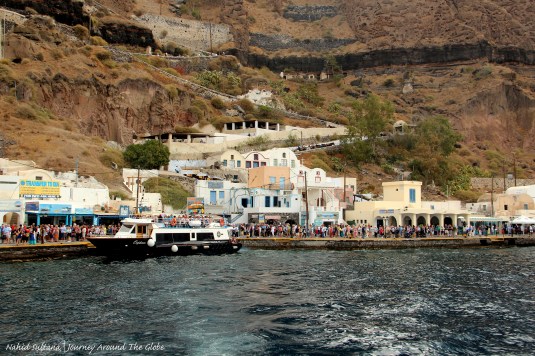
- Fira Old Port and the stairs that goes up to Fira main town
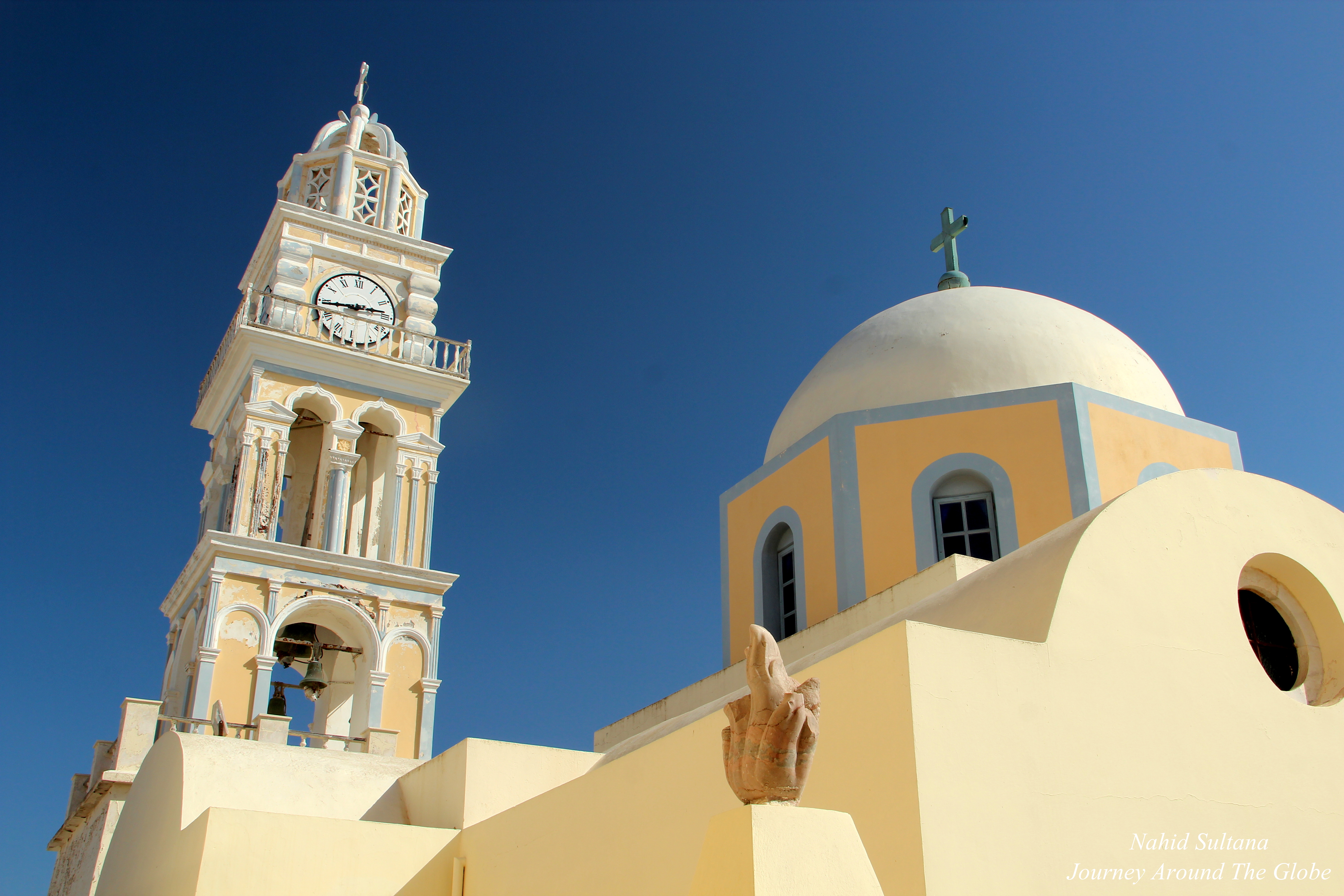
Cathedral Church of Candlemas of the Lord is a small but beautiful church in Fira, right beside Hotel Atlantis. Most of the churches I saw in Santorini were closed, but luckily this was open and I could get a taste of what a Greek church looks like. It has lots of frescoes on the wall, high ceiling, and a decorative altar. It was free to enter but we weren’t allowed to take any photos inside. Another cathedral I visited was Catholic Cathedral of Saint John the Baptist. It was built in 1823 but was damaged by the 1956 earthquake. Then finally, it was open again for worship in 1975. Loved its gorgeous ceiling and alter. It’s small but worth climbing the stairs. Dominican Monastery is only few steps away from this church, but it was closed. It’s free to enter.
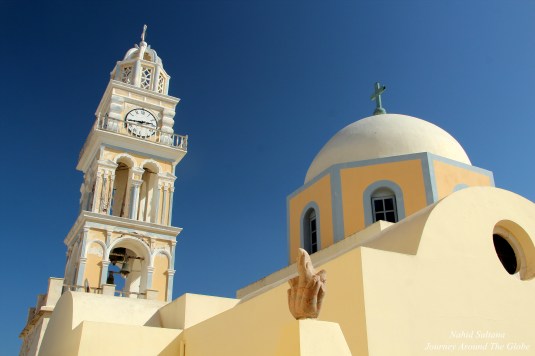
- Catholic Cathedral of Saint John the Baptist in Fira, Santorini
Fira has the main bus stand and wherever you go you have to go thru Fira. That’s why it may take some extra time when you are planning to go to far away villages and beaches.
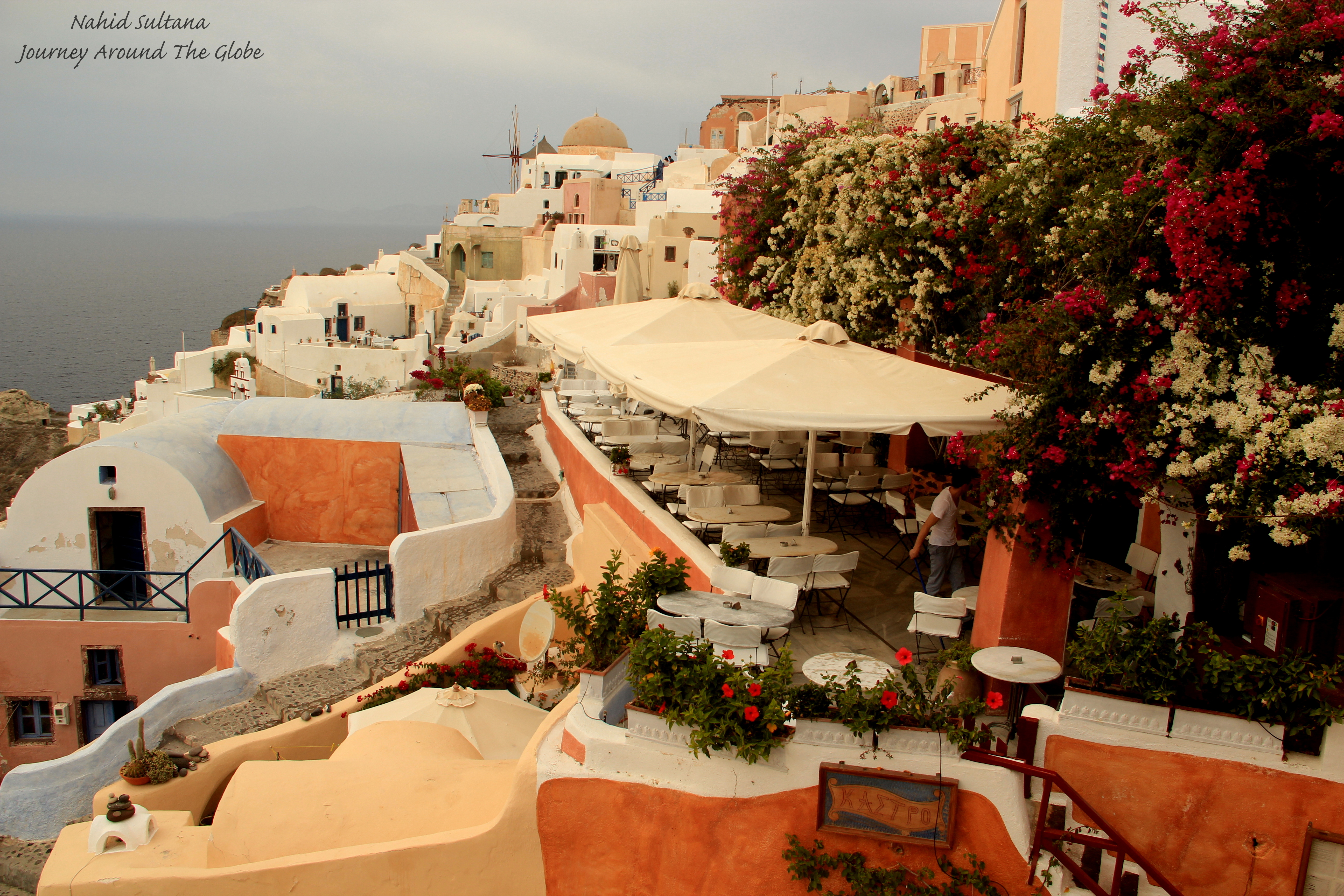
4) OIA: Oia is definitely the most beautiful and vibrant village of Santorini. It’s famous for its reputed world-famous sunset. After it was hit by a hard earthquake in 1956, the village was left barren for many decades. Then slowly started to get back its face, I think, around 1990s. Now Oia is the newest part of the island overlooking the Aegean and attracts more tourists than any other villages here. It has the most beautiful cliff dwellings and luxurious hotels and resorts. The main pedestrian lane is paved with marble and has lines of art studios, Greek gold jewelry shops, bars, taverns, and souvenir shops.
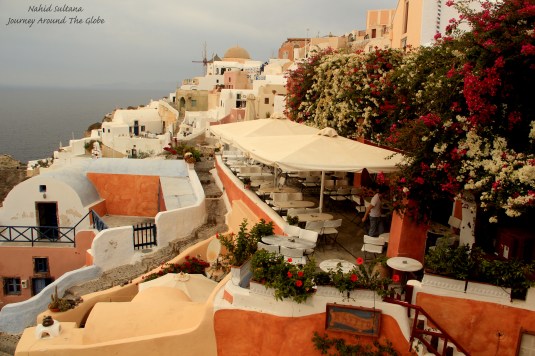
- Oia – the most beautiful village of Santorini
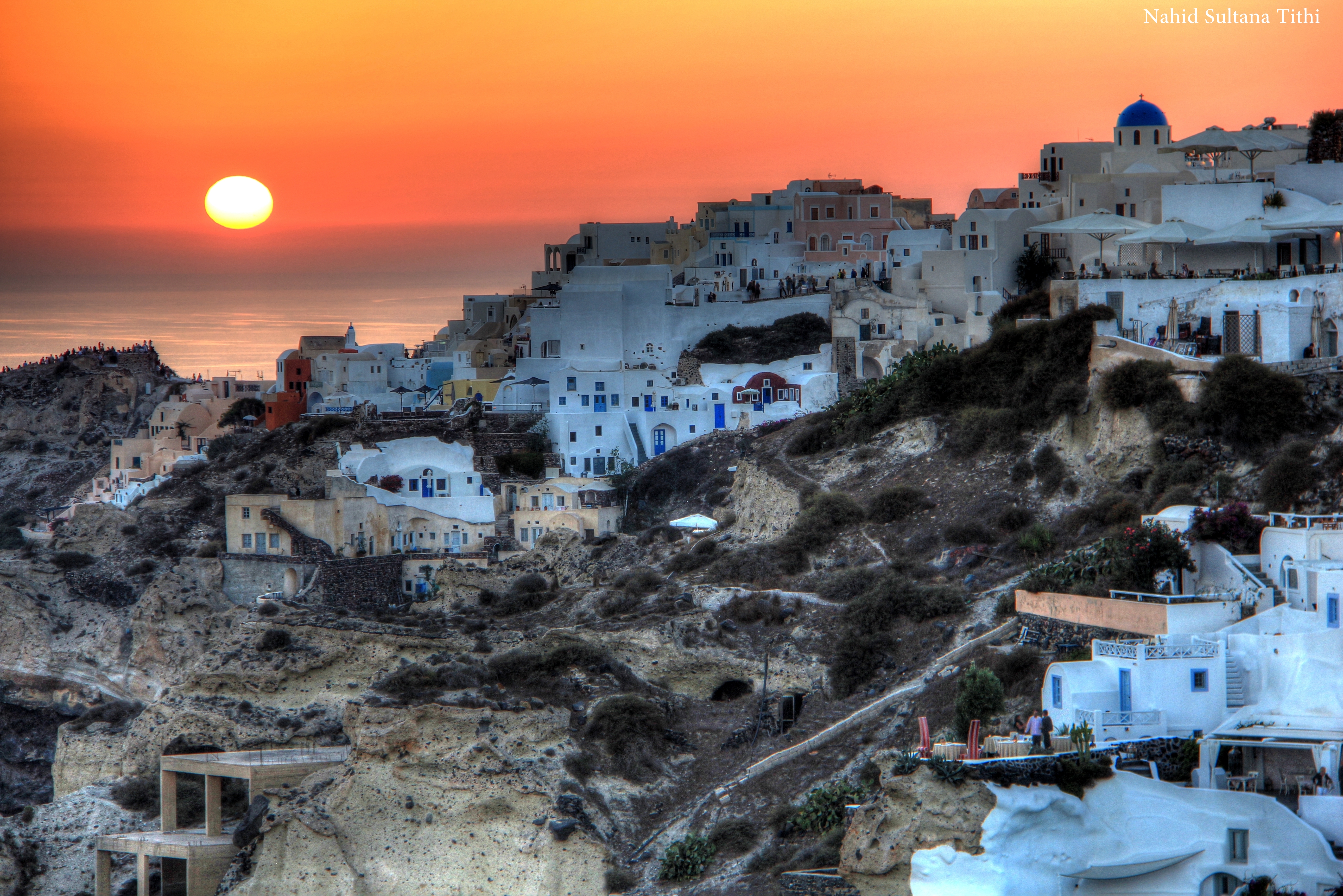
I didn’t go to Oia Castle which is an old Byzantine castle at one end of the village. The best and famous sunset is to be enjoyed from there and you can see every tourist walking that direction right before the sunset to reserve the best spot in the ruins of this castle. During summer/peak season it’s better to be there at least one hour before the sunset so that you don’t have strangers’ heads blocking your view and your viewfinder. I stood at the beginning of pedestrian zone near the church (and right opposite of my hotel) and it was awesome watching the fiery sun slowly hiding under the water.
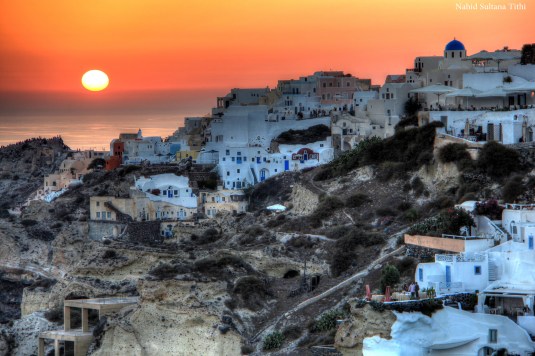
- Sunset Oia – a HDR version
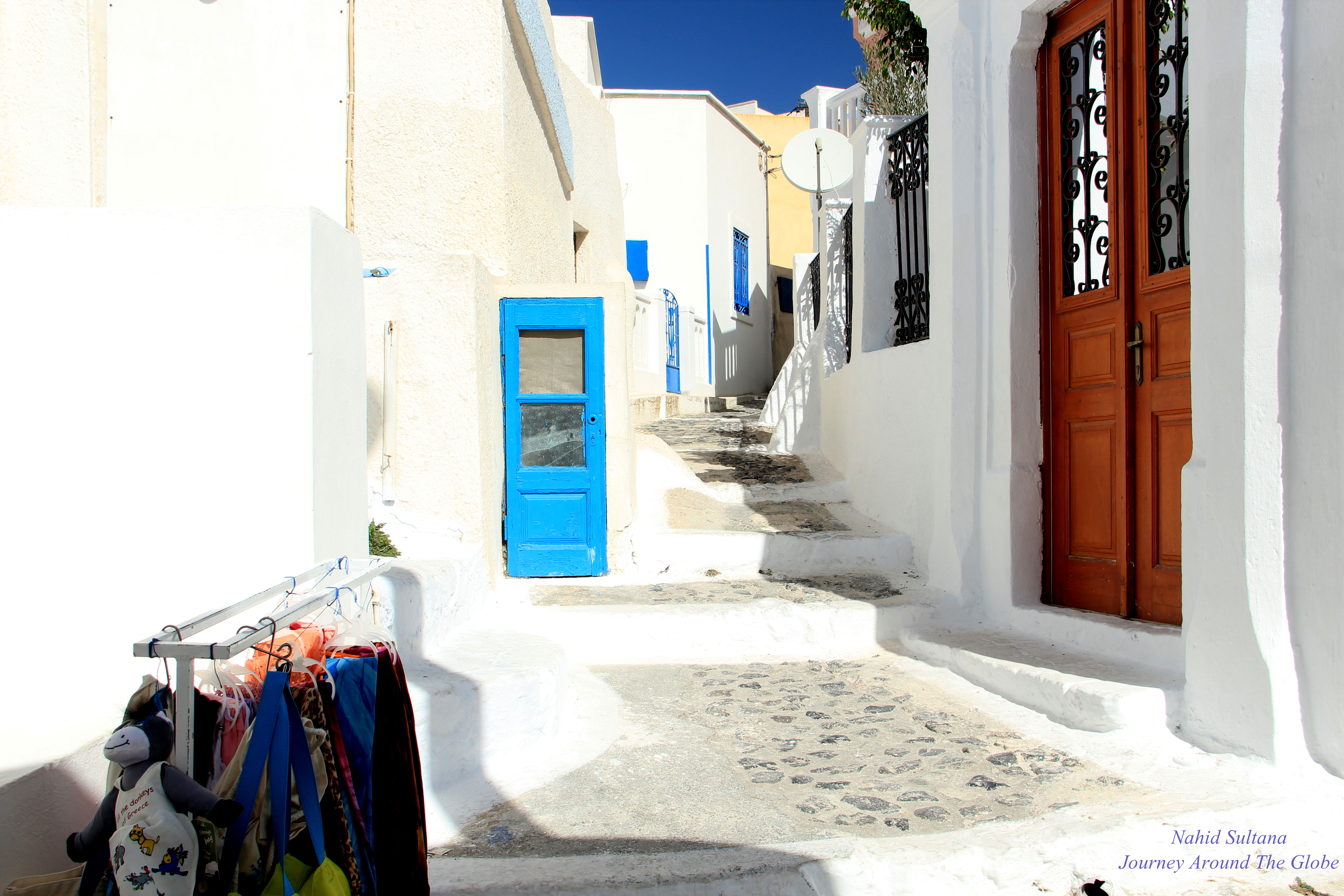
5) PYRGOS: Located on a hill, Pyrgos is the highest point on the island. This is one of the oldest villages here and once was the capital. Cycladic houses, prominent Byzantine churches (all were closed), and homes with blue doors and cute porches made my journey here really unforgettable.
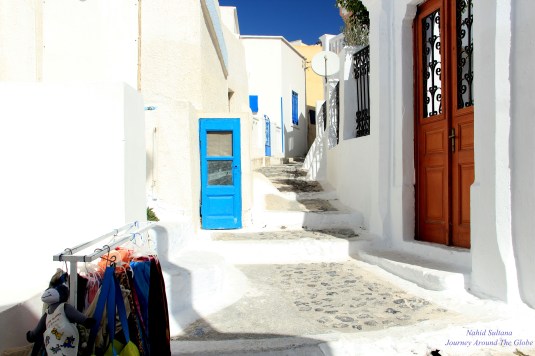
- Walking thru the white-washed walls of Pyrgos
I directly went towards the castle after getting off the bus. I hiked quite a bit here, climbed many stairs, and passed many small windy alleys to get to the castle (just follow the hand-written signs on floors and on walls). But once you are up on the castle, you’ll have an outstanding panoramic view of the whole island, mountains, and the deep blue water. The castle in itself has nothing really to offer other than its old bones and skeletons. Also there is no entrance fee or any information board for tourists.
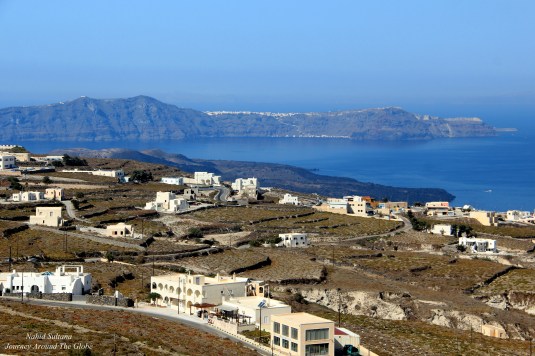
- Stunning view of caldera and Aegean from Pyrgos Castle
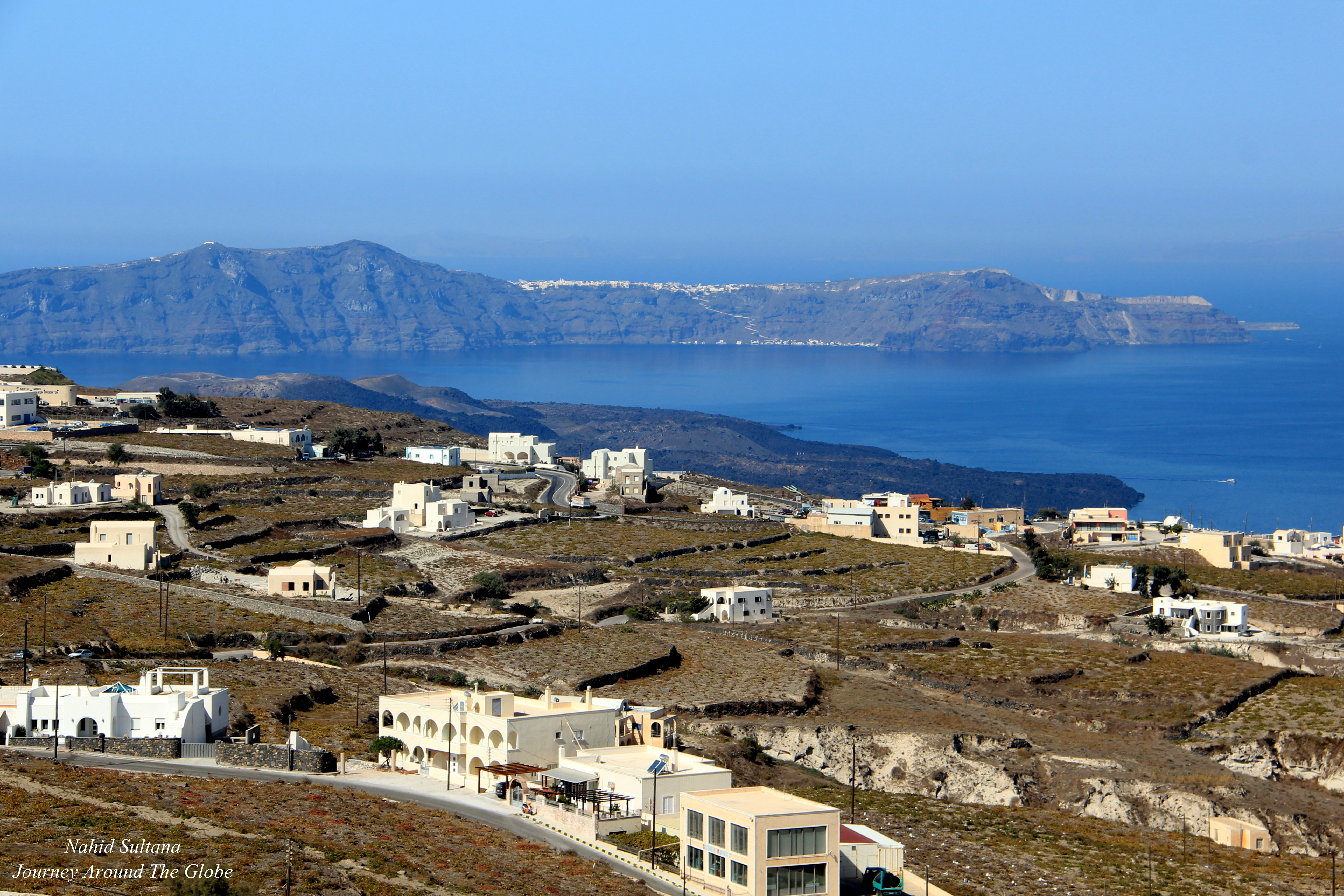
It took me about 15 minutes to come to Pyrgos from Fira by bus. Pyrgos is relatively bigger than Megalochori and I spent about hour and half here.
6) FIRESTEFANI: Firestefani is another cliff-perched village where you can get the best panoramic view of the volcano. It’s smaller than Oia or Fira but definitely has the same view and charm. Many luxurious hotels and resorts are on the cliffs of Firestefani. Apart from those, the village maintained its traditional looks where you can see dominating blue and white colors everywhere and few Cyclades churches.
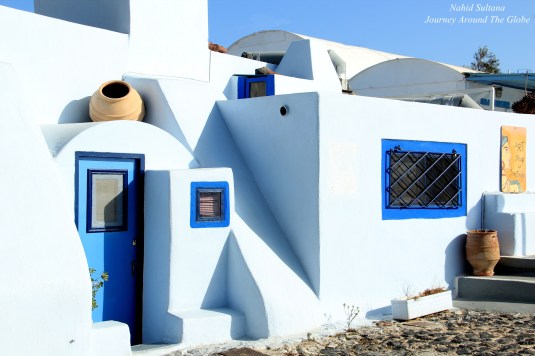
- Beautiful village of Firestefani
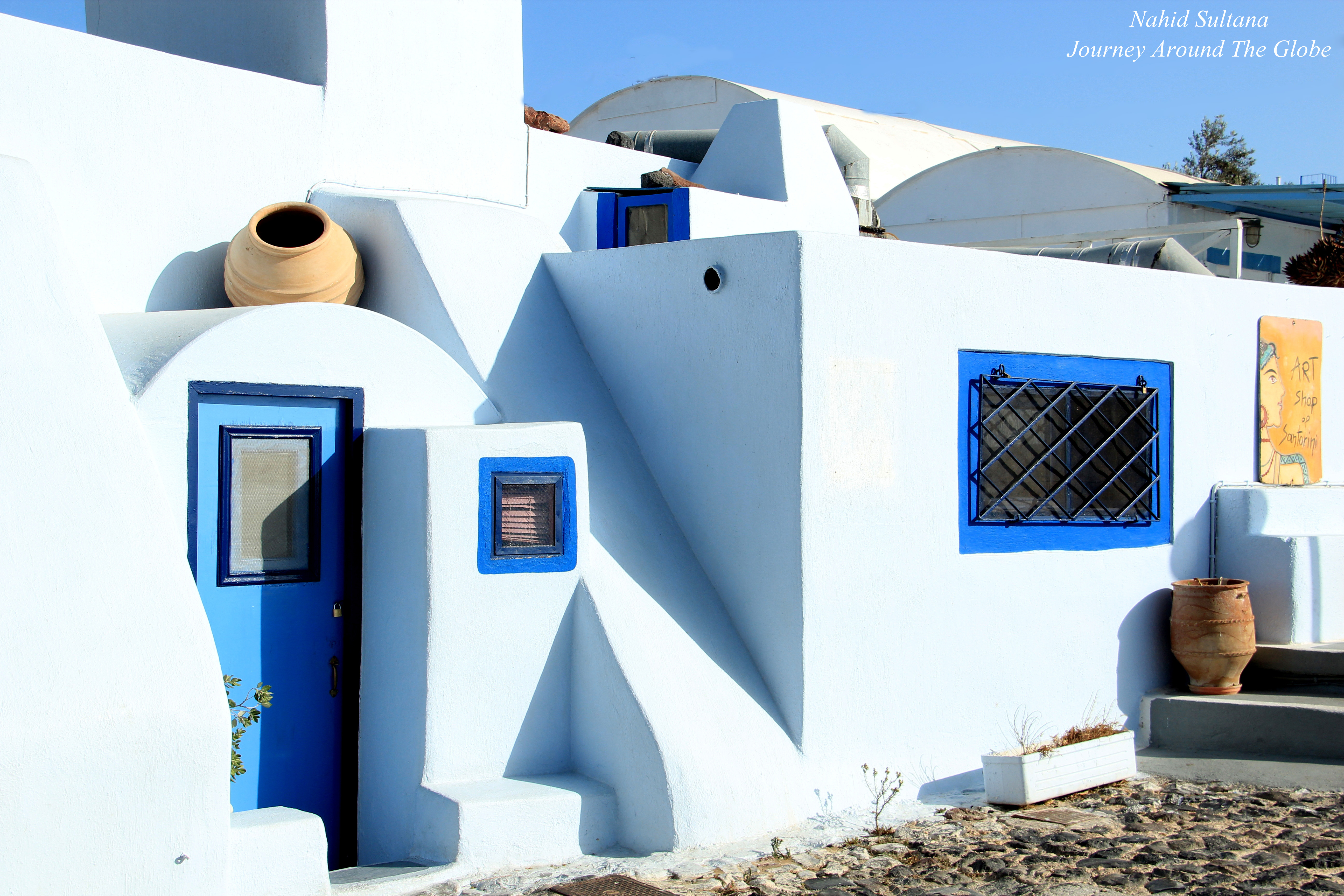
I didn’t go down the stairs here, just spent about an hour walking parallel to the Aegean. Then last few minutes I was just sitting on a bench on the cliff enjoying that great moment right before the sun set down, but didn’t really see the sunset. This was another place from where I wanted to experience a sunset but didn’t. You can avoid the sunset crowd of Oia and come to Firestefani for a serene atmosphere when the sun vanishes in the horizon.
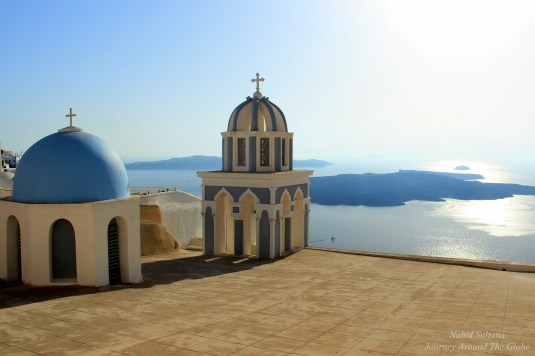
- Looking at Aegean from Firestefani, Santorini
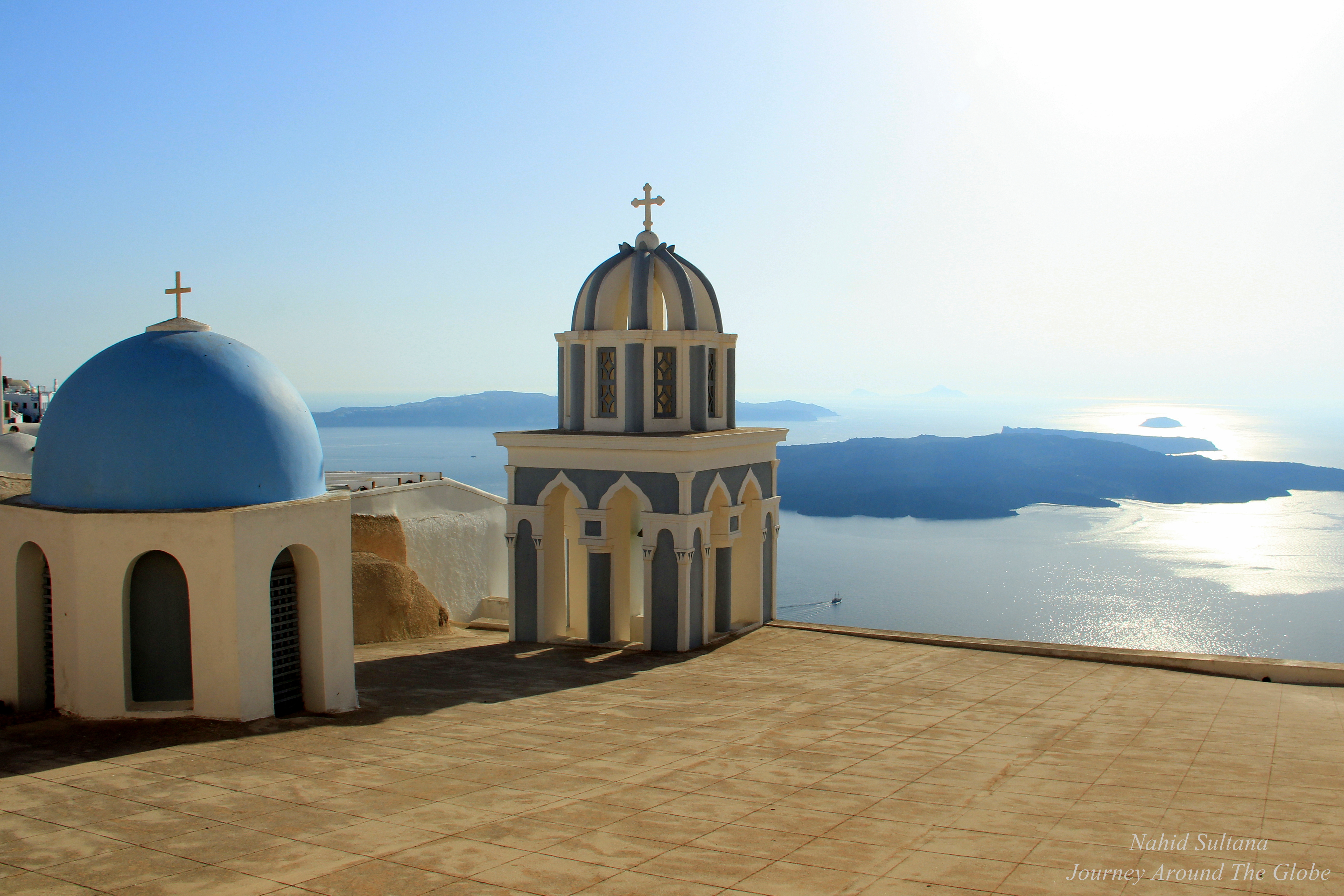
7) IMEROVIGLI: Not too far from Firestefani, Imerovigli is another smaller resort village hanging from the cliff. It’s a short bus ride from either Fira or Oia and offers rewarding views of the caldera and volcanos.
I reached here late afternoon and loved its calm and peaceful life. I went down few steps on the cliff and decided to come back to a café for some ice-cream. As usual, view was marvelous. My original plan was to stay here until sunset but I really couldn’t find a nice spot to sit down or even just stand (like Firestefani had). So after spending about an hour here, I took the next bus to Oia and enjoyed the most famous Santorini sunset from Oia cliffs.
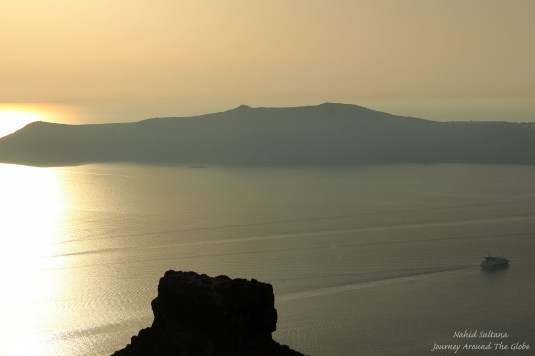
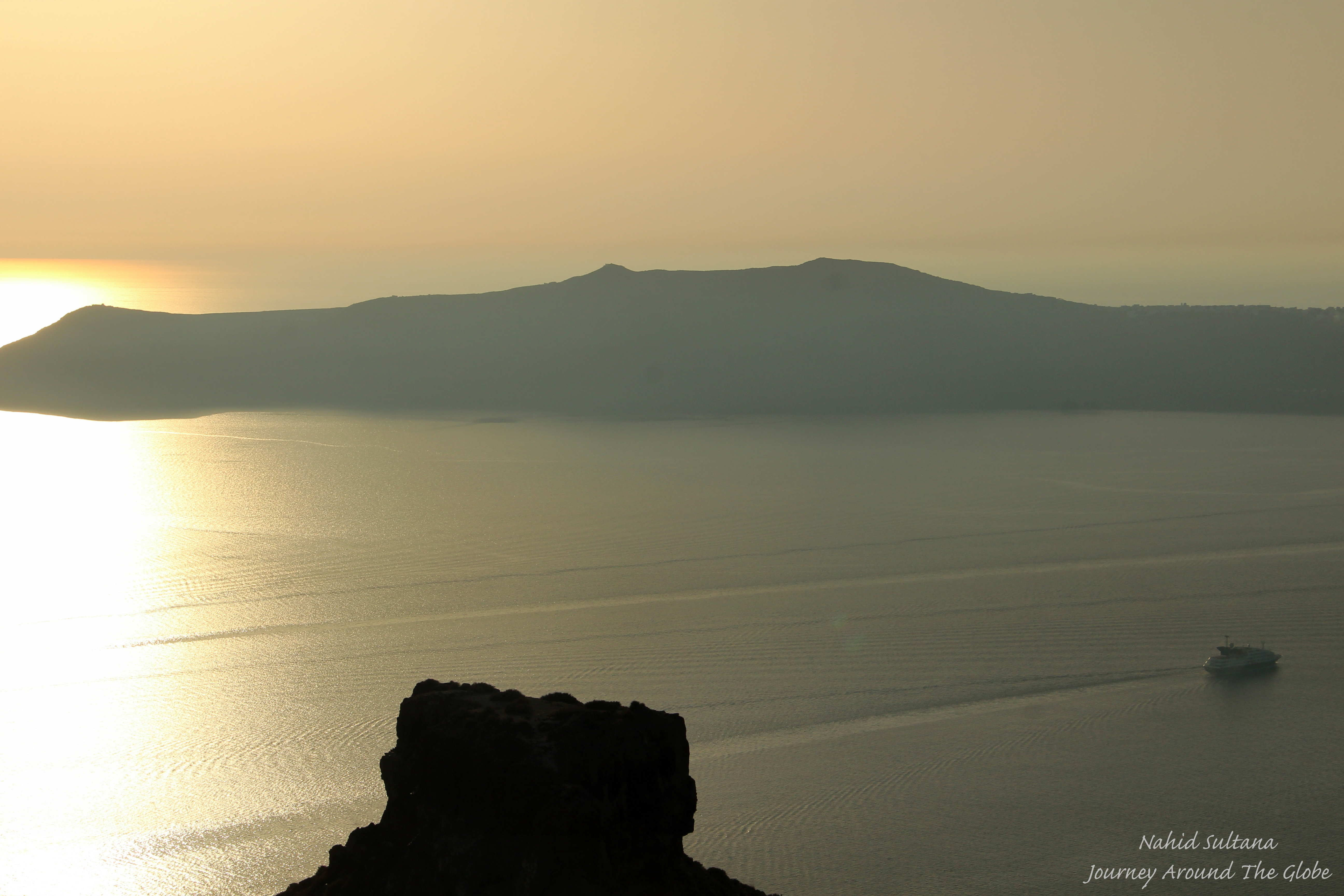
- Looking at Island of Nea Kamini from Imerovigli
8) AMMOUDI BAY: My original plan was to go down to Ammoudi Bay in early morning to see fisherman getting ready to start their days and go out to the sea. But of course I couldn’t do it and went there a bit later around 9:30am on the day I took boat trip to see other islands.
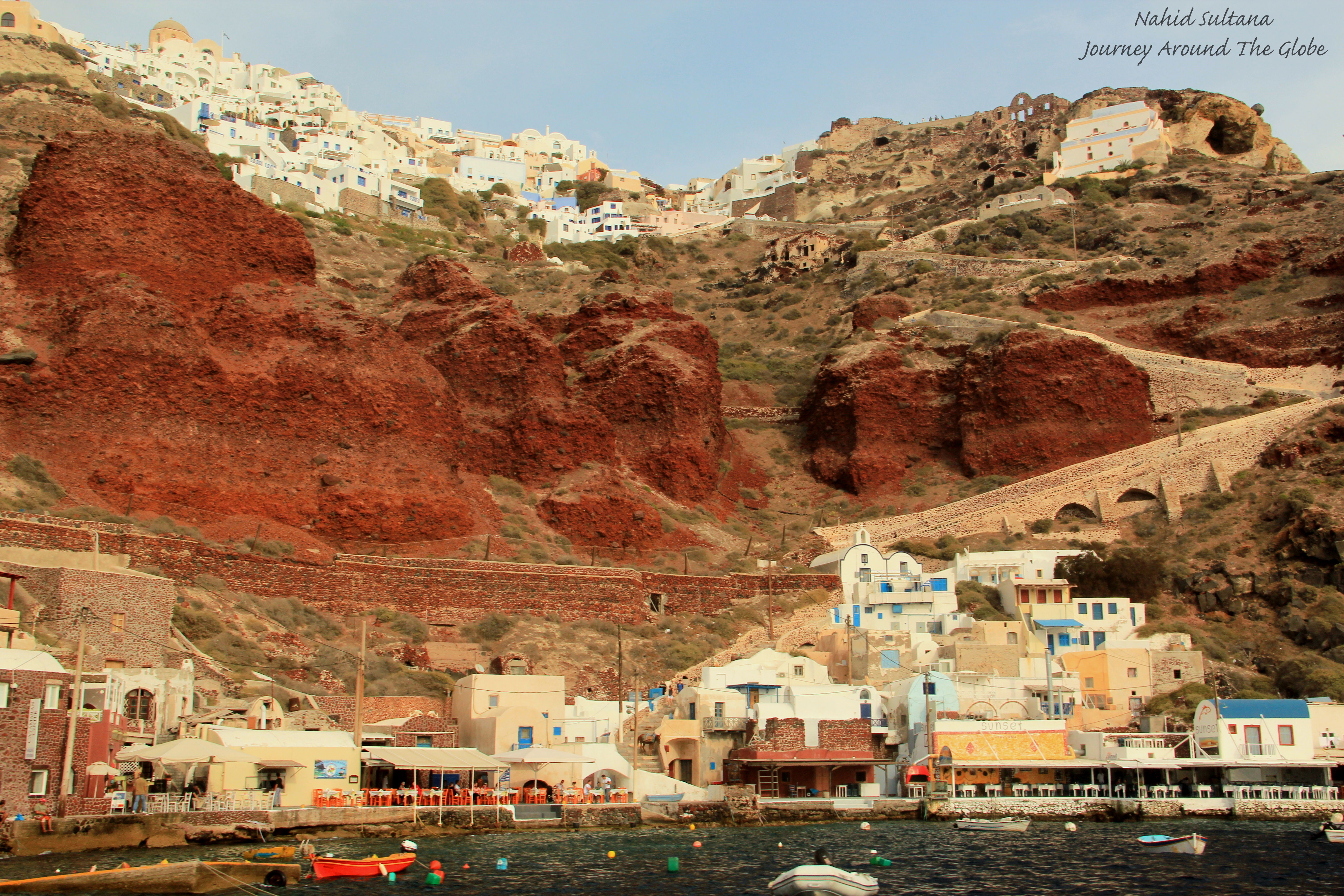
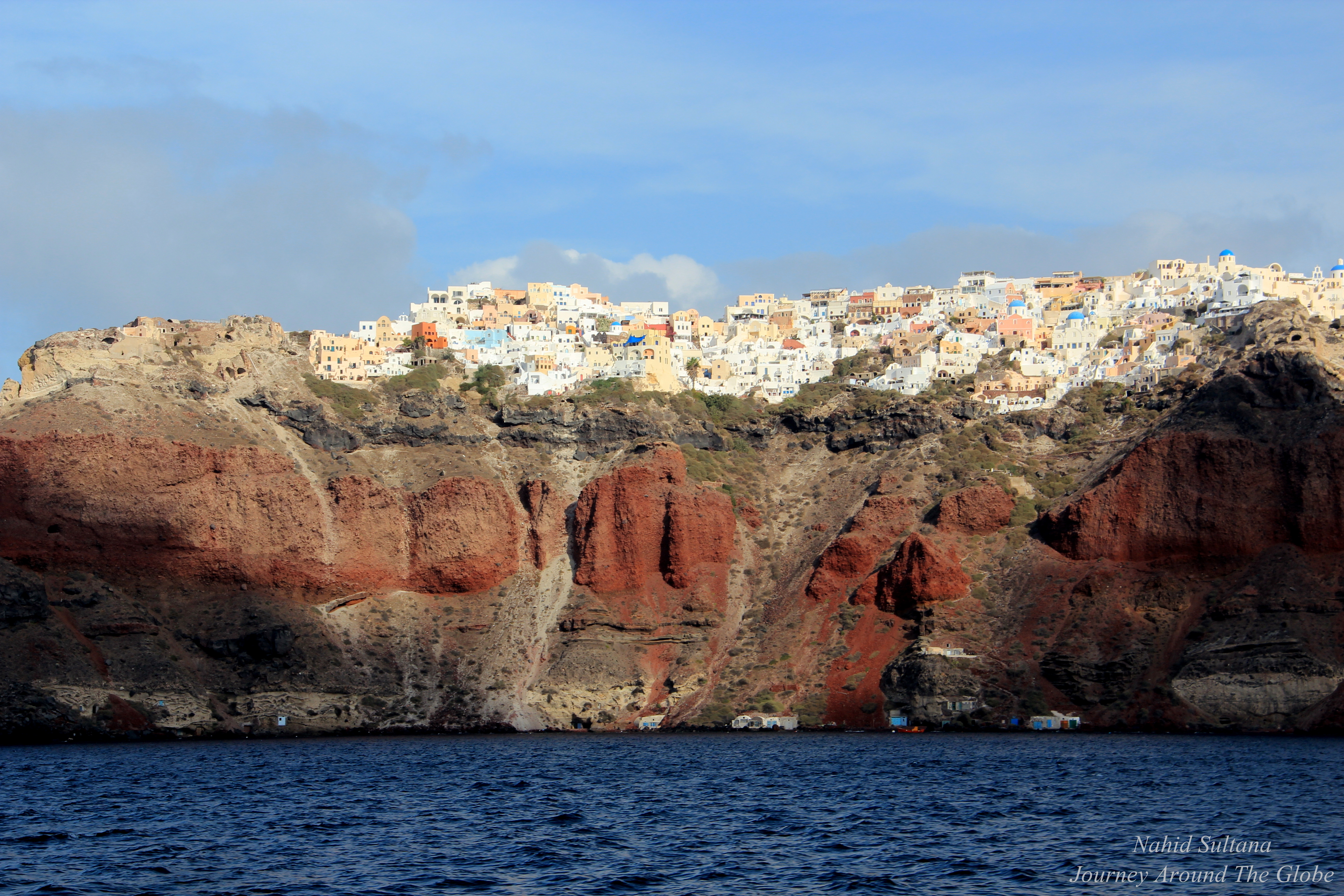
Ammoudi Bay is a petit fishing village at the foothill of Oia where you can find some best fish taverns near the bay. It doesn’t have a beach but has a nice swimming area for public. It’s a small but a must visit place in Santorini to get a different feeling of this island. Look up the red cliffs of Ammoudi Bay and you can see the whole village of Oia in one glimpse. If you are taking a boat trip, don’t forget to look back at Ammoudi Bay and Oia…it’s a fabulous view and shouldn’t be missed. The pebble beach here is nice for swimming and sun-bathing.
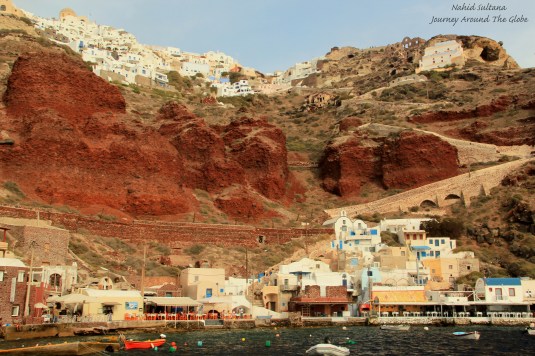
- Ammoudi Bay at the foothill of Oia in Santorini, Greece
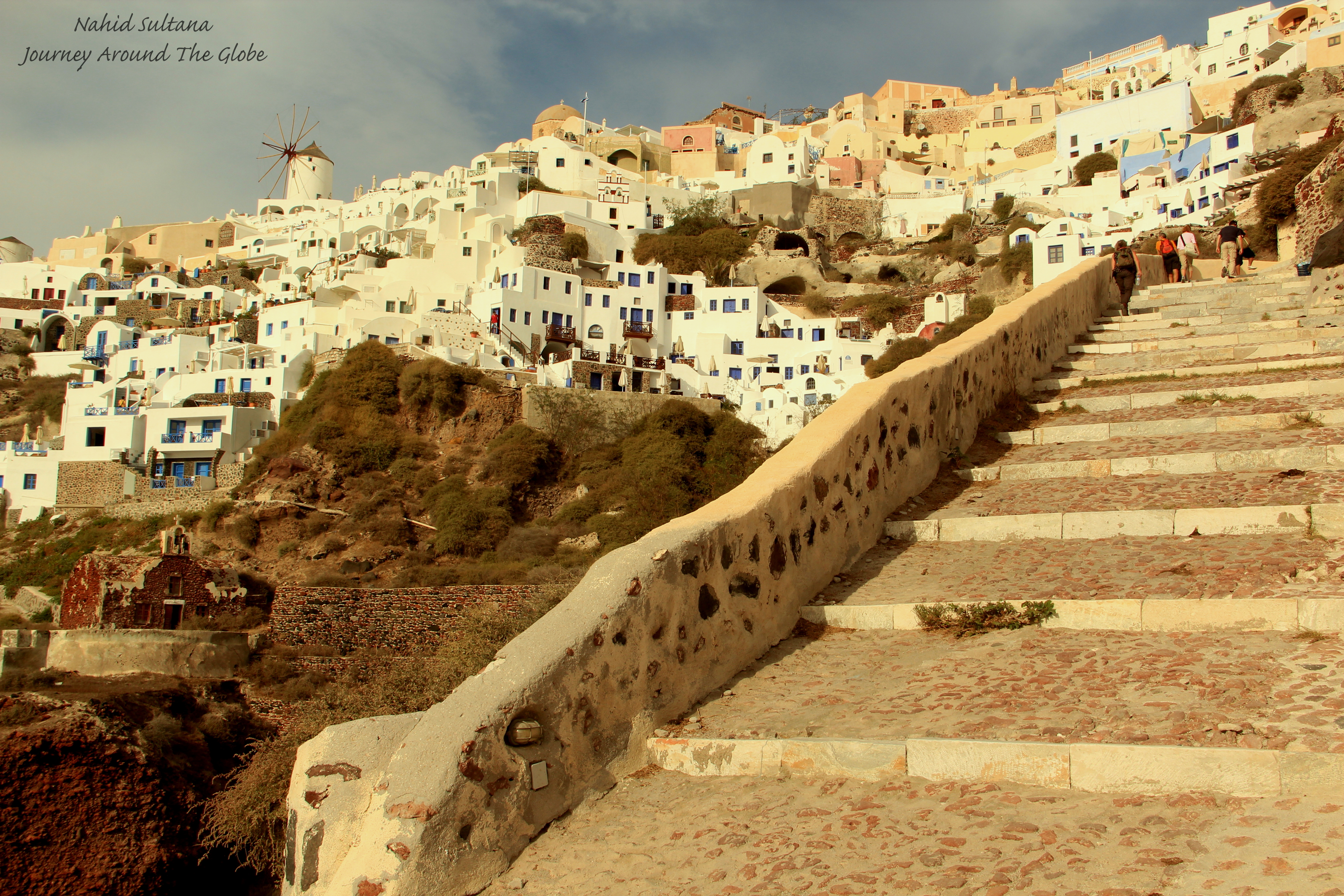
There are 3 ways to go down to Ammoudi Bay. The easiest way is to take taxi from Oia which costs about 10 euros. Second option is to take some 250 steps which starts at one end of the pedestrian zone of Oia and ends at the foothill of the cliff close to the bay. The final and adventurous option would be taking a donkey ride either way only for 5 euros per adult. Be careful when walking down the steps to go to the bay, there are lots of donkey poops all around the stairs. It can get even worse and slippery if it rains. Make sure to have good shoes if you are planning to climb the stairs.
I actually climbed 250 steps from Ammoudi Bay up to Oia center. It can be hard but this is the best way to enjoy the view all around and take some great shots. To be honest, I had to stop and catch breathes every few minutes.
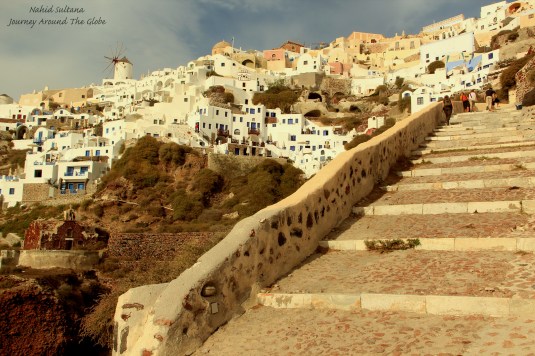
- Climbing some 250 steps from Ammoudi Bay to Oia
9) BOAT EXCURSION to NEA KAMENI, PALIA KAMENI, and THIRASSIA: A shuttle bus picked all the passengers for this boat excursion from our individual hotels and took us to Ammoudi Bay around 9:30 am where we started our tour from. From here we went to Fira, picked up more people, and headed towards our first stop Nea Kameni.
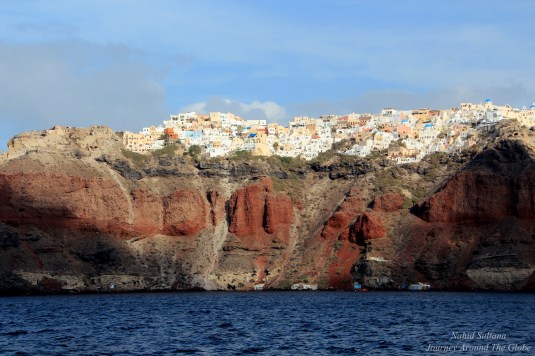
- From our boat, leaving Oia behind
This boat trip is a must-see when in Santorini, you get to walk on lava rocks and experience an active volcano land from up close. The tantalizing dark islands in the middle of caldera are Palea Kameni (Old Burnt Island) and Nea Kameni (New Brunt Island). Both are major scientific interests and protected national monuments of Greece. The sites offer an exceptional natural beauty in and all around the island. Its oldest rock formations date back 430 years and its most recent a mere 50 years. The islet was born and gradually formed through volcanic eruptions spanning since 1575, in six different volcanic events. Sluggish magma at regular intervals added layer upon layer to form Nea and Palia Kameni. Both islands are the youngest landforms in the eastern Mediterranean. Authorities do keep their eyes open for seismic activity and other matters in these areas where they can predict in a period of a few months to a year prior to the eruption. While no one actually lives in Nea Kameni, Palia Kameni has only 1 residence, and Thirassia has about 200 inhabitants.
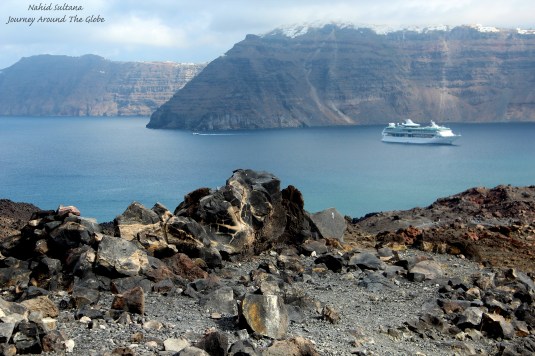
- Volcanic rocks of Nea Kamini and … of course the gorgeous view from here
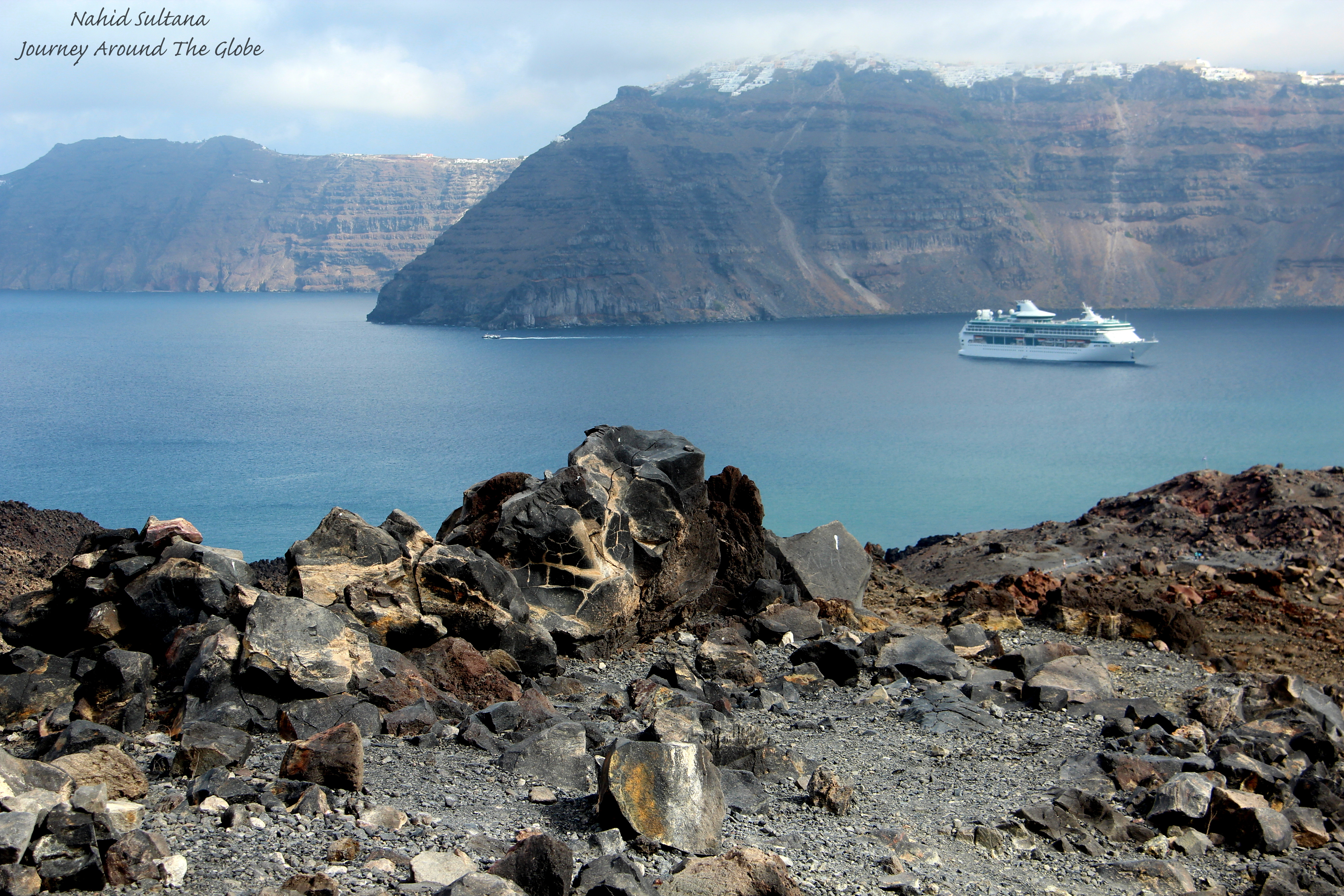
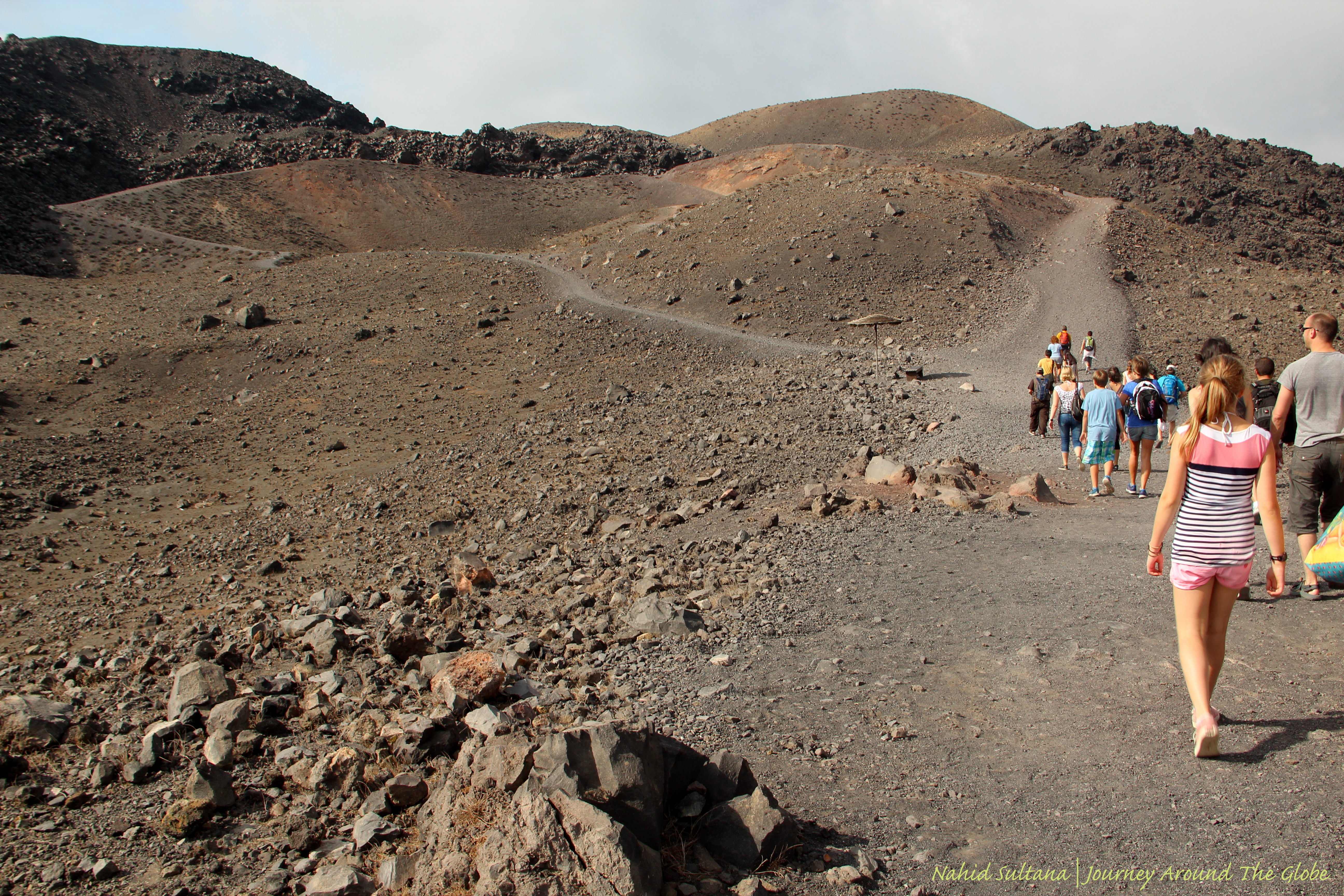
After the last eruption of Nea Kameni in 1950, the Santorini volcano remains dormant till today. We hiked about 1.5 km one way (total little more than 3km) to get all the way up to go near the big craters where you can still see hot fumes at some points and smell sulfuric gas with it. While hiking on this rugged with various colored rock terrain, look around and you will see Fira on the roof of caldera in distance. It can get a little windy at the top but the view from there worth the long hike and heavy sweat. There is a 2 euros fee to enter the preserved landscape.
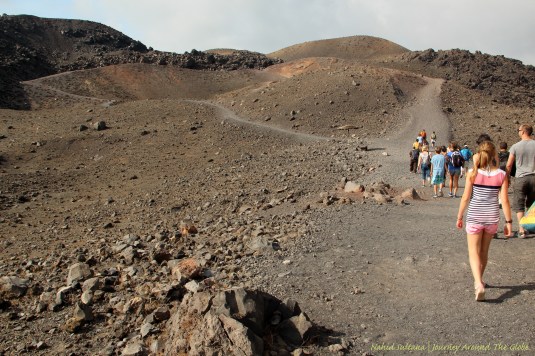
- Hiking on active volcanic island, Nea Kamini…beautifully barren and rugged landscape
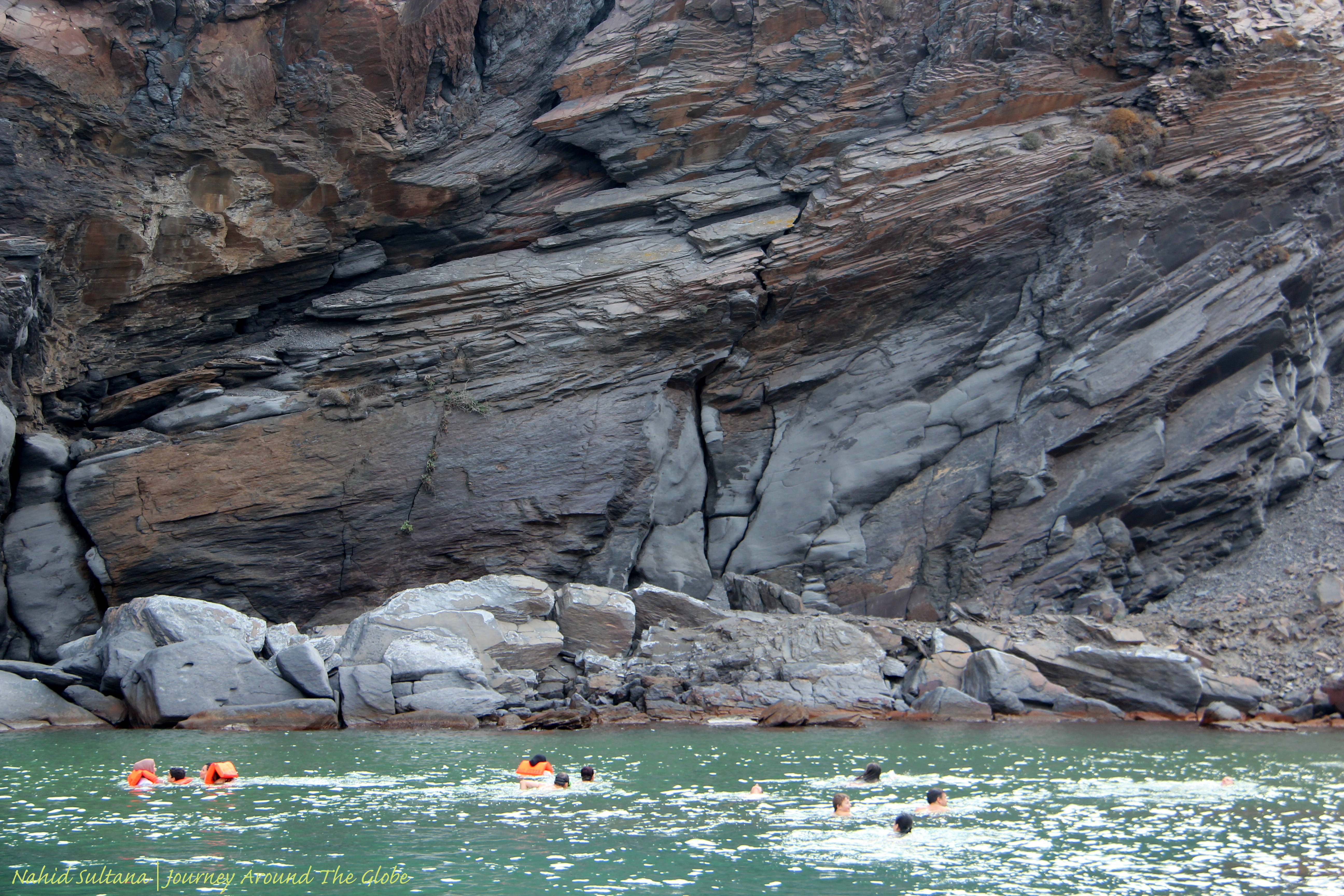
Next we headed towards the hot springs of Palia Kameni. This is smaller than Nea Kameni and looked much greener. First eruption on Palia Kameni was in 197 B.C and the last one was in 725 A.D. but right now this is an inactive volcanic island. The boats really don’t dock here, it stood in the water close to land while people just dived in the sea, swam for half an hour in the hot springs underneath the sea, and got back on the vessel. We spent about half an hour here. Remember that the sulfur rich water here may not be suitable for many people. If you are like me, who doesn’t know how to swim L, enjoy the massive rock walls of the island, greenish water, and Church of St. Nicolas on the edge of water.
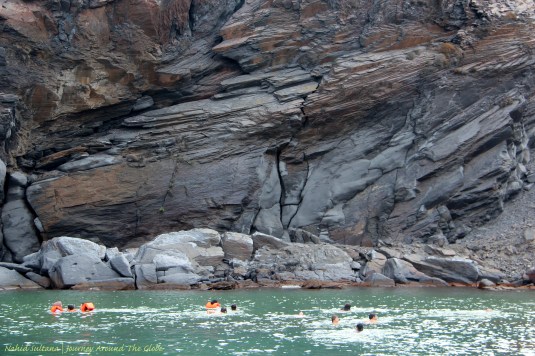
- People swimming in the hot springs of Palea Kamini in Santorini
Thirassia was our last stop on the boat tour before heading back to Oia. This is a small island and a nice place to spend couple hours. There are few ferries that come here from other islands if you don’t want to take any guided tour. We had about 2 hours to spend here out of which I spent an hour enjoying my lunch and the view. Rest of the time I just walked by the water taking photos and enjoying every corner of it. But I didn’t go to the main village up on the cliff.
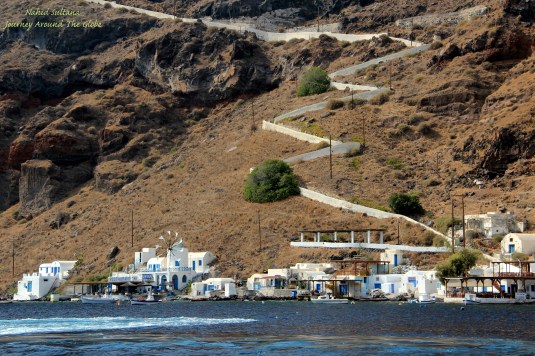
- Harbor of Thirassia, you can see the white stairs going up the cliff
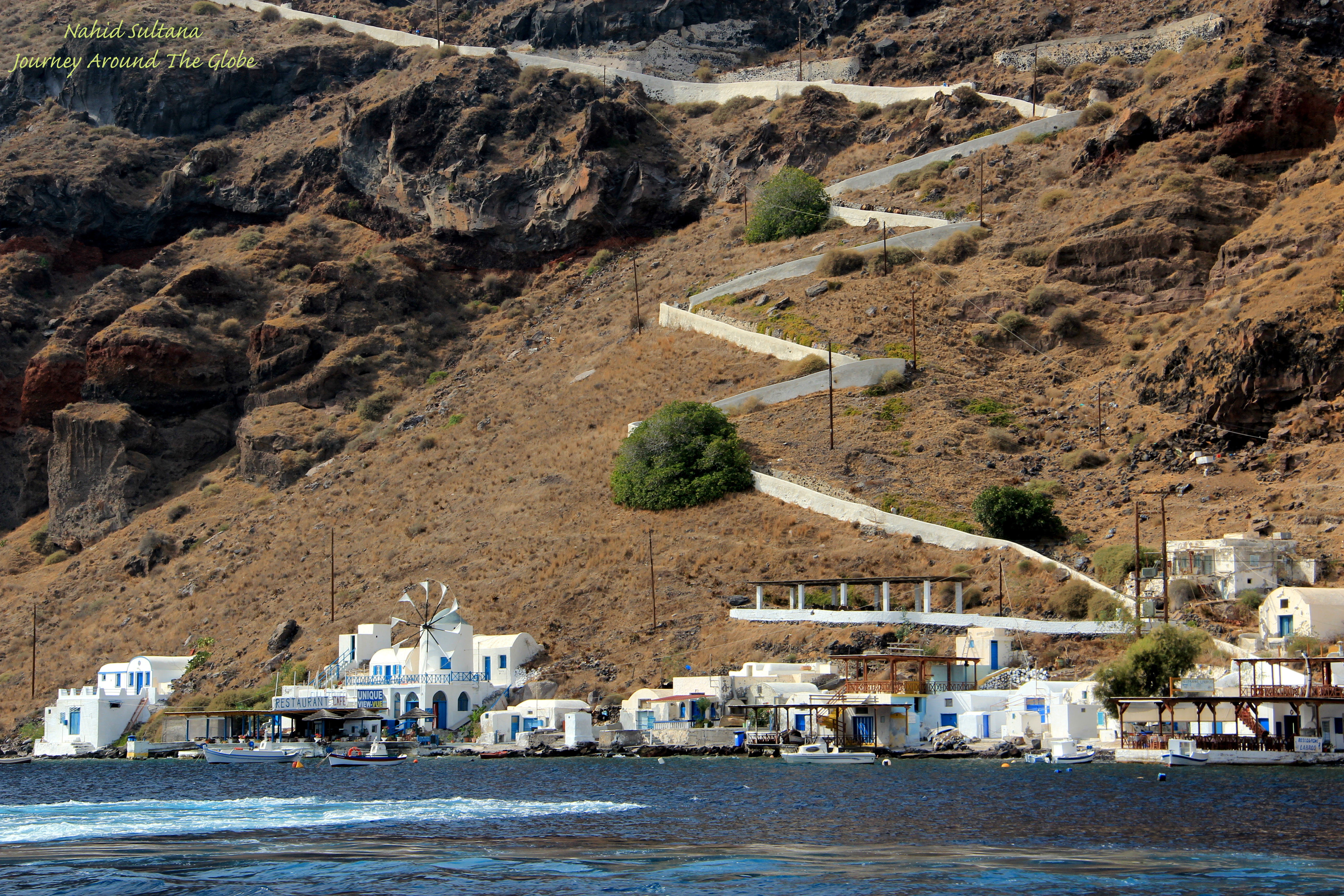
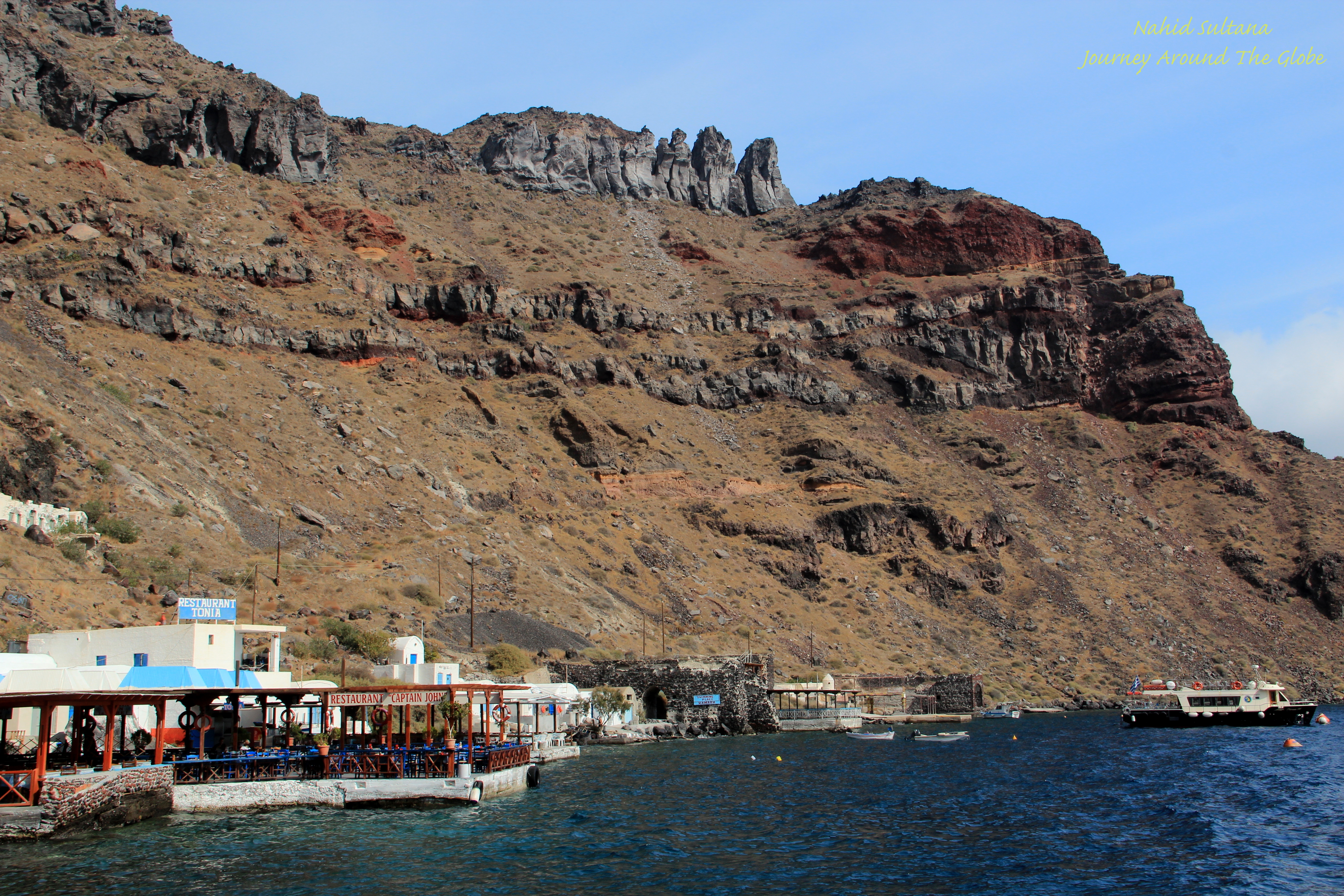
There are couple villages on the cliff top which can be reached by climbing 270 steps or taking a donkey ride for 5 euros. Those villages are supposed to be some typical Grecian villages that kept its old look and feel. The port of Thirassia is a great choice for walking, swimming, and eating. There are plenty restaurant here as well. Our guide recommended Captain John, but many of us on the group had lunch in the restaurant right beside it thinking it was Captain John, but good food either way. Enjoy the cliffs, view, and sound of the sea while here.
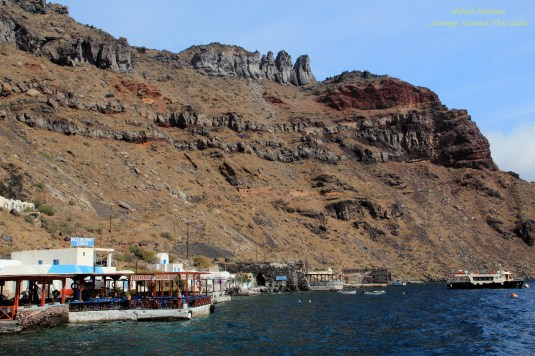
- Island of Thirassia in Santorini, Greece
Overall, Santorini was a great experience for me. I do get excited when going to a new place where I can learn some history (not only by visiting churches and castles), enjoy natural beauty, do nice shopping, taste local cuisines, and where I don’t have to walk with a map or with an itinerary. Santorini was that perfect place for me that fully satisfied all my wishes. Love you Santorini, hope we see each other again.
Related articles
- Watching the Sunset in Oia, Santorini (kulturekitten.wordpress.com)
- Im in Santorini, now what should I do? (lukehymann.wordpress.com)
- Travel theme: Brown (journeyaroundtheglobe.com)
- Chasing Santorini Sunsets (globetrotcat.wordpress.com)
- Day 27 – Santorini (joeredoctober.wordpress.com)
Share this:

Travel theme: Brown
Just came back from Santorini, Greece yesterday. Enjoy this “Brown” photo that I took while hiking 1.5km on volcanic rock of Nea Kameni Island. This was about a 15-20 minutes boat ride on Aegean Sea from Fira, Santorini which is an active volcanic island. This is was by far one of the best trips of my life (if not the best) so far. The post on Santorini coming up shortly…
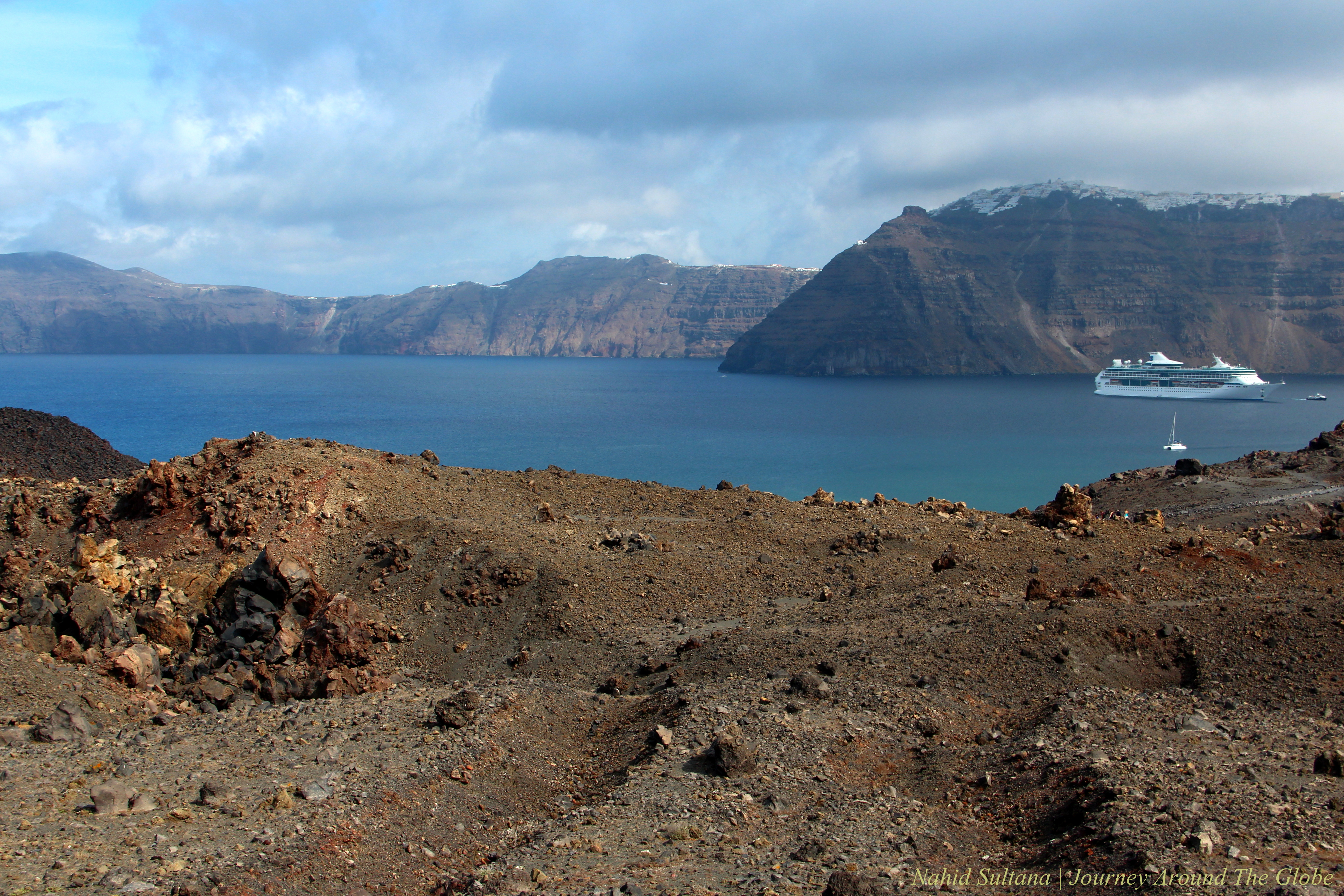
Thanks to http://wheresmybackpack.com/2013/10/18/travel-theme-brown/ for this wonderful theme…missing that brown island and its roughness.
Related articles
- The Prettiest Volcano (globetrotcat.wordpress.com)
- Santorini, Greece (pigeonposto.wordpress.com)
- Santorini – Beyond the Caldera (globetrotcat.wordpress.com)
- Five “5 Star” Santorini Hotels (thetravelerschant.wordpress.com)
- Chasing Santorini Sunsets (globetrotcat.wordpress.com)
Share this:

Business Excellence Award 2020 from AI Global Media for The Most Entertaining Personal Travel Blog – Pacific Northwest USA

Top Posts & Pages


Business Excellence Award 2020 for The Most Entertaining Personal Travel Blog – Pacific Northwest USA

 Globe Runner

