Journey Around The Globe
ready for the next destination
“Sound of Music” Tour in Salzburg, Austria
“SOUND of MUSIC” TOUR in SALZBURG, AUSTRIA: Salzburg become really famous with English-speaking people or at least those who are into English movies by the musical film “Sound of Music”. It was Julie Andrews’ one of the most famous works in her acting career. She played the role of “Maria”, a nun who was appointed to take care of seven children of an Austrian imperial navy captain. Based on a true story of a family with seven children and their father Captain Von Trapp, Christopher Plummer played the role of the captain. The setting of the story was from 1939 during the onset of WWII and the movie was shot in 1965.
I got acquitted with this film when I was very little and my mom used to sing “Do Re Mi Fa…” with much enthusiasm. She even tried to teach us that song (my mom was a professional radio singer and a music teacher) in her harmonium. I have some fond memories with this film and vividly remember my mom singing those melodious songs around the house and doing her chores.
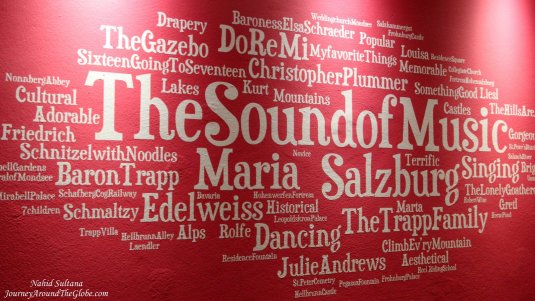
- One of the walls in our hotel, dedicated to the movie “Sound of Music”, in Salzburg, Austria
In our first trip to Salzburg in April of 2009, we spend all our time in the city looking around its old part and the fortress (Hohensalzburg Festung) on the hill. But this time (during Christmas break in December 2013) we decided to go on with this tour to get out of the city. Also because both of our daughters watched “Sound of Music” so many times that they memorized all the songs and most of the dialogues from it.
We booked the tour with “Panorama Tours”. They are the most popular here for this trip. You can book thru you hotel or reserve your seat online ahead of time, like us. They operate even on holidays like Christmas day! Bus leaves every day at 9:30am and 2pm and lasts for 4 hours. It is 40 euros per adult and 20 euros for children 4 – 12. We were picked up from our hotel around 9:15am and taken to their main office near Mirabell Palace. Bus was about half full because it was Christmas day. The guide was fantastic and so was the driver.
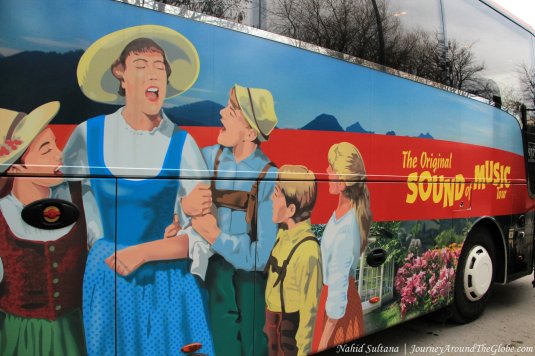
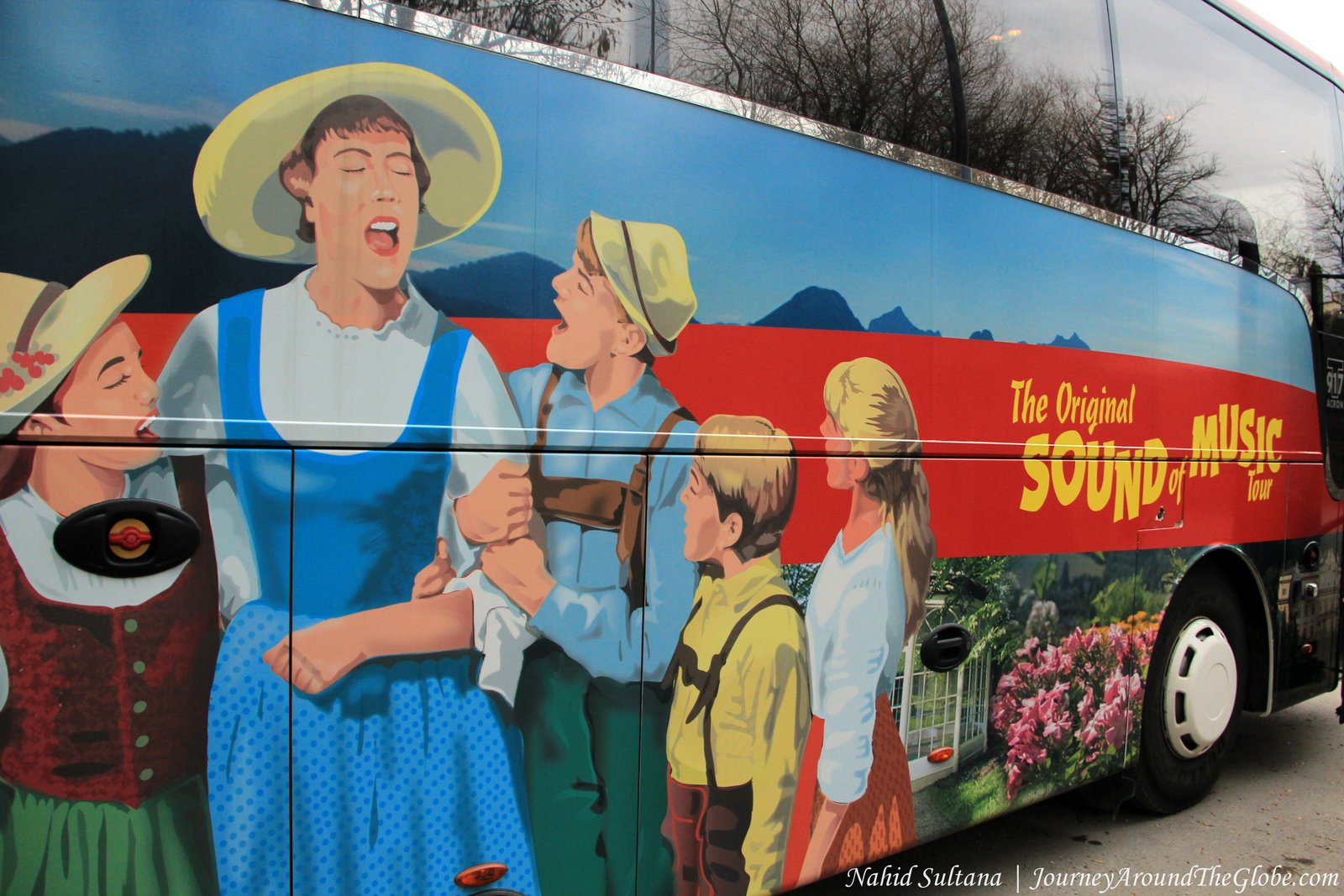
- Our “Sound of Music” bus in Salzburg, Austria
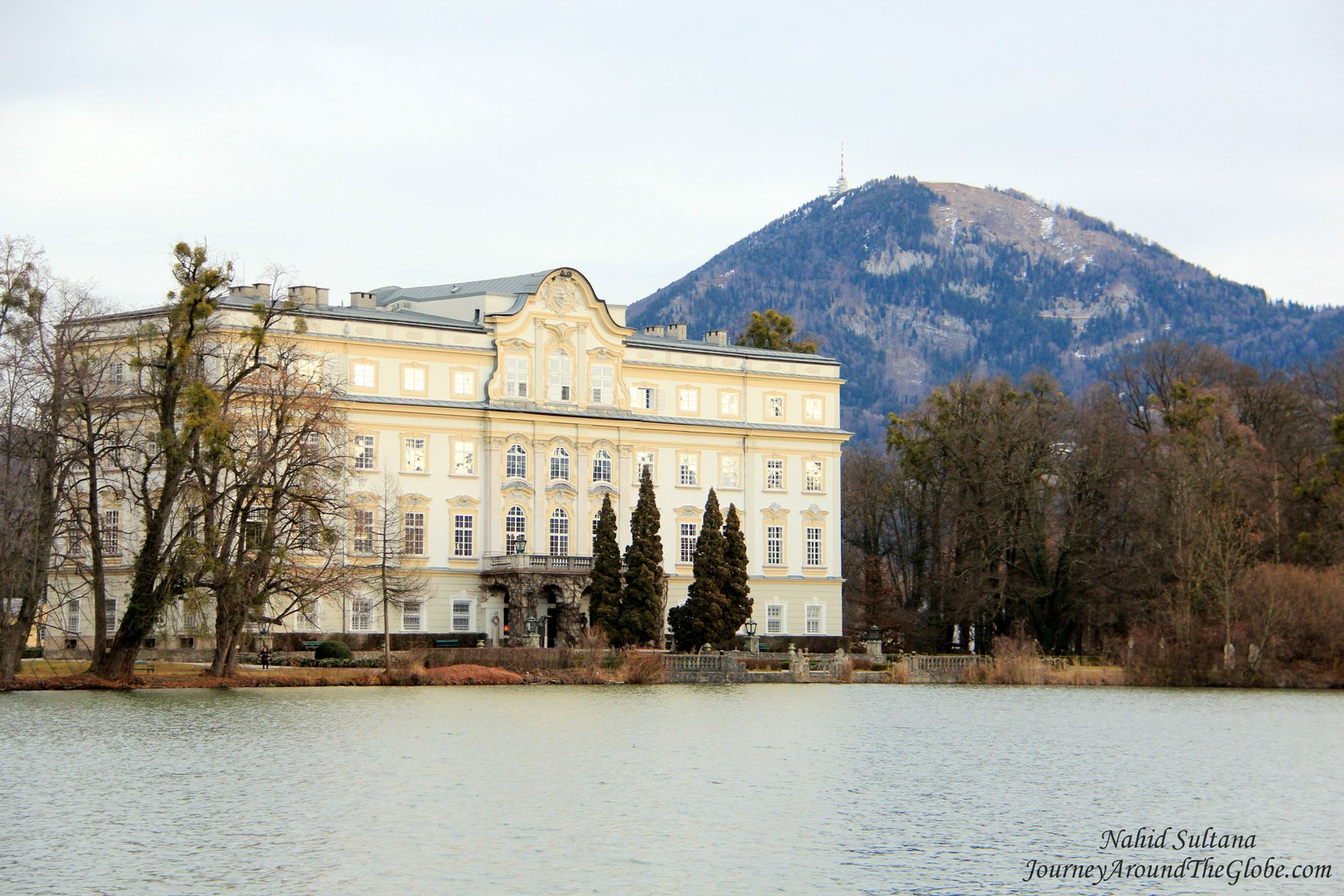
We were first taken to Leopoldskron Palace, just few kms away from Salzburg old town. This palace was used to only shot the “backyard” scenes of the movie. And the lake you see in the picture is where Maria (Julie Andrews) and the kids fell off the boat in one scene. It is a very scenic spot of Salzburg. We couldn’t go inside or even near the palace since it is not open to public, only saw it from the other side of the lake.
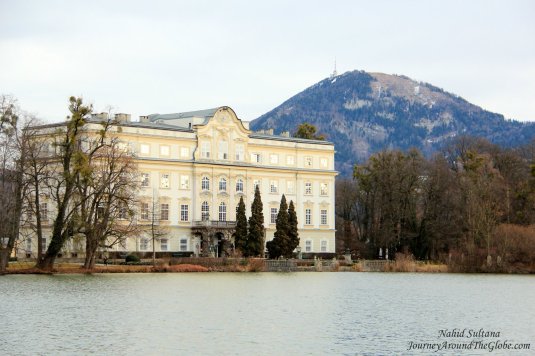
- Leopoldskron Palace was used to shoot all the “backyard” scenes of Julie Andrews’ “Sound of Music”
Next stop was Hellbrunn Palace garden. This is a bit away from the city. Before entering the palace there is an unpaved and tree-shaded road. This long path was used to shoot a small portion of “I have confidence” song when Maria left her abbey, got of the bus and went to captain’s house for the first time.
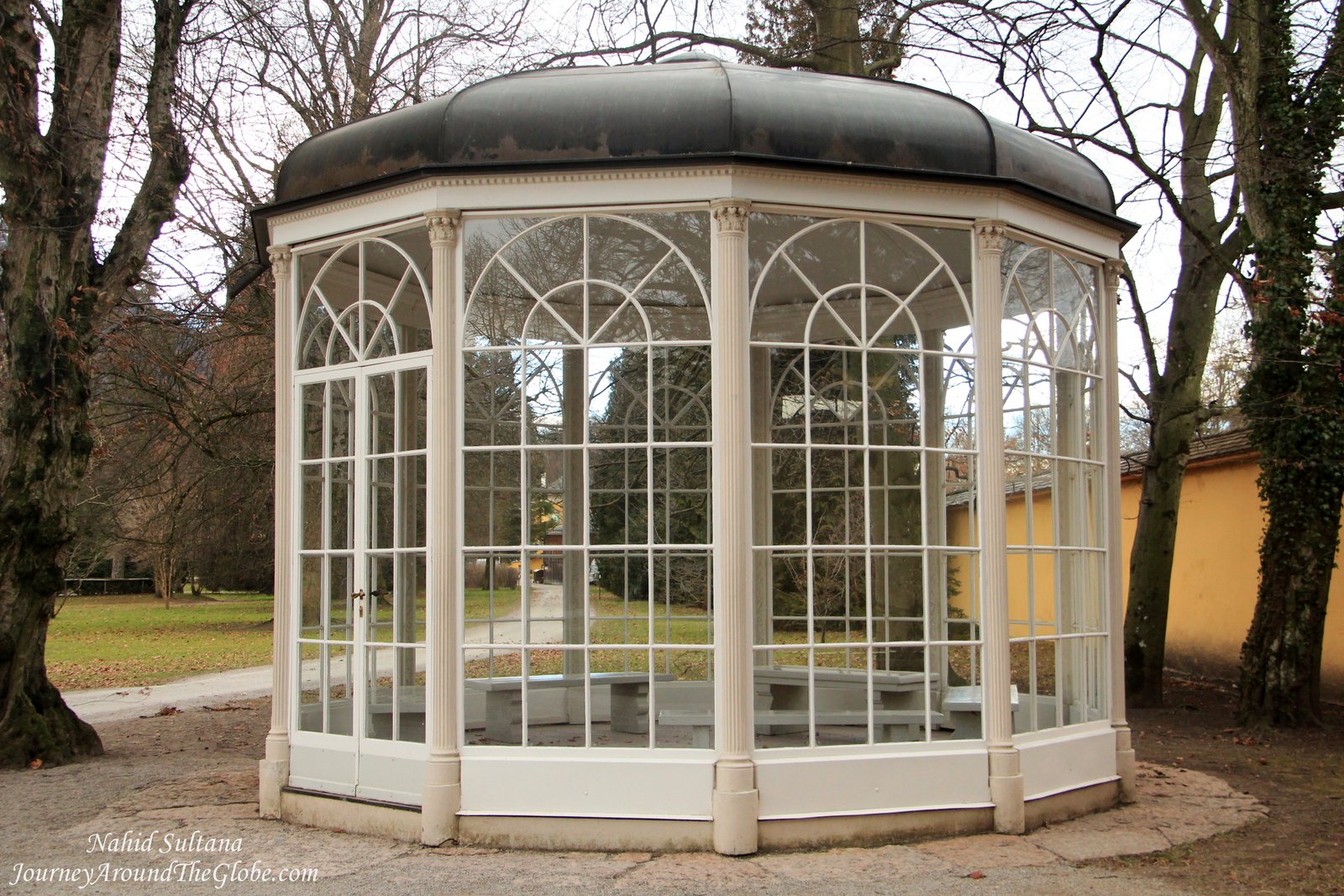
The purpose of coming to Hellbrunn Palace was to visit the famous gazebo of “Sound of Music”. It was shown in the songs “I am 16, going on 17” (with Lisle and Rolf) and “Something good” (with Christopher Plummer and Julie Andrews). The gazebo was originally located in Leopoldskron Palace garden during the movie but later it was moved here.
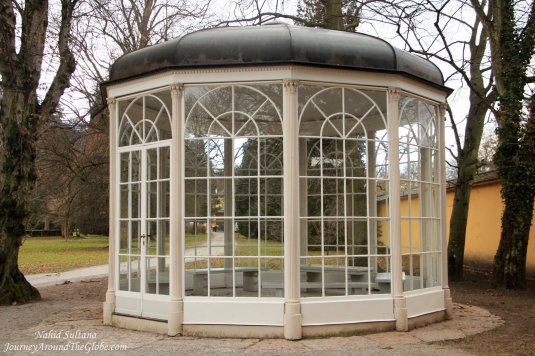
- The famous gazebo from the movie “Sound of Music” where the song “I am 16, going on 17” was shot, in Schloss Hellbrunn, Salzburg, Austria
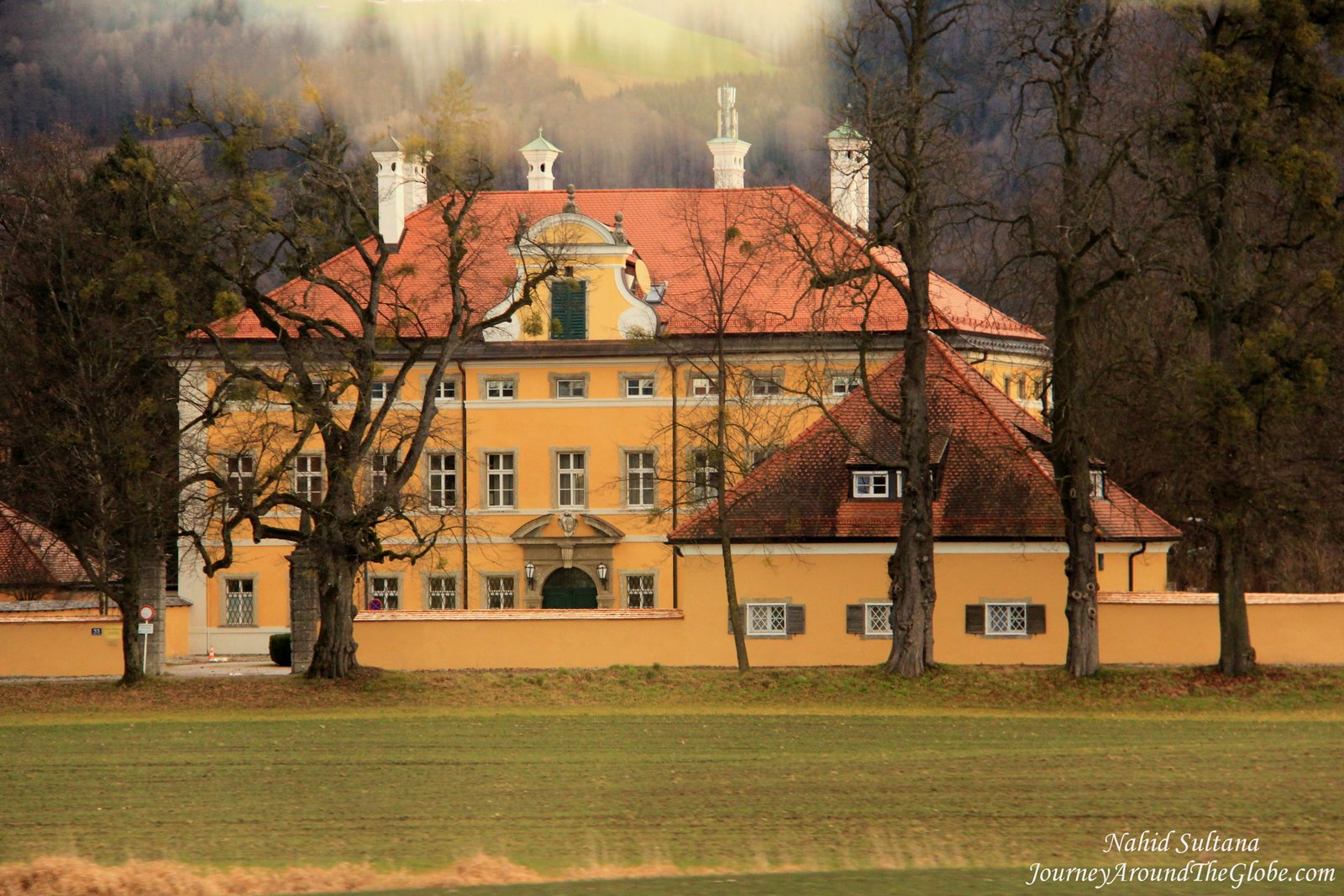
From Hellbrunn Palace, we drove by the mountains which you may have seen in the last scene of the movie when the family escape to Switzerland. Another spot we just drove by and didn’t make a stop was Frohnburg Palace. This yellow mansion was used only to show front façade of captain’s home. All the scenes inside the house were done in Hollywood.
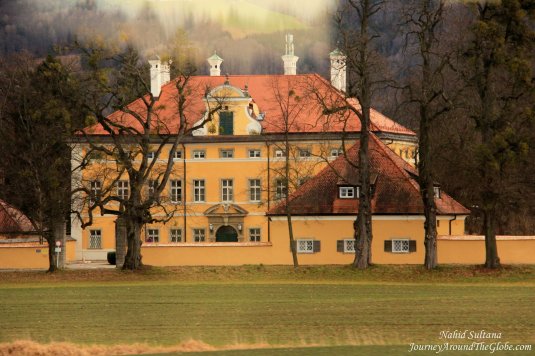
- Frohnburg Palace, they used only its front facade for captain’s home in “Sound of Music”
Third place we drove by without stopping was Nonnberg Abbey in Salzburg, within walking distance from Hohensalzburg Fortress. This abbey is from 740 A.D. and is still active. This is where the real Maria served as a nun. The movie also used the same spot to shoot Julie Andrews’ life as a nun. The abbey is not accessible to public.
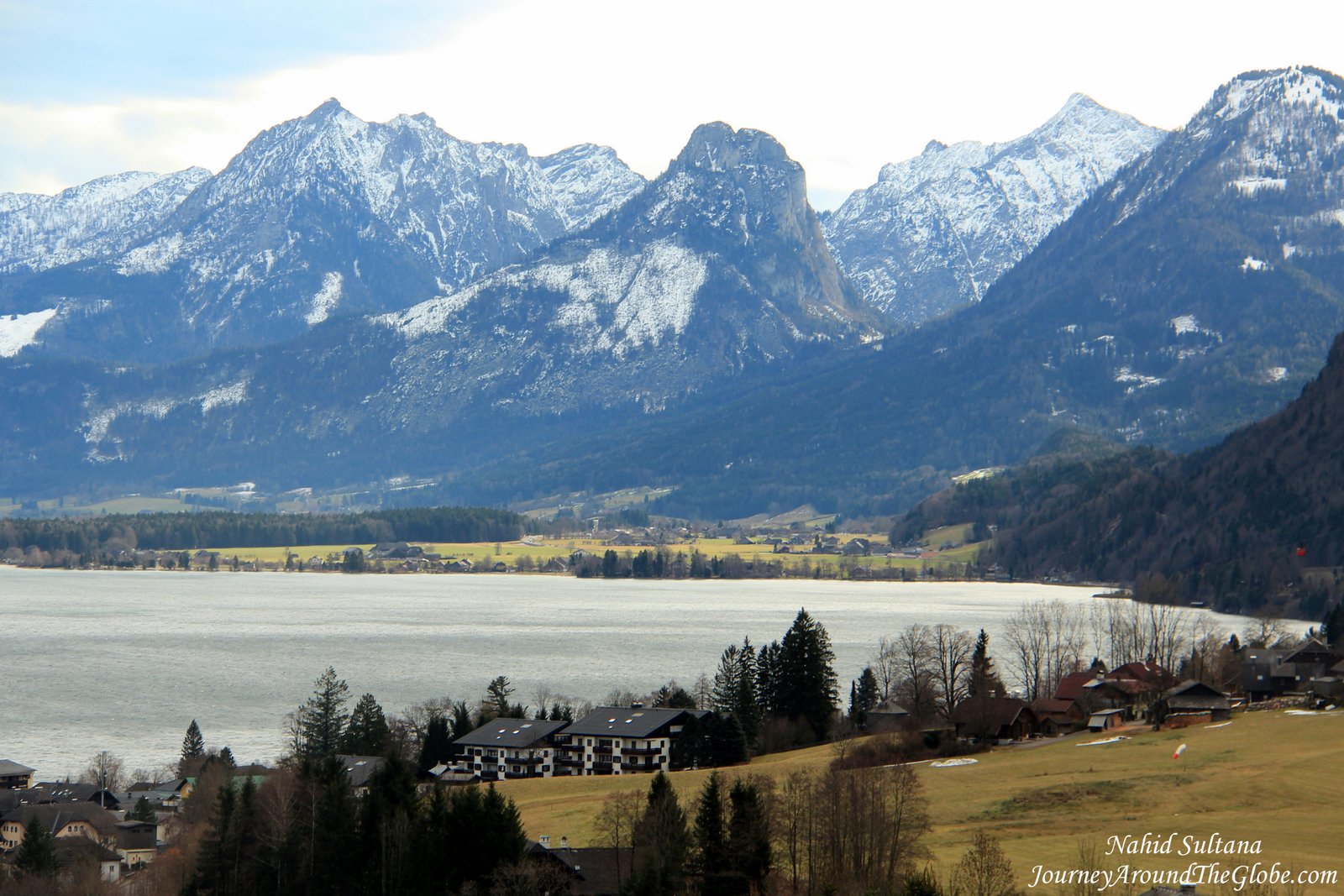
From here, we took a long drive through the mountains and lake-district of Salzburg. This was a very scenic drive with breathtaking views of Alps, meadows, trees, and lakes. After passing Fushel Lake, we made a quick stop at Wolfgang Lake in St. Gilgen. This whole region was shown as an aerial view at the very beginning of the movie and the mountains here were used to shoot the infamous “Do Re Mi Fa” song of this movie. Lots of people come here during summer for many water activities, to just relax by the lake, and to enjoy Alpine beauty. By the way St. Gilgen is also the birthplace of famous composer Mozart’s mother.
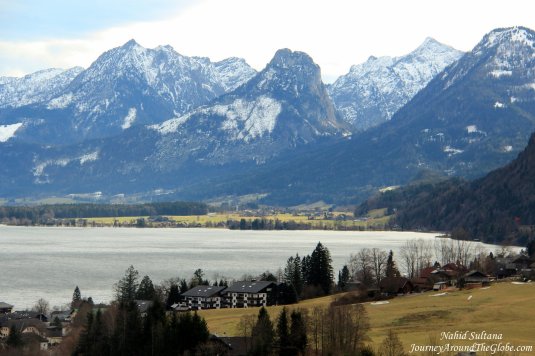
- Stunningly beautiful Lake Wolfgang in St. Gilgen
Our last destination of the tour was the “Wedding Church” in Mondsee. This is the place where Captain Von Trapp and Maria get married in the movie (not in real life). It was a former Benedictine monastery which is now called Parish Church St. Michael or Mondsee Basilica. The original monastery was founded in 748 A.D. Inside the church is extremely gorgeous and elegant, no wonder they chose this spot for their special wedding scenes. This church was selected over the actual abbey (Nonnberg Abbey) for the wedding scene due to its elegance and beauty. Even though in the movie it was portrayed that Maria and Captain got married in Nonnberg abbey!
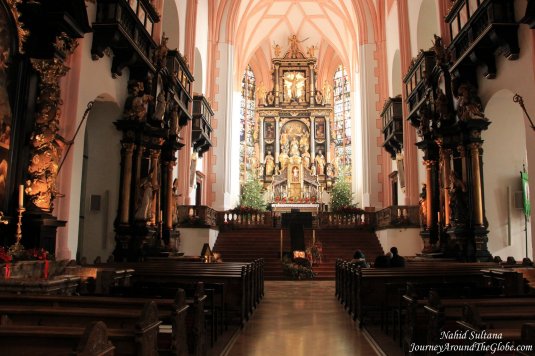
- The “Wedding Church” where Captain and Maria got married in the movie
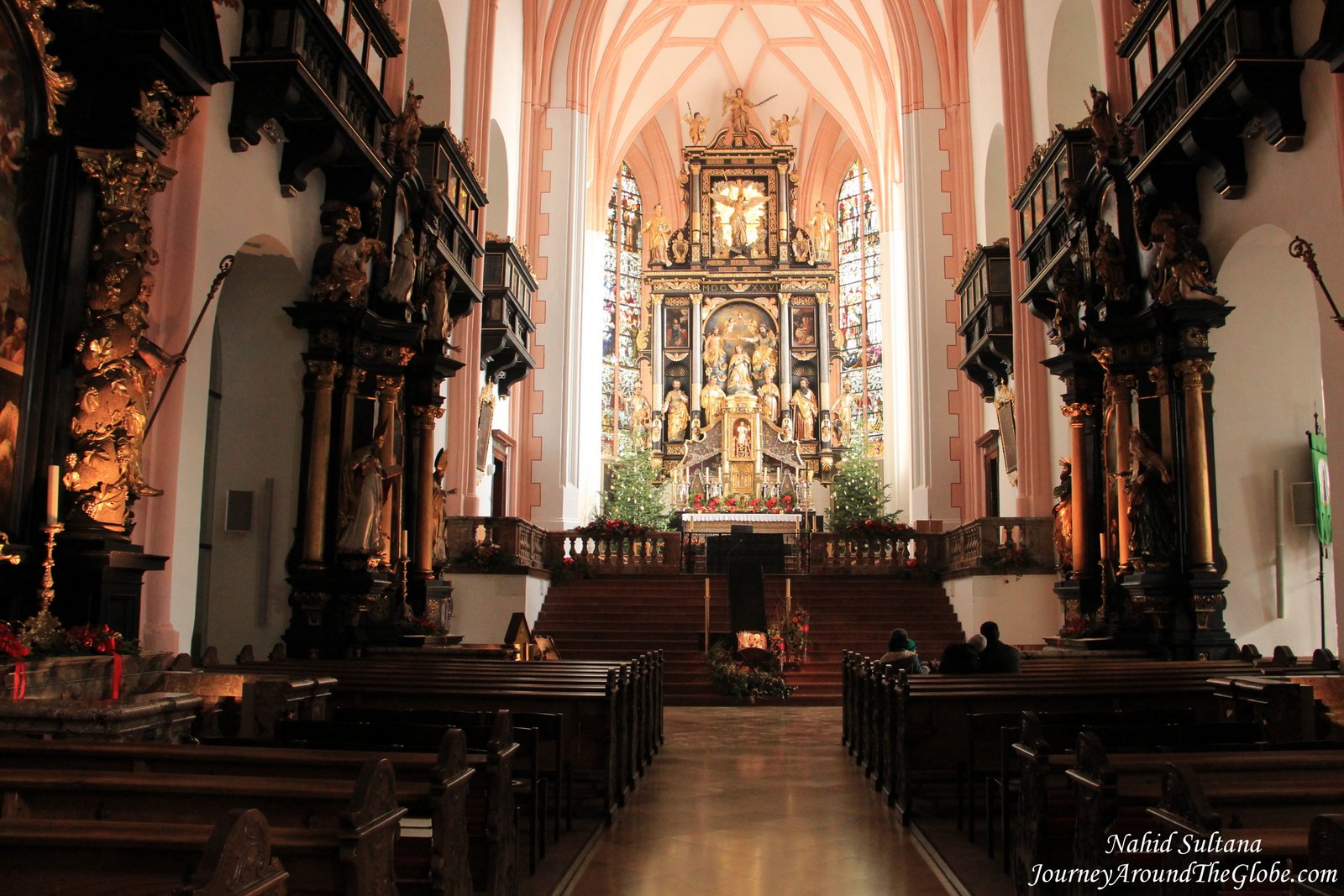
The small village of Mondsee is situated by stunning Mondsee Lake surrounded by the Alps. The city center where the church is located is absolutely beautiful. We didn’t have time to go by the lake, but I am assuming it must have a breathtaking view.
We were dropped off near Mirabell Palace and Garden in Salzburg at the end of the tour. Few scenes were also done in this beautiful garden. But the most remarkable statue was seen in some scenes was the statue of a Pegasus. It was moved around the city few times, I think, before it could find its final home in Mirabell Garden.
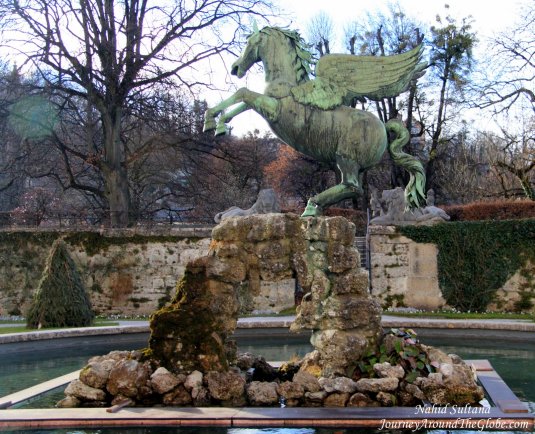
- Pegasus in Mirabell Garden which was seen in the movie couple times
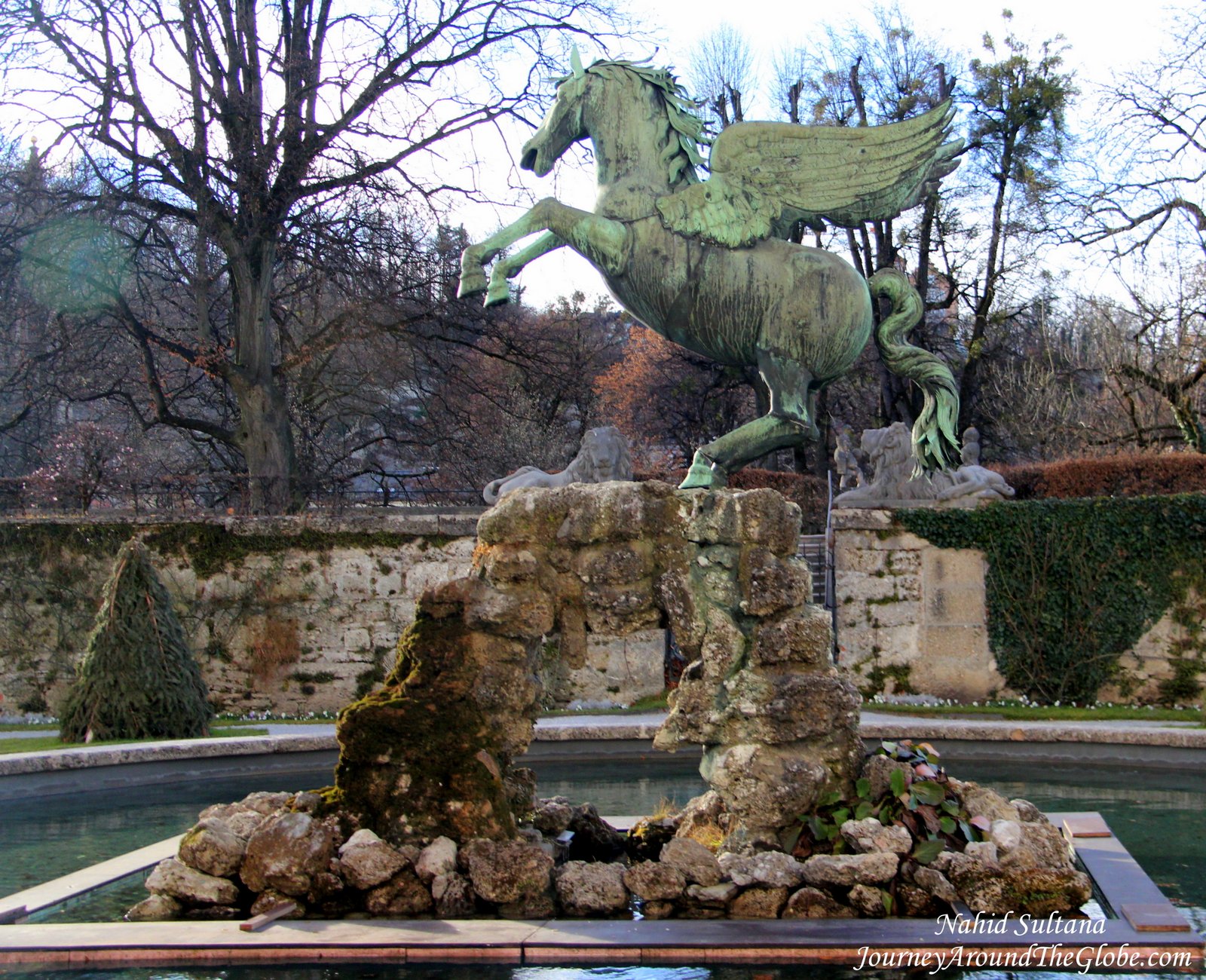
Overall, this trip is a must for the fans of “Sound of Music”. Not only you get to see some spots of the movie right in front of your eyes but also you get to experience some Austrian Alps and its lake-district. It was a wonderful experience…probably the best part of this trip was when a lady on the other aisle started singing some songs from the movie with the CD our driver was playing on our way back to the town…I felt like I am in the movie singing too. By the way, my favorite song is definitely, “Edelweiss…Edelweiss, every morning you greet me, small and white, clean and bright, you look happy to meet me.” What is your favorite song from “Sound of Music”?
Share this:

Mozart’s City – Salzburg, Austria
SALZBURG, AUSTRIA: Salzburg is the city of music for being the birthplace of Mozart and where the famous movie “Sound of Music” was filmed in the 1960s. Mozart and Julie Andrews both made this city a major attraction for many tourists worldwide.
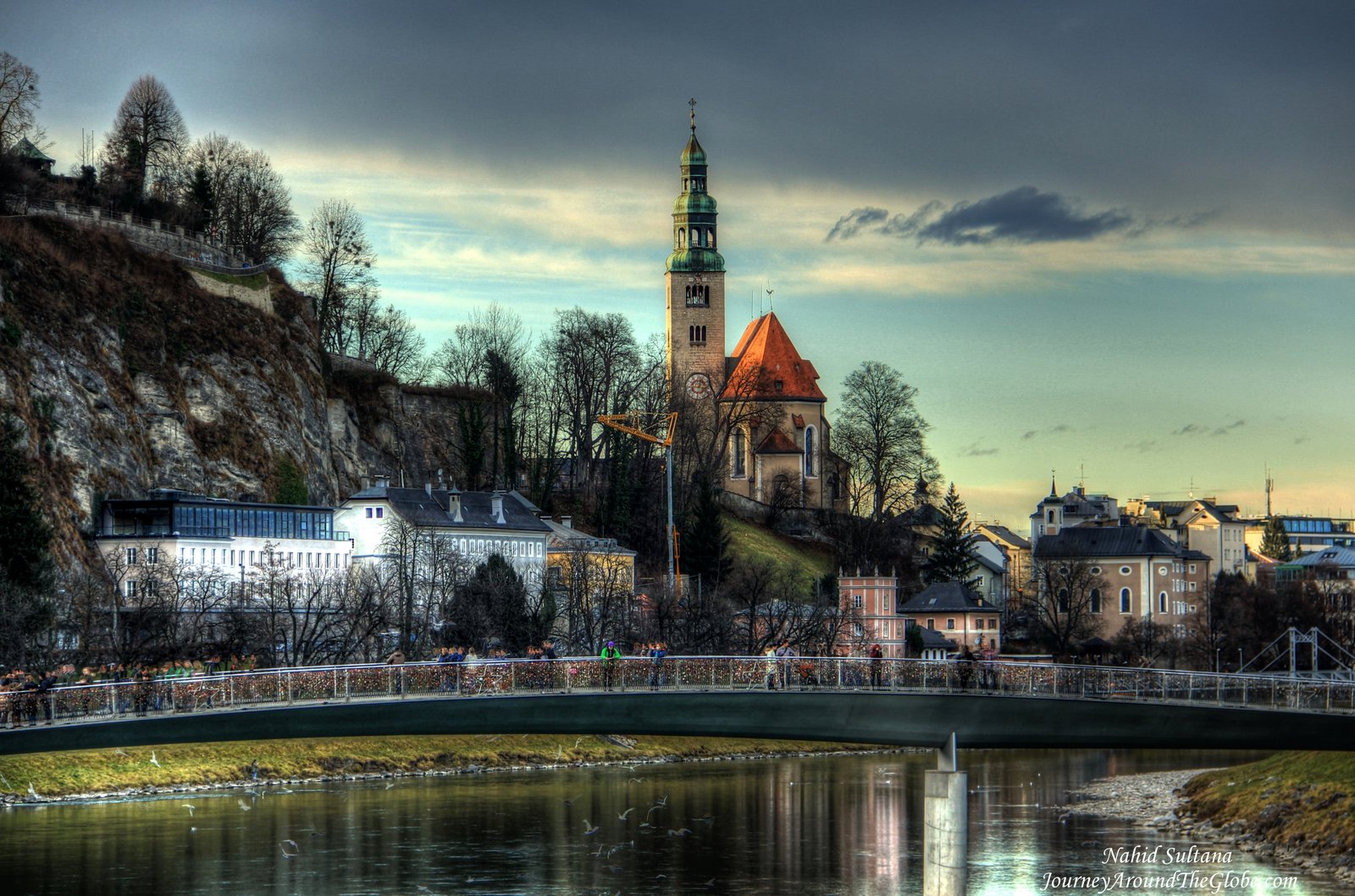
Situated beautifully by River Salzach, Salzburg is one of the most spectacular cities in Europe and one of my most favorite places to visit. I will pick Salzburg over Vienna anytime for its architecture, medieval look, cozy atmosphere, and elegant vibe. This is a city, I sometimes crave to go to and just enjoy its rich history and culture.
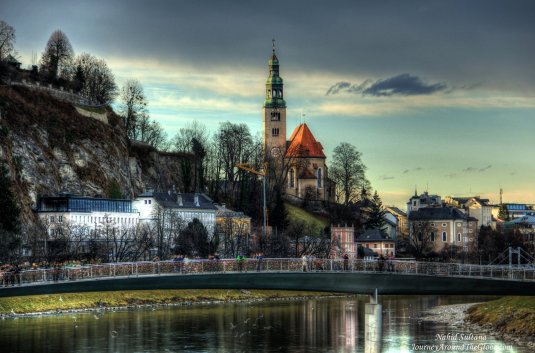
- One of my favorite European cities – Salzburg in Austria
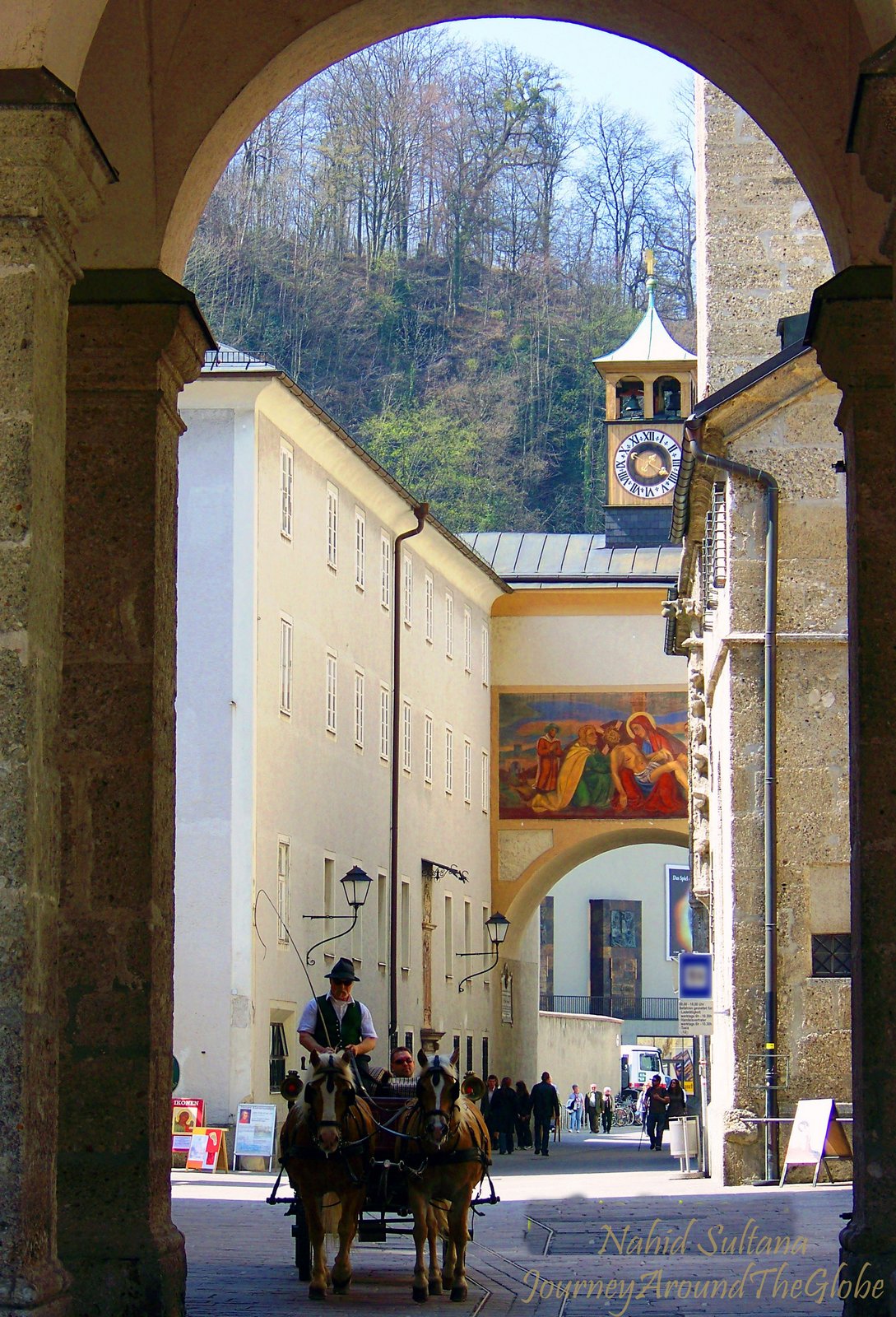
Salzburg is very close to German border and has one of the best-preserved city center in the German-speaking world. The old town with many Baroque architectures, became a UNESCO World Heritage Site in 1997. You can never get bored in Salzburg with so many museums, marionette theaters, old churches and landmarks to visit, and a perfect cozy old town with endearing surroundings.
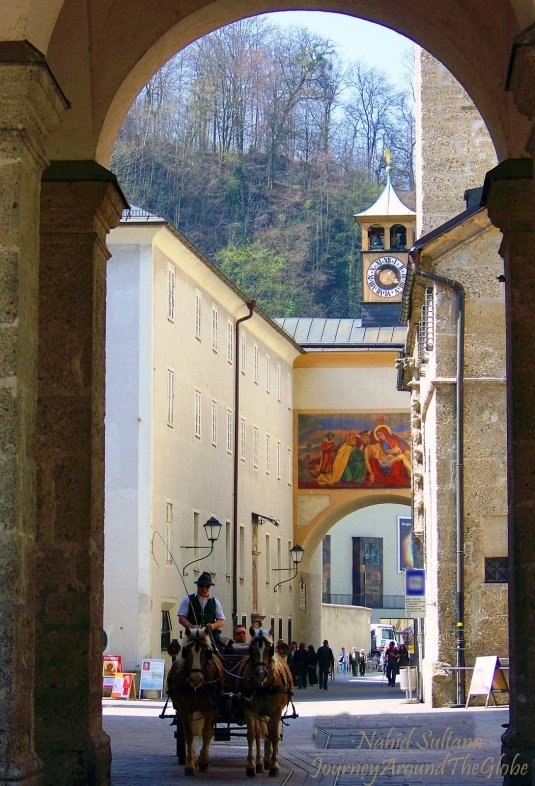
- Old town of Salzburg – kept its traditional look from many centuries ago
TIME of TRAVEL: Salzburg was the 3rd destination of our winter road trip in December 2013. My uncle-in-law was here to escape the below freezing temperatures in Chicago and also to spend few weeks with us. The whole trip was for 12 days. After visiting Fussen in Germany and Innsbruck in Austria, we reached Salzburg on the Christmas Eve. Weather was very mild to my surprise. I was prepared for some harsh cold temperature during Christmas for being so close to the Alps, but it was very nice, may be early to mid-40s during day and early 30s after dark…not bad at all.
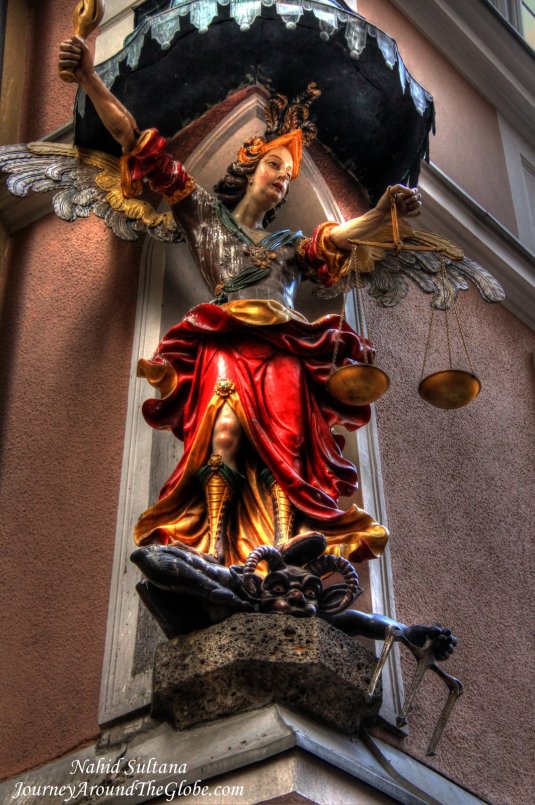
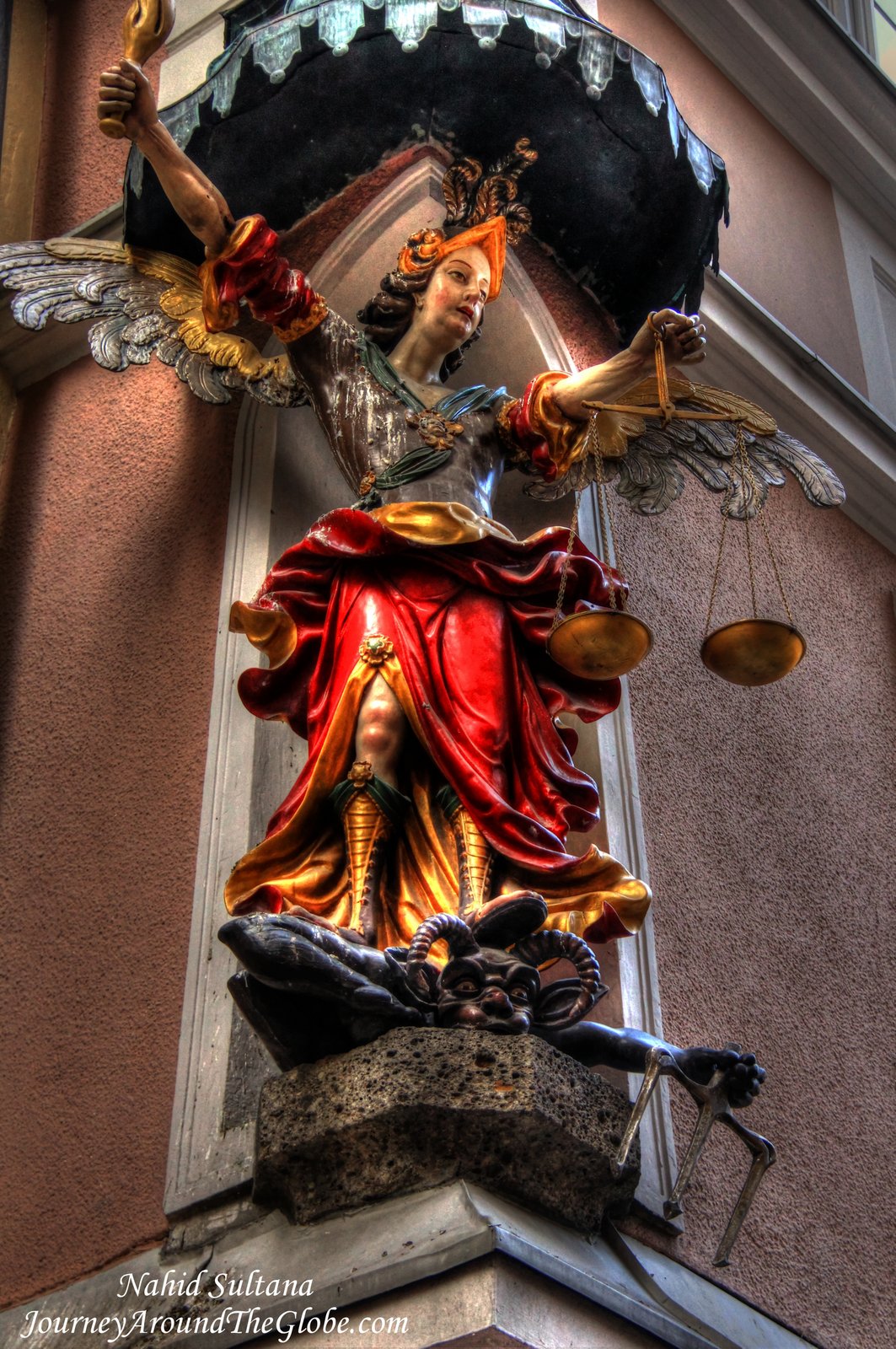
- Building art in the old town of Salzburg
By the way, this was our second time coming to this city. We have been here during Easter Break of 2009, when we were still living in the US. That time we toured around Europe for 2 weeks. I was longing to come back to Salzburg since then and finally it happened last month. Easter in Salzburg (or may be in whole Europe) is absolutely magical…it’s like Christmas in The States. Whole old town Salzburg was sparkling with lights and egg-decors. I have never seen Easter being celebrated with that enthusiasm before.
I have posted pictures from both of our trips, so you can see what the city looks like in spring and in winter. Excuse the big ol’ yellow dates on the old pictures.
OUR HOTEL: We stayed in Hotel Der Salzburger Hof in one side of Mirabel Palace, but was little away from the old town. It had its own restaurant, free breakfast and Wi-Fi for the guests. But the best part of this hotel was that each floor of it was designed in different theme. Like, one floor was in Mozart theme and ours was in “Sound of Music” theme. Our room even had some scenes from the movie printed on the wall. In 2009, we stayed closer to city center, in Hotel Austrotel, which is now called Hotel Am Mirabellplatz. This one didn’t have breakfast but has a bakery at the end of the street.
- One of the walls in our hotel, dedicated to the movie “Sound of Music”, in Salzburg, Austria
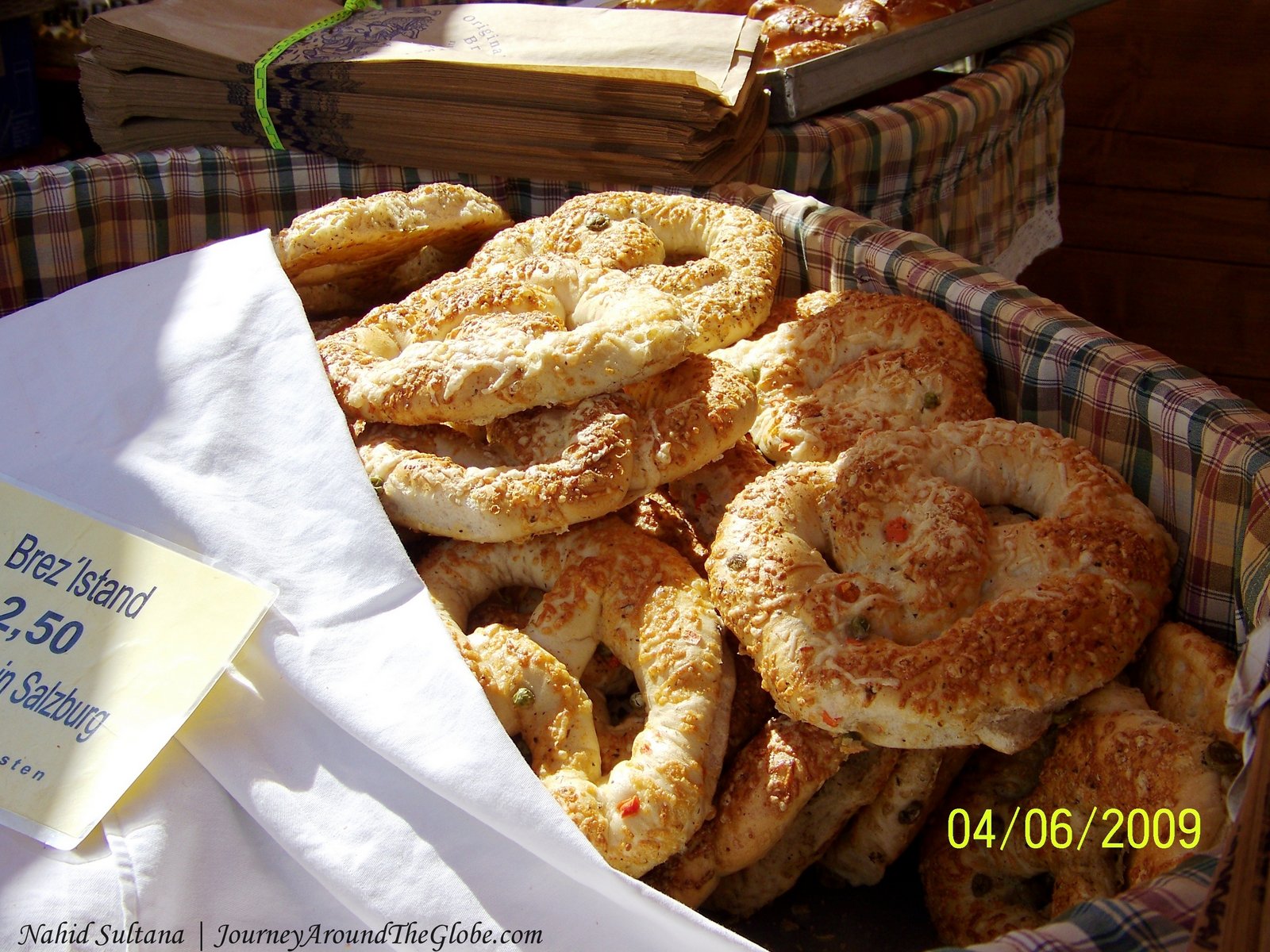
EATING and SHOPPING: That was a night to remember on Christmas Eve in Salzburg. As soon as we reached our hotel and checked in, we headed out for some food. After walking and looking and searching for a place to eat, the only option we were left with was Burger King. Everything was closed or was about to close. Thanks to BK burgers for saving our growling stomach that night. Next day lunch was some to-go sandwiches and for dinner, we had some lovely Indian food in our hotel restaurant. But the restaurant had some local Austrian dishes too, like schnitzel (fried boneless chicken breast with some potatoes and veges) which my husband tried. Do try “brazen” when you are in Salzburg; it’s like big and fat pretzels that come in sweet and savory flavors. You can get them in pizza, onions, herbs, and many other flavors. If you go there in Easter, you will also see colored boiled eggs (they only color the shell, so it’s ok to eat the eggs) in many bakeries or breakfast places. Another thing you will see here in almost every souvenir shop is Mozartkugeln. They are chocolates with marzipan filling inside…can be expensive but Salzburg is all about Mozart 😉
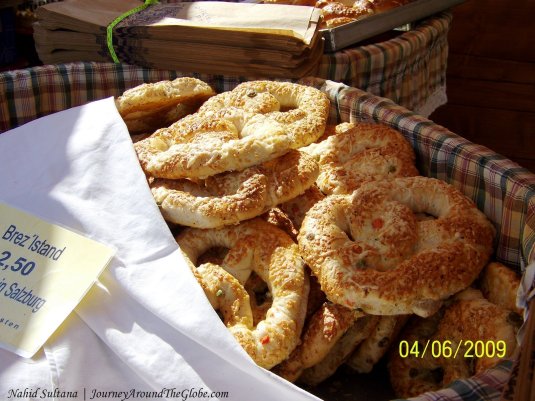
- Brezen, a preztel-like snack, is very popular in Salzburg
Whole old town of Salzburg is packed with tons of souvenir shops. Browse thru the small stands in Alter Markt or other fancy stores in the old alleys. On our first visit in 2009, we bought a decorative Bavarian beer mug (can be pretty expensive depending on the size). This time my husband bought a Tyrolean hat (very traditional here) with a feather on it…looks a bit like Robinhood’s hat; he regretted very much that he didn’t buy it in 2009. For our home, I got some small this and that from the huge Christmas market in Residenzplatz and Domplatz. The annual Christmas market is here very big and colorful here. Even if you don’t buy anything just come and join the fun, may be try some local knickknacks too. Also, marionettes are very popular here and you will find them in almost everywhere in old town. While you are in Mozart’s town, buy his classical CDs or other memorabilia.
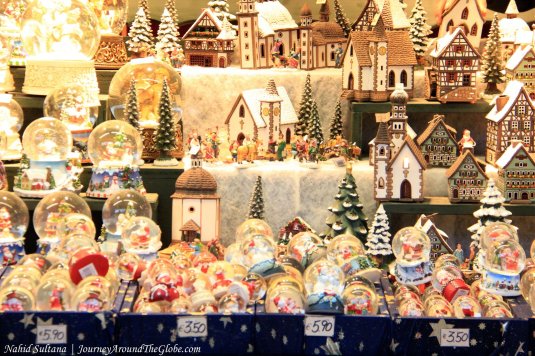
- Christmas market in Residenzplatz in the old town of Salzburg
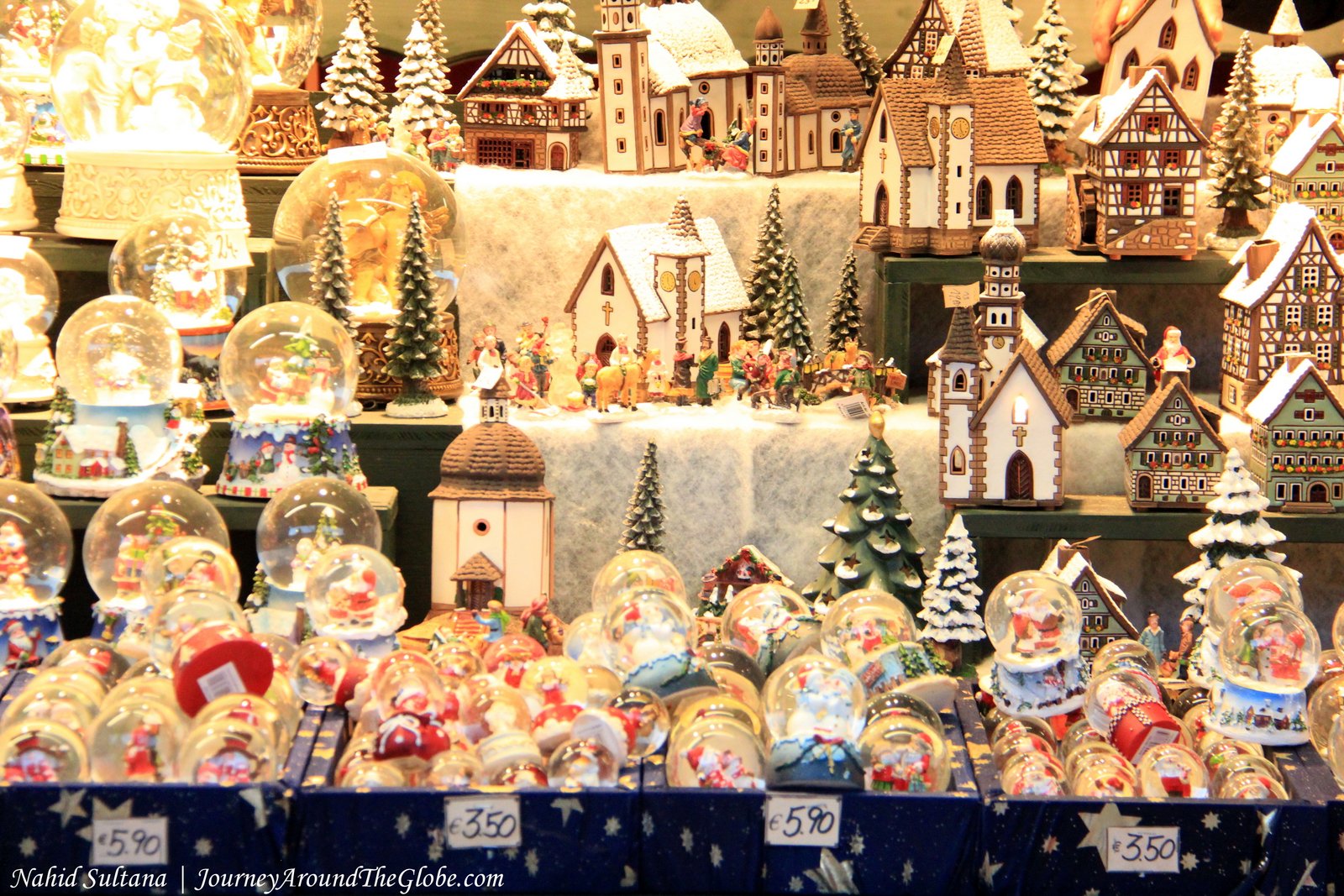
PLACES WE’VE VISITED: We spent two whole days in Salzburg during our first visit in 2009. But this time we took “Sound of Music” tour in the morning; so we were left with only half a day to spend in the city. We were dropped off near Mirabel Garden around 1:30pm by the tour bus and then we were off to venture Mozart’s city. Old town is very compact; take your time to absorb its appealing atmosphere. We did everything on foot and it was fun doing it that way.
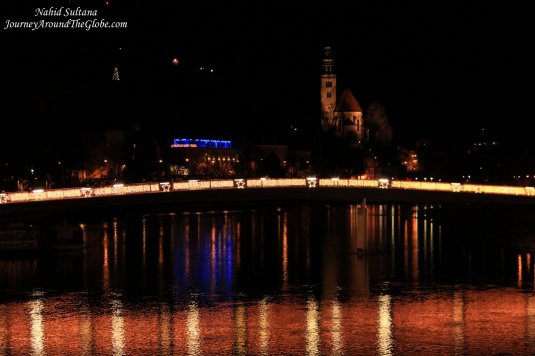
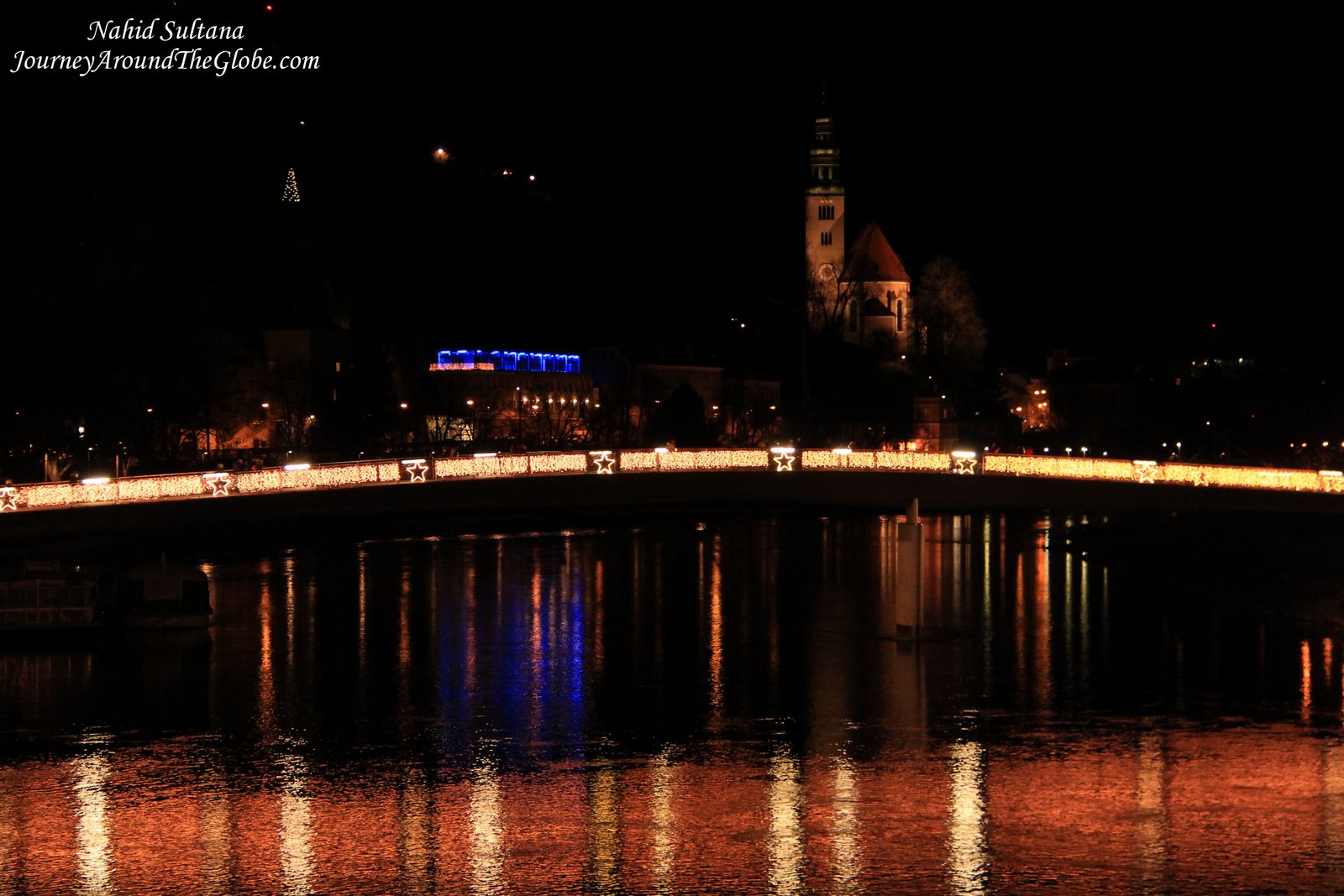
- River Salzach at night, walking back to our hotel
If you are done with the city and have more time, then try going to the lake-district, close to the mountains…few km away from Salzburg. If you have your own car, it takes about half an hour to reach there. It’s a perfect region for summer tourists and makes a nice getaway from the city-life and of course you will love its stunning natural beauty with lakes, mountains, and villages.
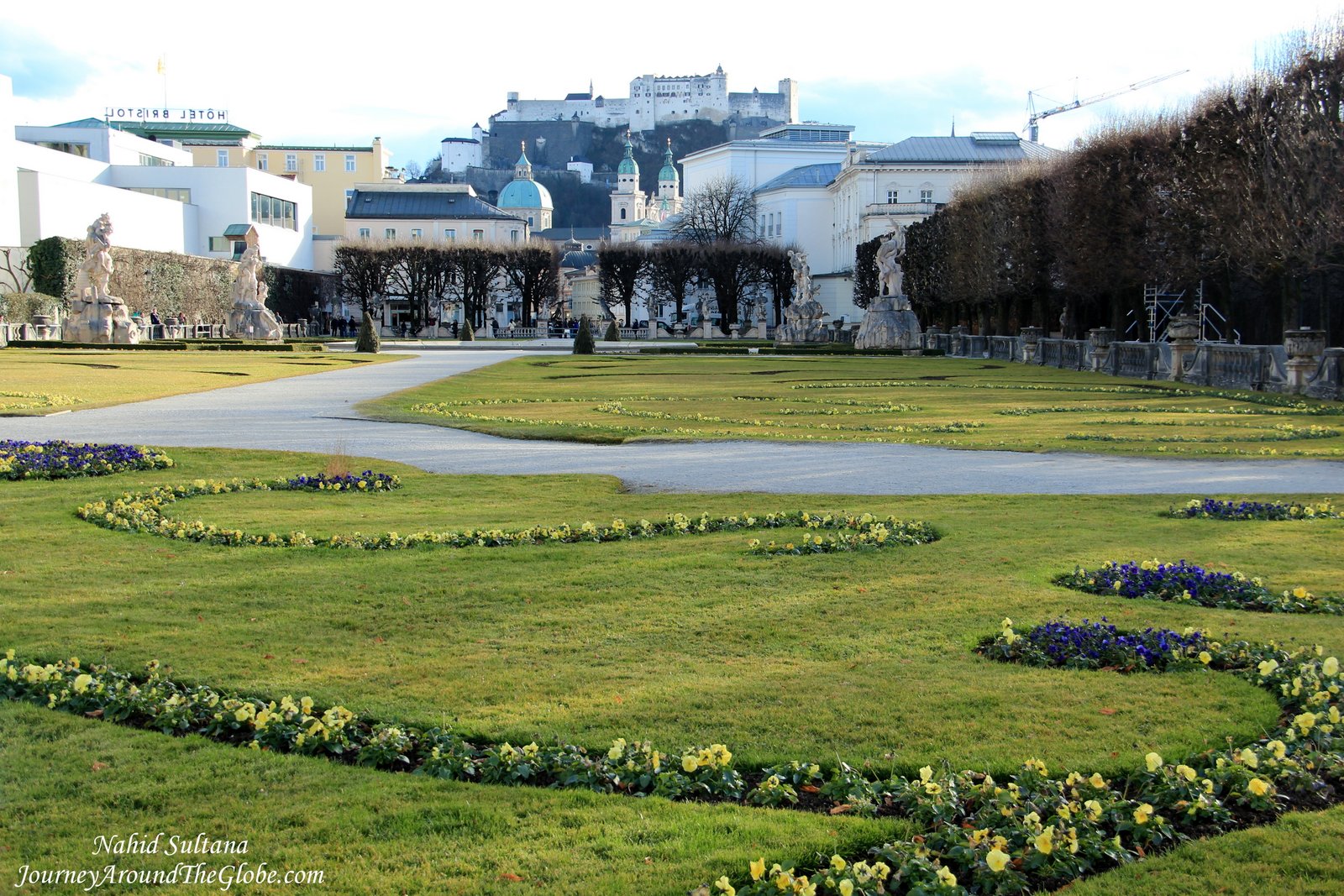
1) MIRABEL GARDEN and PALACE: We started our walk from Mirabel Garden and Palace. We didn’t really go inside the palace because I don’t think it is open to the publics for regular tours. It is said that Mirabel Palace has world’s most beautiful wedding hall and need to be reserved at least a year ahead. We walked via its garden towards Salzach River. Beginning of early spring, this garden looks at its best with fresh flowers and a big fountain in the middle surrounded by sculptures on the four sides. But we didn’t really see any flowers this time. The fountain was not on either. But it is a nice place to stroll around and sit down to take a little break.
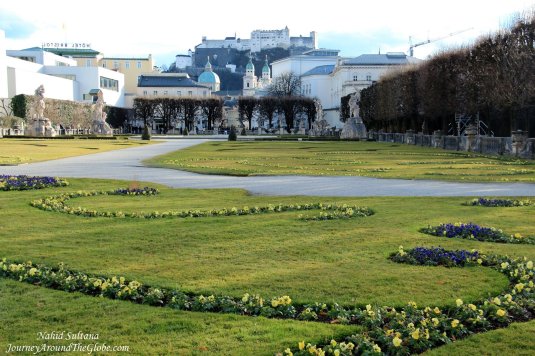
- Mirabel Garden and Hohensalzburg Fortress it the distance…in Salzburg, Austria
Mirabel Palace is located in Mirabellplatz, little bit away from old town. The walk is only about 10 minutes from old town but very close to Mozart Residence.
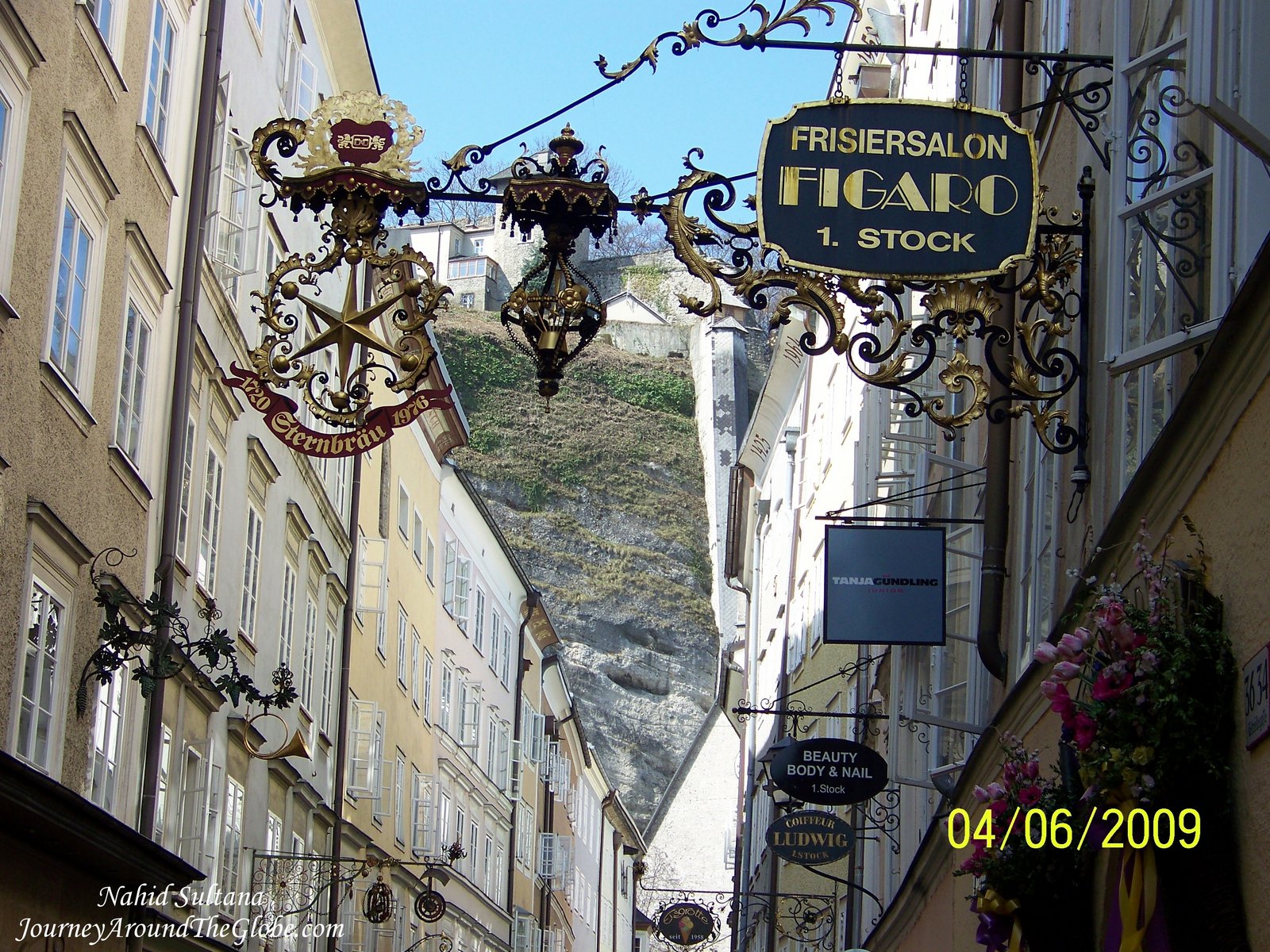
2) GETREIDEGASSE: After crossing a bridge on River Salzach from Mozart’s Residence/Wohnhaus we crossed the street and entered the old town. This is a long and narrow street here with full of shops and souvenir places. Stores on Getreidegasse still decorate their entrances with metal signs of what their stores are about, just like the old times. This can be a very crowded place to walk around but I guess that’s why I loved strolling up and down this street.
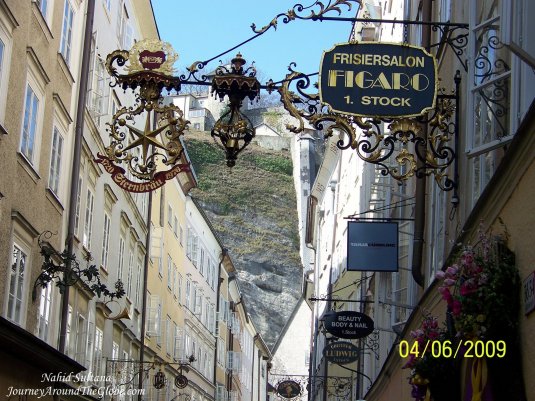
- Old store signs in Getreidegasse
3) MOZART’S BIRTHPLACE (MOZARTS GEBURTHAUS) and MUSEUM: On Getreidegasse, a bright yellow house stands amongst some other old buildings from few centuries ago. The famous composer Wolfgang Amadeus Mozart was born in this house in 1756 and lived here until 1773. Now it’s a popular museum devoted to his life, work, and family. Mozart is a major attraction of Salzburg and his birthplace is a site which his fans wouldn’t want to miss. This museum (along with Mozart Wohnhaus) has the largest collection of Mozartiana worldwide.
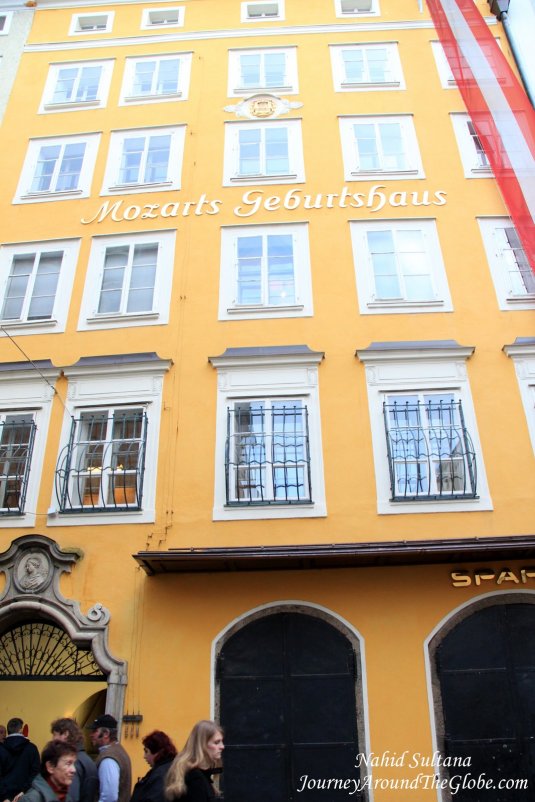
- Mozart’s Birthplace where he was born in 1756 and spent his childhood…Salzburg, Austria
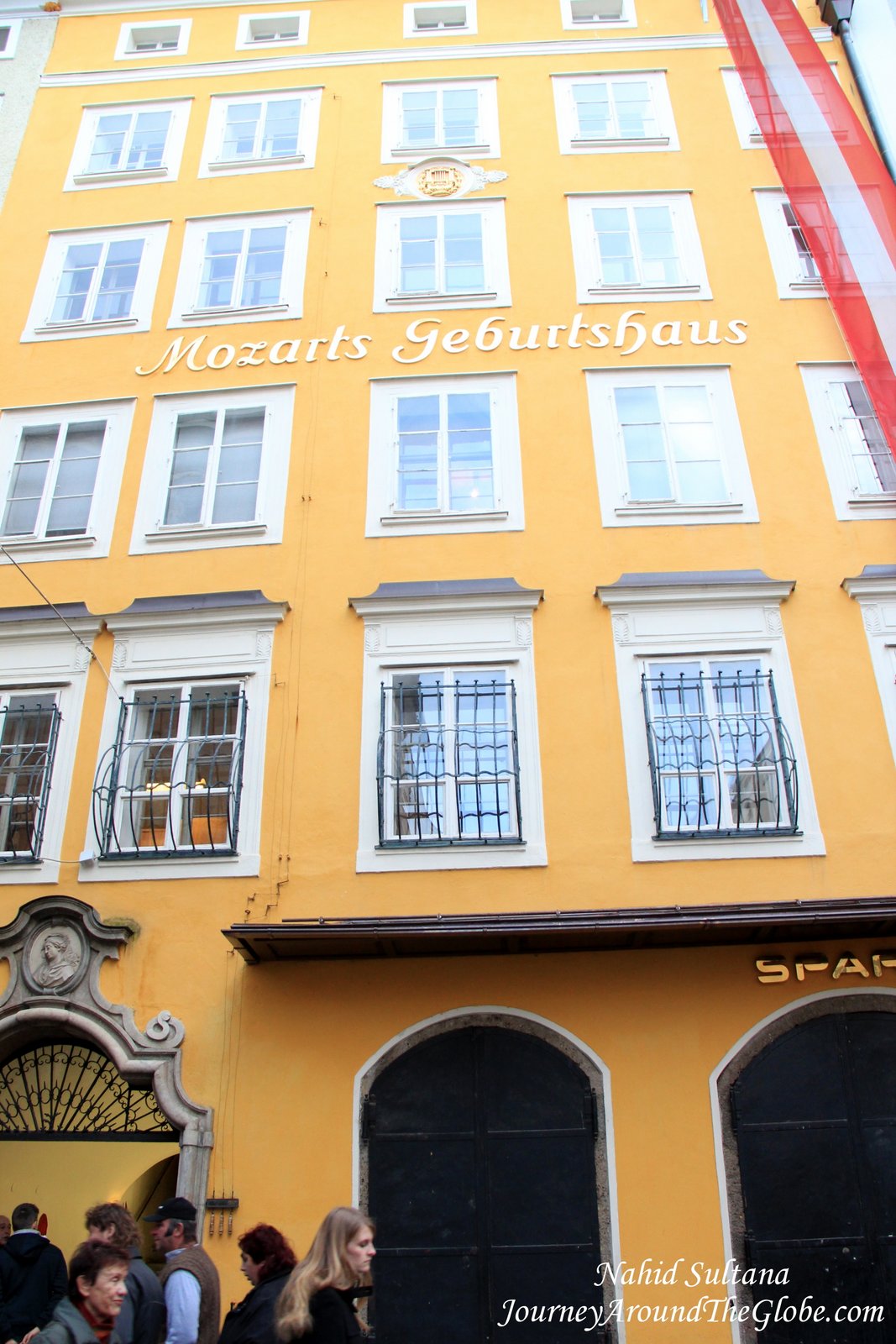
This is a very special experience – to see, hear, and absorb the atmosphere of the place where Mozart was born and spent his childhood. In this three level exhibition, the visitors can learn details of his life including domestic circumstances, when he began to play music, his relationship with his family, his passion for opera, and much more. Besides original portraits and documents, there are some rare exhibits from Mozart’s possessions, such as the violin he played as a child and an authentic portrait which was painted two years before his death.
The museum is open daily (including Sundays and holidays) from 9am to 5:30pm and in July and August from 9am to 8pm. You can buy combine tickets for Mozart’s Birthplace and Mozart Residence in any one of these museums for a discounted price.
4) MOZART WOHNHAUS or MOZART RESIDENCE: Also known as the “Dancing Master’s House”, the former residence of the Mozart family stands on the right bank of Salzach River. Like Mozart’s Birthplace, this house is one of the most important memorial sites in Salzburg. By the fall of 1773, the rooms of Getreidegasse had become too small for the Mozarts. The family moved here in 1773 and Mozart himself lived here until 1780. His father died in this apartment in 1787. You can see the rooms used by the Mozart Family and the composer himself.
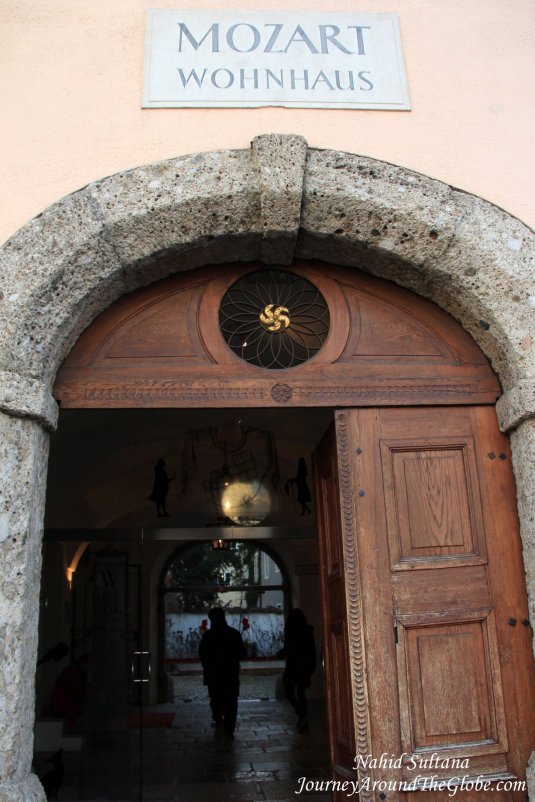
- Mozart Residence, apartment where he spent few years of his life
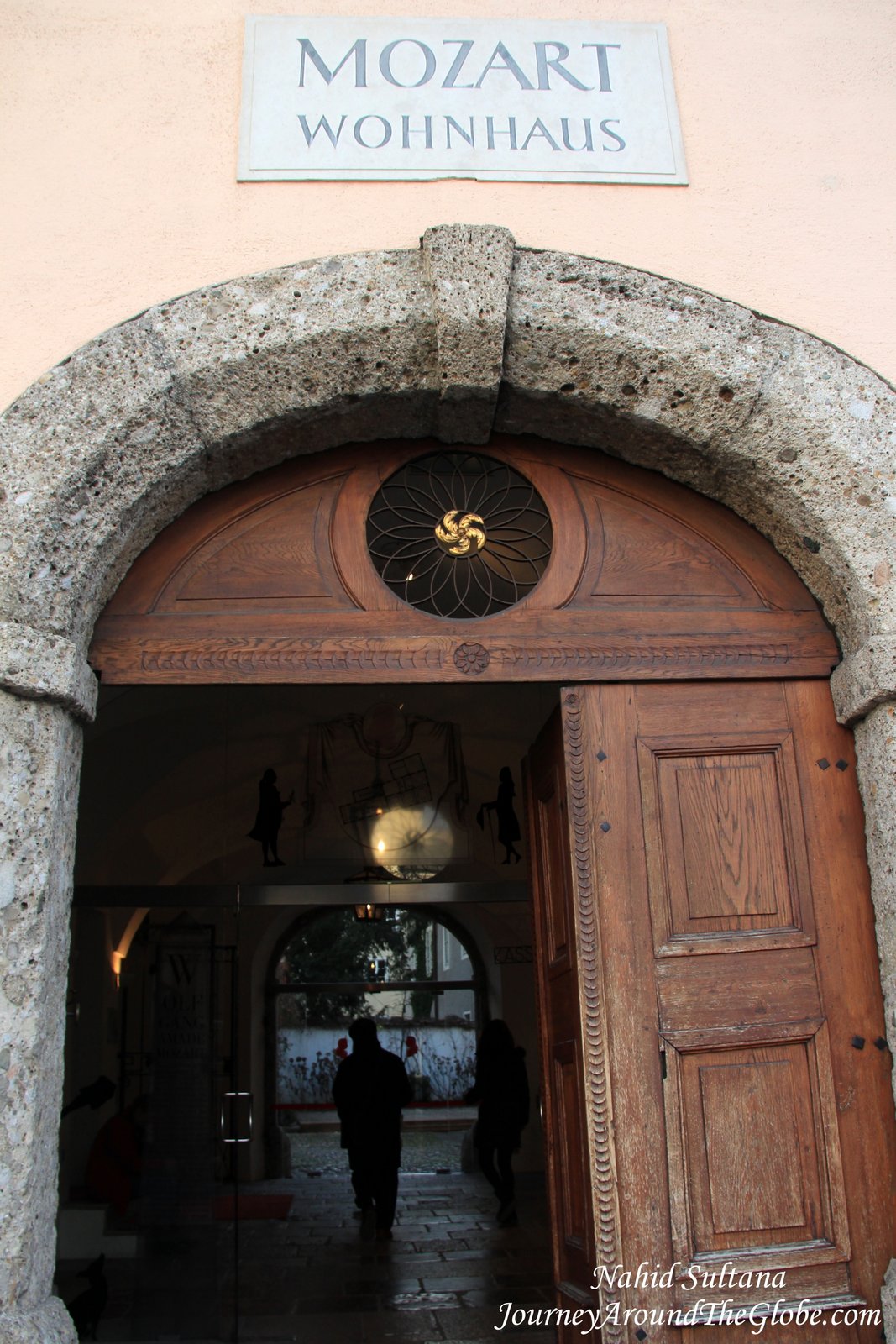
The building was largely destroyed during WWII but was reconstructed according to the original plan to reopen it as a second Mozart museum. Mozart’s own piano, music notes, and some portraits are some particular attractions here. His audio-visual collections, in addition to the exhibitions, contain sound and film recordings concerning the life and works of Mozart – some 22,000 audio and 2,800 video recordings.
Mozart Residence is located in Makartplatz, only 5 minutes of walk from his birthplace and opposite of Mirabel Garden. The museum is open daily (including Sundays and holidays) from 9am to 5:30pm and in July and August from 9am to 8pm. You can buy combine tickets for 12 euros per person for Mozart’s Birthplace and Mozart Residence in any one of these museums for a discounted price.
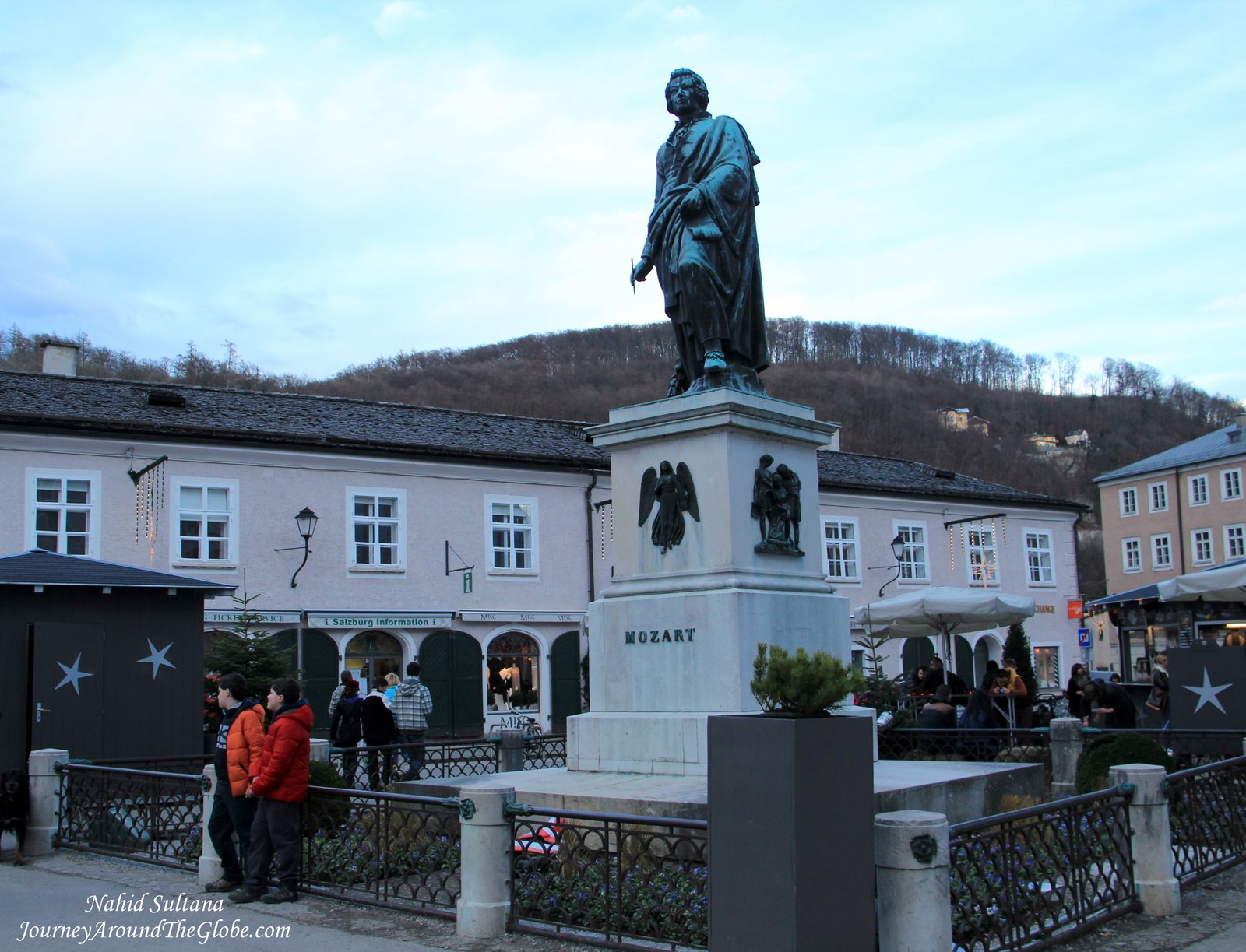
5) MOZARTPLATZ: This square is dedicated to Salzburg’s talented son, Mozart. A statue of young Mozart stands in the middle here. There was an ice-rink in the middle of the square when we were there in December. Many souvenir shops are here too.
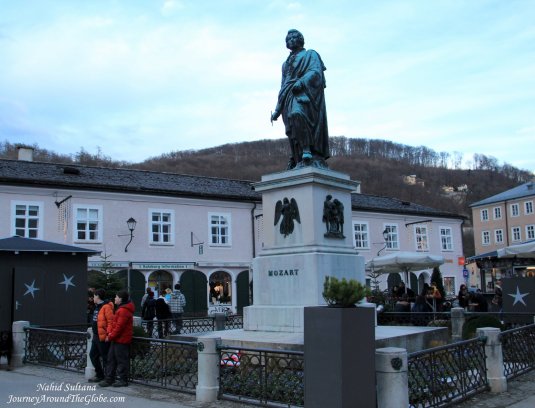
- A statue of young Mozart in Mozartplatz, Salzburg, Austria
6) RESIDENZPLATZ: Right beside Mozartplatz is Residenzplatz. St. Michaels Church in Residenzplatz is an old church. It’s a small but beautiful church inside. We didn’t find it open on our 2nd visit but outside the church is very nice too.
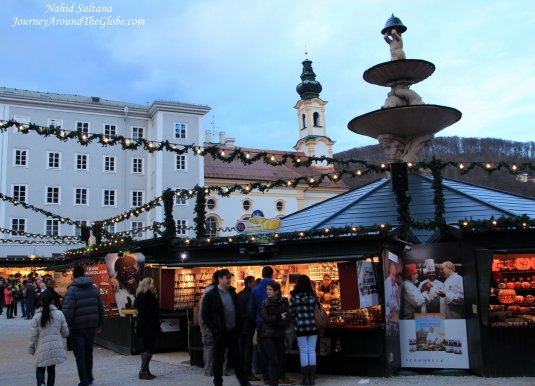
- Christmas market in Residenzplatz in old town of Salzburg, Austria
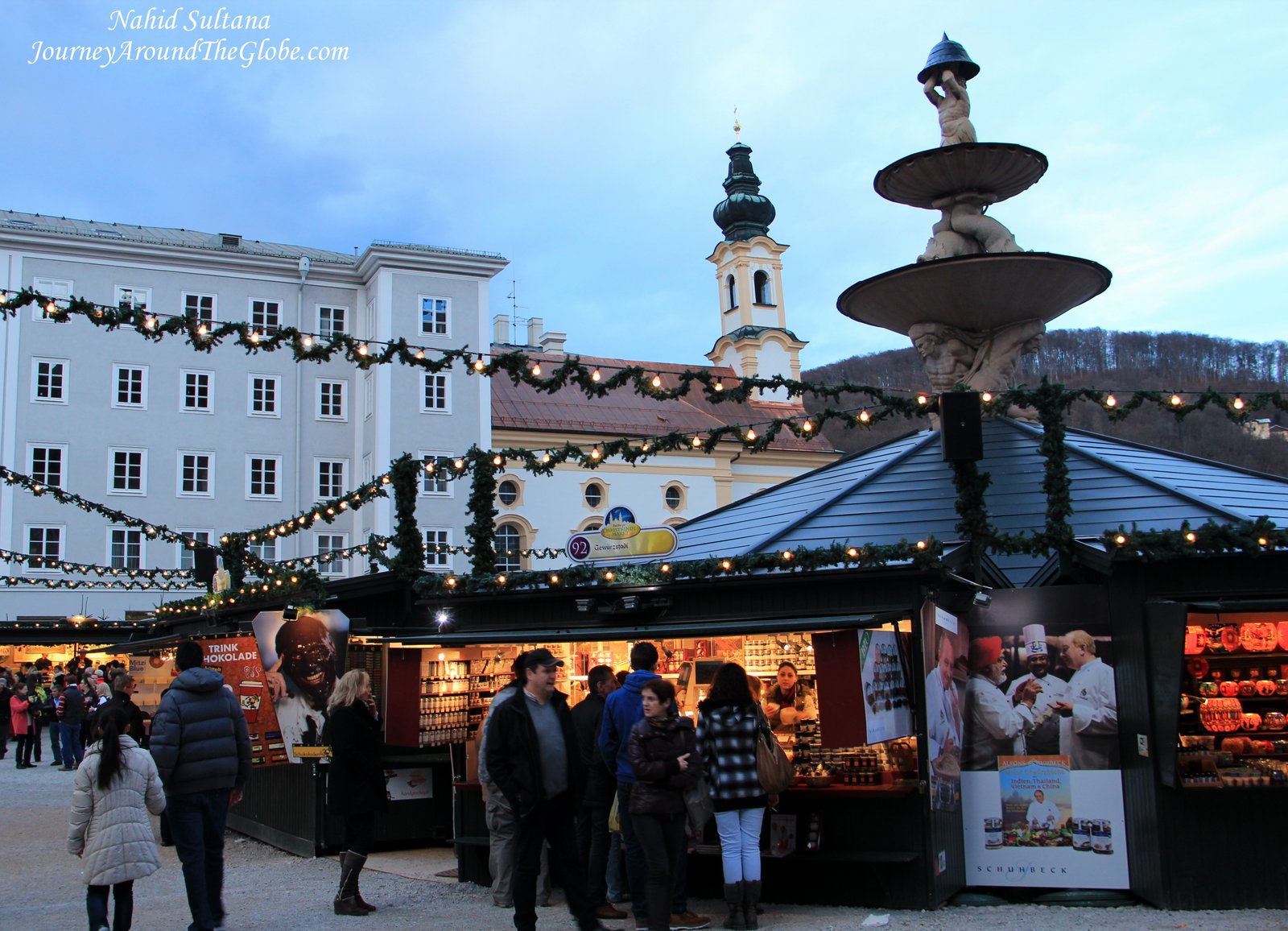
You can get horse-carriages from Residenzplatz to tour around the old town. Salzburg Museum and Residence Gallery are located in this platz. Christmas market here was one of the gorgeous ones I’ve seen so far. The place was bustling with many tourists and locals – everyone enjoying hot drinks, snacks, sweet treats, and of course doing little shopping along the way. This is probably one of the best places to try some local fresh finger-foods (same goes for the market in Domplatz).
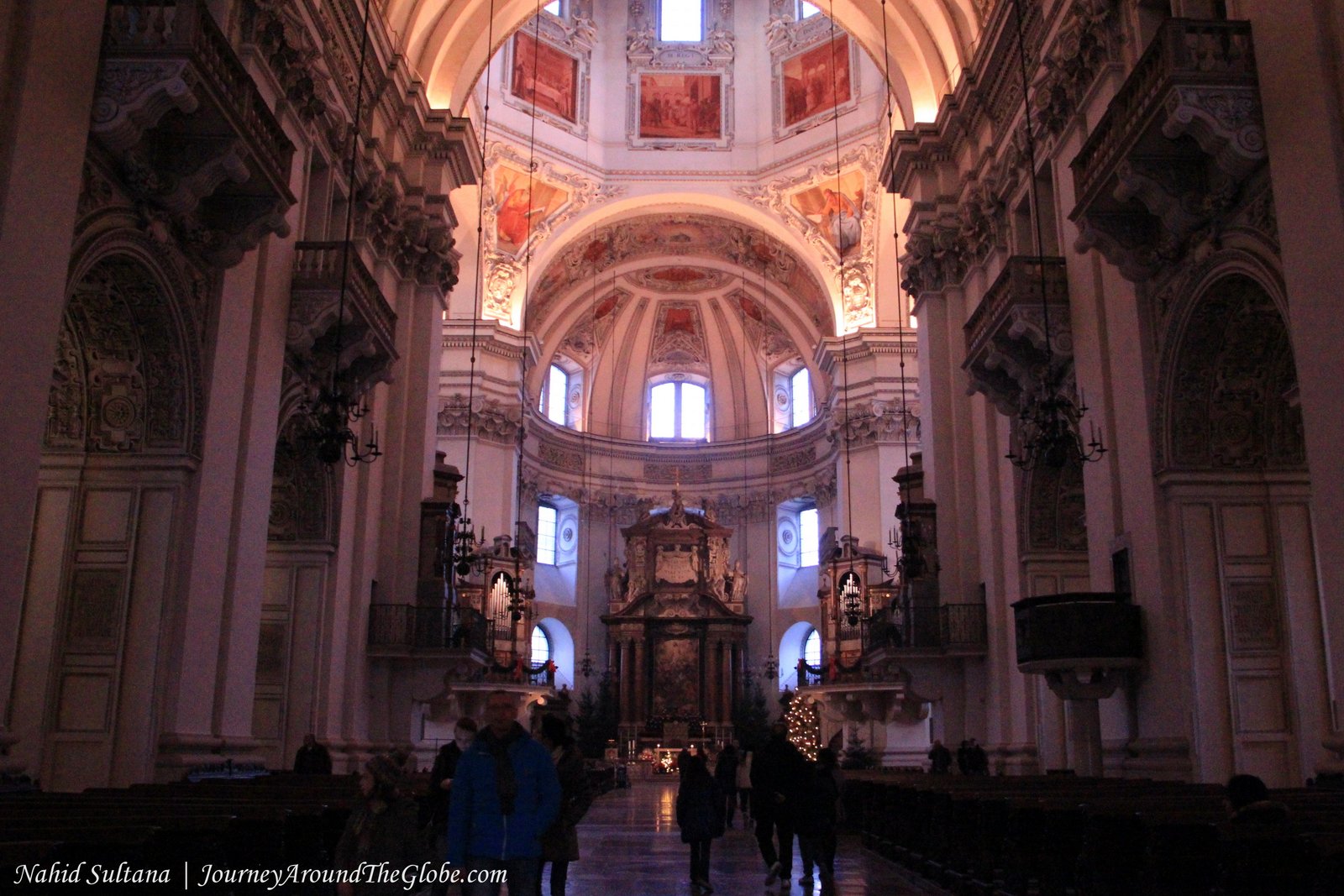
7) DOMPLATZ and SALZBURG DOME CATHEDRAL: After passing Residenzplatz take few steps and you are in Domplatz. Dome Cathedral is one of the grandest architectures in whole of Salzburg. It’s an attractive cathedral both outside and inside. You will just love its high dome, impressive ceiling, majestic organ, old frescoes, and large biblical paintings. I think there is a fee to get inside but it was free on the Christmas Day.
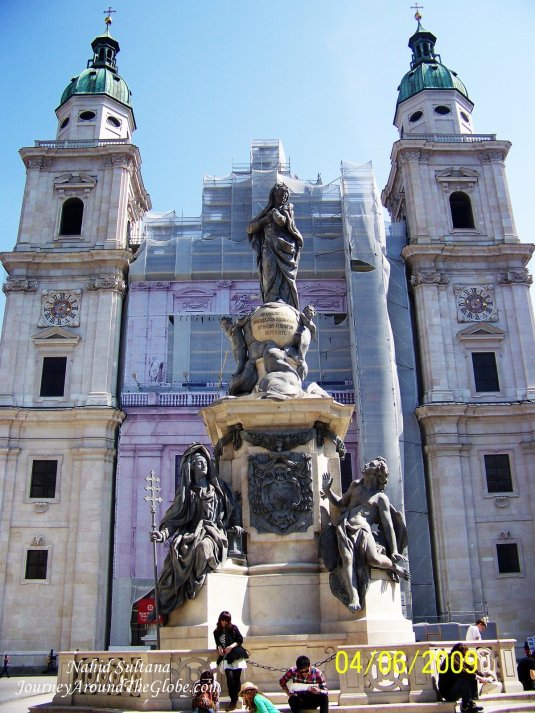
- Salzburg Cathedral in Domplatz
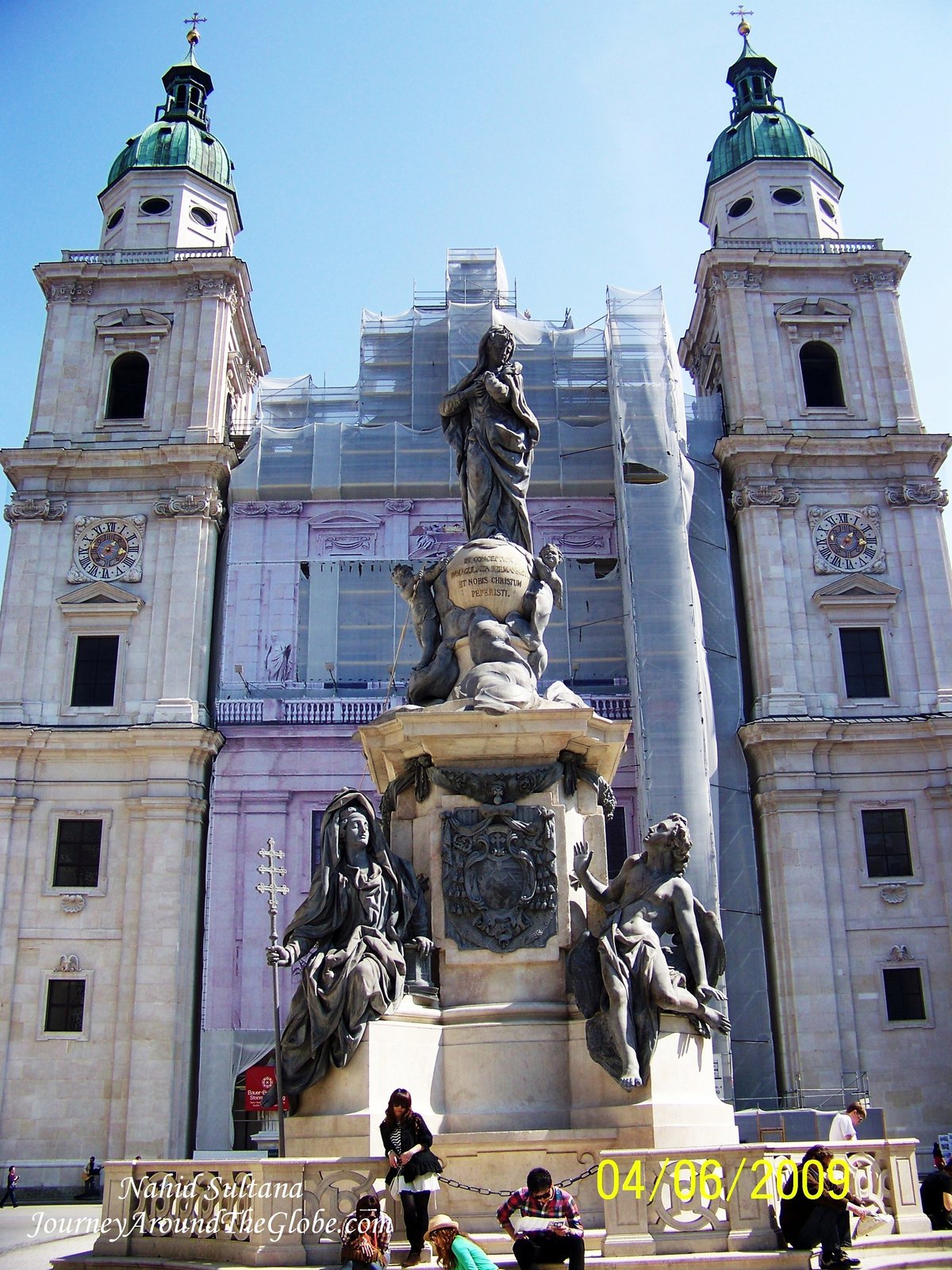
Domplatz also had a big Christmas market in front of the cathedral. It was also sparkling and dazzling with lights and decors. We bought some brezens (pretzel-like snack) from here and cotton candies for the kids while enjoying this big gathering. When we were here in April of 2009, the square was empty and quiet. There is a beautiful fountain in the middle of the square right in front of the cathedral.
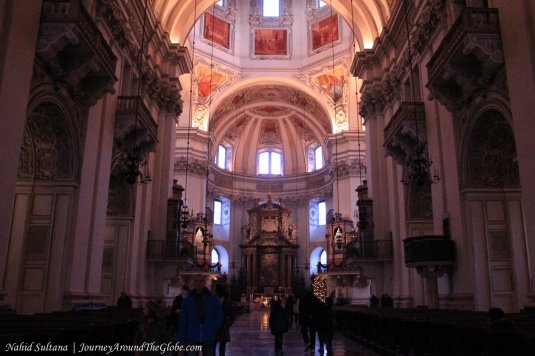
- Inside Salzburg/Dome Cathedral in Salzburg, Austria
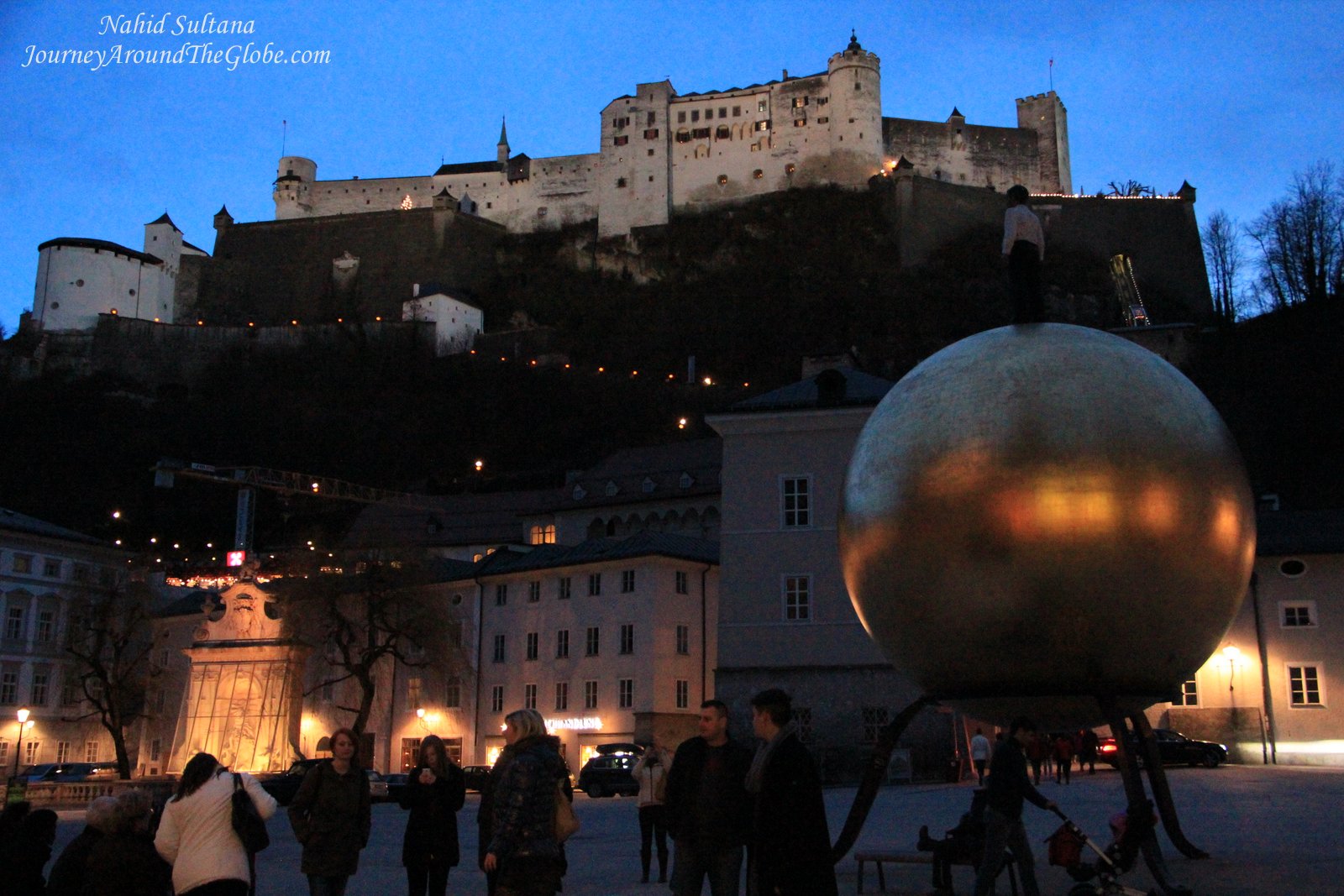
8) CAPITALPLATZ: Another few steps and on the left side of the cathedral is Capitalplatz. You can see Hohensalzburg Fortress on the hill from all the above squares but the closest view is from here. There is a big fountain in one side of this square right below Hohensalzburg. Play the giant chess if you ever get a chance or watch other people playing it.
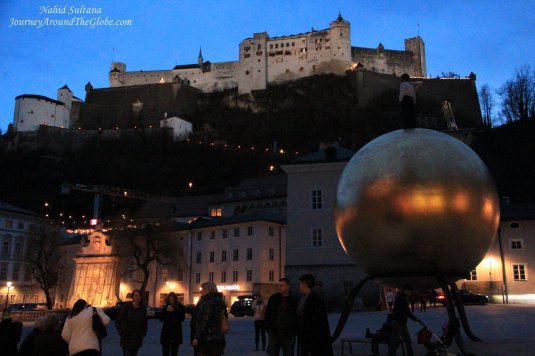
- Hohensalzburg Fortress on the hill from Capitalplatz
9) ST. PETER’S CHURCH and CEMETERY: We didn’t go to this church this time. But I remember going there on our first trip. It’s another beautiful church of Salzburg. Can’t remember which square it is situated in, but it was a gorgeous church outside and inside. Before we reached the church, we saw St. Peter Cemetery. This is a really old cemetery and a very calm place. You can see many few hundred years old tombs.
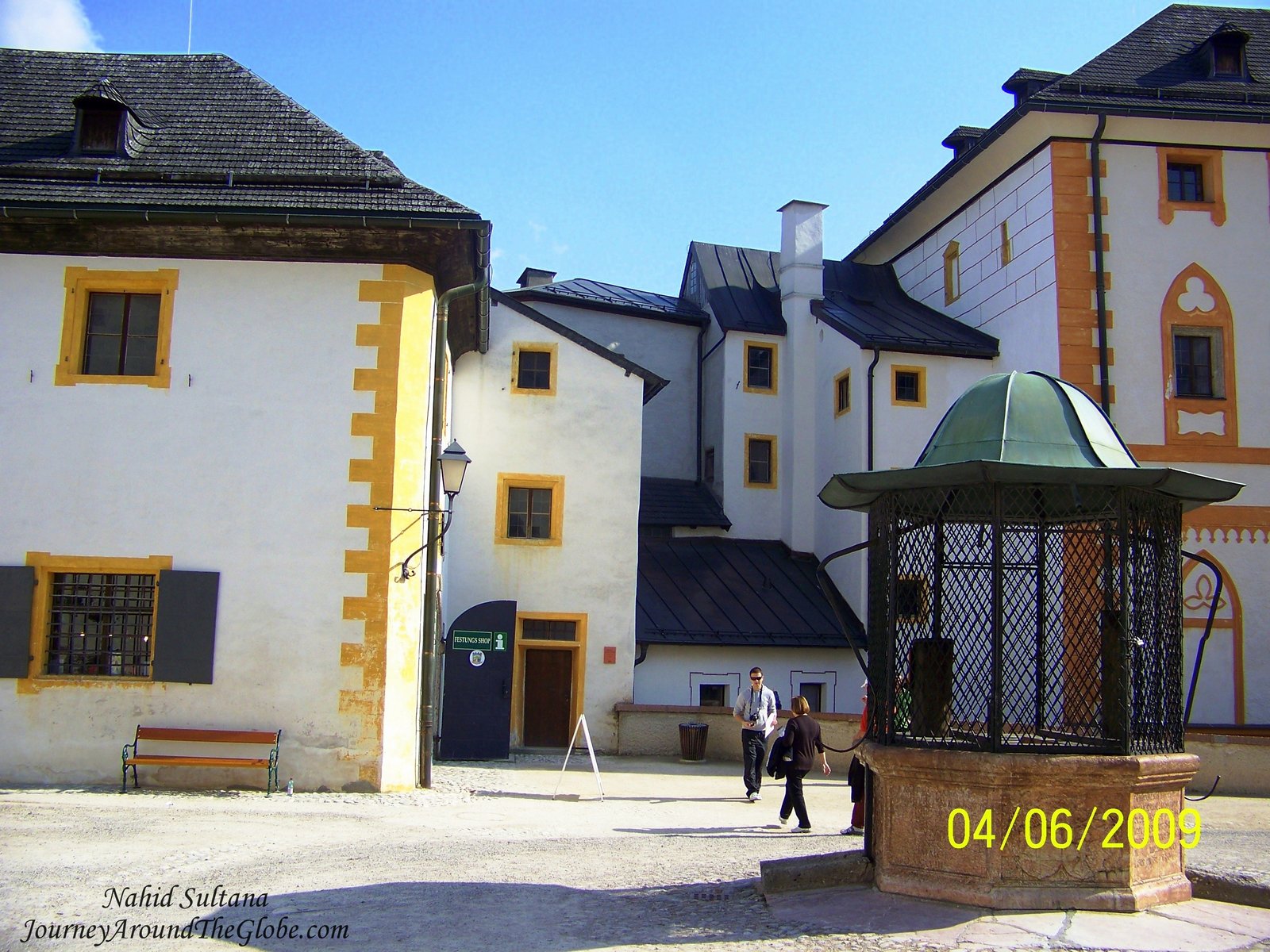
10) HOHENSALZBURG FORTRESS (FESTUNG): This fortress is like the guardian of Salzburg looking over the city all the time. It’s located on top of a small mountain and can be seen from almost any point of Salzburg, far or close. The fortress was built in 1077 and expanded in the following centuries.
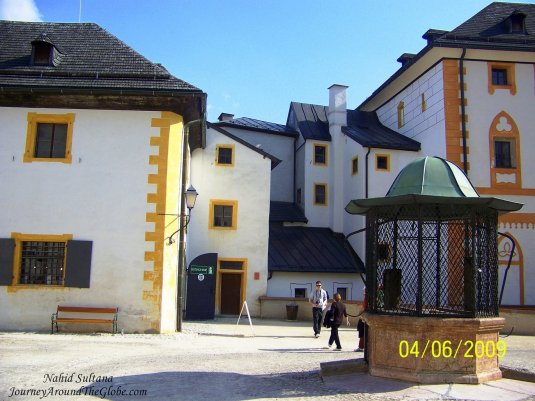
- Old barracks and quarters of Hohensalzburg Fortress in Salzburg, Austria
We didn’t’ go to up to the fortress this time. If I can remember correctly from our first visit, there are couple museums there and one of them is a marionette puppet museum, called “Welt Der Marionetten – World of String Puppets”. Walking in between its old walls on cobbled streets takes you back to medieval age. Visit small churches and old style buildings of this fortress.
This is probably one of the best places in Salzburg to get a breathtaking panoramic view of the city. You can see River Salzach, steeples of many big and small churches, mountains in the distance, and the whole old town.
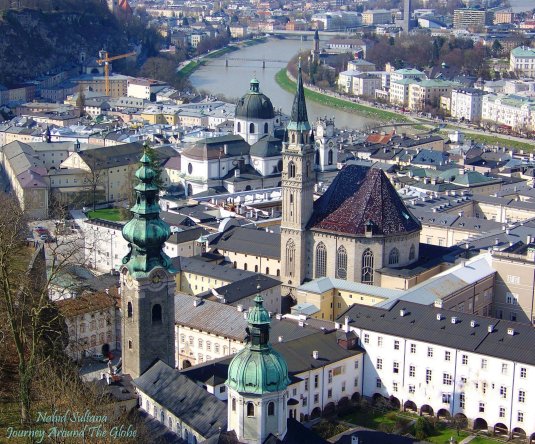
- Stunning view of Salzburg from Hohensalzburg Fortress
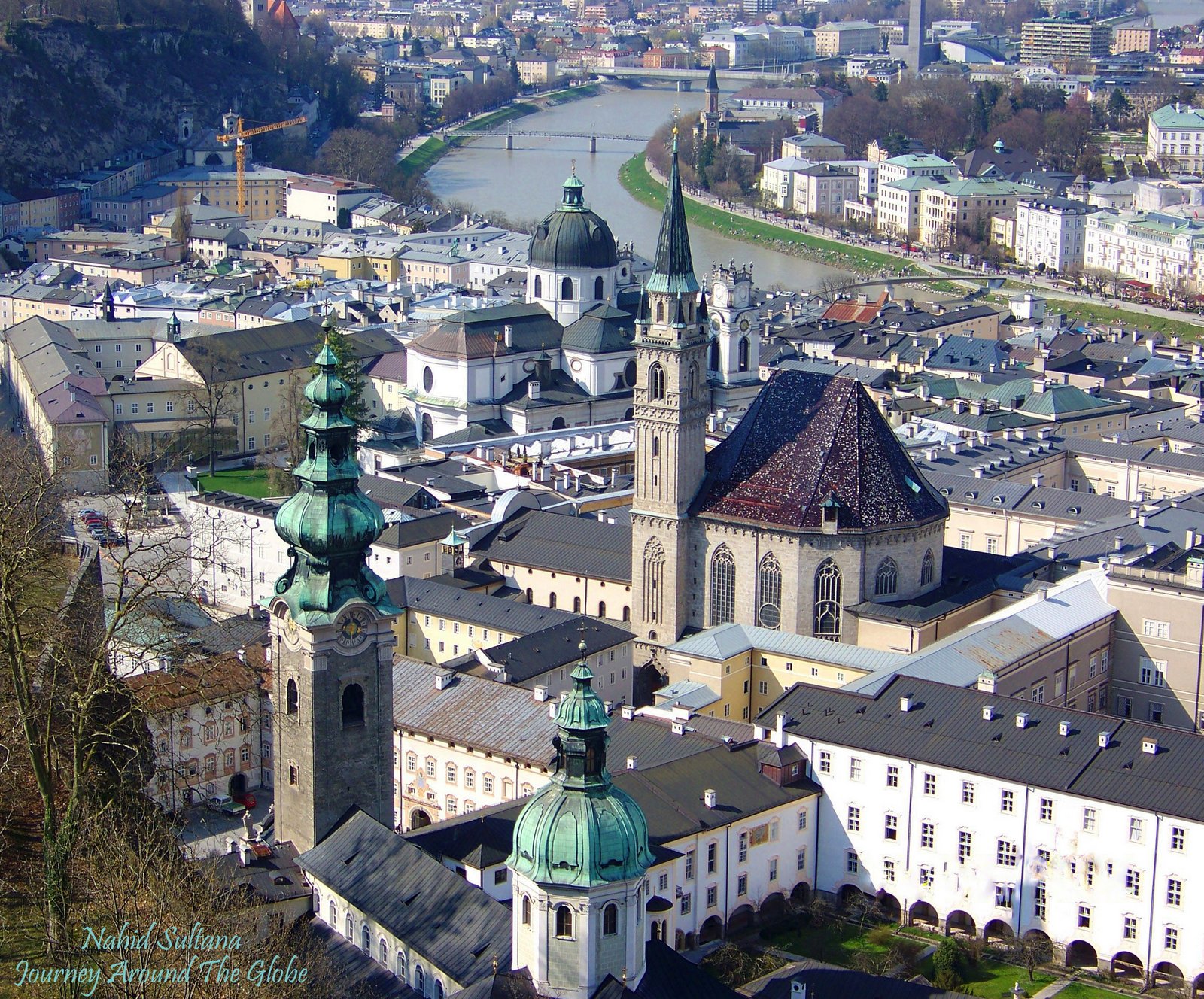
We took a funicular or “Festungsbahn” to go up to the fortress. I am not sure if you can walk up there but that would be quite hard as the mountain is a bit steep.
11) SCHLOSS HELLBRUNN: We didn’t really see whole of this place. As I mentioned above that we took “Sound of Music” tour the day we visited Salzburg. Our tour bus brought us here to show the famous gazebo from that movie where the song “I am 16, going on 17” was shot. It was a short visit but looked very beautiful even in winter with some gardens and little parks. This was originally the summer palace of Archbishop of Salzburg. I am guessing you easily can spend half a day or a day strolling around the garden, parks, and fountains…a perfect place for families with children.
- The famous gazebo from the movie “Sound of Music” where the song “I am 16, going on 17” was shot, in Schloss Hellbrunn, Salzburg, Austria
Share this:

Few Hours in Innsbruck, Austria
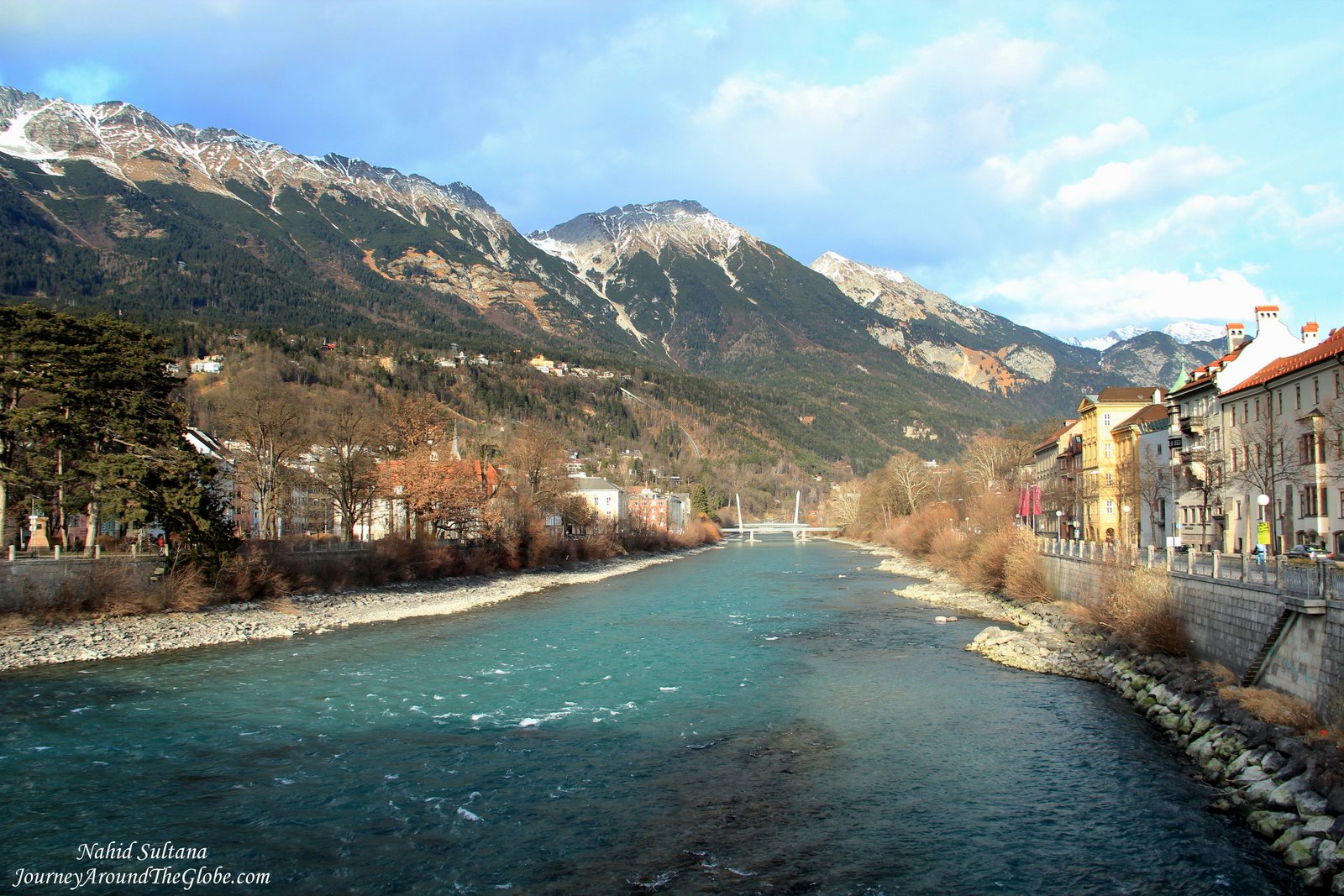
INNSBRUCK, AUSTRIA: Surrounded by the beautiful Alps and its snow-capped peaks, Innsbruck is a place to be at any time of the year. It’s a paradise for winter sports lovers for being surrounded by gorgeous mountain ranges. The city is known for alpine sports opportunities, especially in winter. Winter attracts more people in Innsbruck from all around Europe and the world. It hosted couple Winter Olympics before and winter sports are part of this city’s culture and pride.
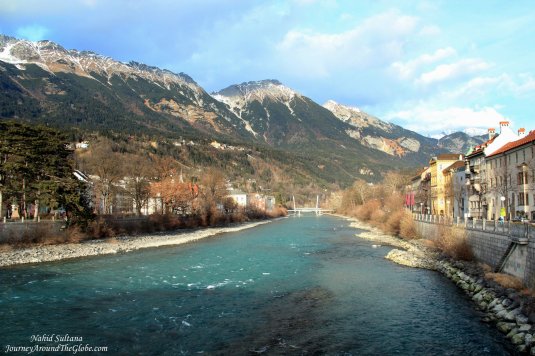
- River Inn running thru Innsbruck with the Alps surrounding the town
For us, we had only few hours here and we stayed mainly in the old town which is an absolute charmer. There are tons of things to do in Innsbruck, especially for energetic athletes. Other than many historic landmarks, middle age buildings in old town, and lively city life, it has the largest ski resort in the Alps.
There is a parking structure very close to the old town where we parked our car. Old town can be covered on foot and you see a lot more doing it that way. If you don’t speak German like me, its ok, all the shops, restaurants, and tourist spots usually have people who speak very good English.
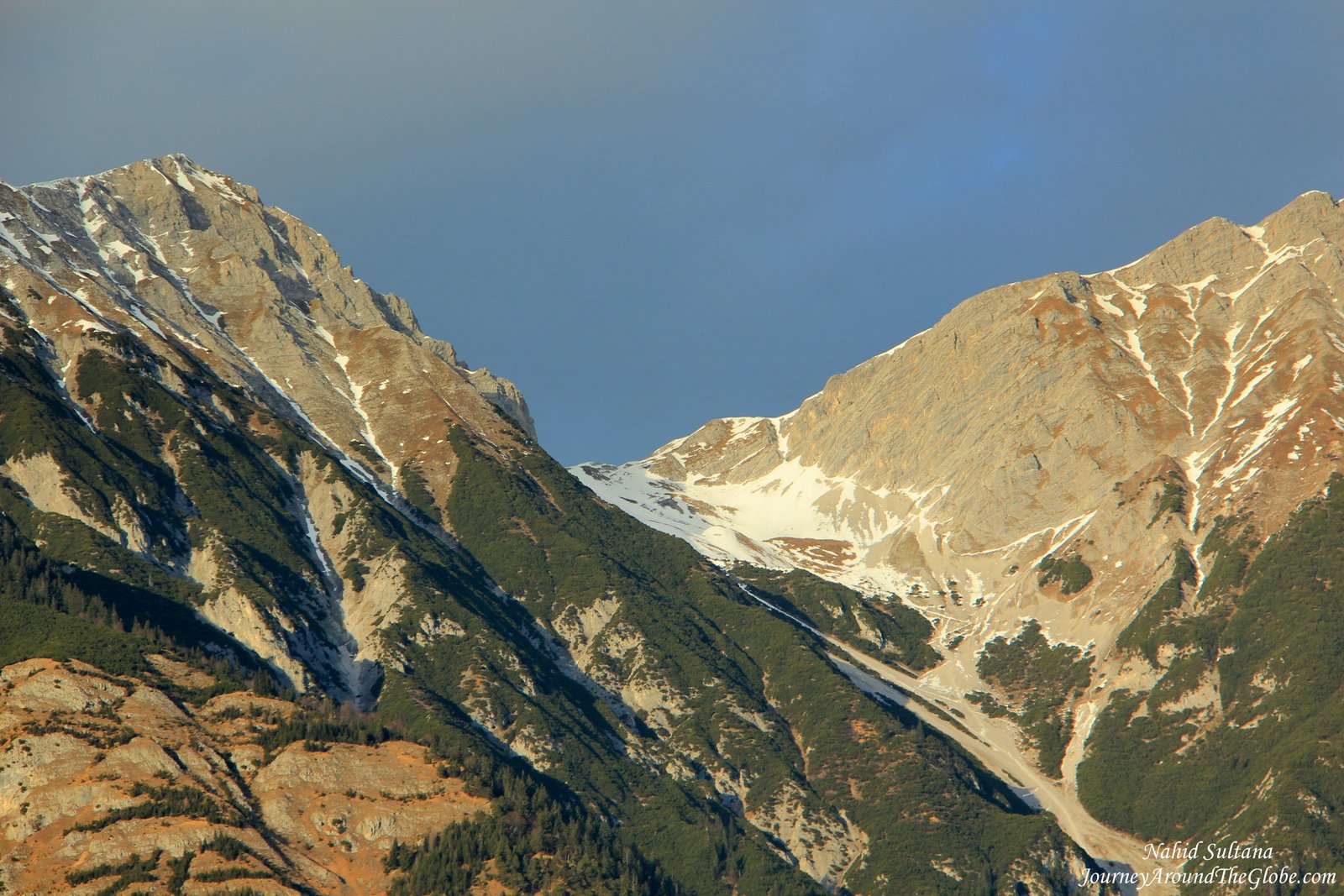
- Austrian Alps in Innsbruck
TIME of TRAVEL: Innsbruck was the second stop in our winter road trip 2013. We started our journey at the beginning of Christmas break. After visiting two famous castles in Fussen, Germany (first stop of this trip) we crossed into Austrian border the same night, stayed in Mieming (a small Austrian town very close to Innsbruck), and drove to Innsbruck next day for few hours before our next destination to Salzburg.
OUR HOTEL: We stayed about little less than an hour drive from Innsbruck in a tiny town called Mieming. Hotel’s name was Pension Café Seelos. The setting of this accommodation was like right out of a romantic book. Surrounded by the mountains, this homely place is in the middle of a quiet town away from any chaotic environment. It had free breakfast, parking and Wi-Fi with few restaurants within walking distance. We were traveling with my uncle-in-law in this trip. He fell in love with this town and hotel instantly and mentioned few times how he wished he could stay there little longer just to wake up close to the mountains and read books leisurely.
EATING and SHOPPING: There are plenty of restaurants and cafés in the old town of Innsbruck. We finished our lunch in Nord See, which is, I think, a German sea-food chain. It’s more like a fast-food type place with much better options and tastier food. We had some hot dishes but there were many take-away options too, like sandwiches and etc.
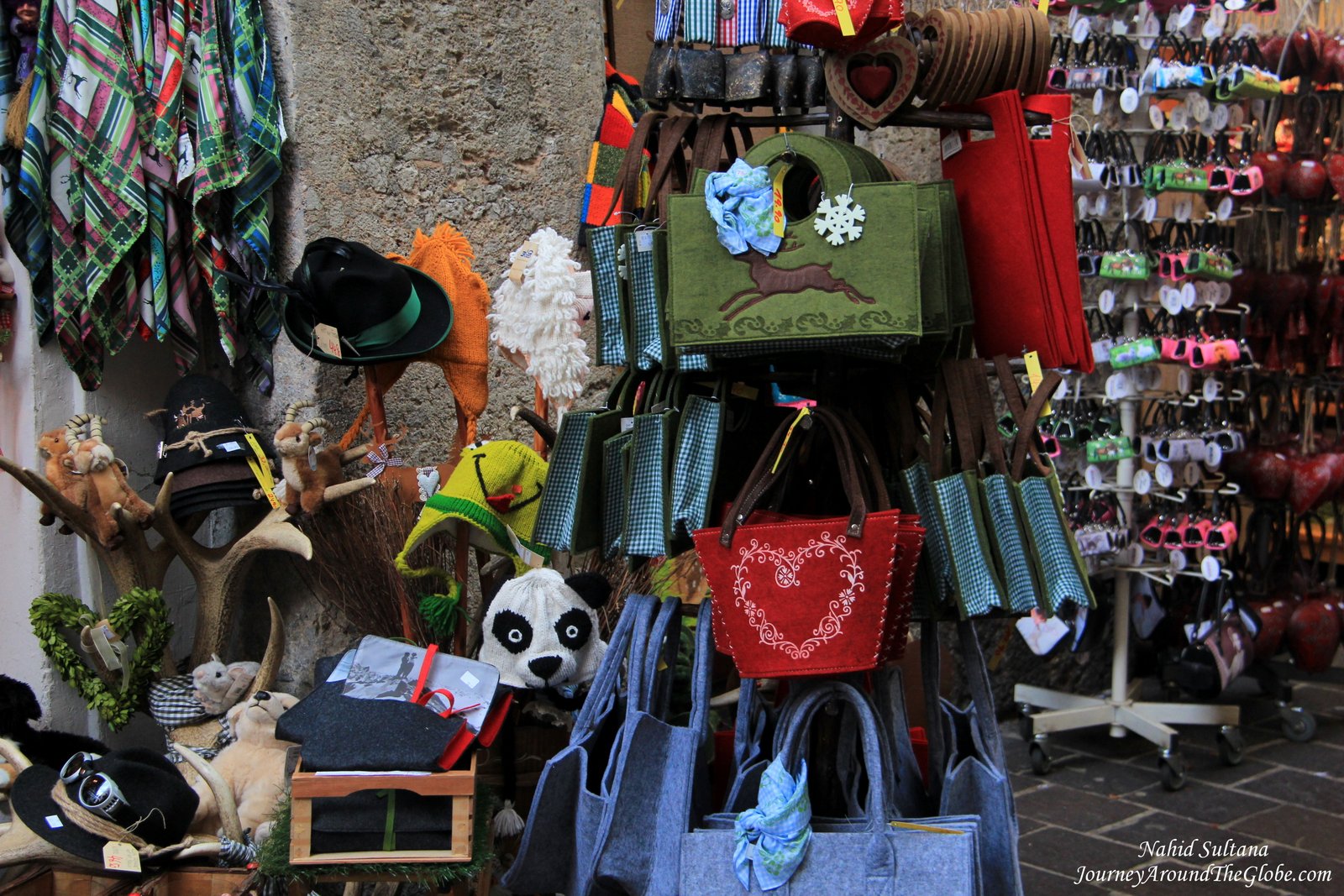
Austrian or Tyrolean hats are pretty famous and unique here. They are very elegant looking, sometimes decorated with feathers or ribbons or ropes. Most of the souvenir shops have these hats along with regular t-shirts, key-rings, and other stuff. We saw many unique Christmas decors during our visit. Winter cloth accessories (like woolen gloves and scarfs), Bavarian mugs, cuckoo clocks are some things you can find in the shops here too.
- A souvenir shop in Innsbruck old town
PLACES WE’VE VISITED: We stopped at Innsbruck on our way to Salzburg and spent few hours just touching only the highlights of this city. Innsbruck has bunch of museums, a zoo, and many historic landmarks within the city limit. If you are more of a nature-lover or like winter sports then you can drive up to the mountains and find some ski resorts. There is also a castle, Schloss Ambras short distance from the city…we haven’t been there but may be worth a visit if you have time.
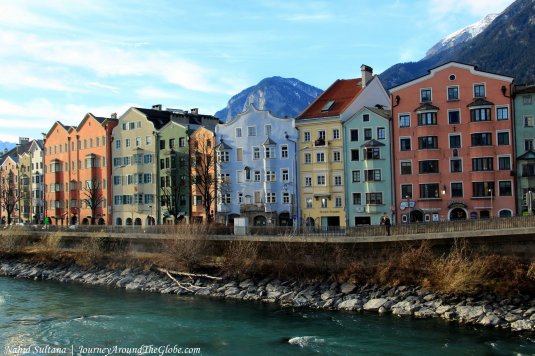
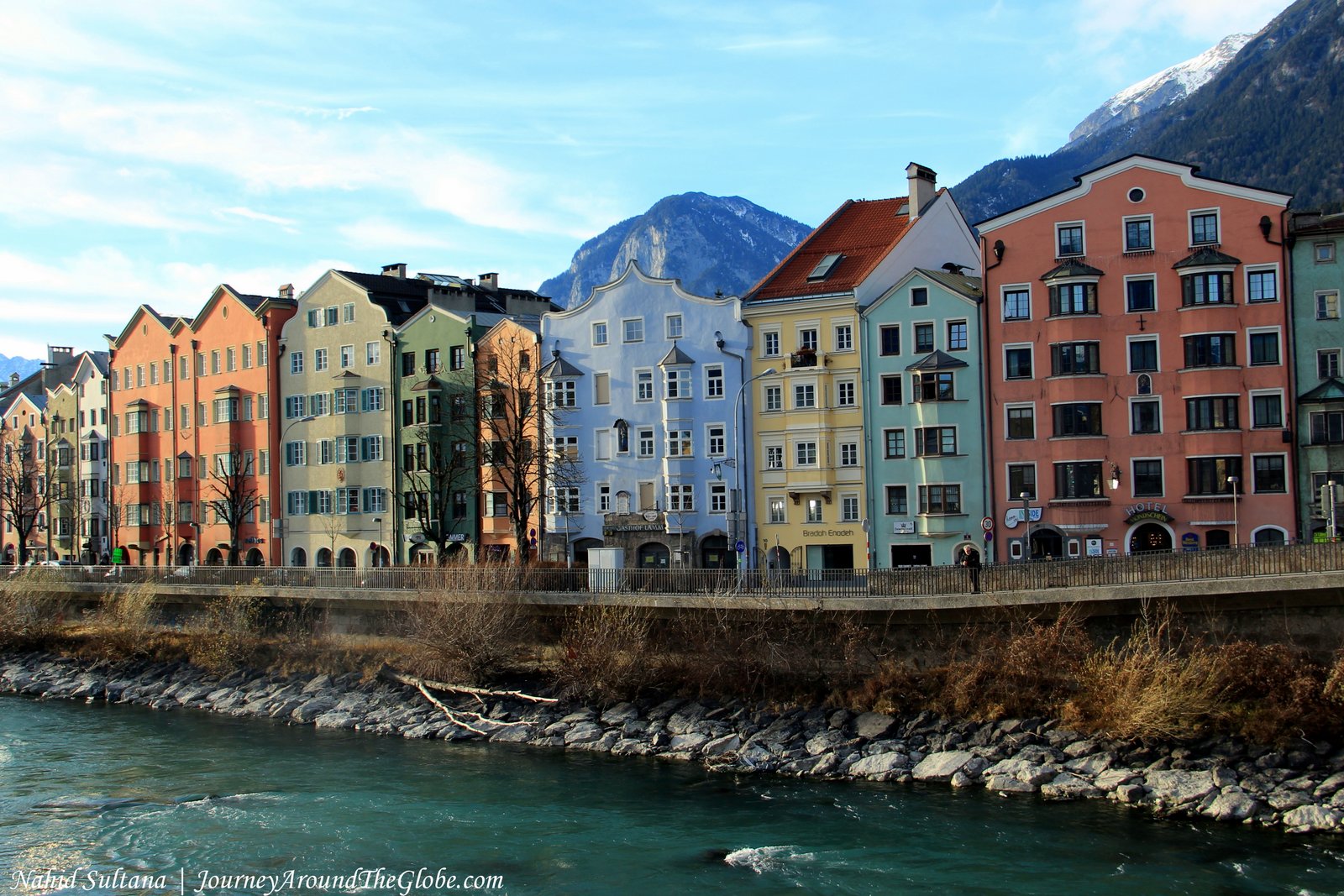
- Innsbruck – a beautiful city by River Inn
1) JESUITKIRCHE (JESUIT CHURCH or UNIVERSITY CHURCH): This was our first stop although wasn’t in the list. The church was erected between 1627 – 1646 with the support of sovereign of Tyrol, Archduke Leopold V, and his wife, Archduchess Claudia de Medici, both of who are buried in the crypt here. It was severely damaged during WWII and looked like a ruin. Much of the interior decoration was lost forever. In 1953 it was newly constructed. Its high dome and white ceiling with detail design are worth seeing.
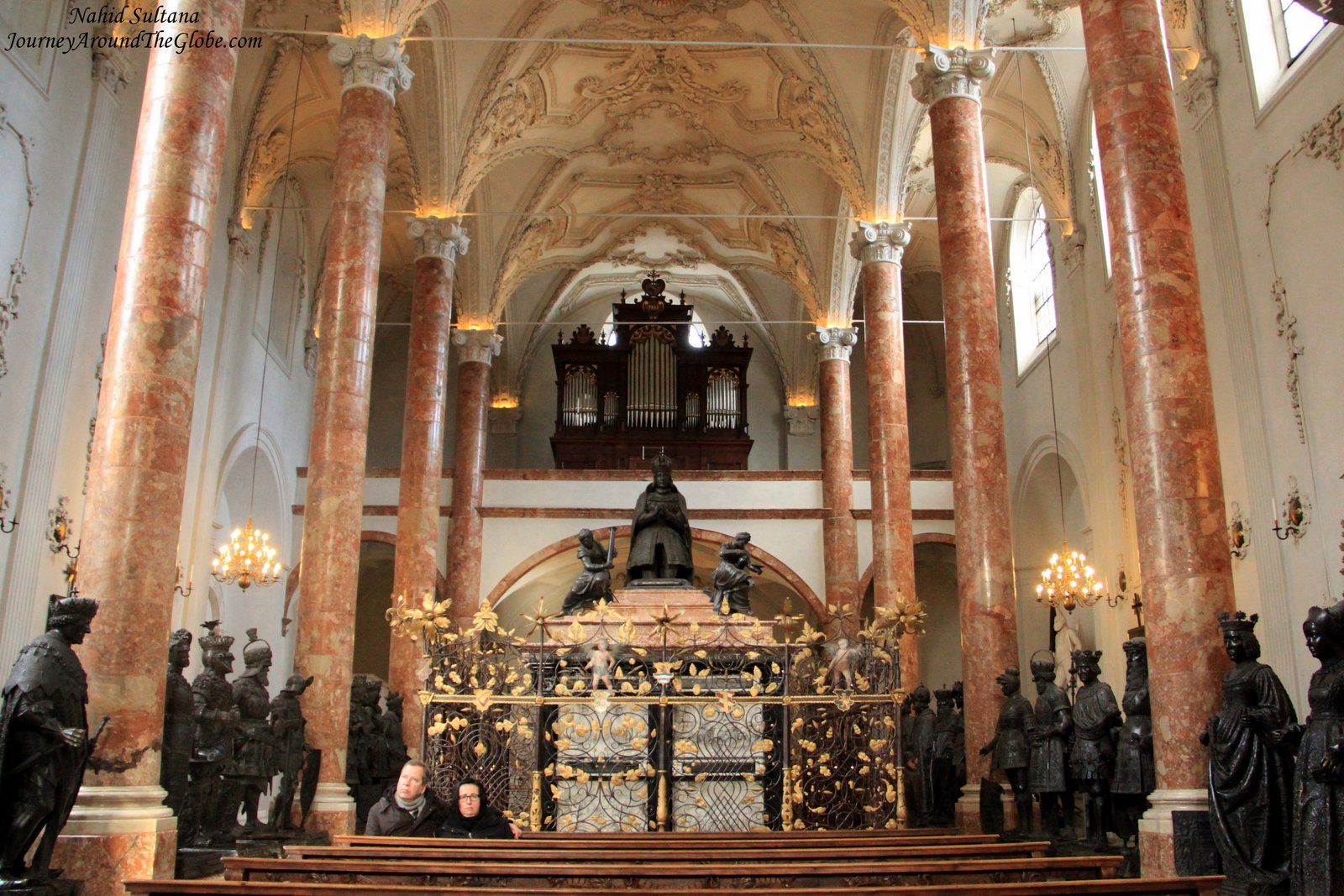
2) HOFKIRCHE: The Innsbruck Hofkirche with the tomb of Emperor Maximilian I is the most important monument in the Tyrol region and the most splendid of all imperial tombs in Europe. It is a product of European courtly art from far more than the German-speaking areas, for which Maximilian I employed the best artists of the period. King Maximilian I’s decorative tomb is enclosed by some real-size bronze statues that show members of different dynasties. It is a gorgeous church with grand interior and a must-see in Innsbruck.
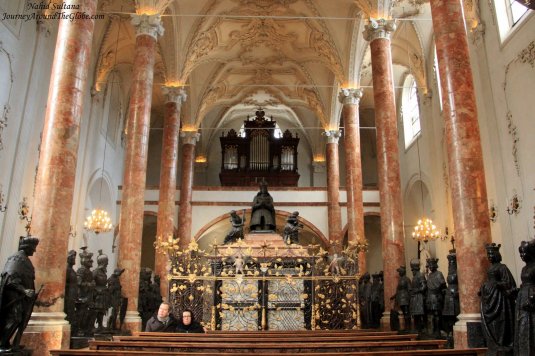
- Hofkirche with the tomb of Emperor Maximilian I in Innsbruck, Austria
Although we didn’t go to Tyrolean Museum of Popular Art, it is in the same building with Hofkirche. It houses the biggest and most significant cultural heritage collection in Tyrol and offers an insight into the diversity of the arts and crafts from “Land in the Mountains”.
It’s open from Monday to Saturday from 9 to 5 pm and Sundays and holidays from 12:30 to 5 pm. There is a fee to enter the church, but we were there on Christmas Eve and it was free that day.
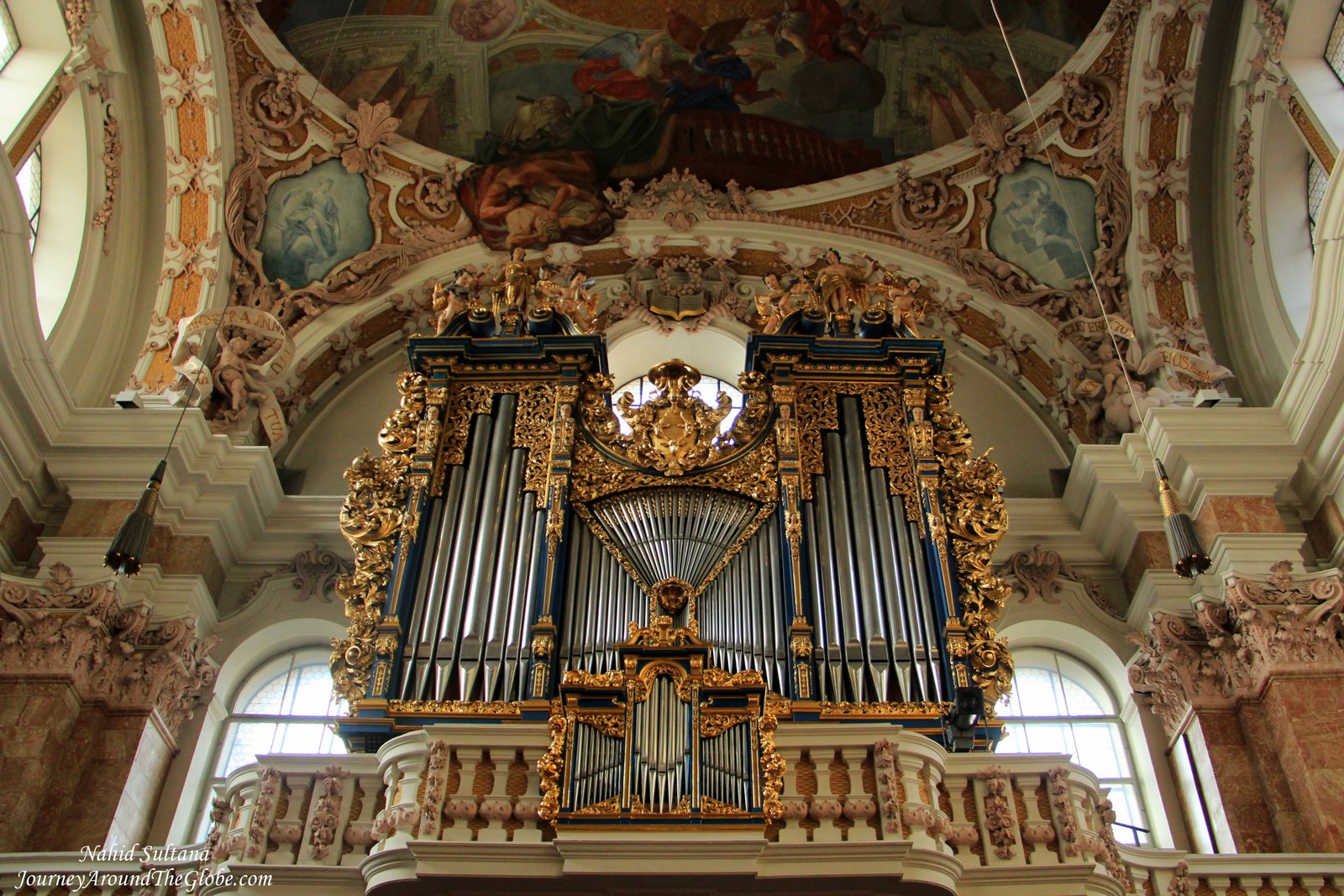
3) ST. JACOB CATHEDRAL: This is probably the most beautiful church/cathedral in Innsbruck. Few minutes’ walk from Hofkirche, St. Jacob Cathedral is a Baroque style architecture that deserves attention. Its gorgeous ceiling, fancy vaulted dome, ornate high altar, dazzling organ, frescoes, and pulpit make this cathedral one of the most exemplary works of Baroque interior in whole of Austria.
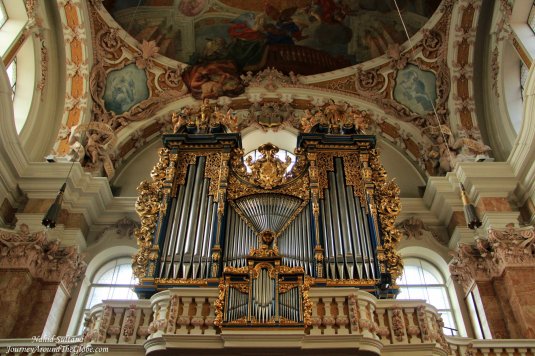
- Grand organ and beautiful ceiling of St. Jacob’s Cathedral in Innsbruck, Austria
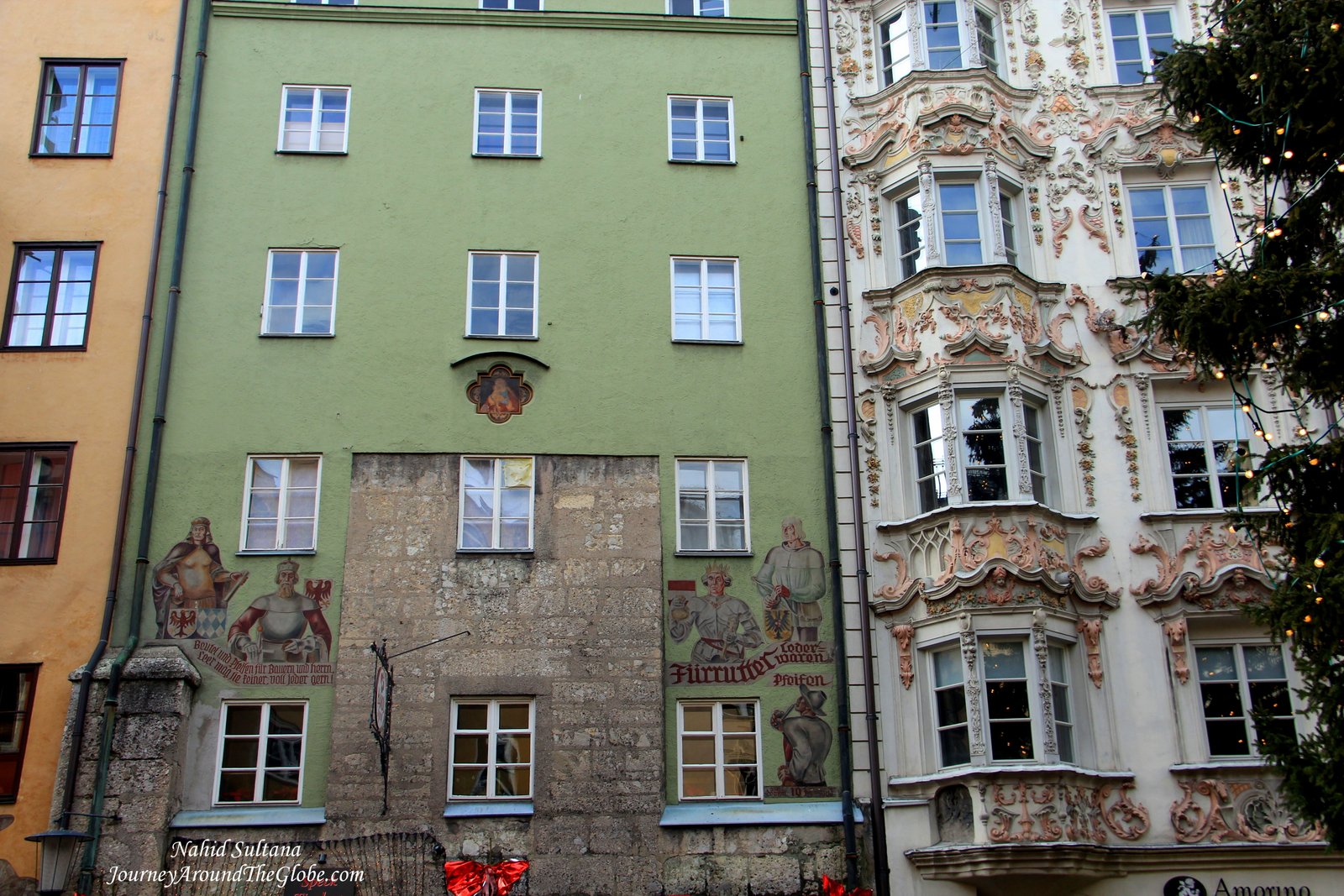
4) HERZOG-FRIEDRICH-STRASSE and GOLDEN ROOF (GOLDENES DACHL):Herzog-Friedrich-Strasse was the old town’s main street once, now a pedestrian zone. Some artistic old buildings decorate both sides of this cobbled-stone street.
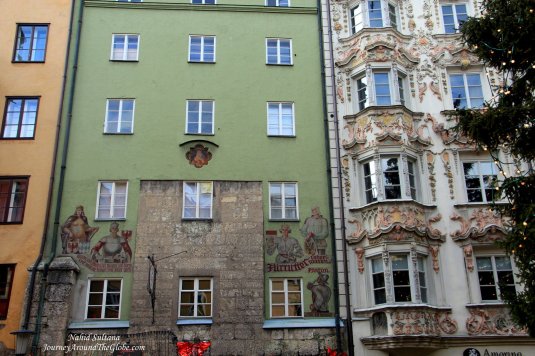
- Some beautiful buildings in Herzog-Friedrich-Strasse in old town of Innsbruck
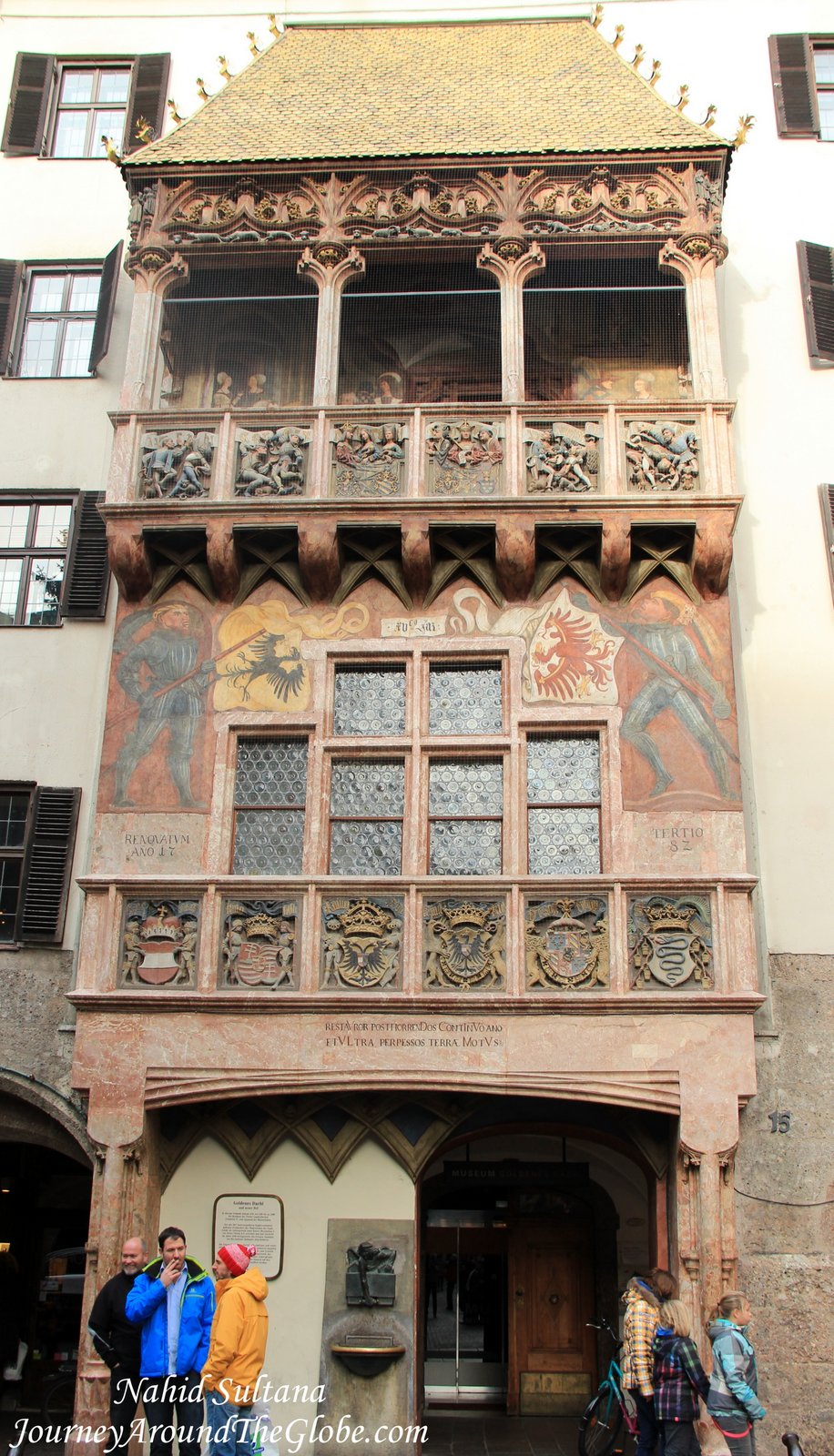
At one end of Herzog-Friedrich-Strasse, is the Golden Roof. It is a historic building from 1420 and was built on behalf of King Maximilian I. It has a beautiful façade with 2657 fire-gilded copper tiles. There is a museum if you want to go inside, we just saw it from outside and loved its marvelous façade.
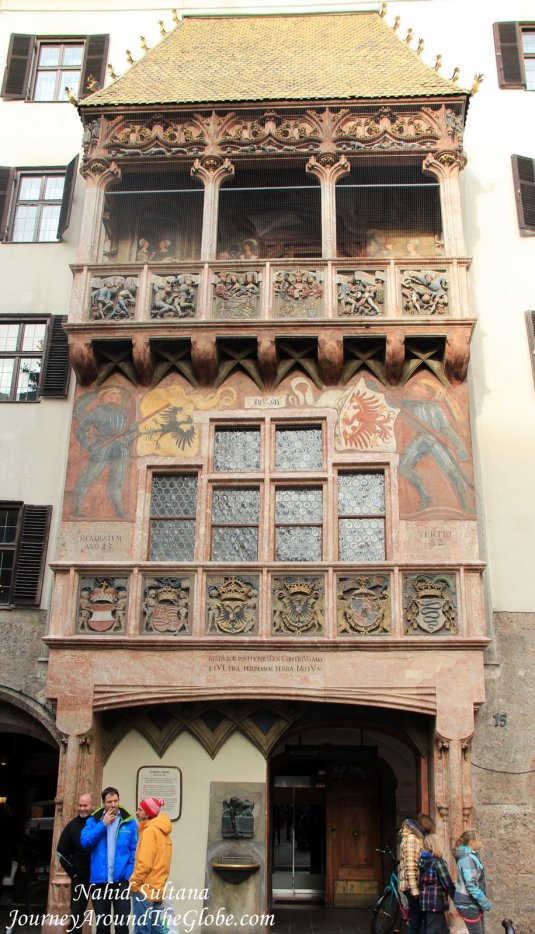
- Golden Roof on Herzog-Friederich-Strasse in Innsbruck, Austria
5) MARIA-THERESIEN-STRASSE and ST. ANNA’S COLUMN: Across the street from Herzog-Friedrich-Strasse, is Maria-Theresien-Strasse. This is the central pedestrian area and a picturesque boulevard of Innsbruck. What makes this street beautiful is the prominent mountains range in the backdrop and its historic colorful buildings. There was a Christmas market here when we visited. Many shops and restaurants make this place a perfect gathering point for the locals and the tourists.
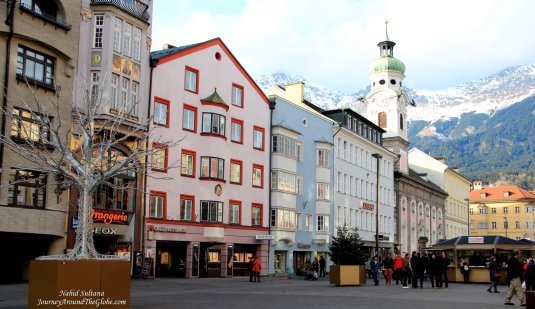
- Maria-Theresien-Strasse – a picturesque pedestrian street of Innsbruck
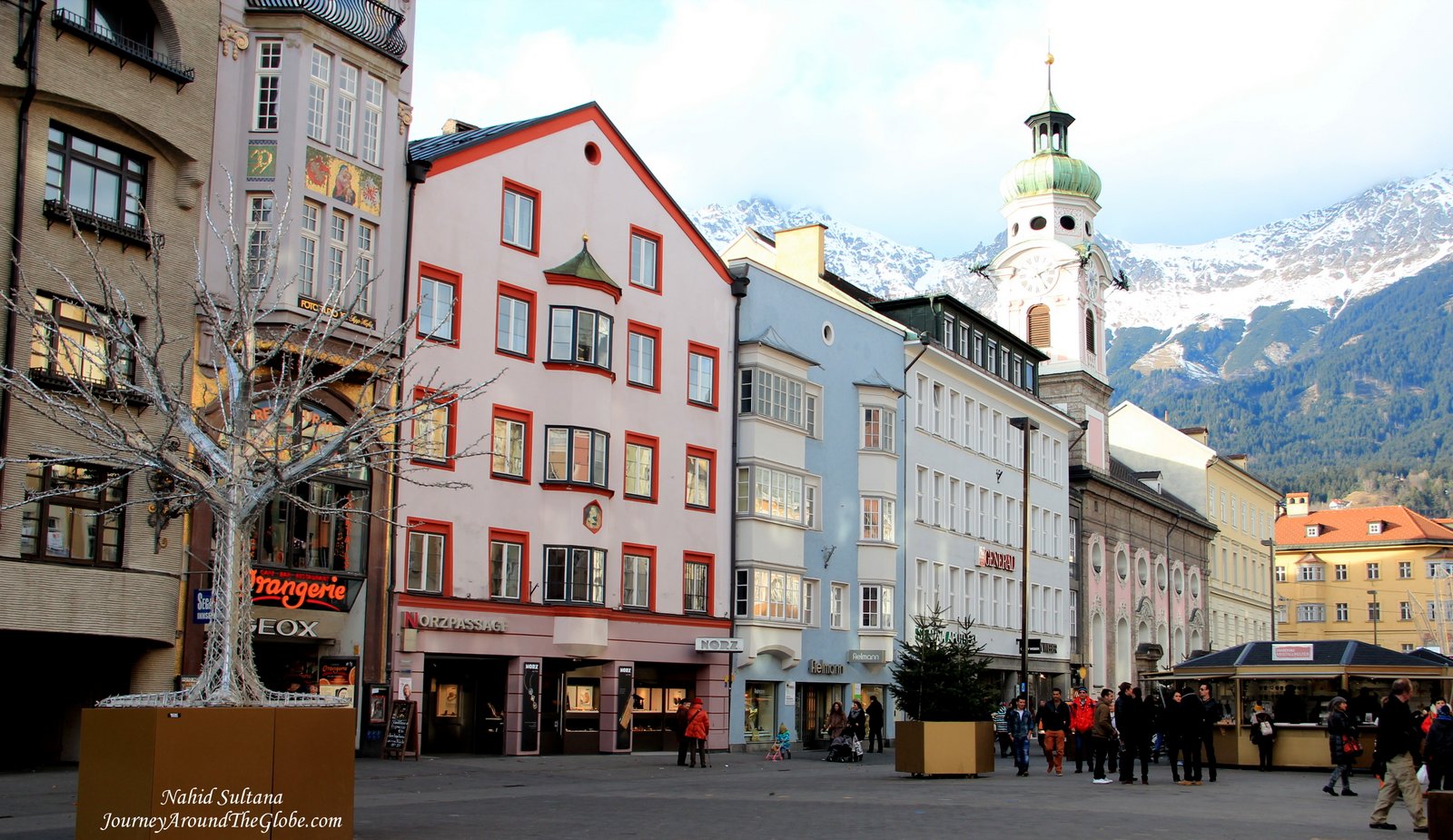
In the middle of this street stands St. Anna’s Column. It was built in 1706 using Tyrolean marble. I loved this part of Innsbruck where hustling city collides with the beauty of Alpine nature…it is an absolutely breathtaking spot.
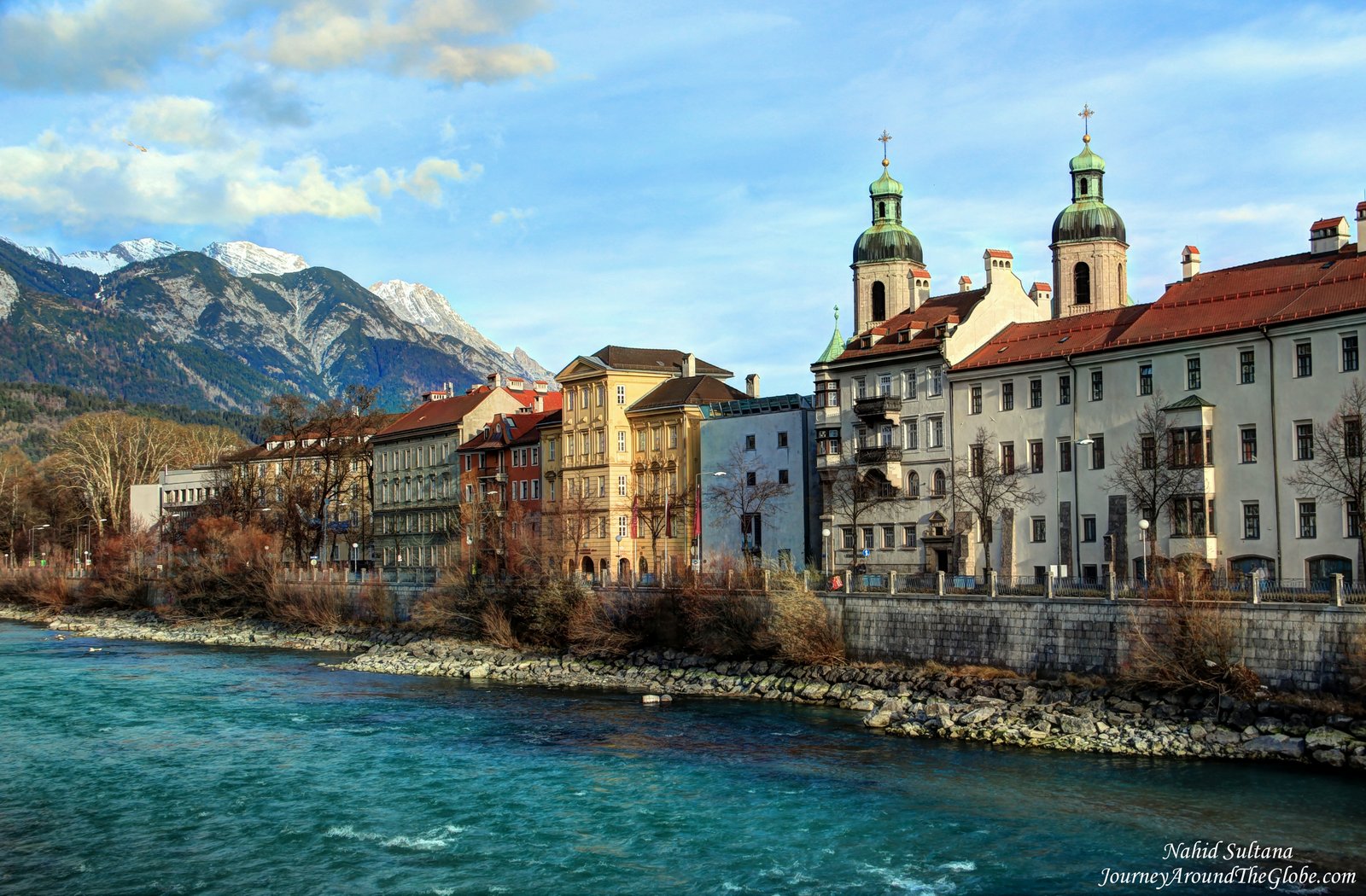
6) RIVER INN and INN BRUCKE: There is a bridge, Innbrucke, over River Inn few steps away from Zerhog-Friedrich-Strasse from which the city adopted its name. There isn’t much to do here except for enjoying the stunning view of River Inn, the mountains, a flourishing city, and colorful buildings by the river. We crossed the bridge, Innbrucke (it’s for both pedestrians and cars) and came back to old town within few minutes. It is a lovely sight and shouldn’t be missed. It’s a slice of Tyrol’s natural beauty within the city.
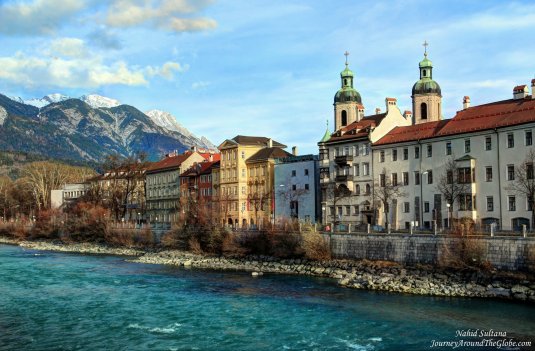
- Standing on Bridge Innbrucke and enjoying this beauty in Innsbruck
Share this:

Castles of Fussen, Germany
FUSSEN, GERMANY: Our main purpose of going to Fussen was to visit the two castles on the mountains of Bavarian Alps here. It’s a shame that we left this magnificent little town unexplored. A small village of Fussen, Hohenschwangau, is situated at the foothills of Alps in southern Germany very close to Austrian border. This is where the two castles, Hohenschwangau Castle and King Ludwig II’s fairy-tale looking Neuschwanstein Castle are located. It’s a beautiful lake district with breathtaking views at every corner. You can get glimpses of those blue water bodies from here and there as you walk up the mountains to visit these castles.
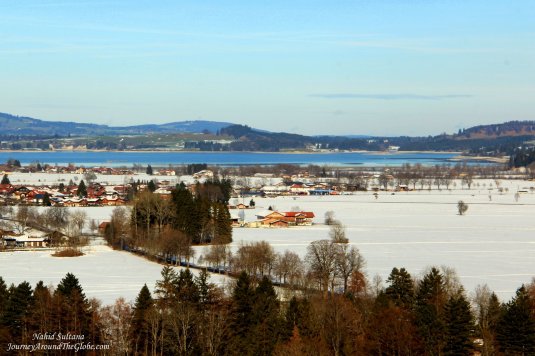
- Stunning view of Fussen and its surroundings from Hohenschwangau Castle in Germany
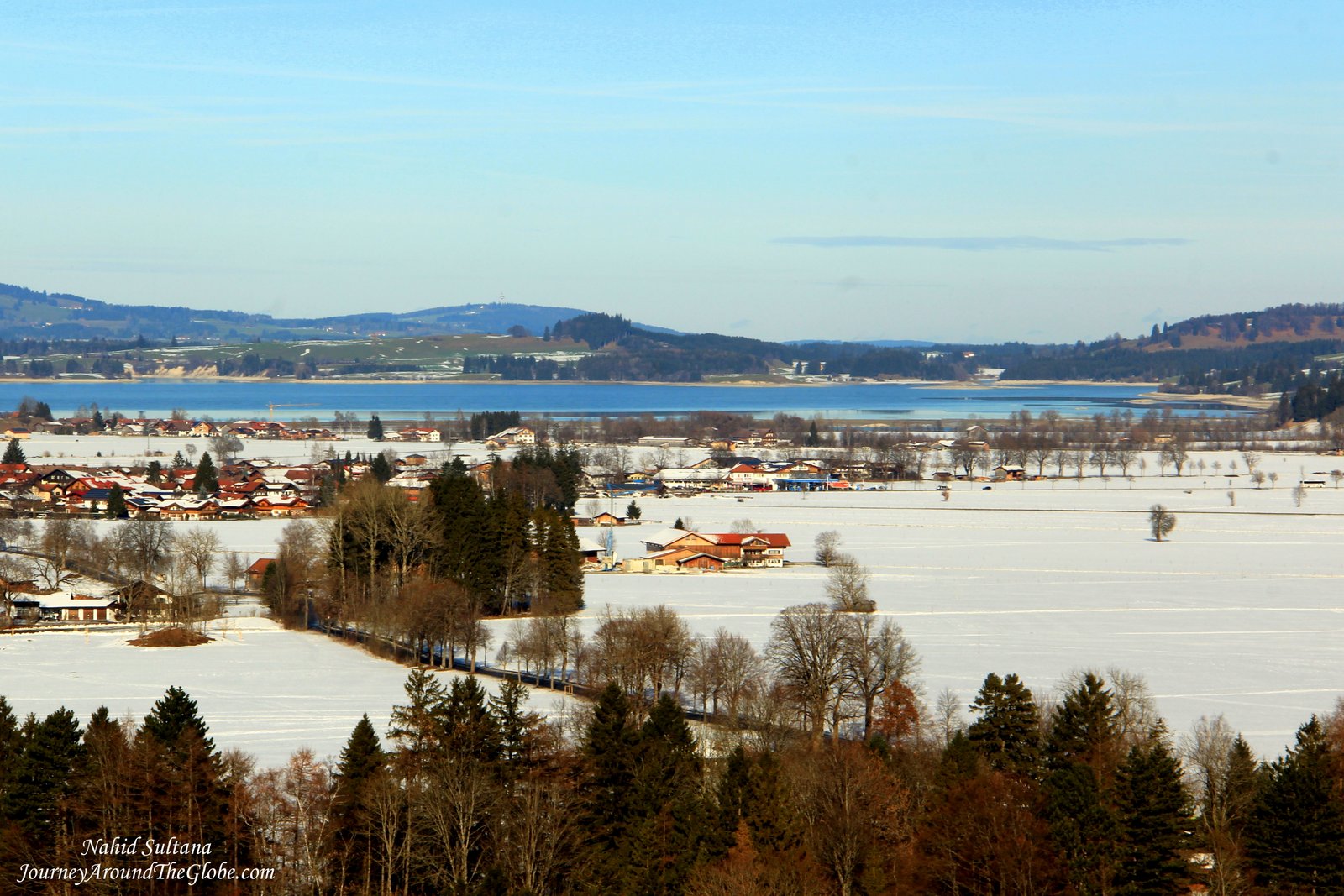
Other than the castles, there is also a museum, Museum of the Bavarian Kings, where we did not go. Also look around the visitor’s center while enjoying a hot drink (if you are there during winter), go to the city center of Schwangau (couple minutes of drive from here), or if you have time drive to the surrounding lakes or mountains, I am sure they offer tons of activities there too. Also to mention that this is the southernmost spot of the “Romantic Road” which run through Germany.
- Loved the wintry look of Bavaria…classic
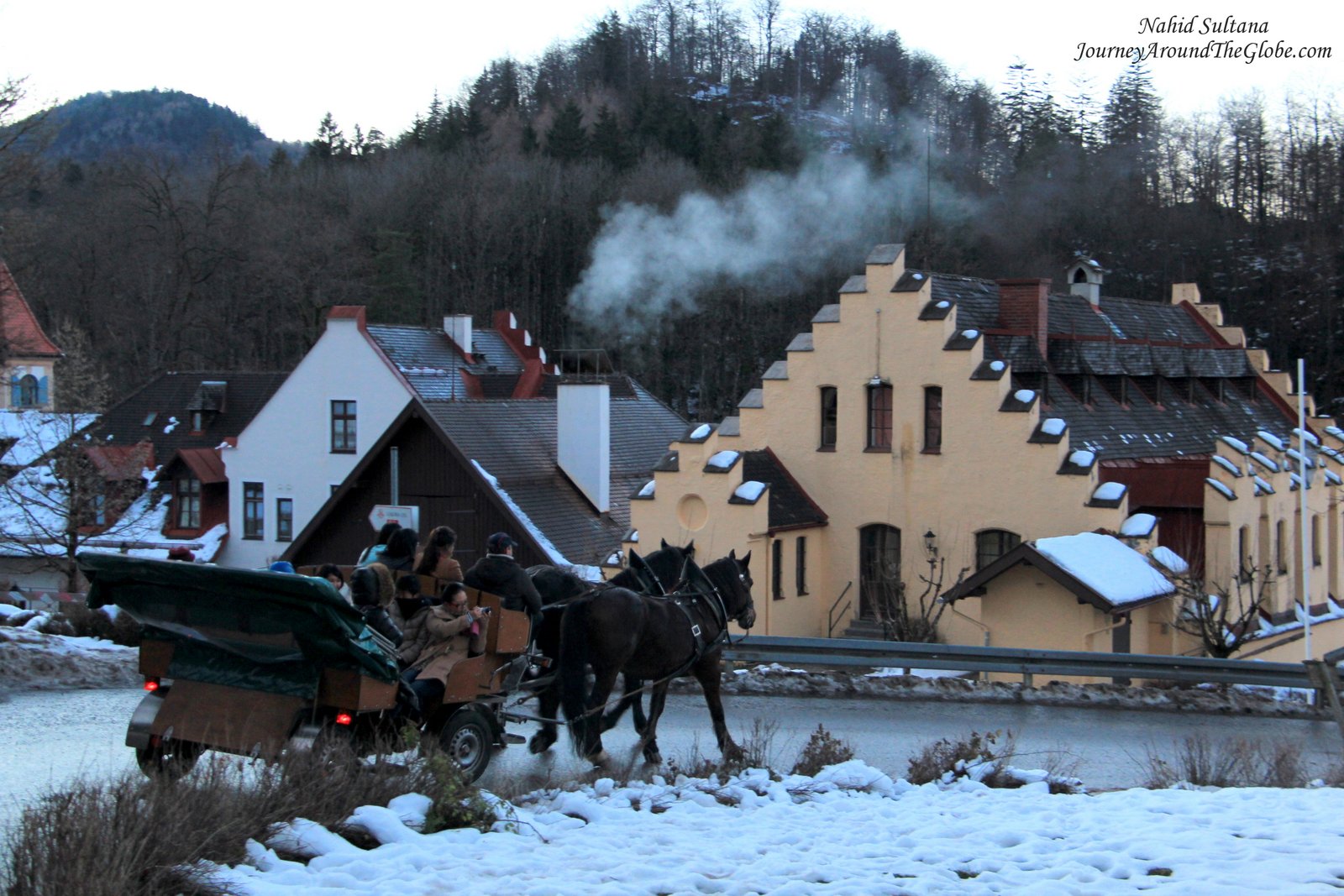
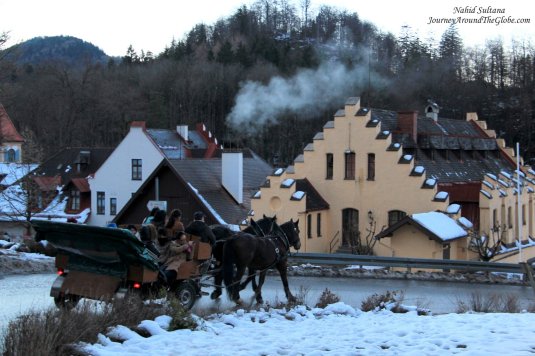
Hohenschwangau and Neuschwanstein castles stand on two separate small hills. There are total of 3 castles in this area, but only these two are accessible to the publics. We walked for about half an hour from Hohenschwangau Castle to go to Neuschwanstein Castle. Honestly, it was a bit hard for me to climb the long stretch of hill to go the 2nd one. If you have time and can wait for a horse-carriage, maybe it’s better and more enjoyable, but you still have to walk another 15 minutes towards the entrance after they drop you off on the top. But we didn’t have much time in between the tours of these castle, so we couldn’t stand in the long line for horse-carriage and had to rush to the other castle.
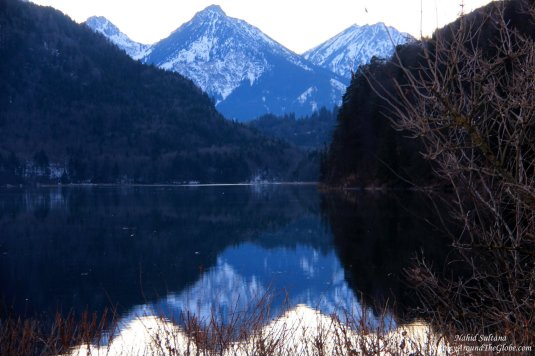
- The Alps and its reflection on Lake Alpsee in Fussen, Germany
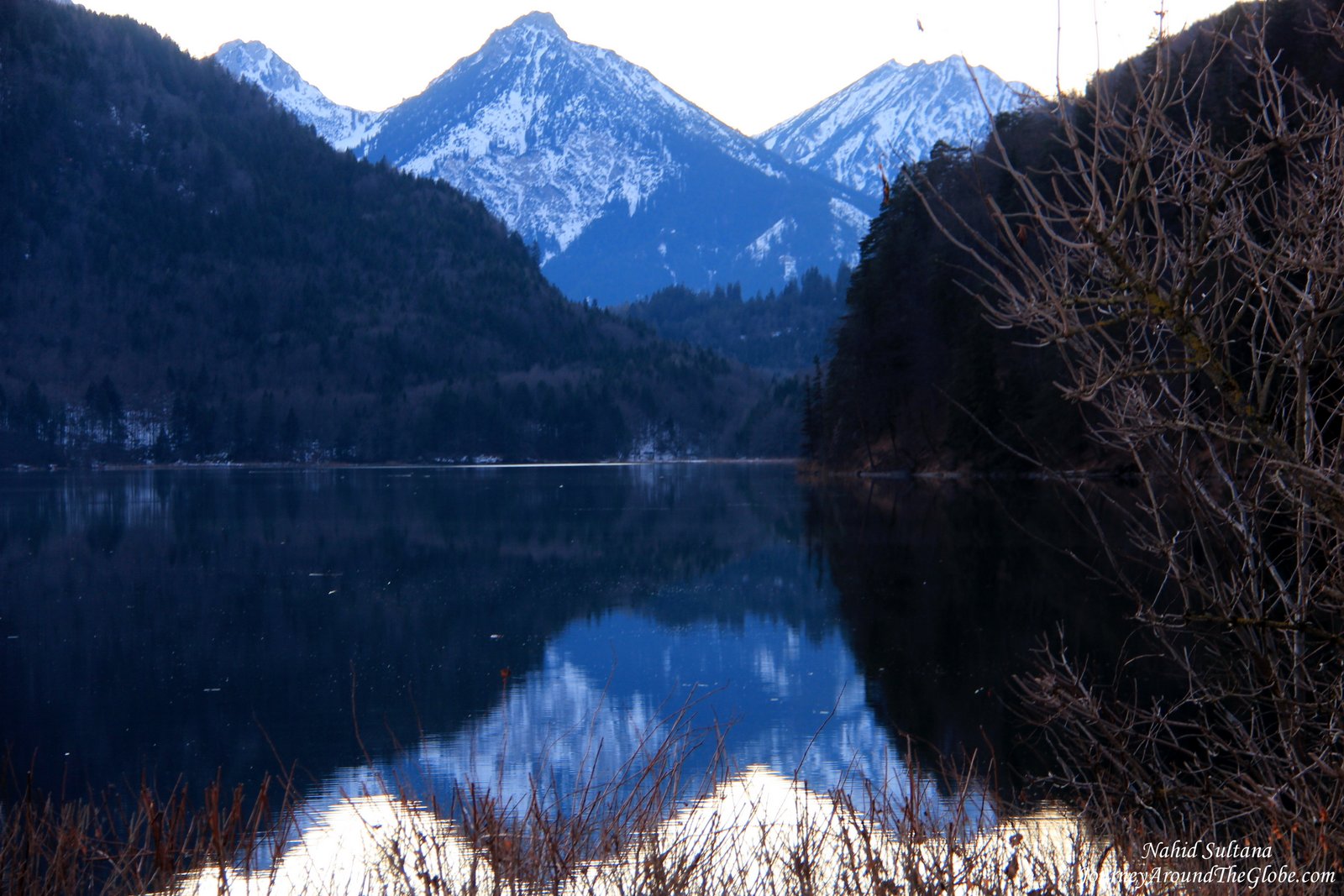
There is a big parking lot for the visitors of these two castles. There is also a beautiful lake, think it’s called Alpsee, by this lot where you can get a stunning view of portion of Bavarian Alps with its beautiful reflection on the water.
TIME of TRAVEL: During Christmas break of 2013, we took 2 weeks long road trip thru the Bavarian region of Germany and Austria, then to Czech Republic, and finally driving up north to end up in the eastern part of Germany. My uncle-in-law from Chicago was here with us for this wonderful trip. Visiting these two castles in Fussen, Germany was the first spot in our itinerary. It is a winter wonderland near the Alps in December. You can see snow on the ground, snow-capped mountains in the far distance, and skeletons of trees in the forests. It is a beautiful place to visit any time of the year. But don’t think you will find less crowded just because you are coming in winter. Everyone was bundled up and ready to enjoy the nature and history of this place.
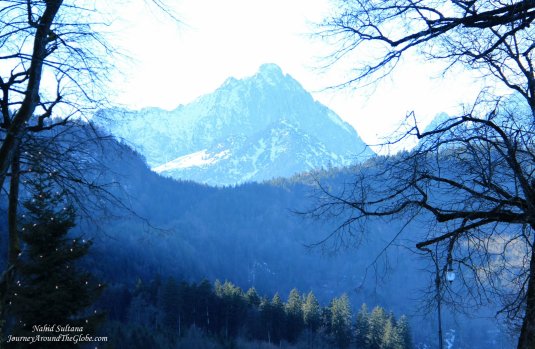
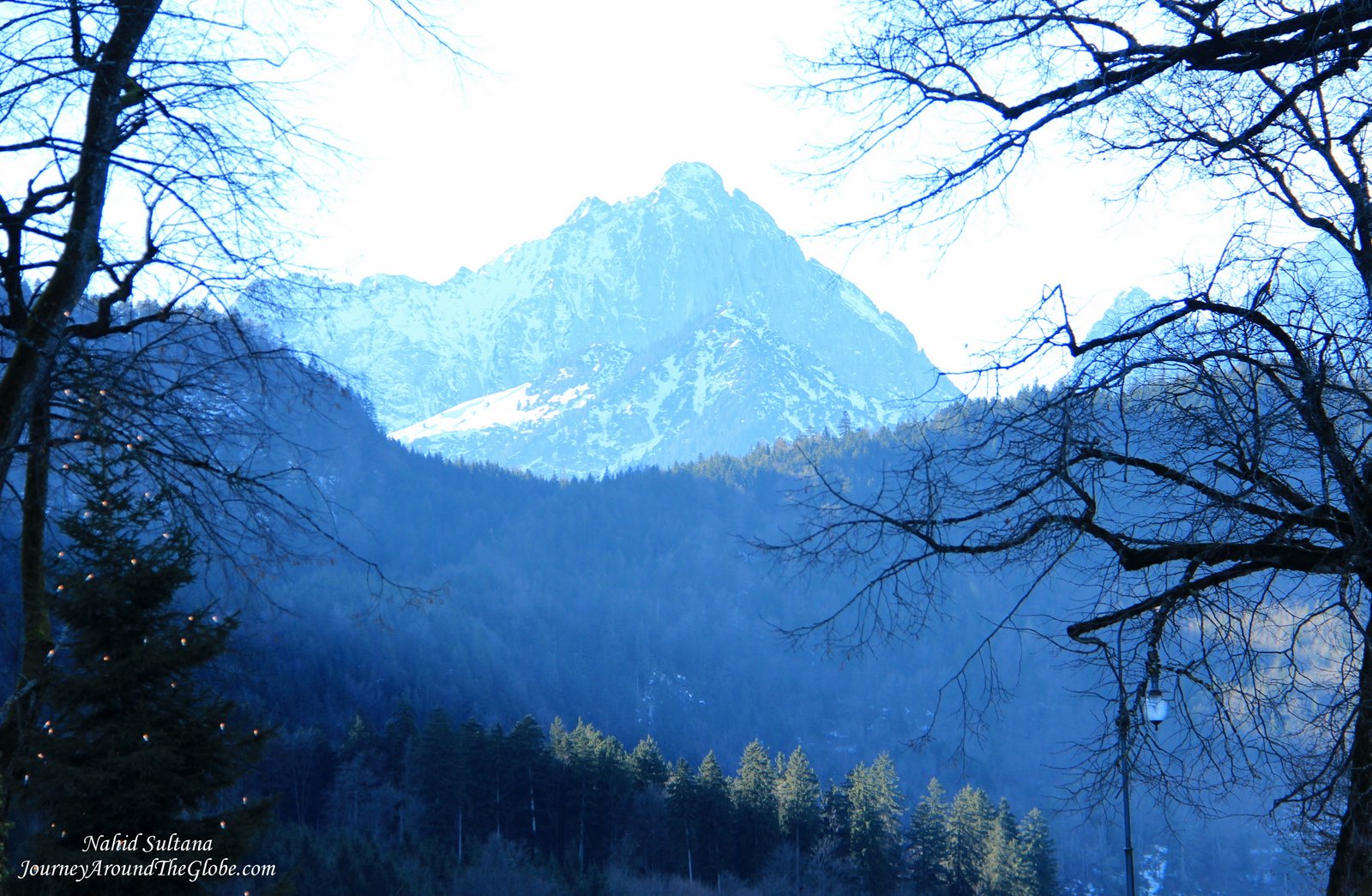
- Mountains, mountains, and more mountains
EATING and SHOPPING: There are plenty of snack bars and restaurants near the tourist center of the castles. We actually picked up some sandwiches while going up the mountain towards Neuschwanstein Castle. But there were plenty sit-down and formal restaurants if you prefer that.
There were some souvenir stores in Hohenschwangau visitor center where you can get local t-shirts and etc. with some typical Bavarian items like beer mugs, wooly hats and gloves, sweet treat, and many more.
PLACES WE’VE VISITED: We reached Fussen around 10 in the morning and by the time we were done with both the castles and lunch in between, it was about 5pm. It was almost dark outside by then. But if the kids weren’t tired, maybe we could have spent some time in the surrounding areas before driving to our next destination…Innsbruck.
Please keep in mind that tickets for these below castles are not sold at the individual castles, rather in the visitor center. My husband actually booked them online way before our trip there. It is advisable to book tickets online else you run the risk of either standing in a long queue in the visitor’s center or missing out completely due to heavy crowd. You can visit either only one of the castles or both or a combo of both castles and the museum. Visit to these royal castles are only possible with guided tours and there are many different language tours available. Tours to both of this castles last about 30 to 45 minutes each.
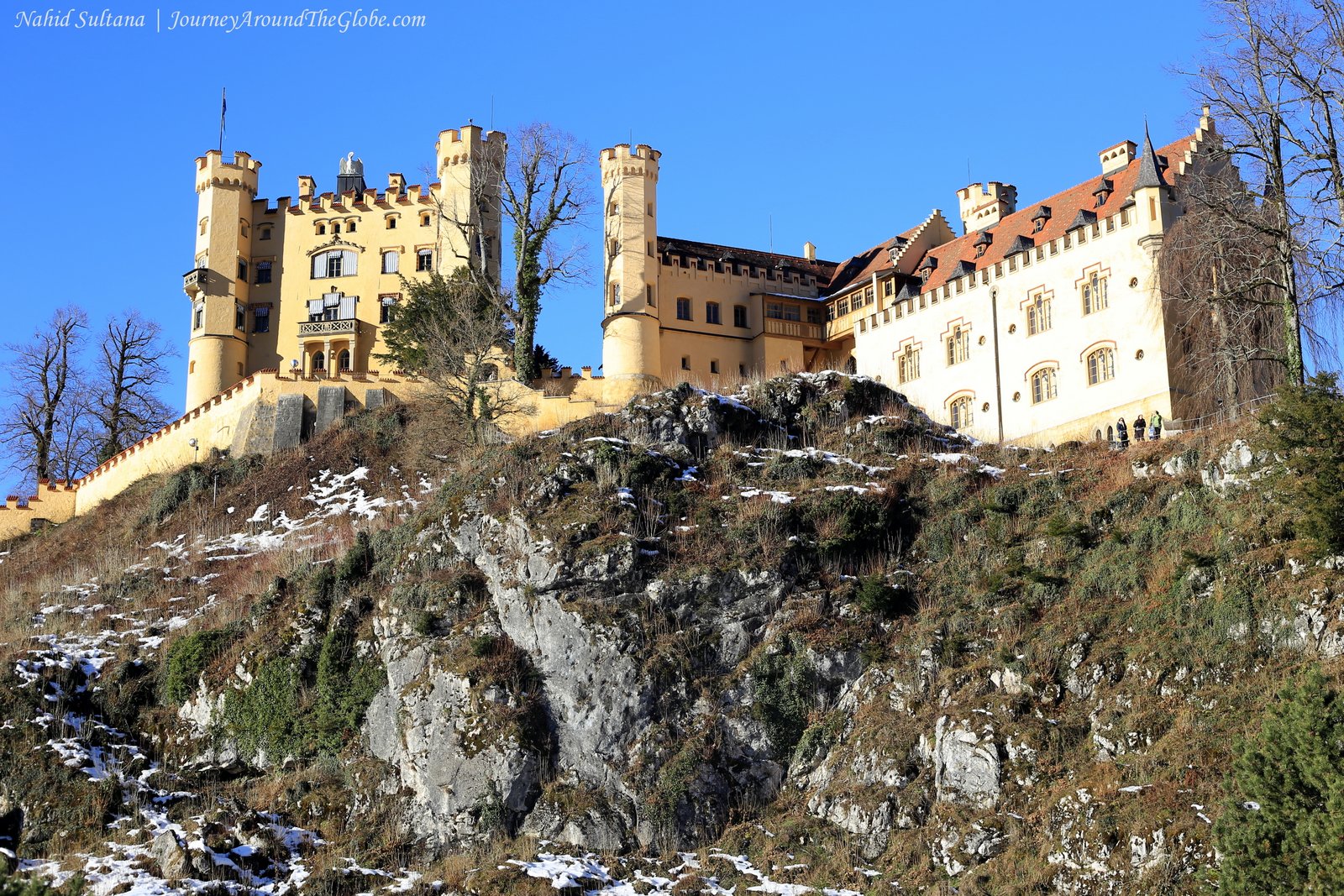
1) HOHENSCHWANGAU CASTLE (SCHLOSS HOHENSCHWANGAU): This castle in the Southern Germany was built by King Ludwig II’s father King Maximilian II in the 19th century where Ludwig II spent his childhood with his family. The castle was constructed on an early fortress from the 12th century that was built by the knights. It served as their summer residence during the reign of King Maximilian II.
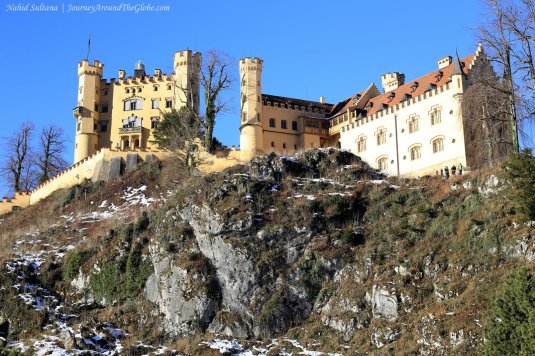
- Hohenschwangau Castle, built by King Maximilian II of Bavaria in southern Germany
The castle is worth visiting for its new Gothic style façade, artistic ceilings, wall paintings, decorative pieces and furniture, portraits and wall frescoes from the mid-19th century, and the royal Banquet Hall. You can see the original billiard board in the Dining Hall from the early 19th century. Visitors can still see the antique items here since it didn’t suffer any damage during WWI or WWII.
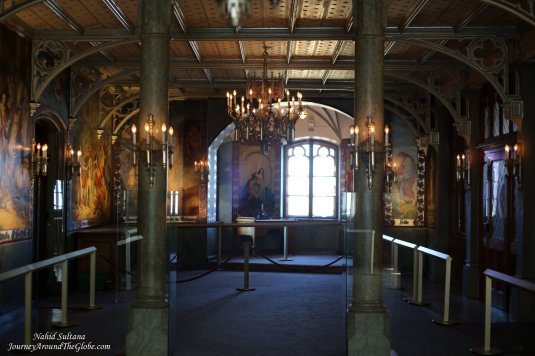
- Inside Hohenschwangau Castle, the guide let me take only this picture
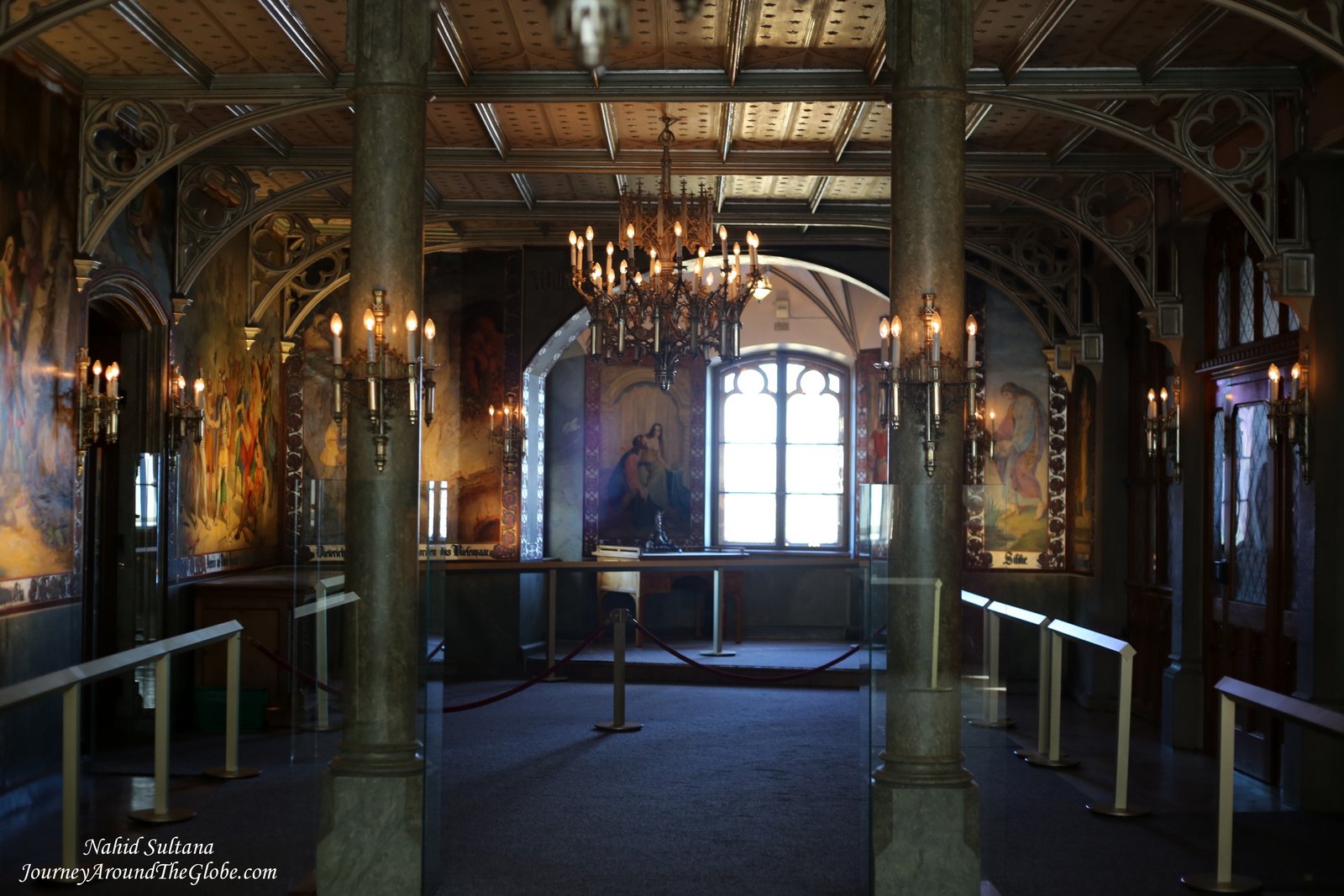
The castle is located in the village of Hohenschwangau in Fussen. The guided tour was for about 45 minutes and we were not allowed to take any pictures inside. But as I mentioned above, do plan to buy your tickets online or early to save a space for you.
2) NEUSCHWANSTEIN CASTLE (SCHLOSS NEUSCHWANSTEIN): This is the mother of all German castles and is the most photogenic castle of this country. Beautifully situated on the south Bavarian Alps surrounded by green forests, blue lakes, and snowy mountains, this is known to be the most visited castle in Germany. It is one of the most famous buildings in the world and a central symbol of German idealism. By the way, this castle was the inspiration for Disneyland’s Sleeping Beauty Castle.
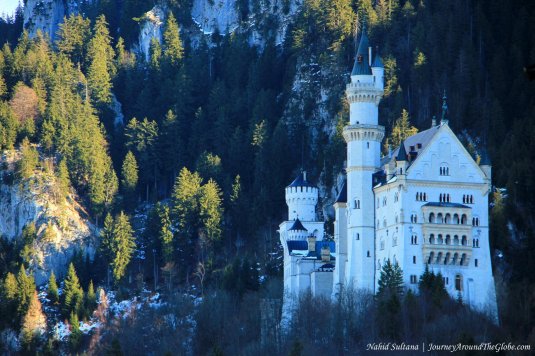
- Neuschwanstein Castle, as seen from Hohenschwangau Castle
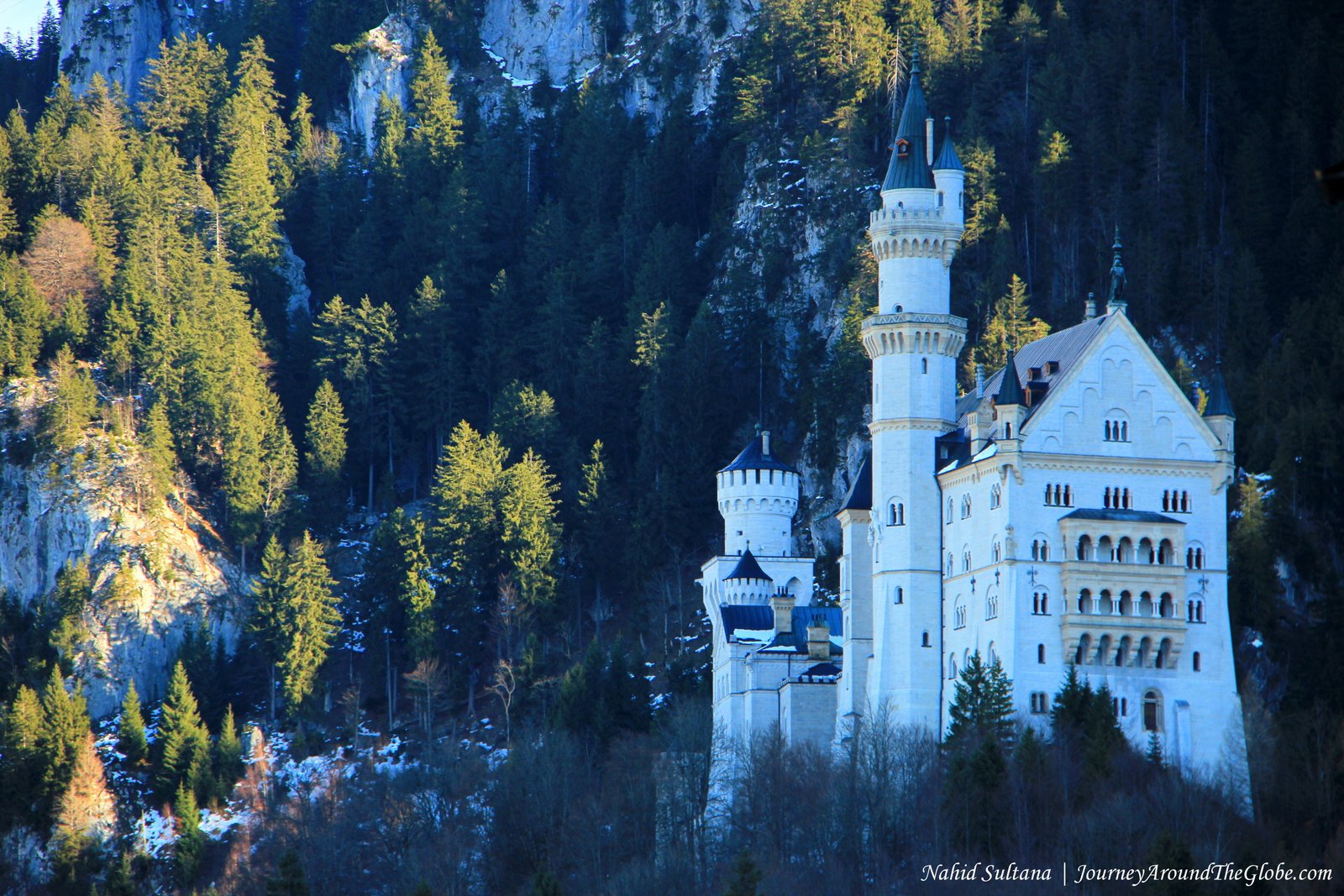
Directly opposite of Hohenschwangau Castle, King Ludwig II of Bavaria commenced this new castle in 1869 after his father Maximilian II died in 1864. The castle was built in Late Romanesque design in the style of late 11th or 12th century high above Ludwig II’s father’s Hohenschwangau Castle. Only one-third of it was completed and is still unfinished. Built and furnished in medieval styles, this castle was equipped with the latest technology of that time. Some of the halls and sections were inspired by Byzantine and early Christian churches.
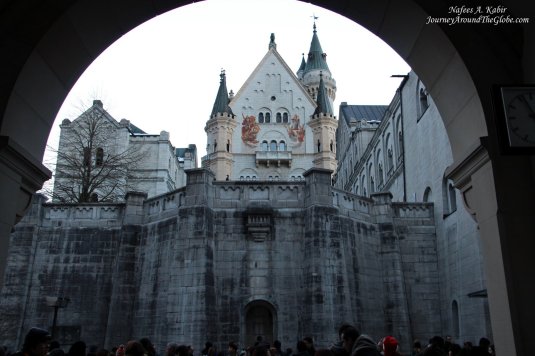
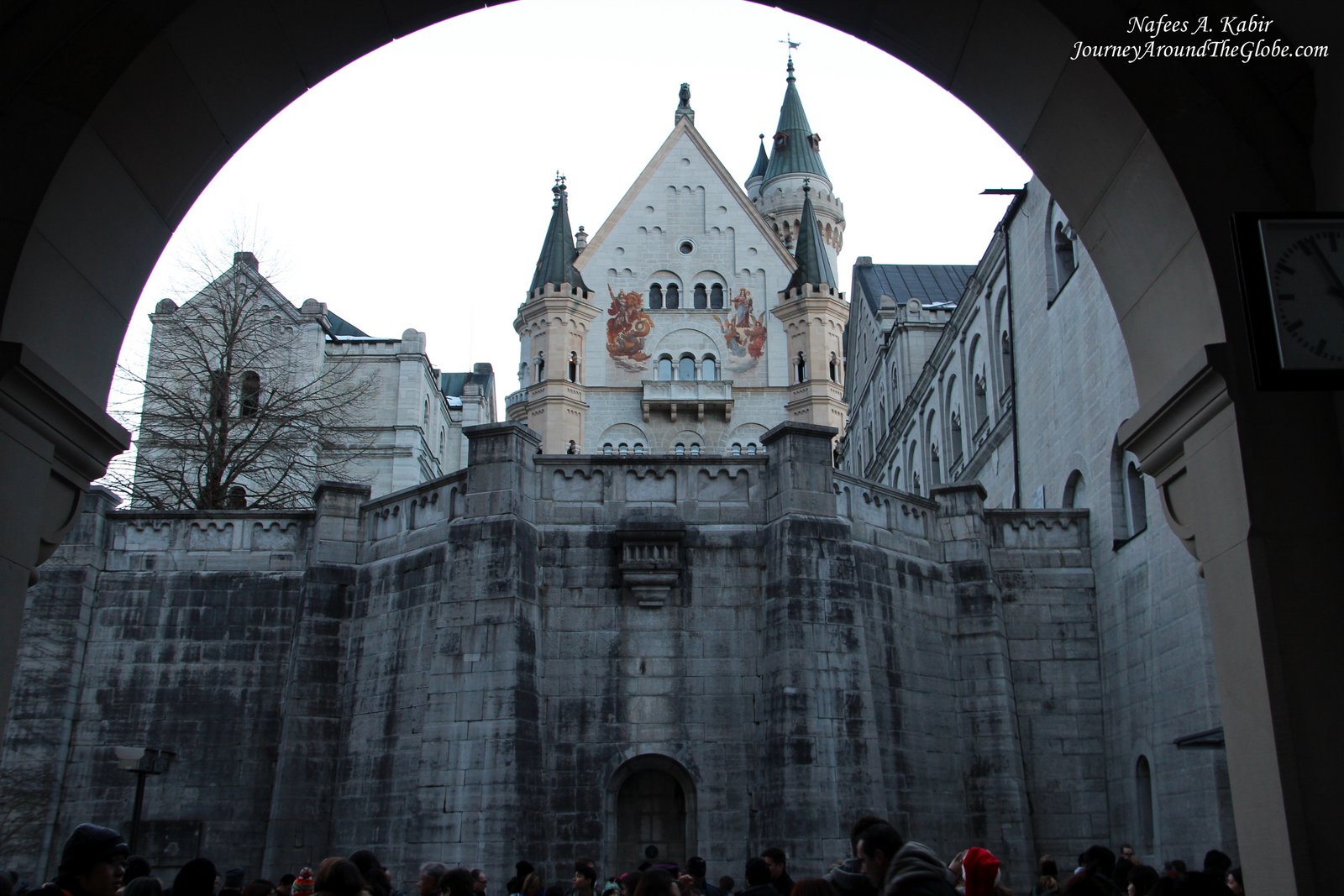
- Entrance to Neuschwanstein Castle in Fussen, Germany
The history goes something like this, Ludwig II became king in 1864. Two years later he was forced to accept the defeat and domination of his country by Prussia. No longer a sovereign ruler, he was unable to cope with the role of a constitutional monarch. He created his own alternative world, in which as the reigning king of Bavaria he could live like a king of the Middle Ages or the Baroque age of absolutism. This is the idea behind his castles. On a ridge in a magnificent setting high above the Pollat Gorge with the mountains as a backdrop he built his new castle over the remains of two small medieval castles. It’s a pity that the king lived less than 200 days in this castle (I think, 176 days to be exact) before he was declared mentally ill and was sent to Munich for treatment where he eventually died (drowned) or was murdered; his death is still a mystery.
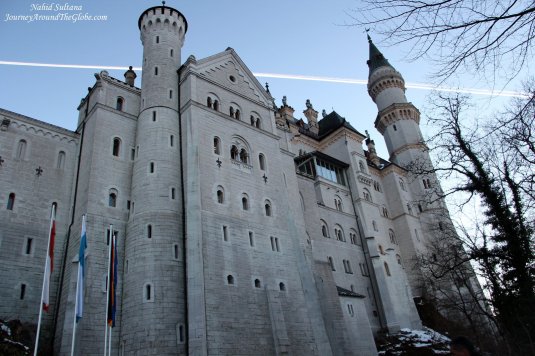
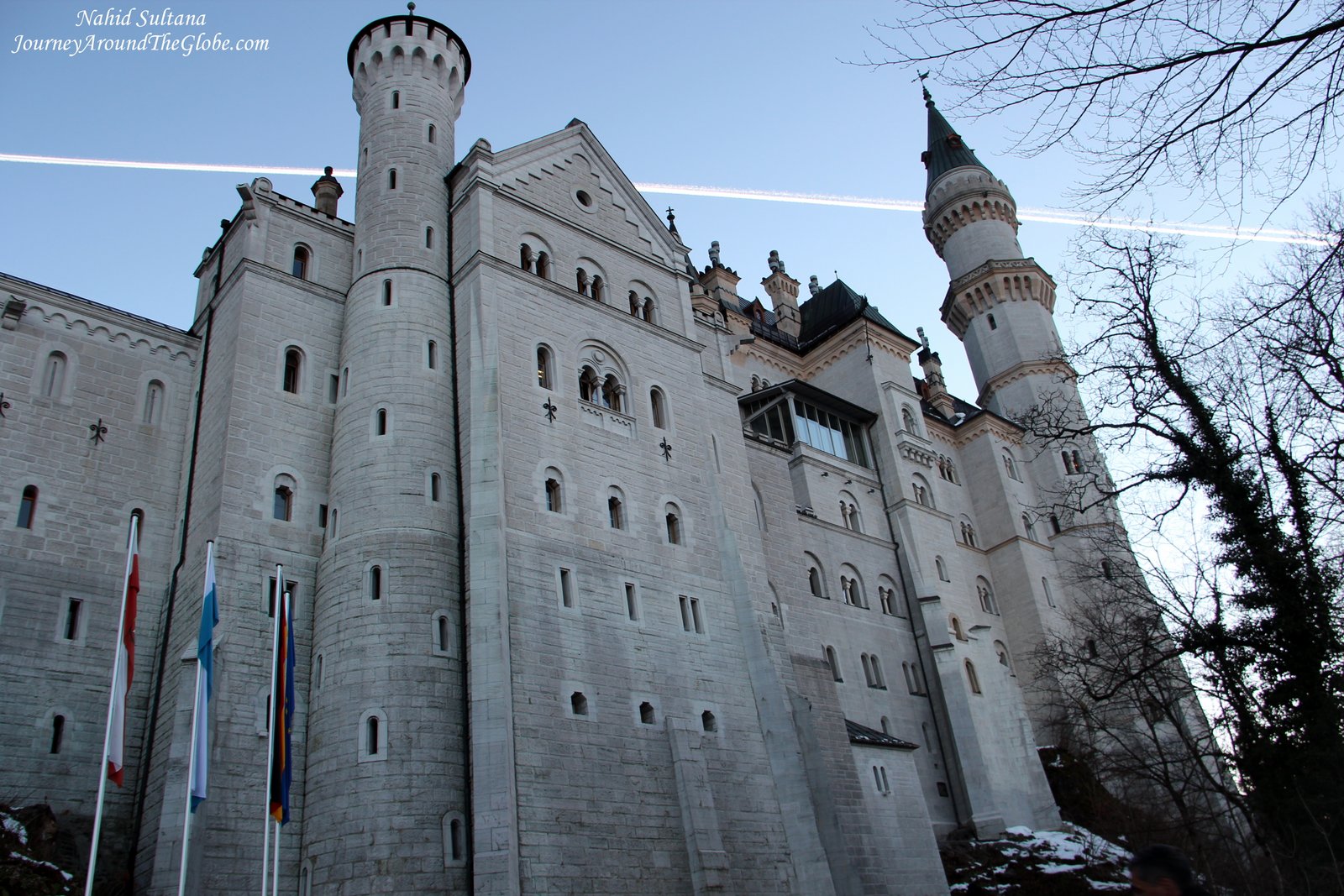
- Neuschwanstein Castle built by King Ludwig II of Bavaria in the mid-19th century in Fussen, Germany
Neuschwanstein Castle is definitely more gorgeous than Hohenschwangau Castle. We saw couple chandeliers with precious stones, Moorish style ceilings, luxurious upholstery, detailed wood-curved doors and wall, and Gothic style King’s bedroom along with castle’s kitchen and other areas.
The walk from Hohenschwangau Castle to here is about 30-45 minutes (as I mentioned horse-carriage is also available). Make sure to buy your tickets ahead of time, doesn’t matter what time of the year you are visiting it. It’s only accessible by guided-tour and it lasts about 15-20 minutes, then you can roam around on your own for another 10/15 minutes.
Share this:

Visiting a Turkish territory in Cyprus
NORTHERN CYPRUS (or TURKISH REPUBLIC of NORTHERN CYPRUS): Sad but true that Cyprus is the only divided country in Europe and its northern part has been occupied by Turkish forces since 1974. Since then Turkey has been occupying 1/3 of this island and only Turkey recognizes this land officially calling it “Turkish Republic of Northern Cyprus”. Other countries and UN recognize this island as Republic of Cyprus and calls the Turkish side “Northern Cyprus or occupied Cyprus”. With proper documentation anyone can cross the border to go the northern part of Cyprus.
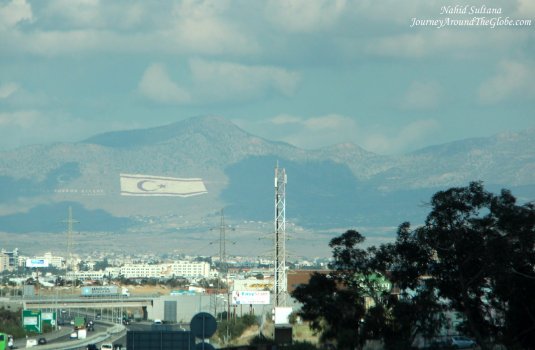
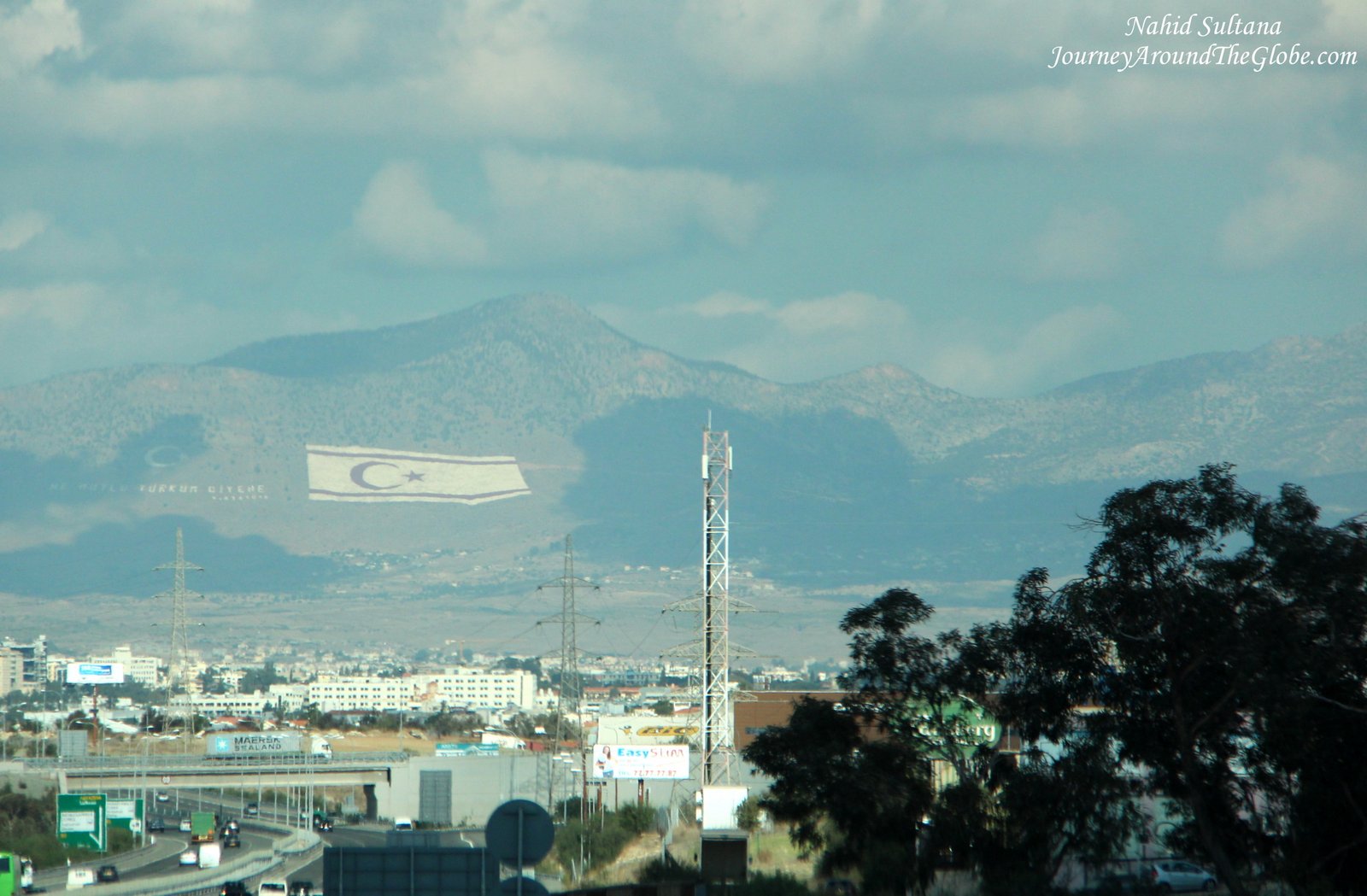
- Driving towards Nicosia, you can see a Turkish flag on the mountain
We spent a day in Northern Cyprus during our visit to Cyprus and got a little taste of Turkey in the northern part. Nicosia is the capital of Republic of Cyprus. Most of the tourists usually cross the border to go to the northern part on foot via Ledra Street for a day-trip and come back to the southern part. We parked our car in South Nicosia and walked to the border to go to the Turkish side. Northern Nicosia contains about half of the old city and this old walled city boasts of many attractions and heritage for its tourists.
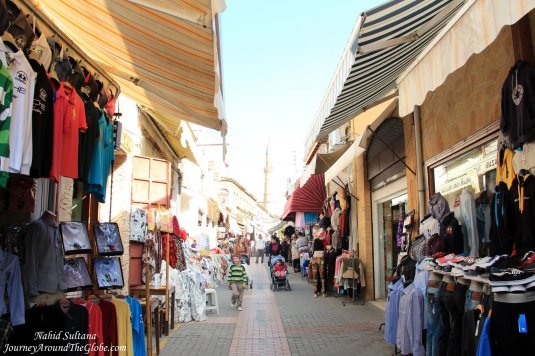
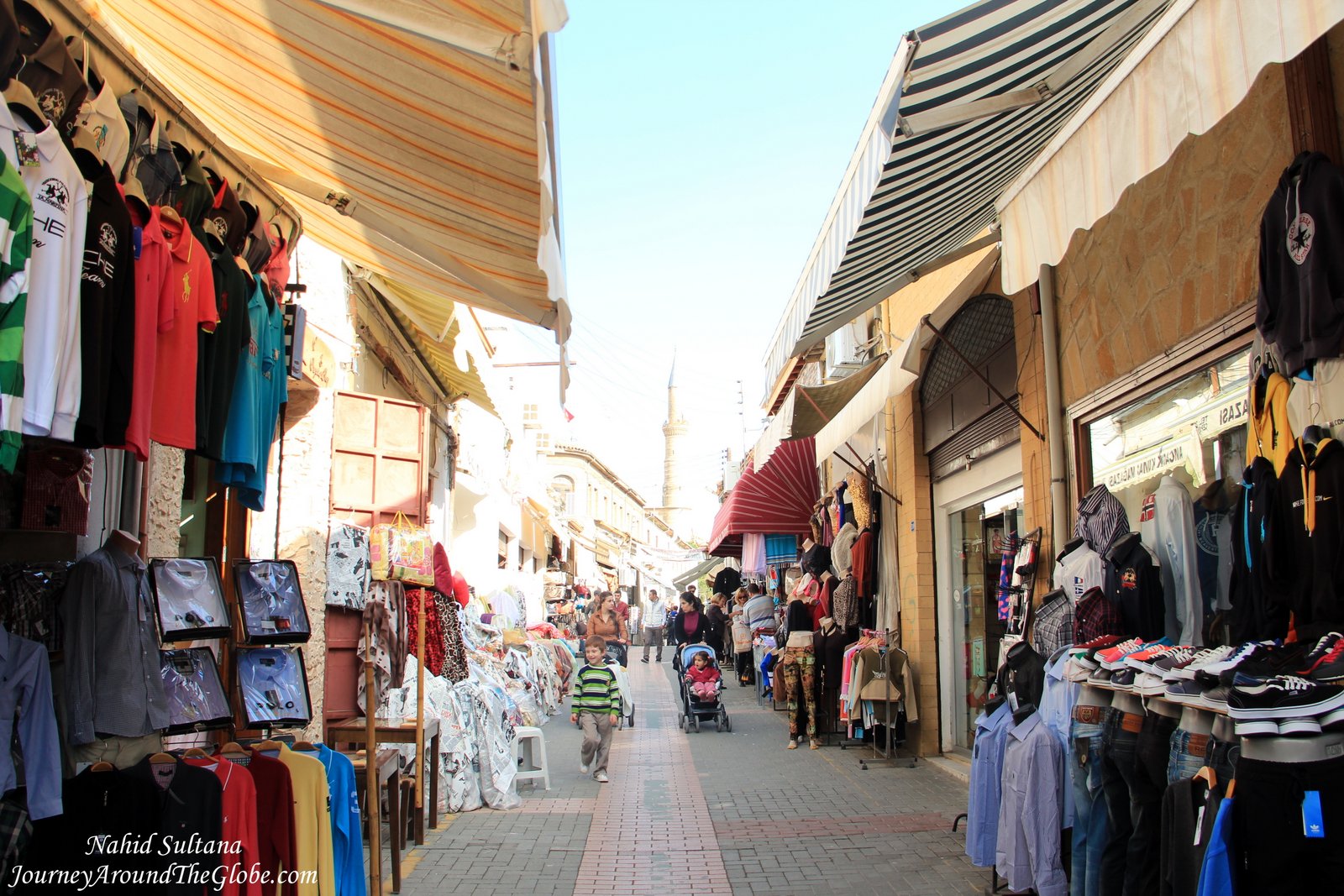
- After crossing the border to North Nicosia in the old town
TIME of TRAVEL: We flew to Cyprus in December 2013 only for few days out of which we spent a day in the northern side. Weather is actually very pleasant in Cyprus in December, I guess being by the Mediterranean helps. It was a bit colder once in a while, especially after dark.
OUR HOTEL: Please see my page on Republic of Cyprus on the right-side bar to see which accommodation we used in Cyprus.
EATING and SHOPPING: When you are in Northern Cyprus/the Turkish territory, you can get a little bit everything that you would normally get in Turkey. Turkish delights, apple tea, potteries, wall décor, and small trinkets can be found in the old town of Northern Nicosia.
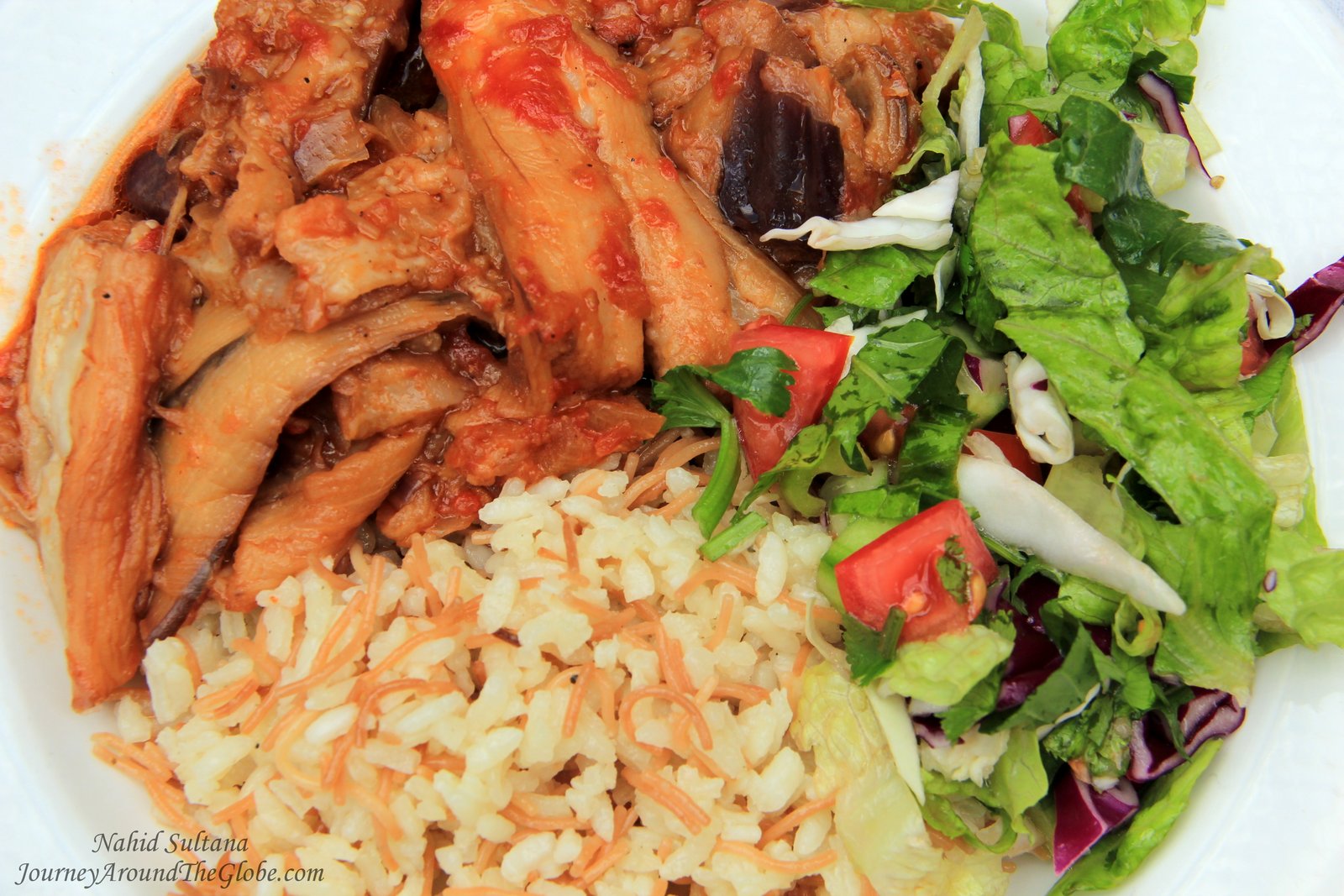
Dishes here are not very typical Turkish, nor Cypriot; they are more like blend of both. We had lunch in Muze Dostlari near Selimiye Mosque. They had very limited menu but had some good traditional food. I wanted to try moussaka but when I ordered it here, it didn’t look like the traditional Greek moussaka. I had moussaka which was more like a casserole but here the dish came with some cooked aubergine with Turkish style rice and salad. It was very tasty but just looked different. My girls had rice with Turkish style meat-balls, very well too.
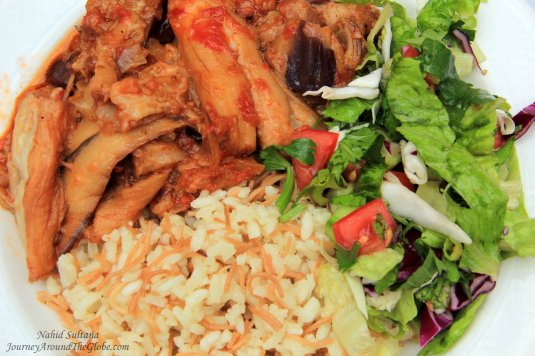
- My lunch in Northern Cyprus – moussaka, Turkish style???
PLACES WE’VE VISITED: After crossing the border to Northern Cyprus, we spent few hours here, mainly staying in the old town and visiting sites within the wall. You can cover the old part on foot very leisurely, it’s small and very well marked.
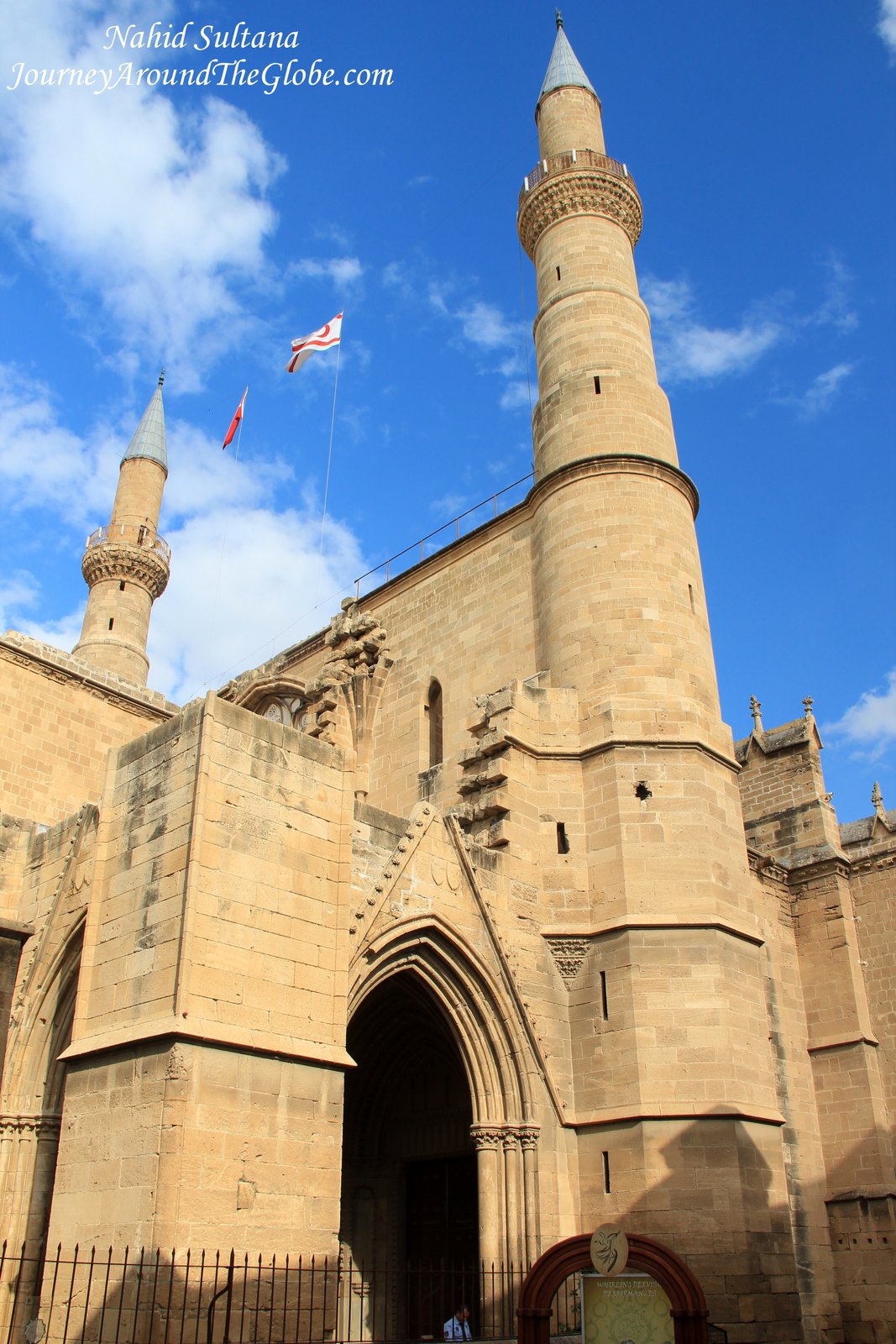
1) SELIMIYE MOSQUE: As locals call it Selimiye Camii, was once known as St. Sophia Cathedral. This is a top attraction of Northern Nicosia and a must-visit landmark. This fortress-looking mosque was built from 1208 – 1326. It was converted to a mosque in 1570 during Ottoman’ time and two minarets were added then. This is still an active mosque, therefore no visitors are allowed during prayer time. It’s a beautiful masjid/mosque inside and outside, especially loved the courtyard.
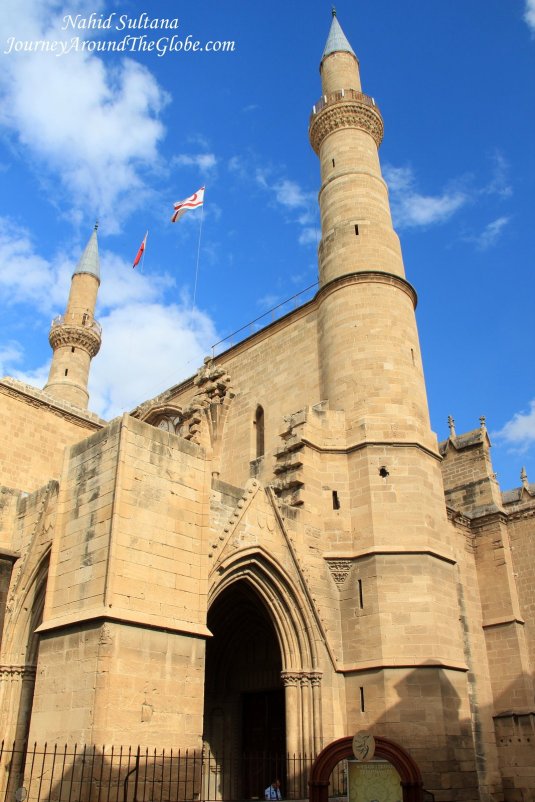
- Selimiye Mosque from the 13th century, one of the top landmarks of Northern Cyprus
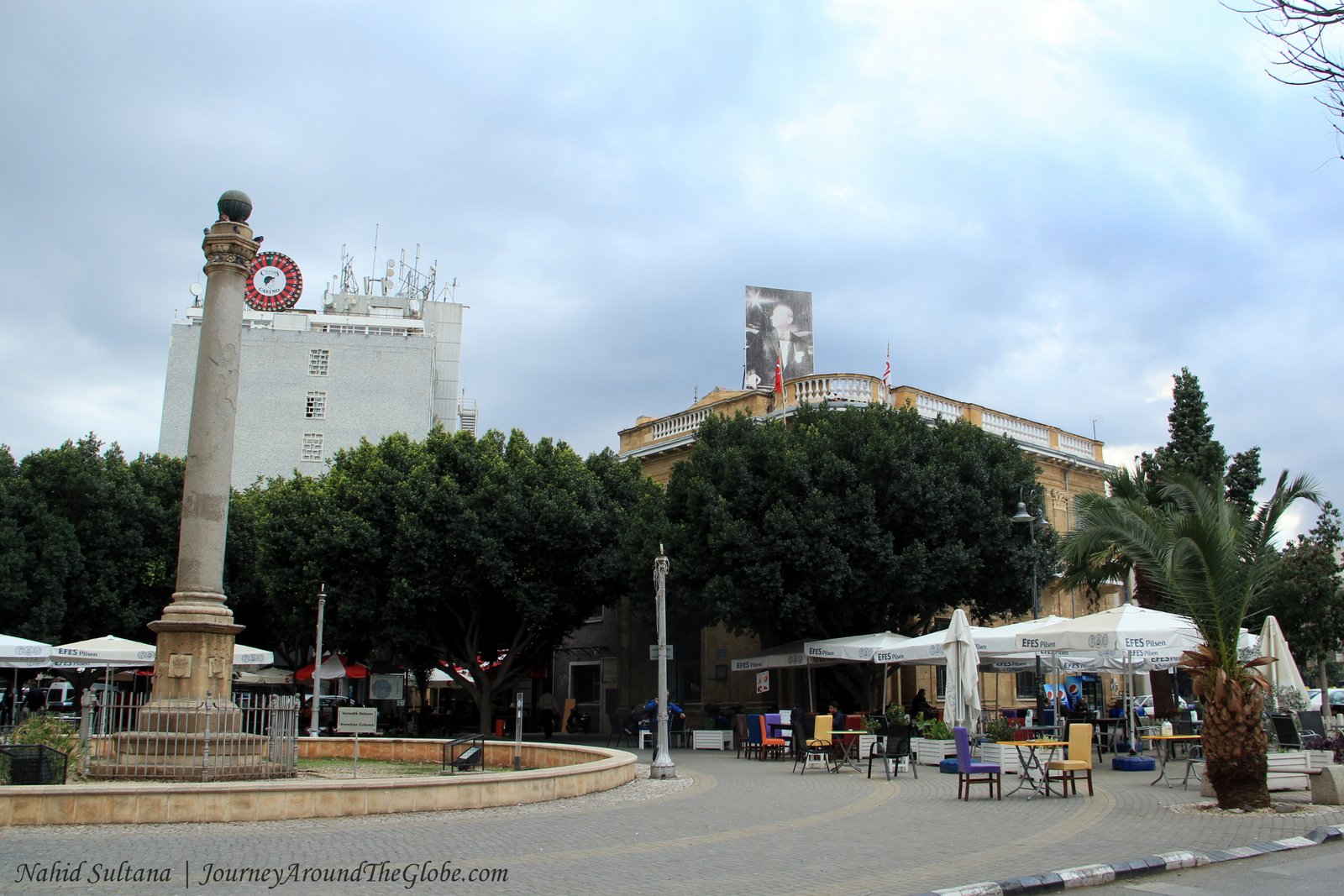
2) ATATURK SQUARE: This is the main square and supposed to be heart of the city. Don’t be disappointed by its simple and dull look. A thin medieval Venetian columns stands in the middle of the square surrounded by pedestrian walking zones. Historic judicial building is in one side of the square.
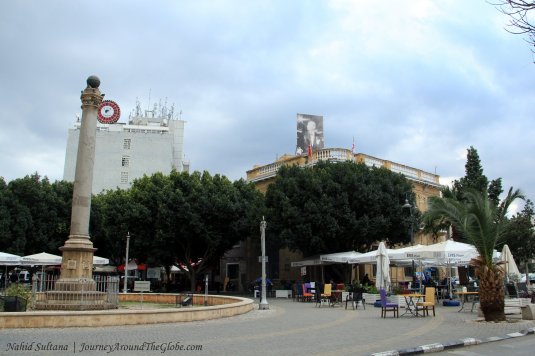
- Ataturk Square
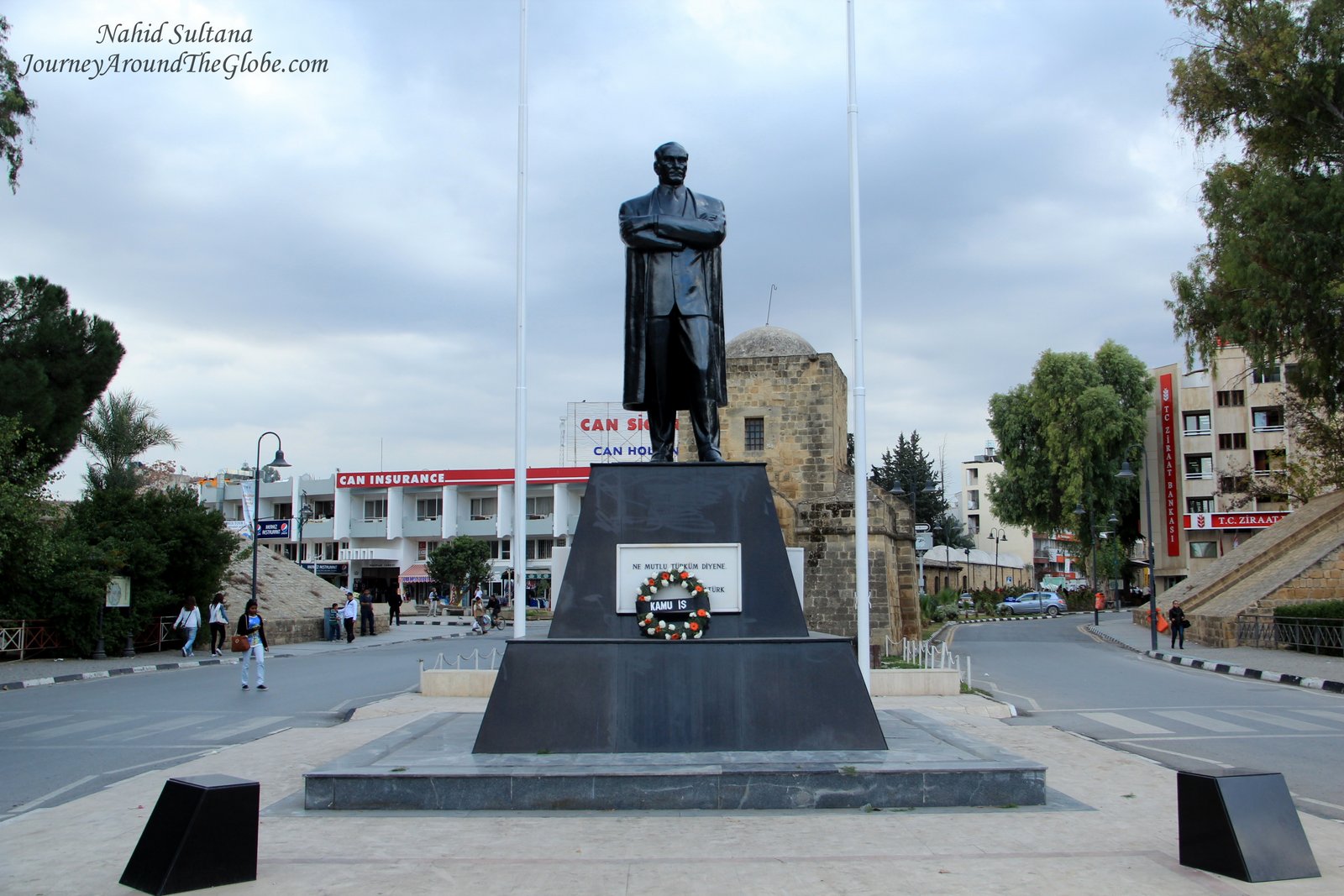
3) KYRENIA GATE: This is one of the original gates of the city from the Venetian time in 1567. A statue of Kamal Ataturk stands facing the big street in front of it.
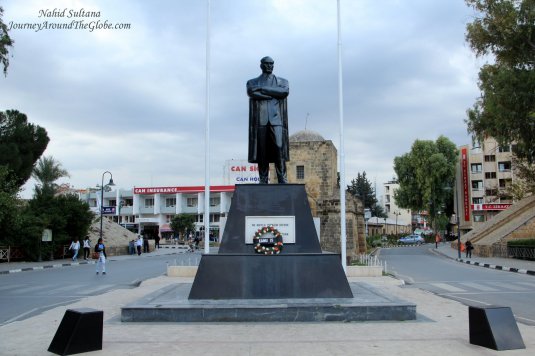
- Kyrenia Gate from the 16th century with statue of Kamal Ataturk in Northern Cyprus
4) SAMANBAHCE HOUSES: This is a must-visit place in Northern Nicosia. You can see traditional Turkish Cypriot architecture and houses in this small neighborhood. The houses and streets are very well persevered and were decorated with fresh flowers and plants.
Originally, Samanbahce is thought to have been one of several gardens used by the residents of the Walled City. As the demand for housing grew, Samanbahce was developed into a social housing complex. Approximately by 1894 this was partially built and functioning as social housing. The whole construction was done in phases and was completed in 1955. This was the first known social housing to have been constructed in Cyprus and consists of 72 separate units along 5 rows parallel to Kyrenia Avenue.
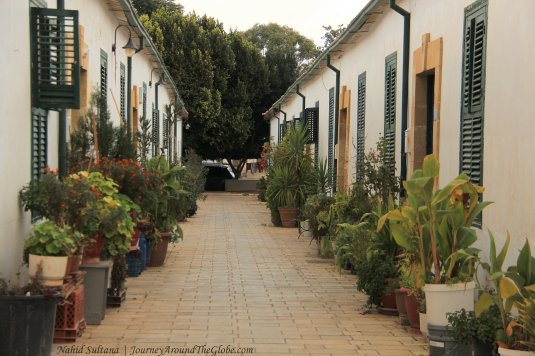
- Traditional Turkish Cypriot architecture and houses of Samanbahce neighborhood
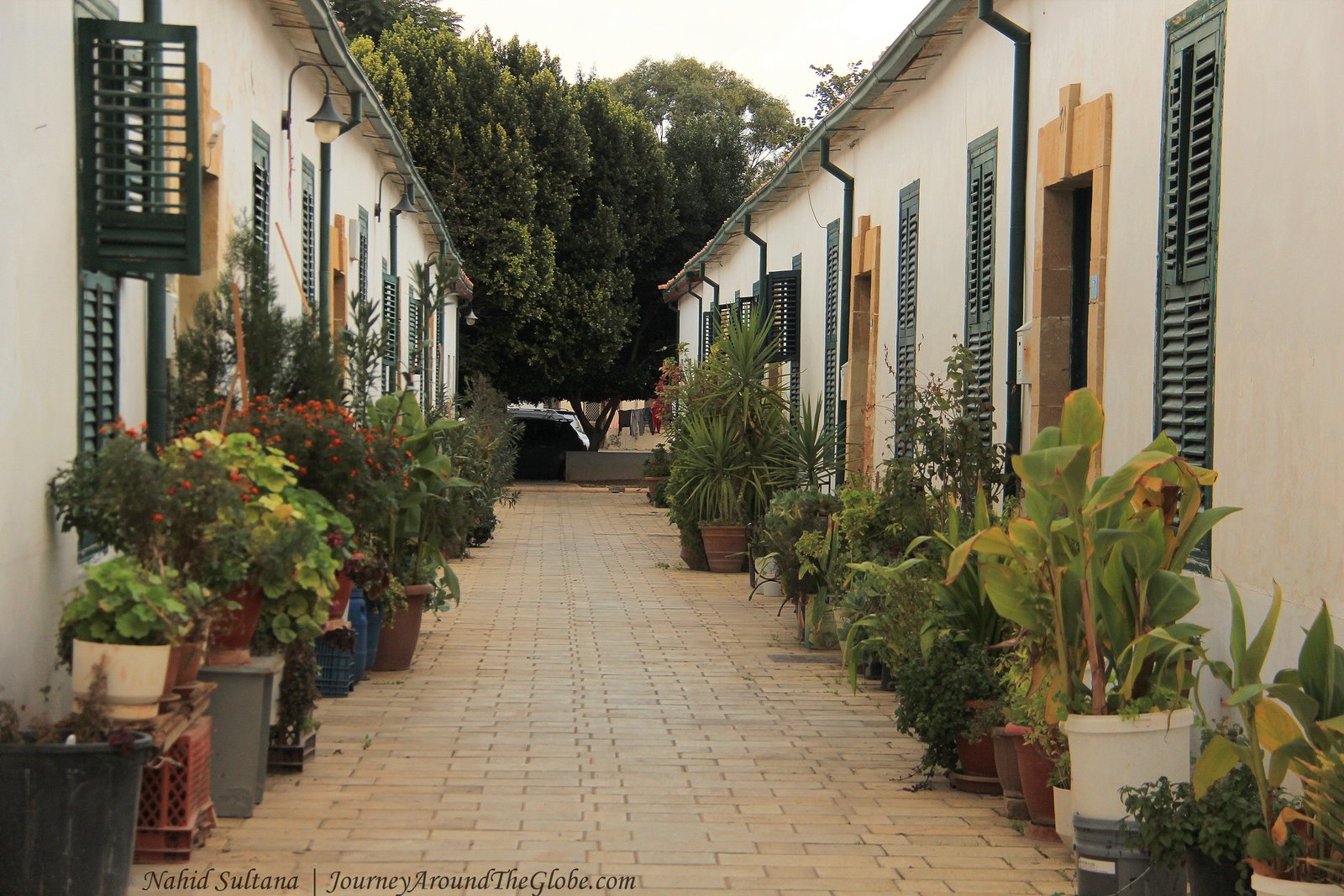
Samanbahce Area covers about 2000 square meters and is located on the northern edges of the walled city of Nicosia, very close to Kyrenia Avenue, and to the bastion of Quirini. It’s a unique neighborhood with much defined geometric narrow roads and units of one story mud-brick construction with red-tiled roof. A large fountain is located in the core of the estate while a large open space (parking and playground for children) can be found in the northern corner.
5) BUYUK HAMAM or GRAND TURKISH BATH: This building was once St. George of Latin’s Church. Built about 500 years ago, it is still an active place for relaxation. The hamam is open every day from 9am, for both men and women but only for customers, not for tourism purposes.
6) BUYUK HAN (THE GREAT INN): Built in 1572, this is one of the most important architectural works of the Turkish period in Cyprus. The “Han”, which was built to provide accommodation for travelers from Anatolia, Turkey and other parts of Cyprus. Presently it’s a nice place to do some souvenirs hunting and have some Turkish drinks or light snacks and enjoy the enclosing architecture of it. We sat down for some Turkish apple tea in the late afternoon after getting some small gift items from the downstairs shops.
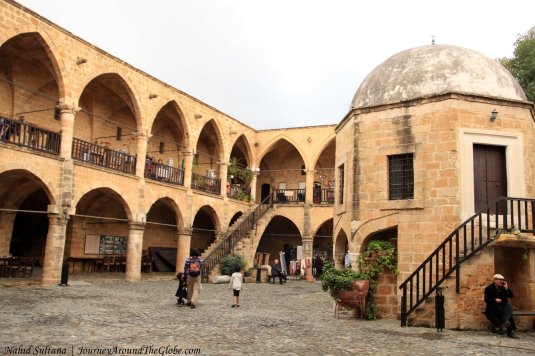
- Buyuk Han (Big Inn) from 1572 in Northern Cyprus
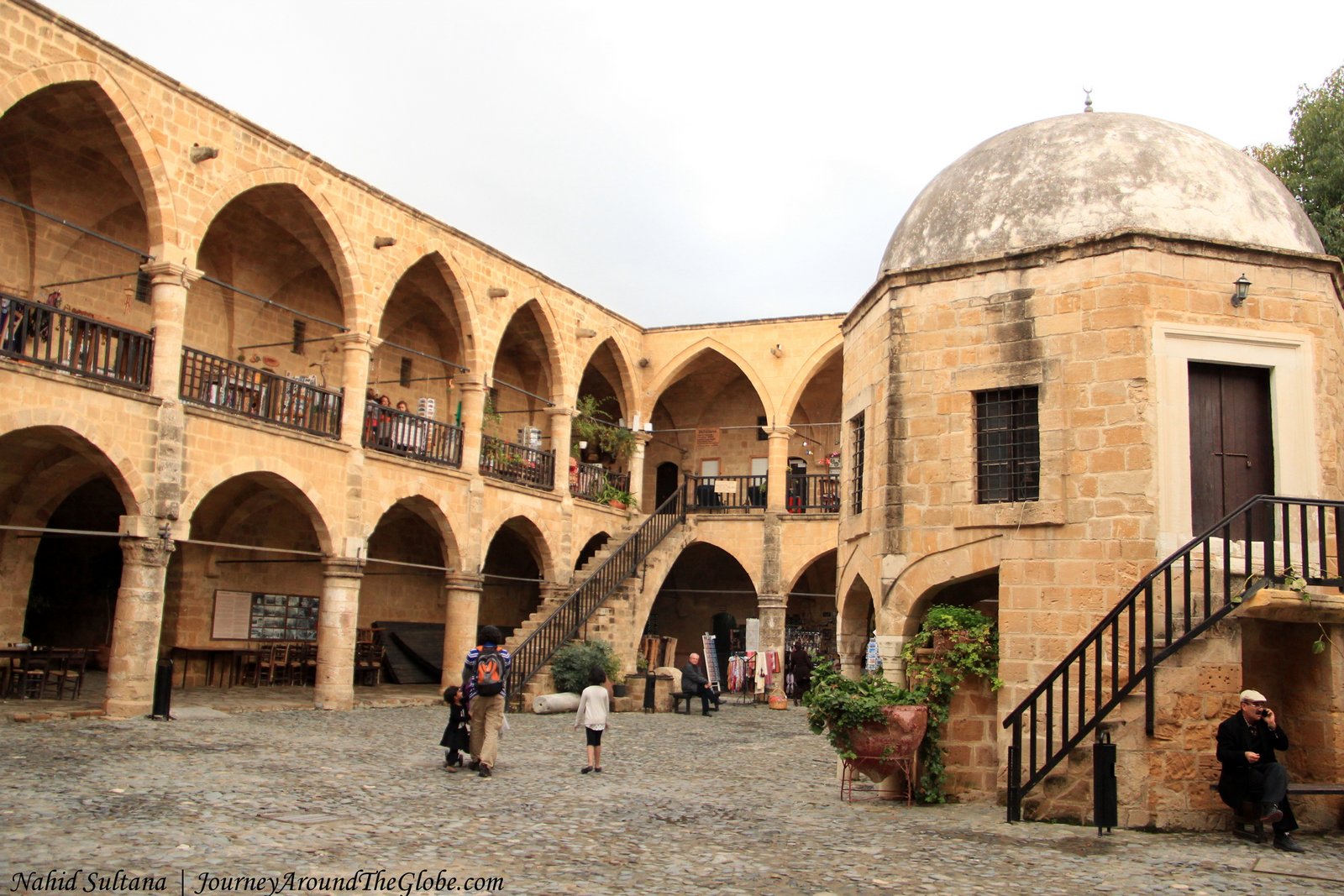
The Buyuk Han (Big Inn) is located in the traditional market center, within the city walls of Nicosia. The stone-paved square has two-story Buyuk Han that consists of 68 rooms which open to the vaulted galleried surrounding a square planned inner courtyard, and few shops which open to the outside of the Han. An Ottoman Masjid stands on marble piers, with a fountain (used for ritual ablutions) beneath, in the center of the courtyard. It has two entrances: east and west.
Share this:

Business Excellence Award 2020 from AI Global Media for The Most Entertaining Personal Travel Blog – Pacific Northwest USA

Top Posts & Pages


Business Excellence Award 2020 for The Most Entertaining Personal Travel Blog – Pacific Northwest USA

 Globe Runner

