Journey Around The Globe
ready for the next destination
Van Gogh Museum in Amsterdam
We were lucky enough to get many chances of visiting Amsterdam from time to time. Different times we visited different sections of this city. Last time we were in Amsterdam was when we took Baltic Sea cruise in August of 2013. Our ship was docked near the city for few hours and we managed to visit only this museum which I’ve been longing for quite a while.
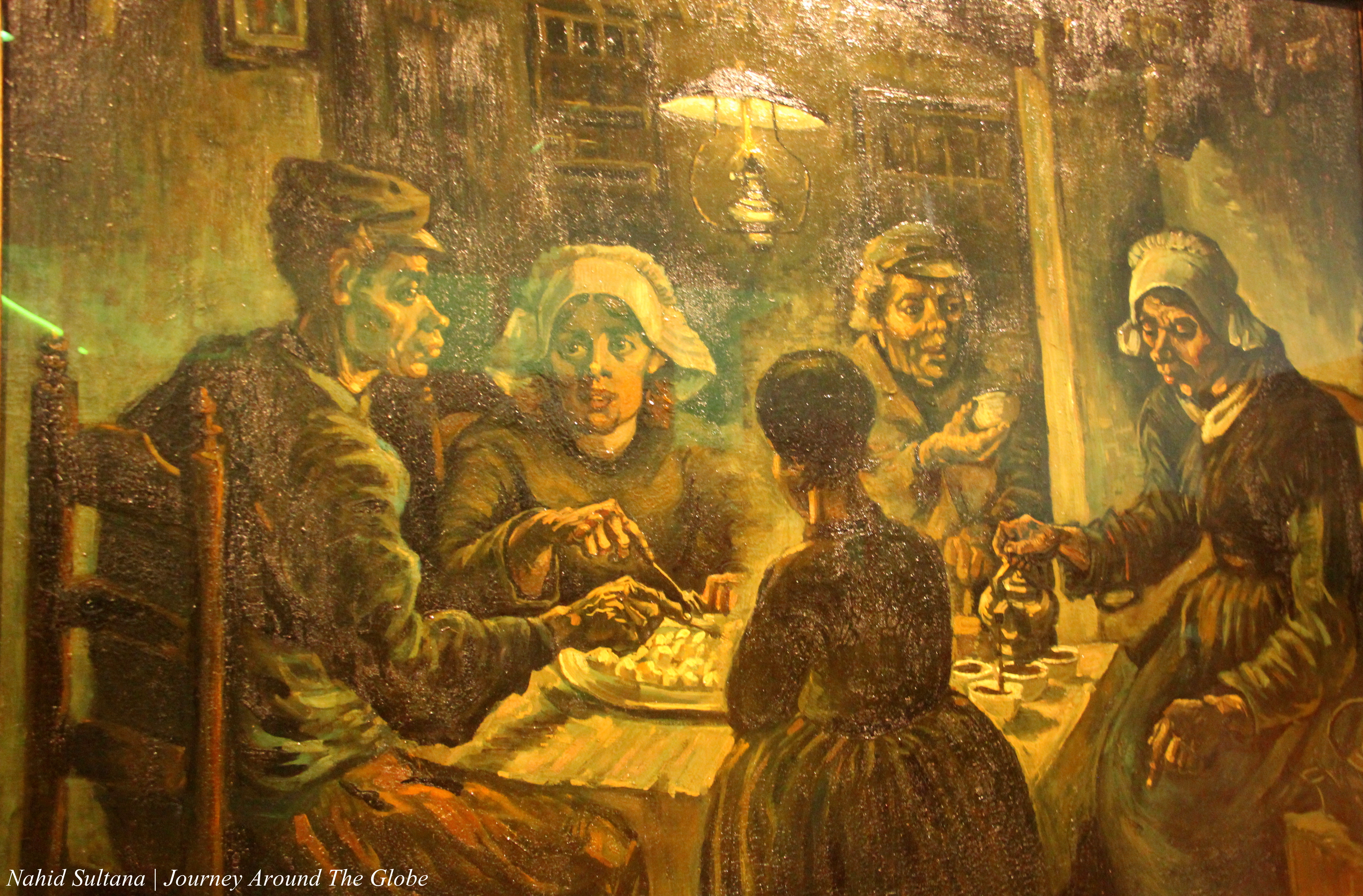
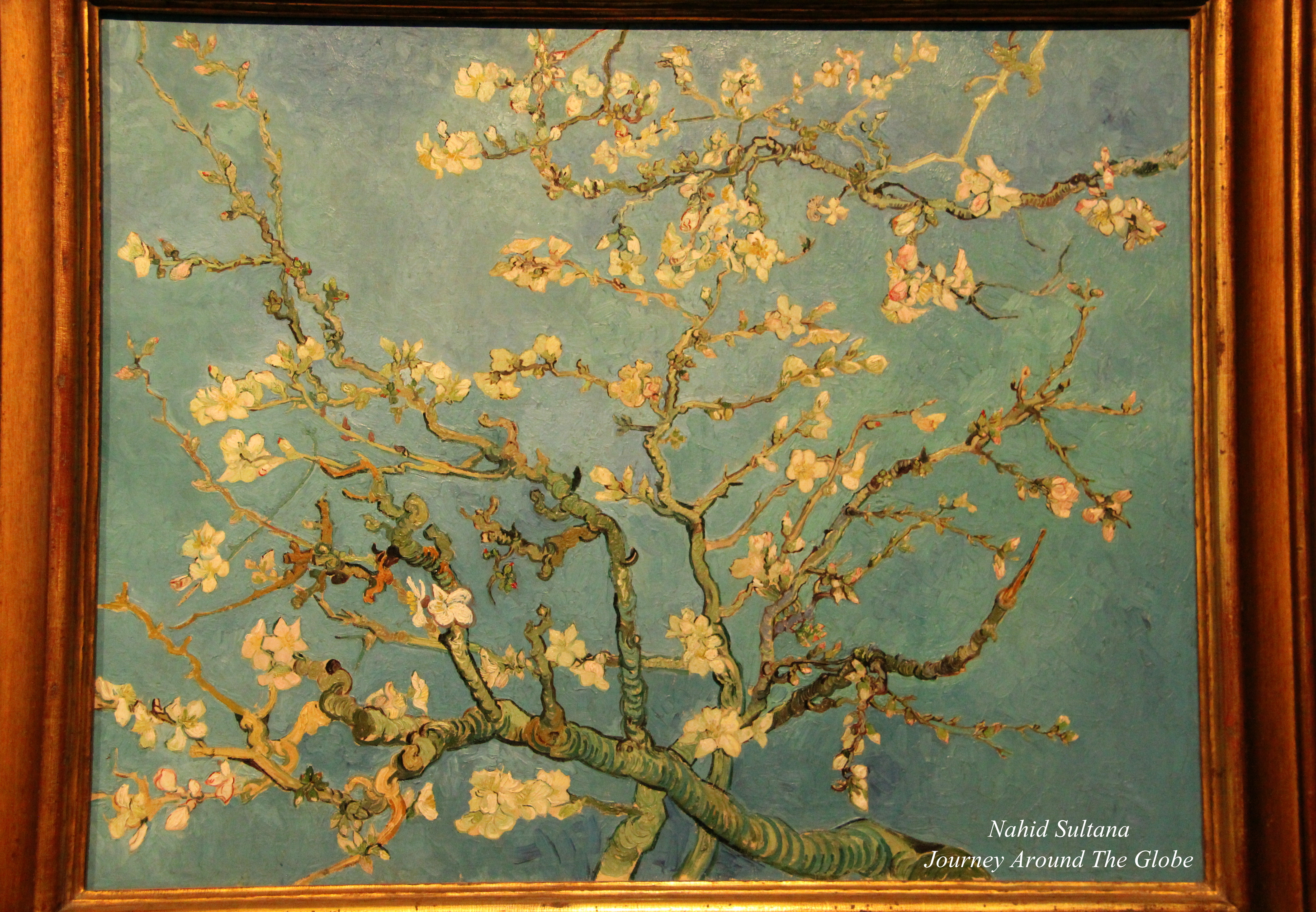
Van Gogh Museum is a must see when in Amsterdam, even if you are not into arts and paintings. It has the largest collections of world-famous Dutch artist Van Gogh’s many early works and iconic well-known paintings which he painted before his death. Unfortunately, we couldn’t see his famous “Starry Night” here (it’s in a museum in New York), but some of his other famous works, such as “Almond Blossom”, “The Potato Eaters“, “Sunflowers”, and many others are hanging in this museum walls of Amsterdam.
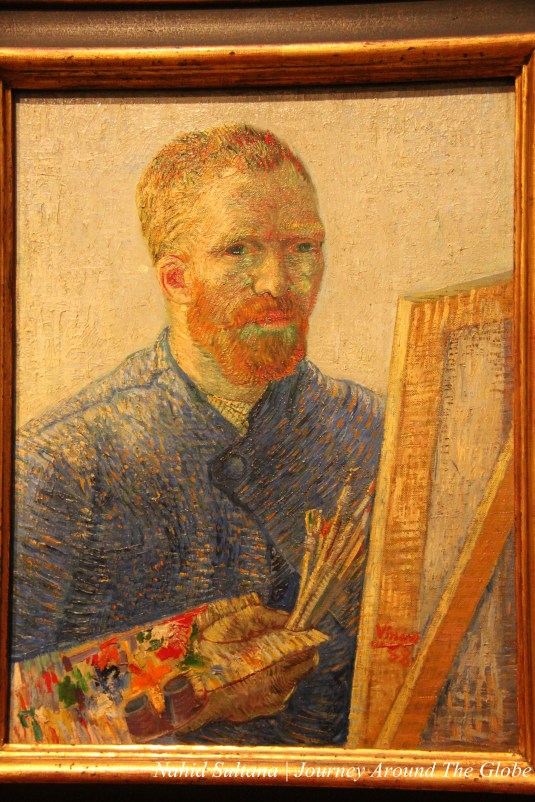
- Last self-portrait by Van Gogh painted in 1888 in the Van Gogh Museum, Amsterdam
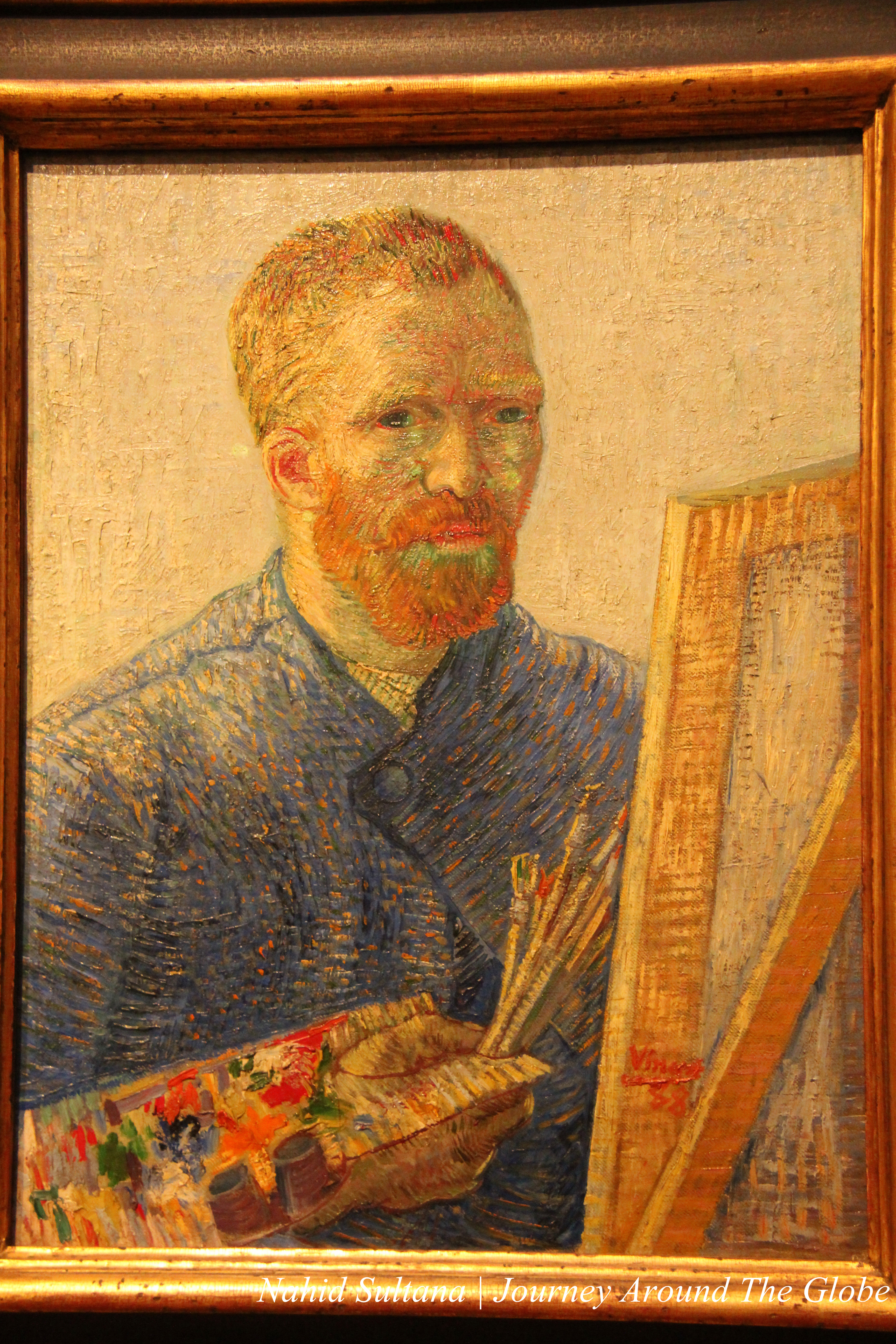
To give you a little bio on this famous artist of all time, Van Gogh was born in 1853 and was only active as an artist for 10 years, from 1880 until his death in 1890. In those 10 years he produced about 800 paintings and more than 1000 drawings, as well as large number of watercolors, lithographs, and sketches in hundreds of letters that he wrote to his brother, Theo. He was a self-taught painter with few art lessons from Brussels and Antwerp in Belgium. His dramatic life story, unhappy romances, apparent lack of recognition, illness, and finally his attempt of suicide are some of the events that were great deal of interests after his death, as well as his exceptional use of colors and characteristic brushworks.
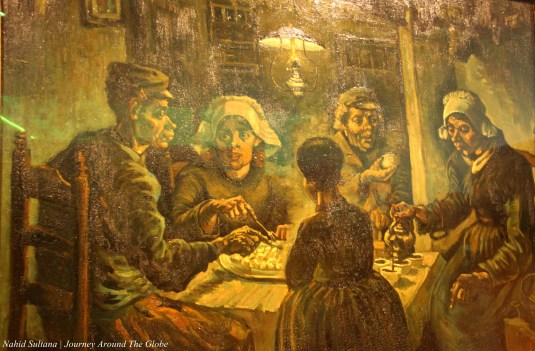
- “The Potato Eaters” by Van Gogh from 1885 in Van Gogh Museum, Amsterdam
It’s a very organized museum with information written both in Dutch and English. It’s a wonderful place to get to know Van Gogh up close and personal. His depressed life, incomplete education, what inspired him, love and relationships, and finally why he was dead at such an early age…all are portrayed here in a very nice sequential way.
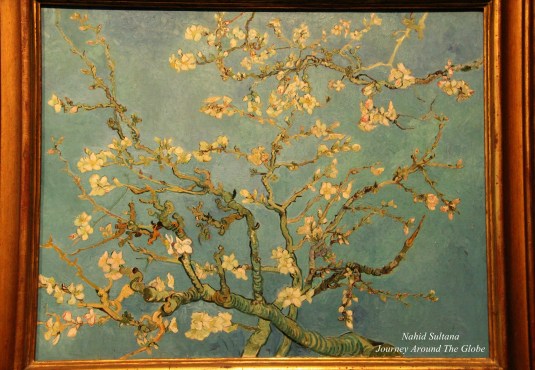
- Another famous painting by Van Gogh “Almond Blossom” from 1890 in Van Gogh Museum, Amsterdam
The museum is located in Museumplein near the city center of Amsterdam where you will find many other different types of museums. Our taxi charged 20 euros for one way from Amsterdam cruise port to the museum. It’s open daily from 9 am – 6 pm. Be ready to stand in the ticket line for a LONG time. We were standing there about half and fifteen minutes, even those who bought tickets online were moving like sloths. Ticket is 15 euros per adult and kids visiting below 17 years are free.
Related articles
- Amsterdam – Things To Do – Van Gogh Museum (icameisawicooked.wordpress.com)
- Bedroom in Arles (ombaoexequiel.wordpress.com)
Share this:

Summer UK trip – Canterbury and Dover
CANTERBURY and DOVER, ENGLAND: Canterbury and Dover are both in the county of Kent, which is the hometown of father of evolution, Charles Darwin. Canterbury is a cathedral and university town. It doesn’t look like it now but it was bombed heavily during the WWII. The city still contains many ancient buildings, especially in the medieval town center. Dover is a port town with English Channel at one side. It’s a natural scenic city and very green too.
We took a cruise to the Baltic Sea on the 1st week of August 2013. The cruise was for 12 days and left from the port of Dover. We drove to Calais, France from Belgium to take ferry to Dover, England. Ferry tickets were booked online ahead of time and the ride was about hour and half one way. The day we arrived Dover, we managed to visit only Canterbury. Dover Castle needed to wait until we were back from cruise. We were dropped off at Dover port again early in the morning after the cruise was over. We headed towards Dover Castle first thing in the morning.
If you are going to in England for few days for visiting purposes, it’s better to buy an “English Heritage” membership. That way you can visit all of their properties free of charge and it includes some of the major touristic destinations like Stonehenge, Shakespeare’s birthplace, and so on.
TIME of TRAVEL: Both the days we visited Canterbury and Dover were lovely and without rain. We weren’t so sure about the typical English weather but luckily the days turned out to be great for exploring.
OUR HOTEL: We stayed at Holiday Inn in Ashford the night before boarding the ship. Ashford is a small town about 30 minutes’ drive from both Canterbury and Dover. Staying in Holiday Inn felt like I was in America…felt very homely. It’s a very nice hotel with free breakfast and free Wi-Fi (only in the lobby). England being the capital of curry or Indian cuisine (after India), we had to hit a local curry place. The restaurant was called “Spices of Bengal”, about less than 10 minute drive from Holiday Inn, with an excellent view of the valley down. Loved the typical English setting and their excellent taste of food.
EATING and SHOPPING: Old town Canterbury has many cafes, restaurants, and shopping areas and probably one of the nicest places for meal or tea time. When you are in England, of course, fish and chips are everywhere, but I prefer their yummy meat pasties when I am here. Dover Castle has a small cafeteria inside and a souvenir shop where you can get many Great Britain souvenirs. Also, look for their variety of jam/jelly selections in the shop.
PLACES WE’VE VISITED: We reached Dover by ferry from Calais, France about 1pm and from there we went straight to Canterbury to check its main spots. We had to catch our cruise boat by 2 pm the next day. If you have extra time, you can visit the Canterbury Castle which was built by the Normans in the 11th century which we missed this time.
1. CANTERBURY CATHEDRAL: This is a must see in Canterbury and a magnificent historical monument in England. In 597 AD when Pope Gregory sent an Italian monk, Augustine, to England as a missionary, he established a monastery here and then became England’s first archbishop. It became one of Europe’s most important pilgrimage centers after the murder of Archbishop Thomas Becket in 1170. It is still very much a working and living church and part of a UNESCO World Heritage Site.
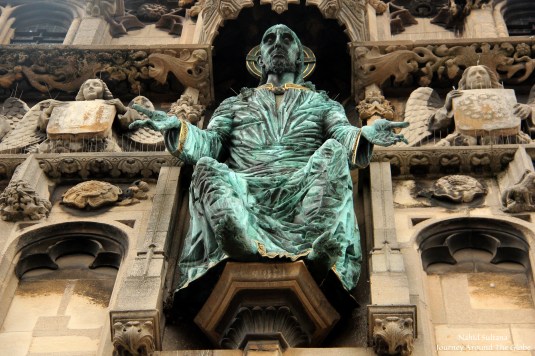
- Main façade of Canterbury Cathedral in England
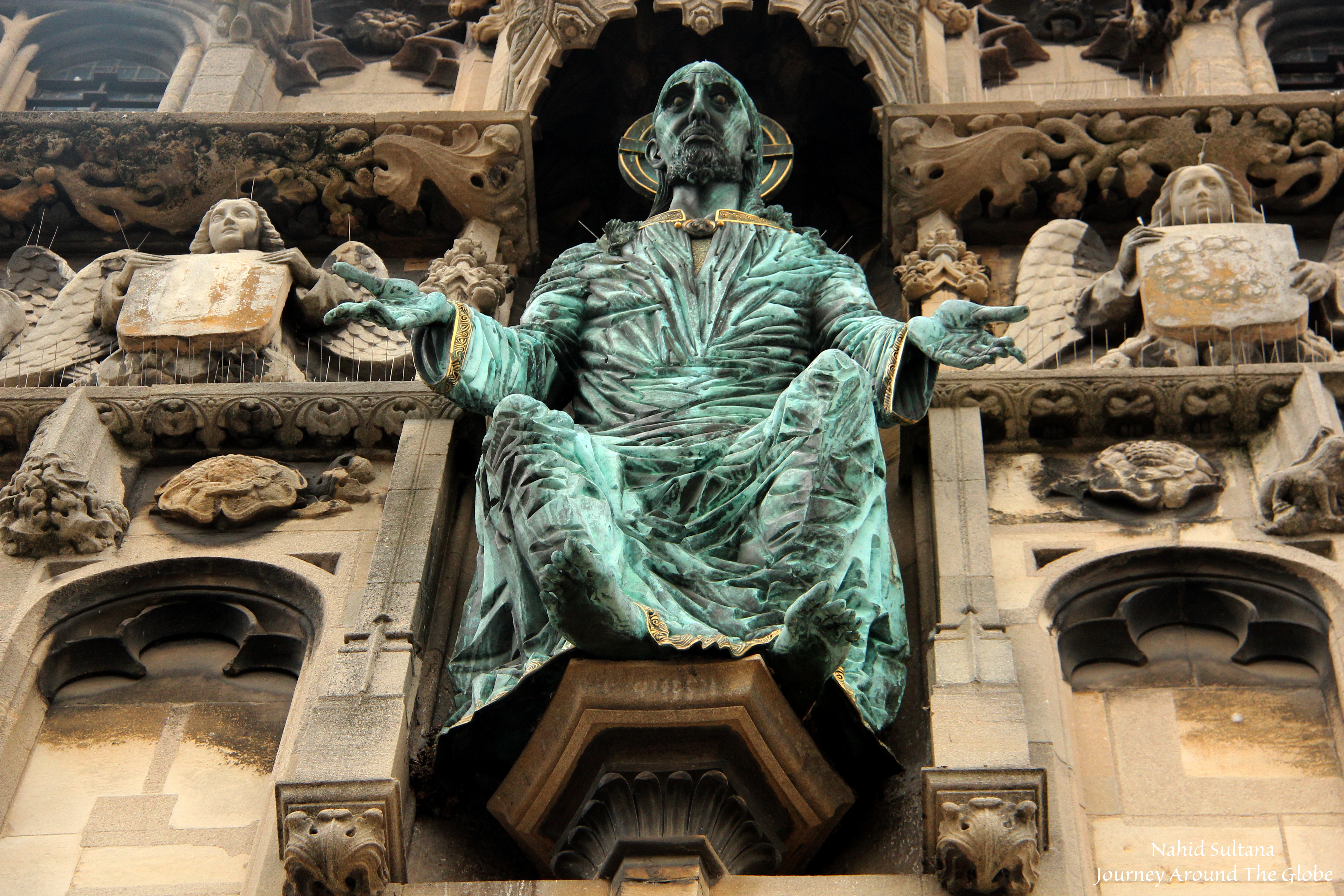
From outside, it’s a massive building with typical English style cathedral. Nave of Canterbury Cathedral is a 14th century Perpendicular Gothic architecture. Look up high and you can see the pillars soaring up to heaven. Visitors can see and pay respect to the exact place where Archbishop Thomas Becket was murdered in 12th century. Cloister of it has beautiful carvings of heraldic shields, fascinating faces, and animals. Don’t miss the crypt as it is the oldest part of the cathedral, dating back to 11th century. Note the round arches, decorated columns, and some of the oldest Christian wall paintings of England in the crypt. Trinity Chapel has some beautiful 12th century stained glass windows. But most importantly, it houses the royal tombs of King Henry IV and Edward, Prince of Wales, also known as “The Black Prince” along with many other archbishops from 13th and 14th century.
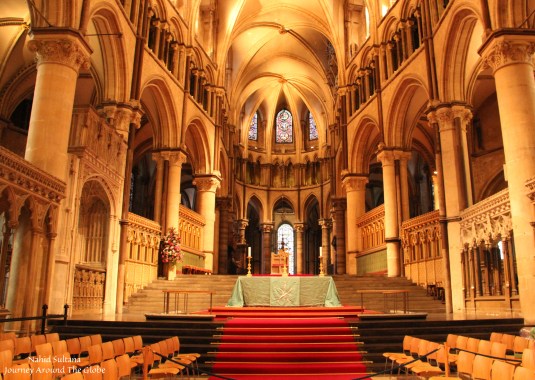
- Inside Canterbury Cathedral in England
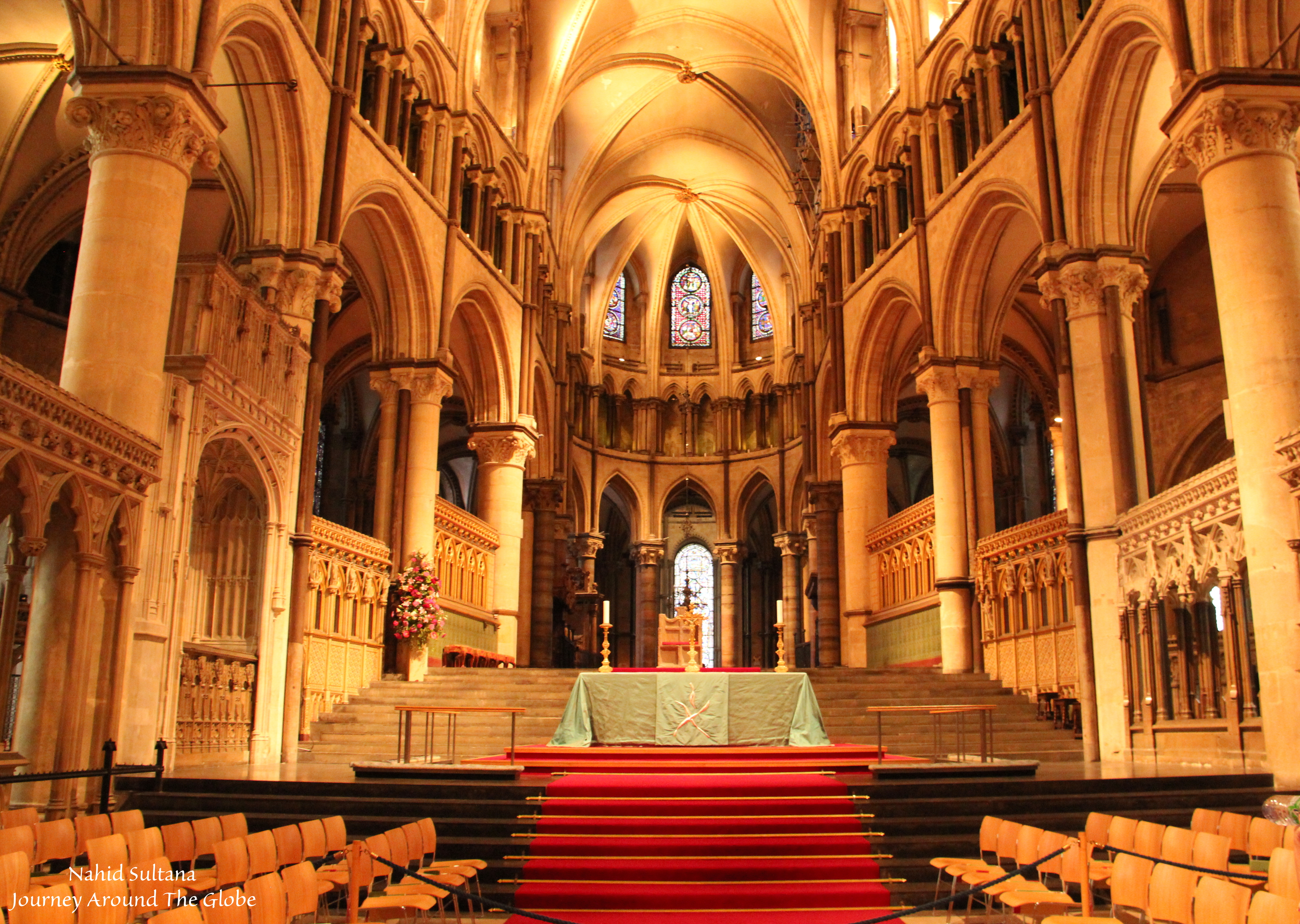
It is a big cathedral and we needed about an hour to visit all the corners. The cathedral is open to the public from 7 am to 5:30 pm in summer time, from 9 am to 5 pm in winter time, and Sundays from 12:30 pm to 2:30 pm. Last entry is half an hour prior to closing time. Entry fee is 9.50 GBP for adults and 6.50 GBP for kids above 5 years. It’s about half an hour drive from Dover Ferry Terminal and there is a paid parking close to the cathedral.
2. ST. AUGUSTINE’S ABBEY: This is one of the oldest and most important monasteries in the country. It was from here that the conversion of the English people to Christianity began. St. Augustine from Italy was sent here by the Pope in the 6th century. He began building the first church here soon after 597 AD. A thriving Anglo-Saxon monastery developed and its grounds became an important place of burial for several Anglo-Saxon kings, early archbishops, saints, and St. Augustine himself. Later, Normans built a great abbey here that flourished for four centuries until King Henry VIII pulled it down in 1538 and built a royal palace here.
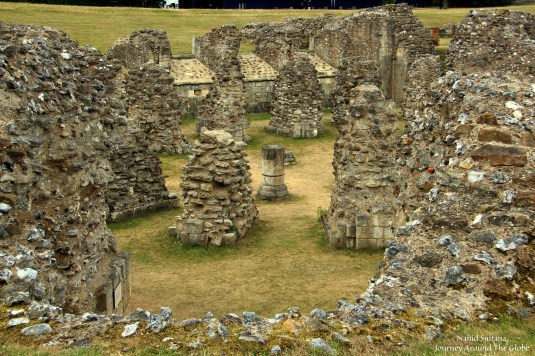
- Ruins of St. Augustine’s Abbey in Canterbury, England
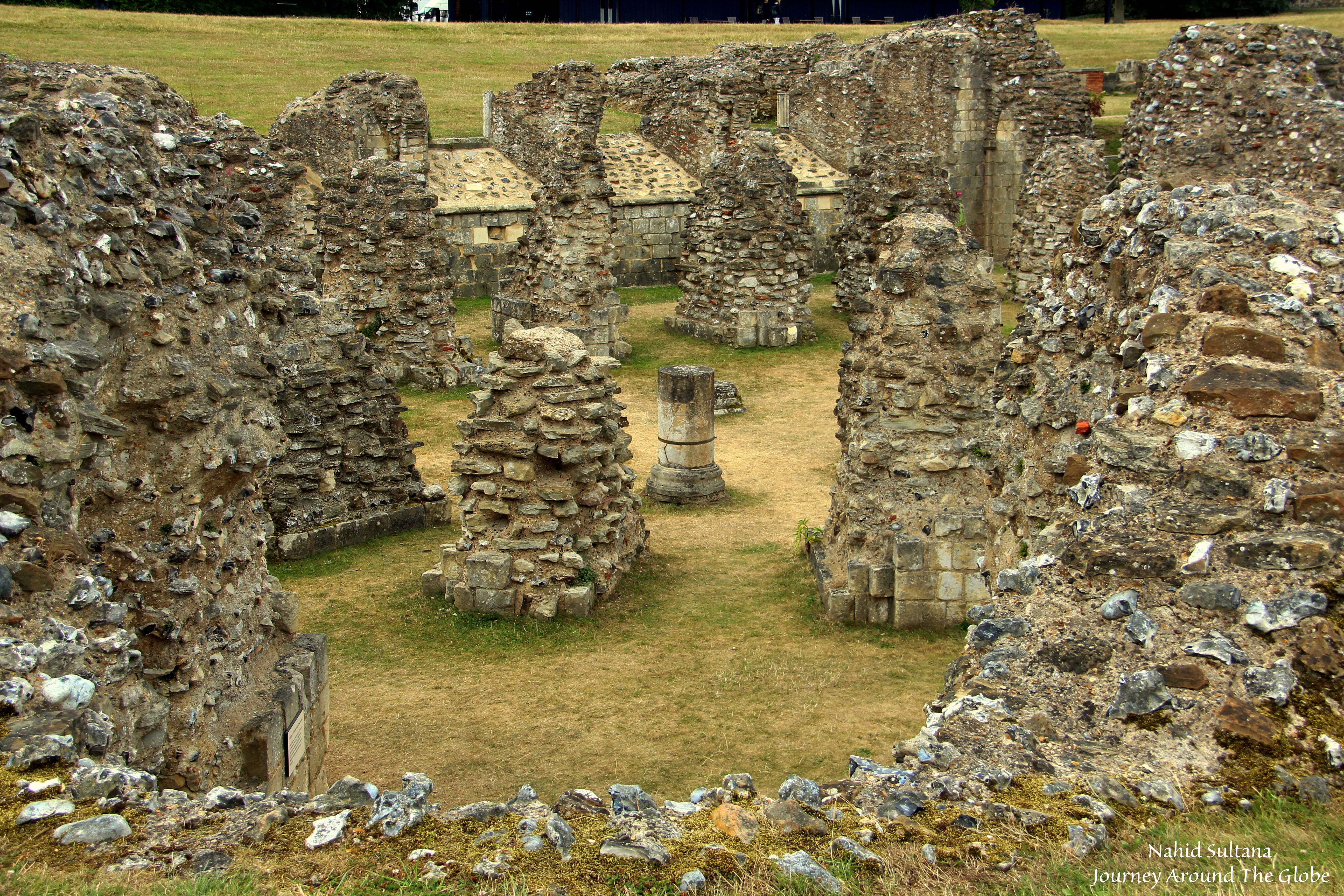
St. Augustine’s Abbey is also a UNESCO World Heritage Site. This big open space has lots and lots of ruins and grassy meadows. Take time, walk around and enjoy its elegant past. Then go inside the museum which holds a detail timeline of this place along with many things archeologists have found at the site.
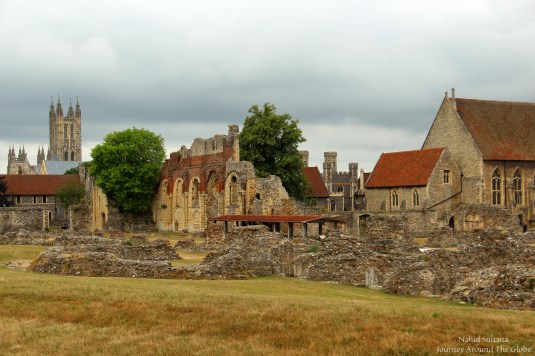
- Walking and enjoying late afternoon in St. Augustine’s Abbey, can see Canterbury Cathedral in the back
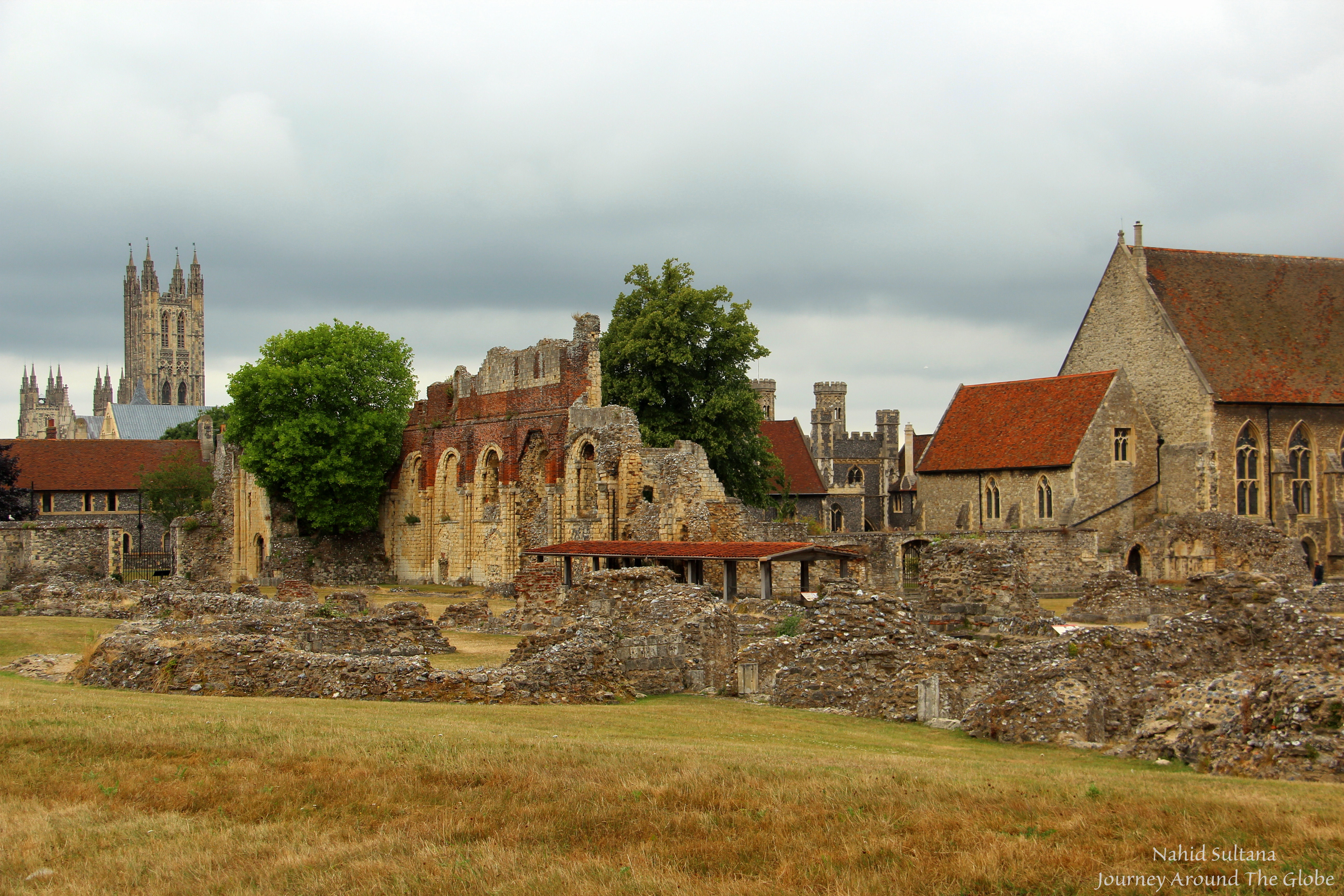
Ticket is 5 GBP per adult, 3 GBP for kids 5 – 15 years, and 13 GBP for family ticket. The ticket includes audio tour of the site and a small museum. Allow at least an hour for this forgotten abbey. It’s located within the walking distance from the cathedral and shouldn’t be missed.
3. ST. MARTIN’S CHURCH: This is the oldest English parish church in England dating back to 6th century. It is an active church and part of Canterbury World Heritage Site. Setting of this church is very peaceful with an old cemetery in its yard. We couldn’t go inside, because it’s only open on Tuesdays, Thursdays, and Saturdays from 11 – 4. It’s about 5-7 minutes of walk from St. Augustine’s Abbey.
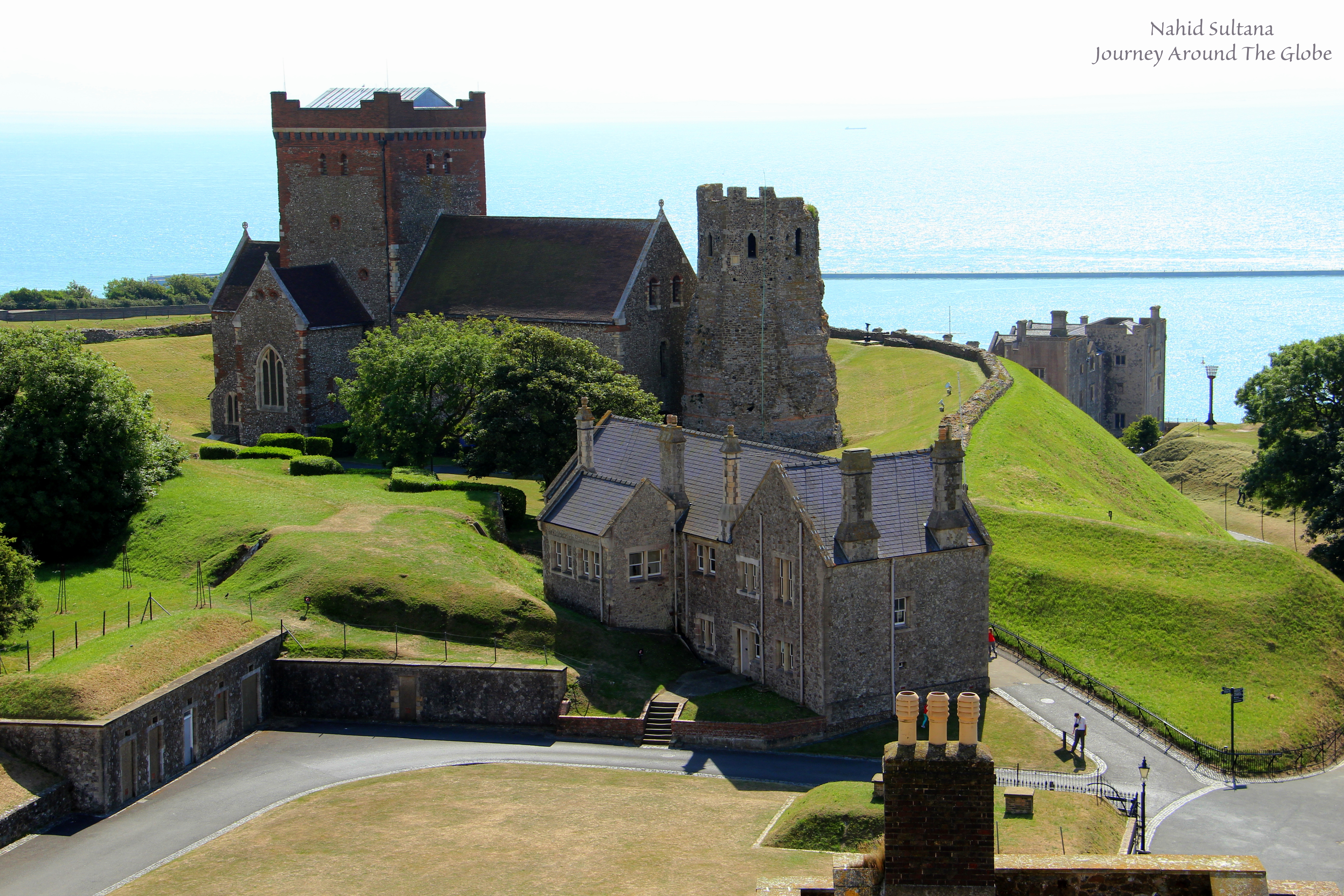
4. DOVER CASTLE: This is a 2000 years old fortification that have been protecting English coast since 1180. King Henry II built this present castle on the beautiful White Cliffs of Dover. Roman Lighthouse or Roman pharos is the oldest building in the castle standing right beside a Saxon church, called Church of St Mary-In-Castro. This Roman lighthouse is considered to be one of the oldest buildings in Britain which was built on the site of Dover Castle. At the heart of the castle lies the inner bailey and Great Tower. Great Tower, once the royal palace, is now recreated to its 1180s glory. Don’t be lazy to climb to its roof for some brilliant views. Many sections/barracks of this castle features different museums and settings from the old time. There are some underground tunnels, secret wartime tunnels, an underground hospital, and casemates here which are accessible to publics by guided tours. By the way, do go to Princess of Wales’ Royal Regiment Museum for some wartime memorabilia. Finally, the English Channel, Dover Port, and white chalk cliffs look amazing when you stand on hills or from any towers.
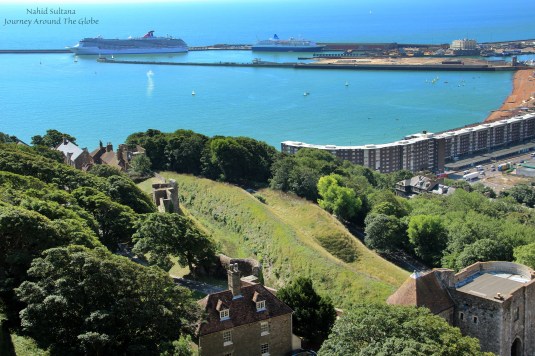
- View of English Channel and Dover Port from Dover Castle in England
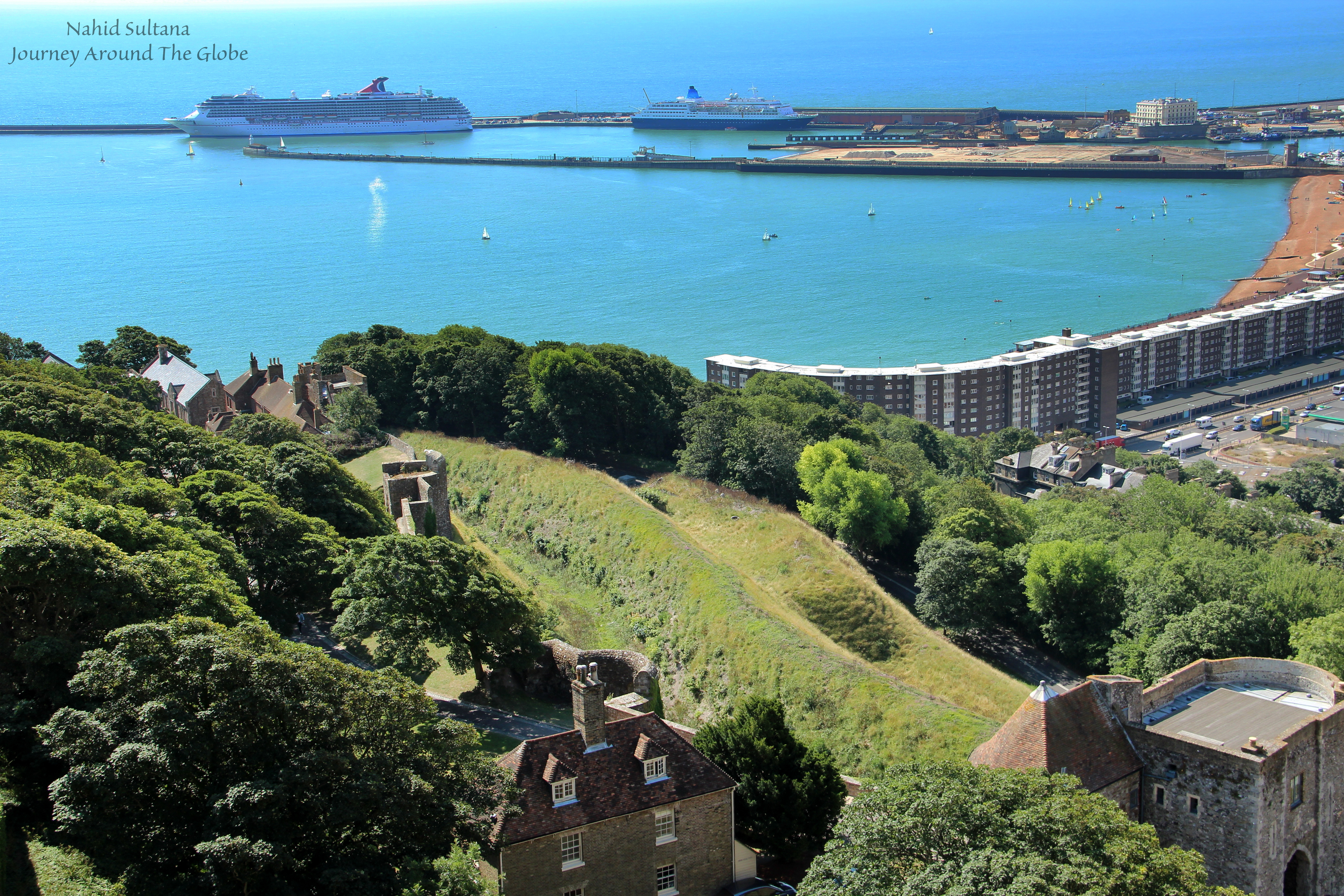
Dover Castle is very kid and family friendly. We saw a small interactive play of King Henry II with his daughter, Mathilda and constable inside the Great Tower. There were also some archers dressed in medieval armory in front of cafeteria teaching kids’ archery. Pick up a map from the tourist office and enjoy the vast land of this fort. There is a free train ride to help you get around the site.
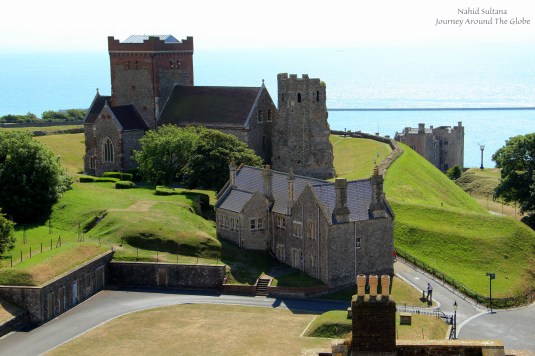
- Roman lighthouse (right) and Church of St Mary-in-Castro (left) in Dover Castle
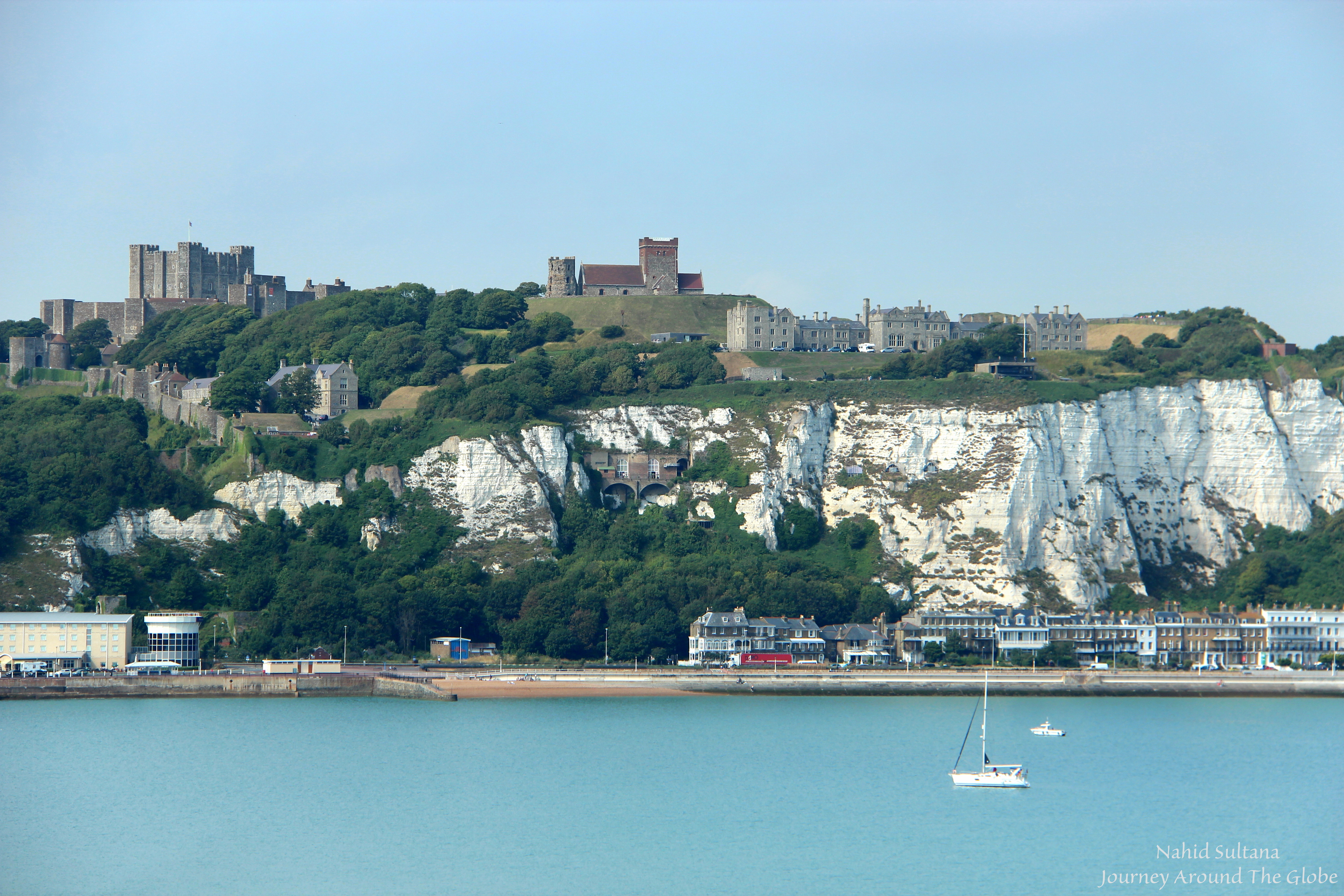
Dover port is the closest port to Continental Europe from mainland Britain. If you are coming from a ship or ferry you can see the towers of Dover Castle from far away with the white cliffs down below.
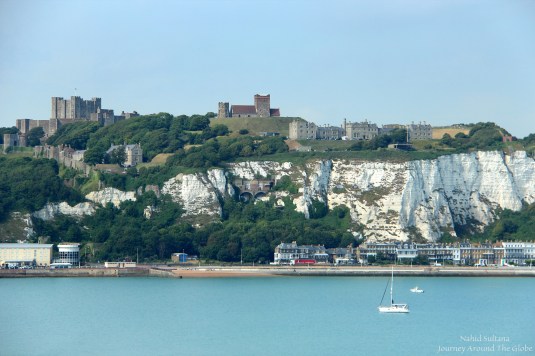
- Reaching Dover Port, saw chalk-white cliffs of Dover with Dover Castle in the backdrop in England
Related articles
- A day in Canterbury (williamtheconcretor.wordpress.com)
- A tale of two cathedrals (marlyb.wordpress.com)
- Welcome to the Countryside (kristofferkoper.wordpress.com)
- Reims – Part II (emilyhambi.wordpress.com)
- Canterbury Cathedral (bethanybrownled.wordpress.com)
- Canterbury and Dover (holidatewithkate.wordpress.com)
Share this:

Modern Dutch city Eindhoven, The Netherlands
EINDHOVEN, THE NETHERLANDS: Eindhoven is a thriving ultra-modern Dutch city with lots of bold and futuristic buildings. The actual city is very spread out and big but the city center is walkable to all the main spots. Unlike many other European cities, Eindhoven doesn’t have an “old town” per say; look of its city center is very up-to-date and stylish.
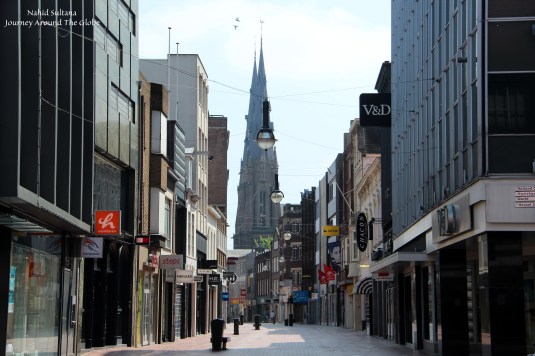
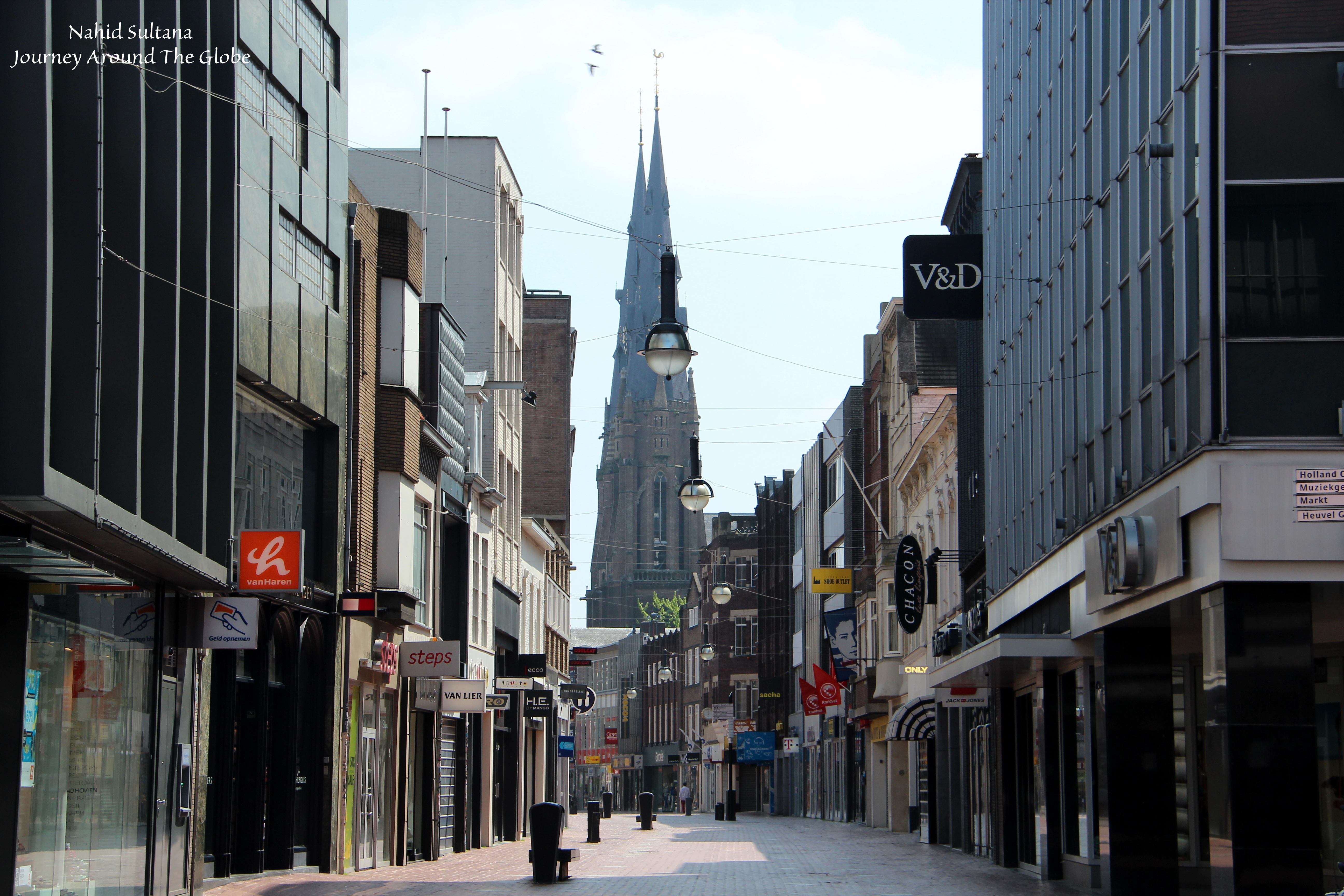
- Walking towards St. Catherine Church in Eindhoven, The Netherlands was very empty that Sunday
TIME of TRAVELING: We visited Eindhoven when my elder sister and her family came to visit us in Belgium. It was one Sunday in May of 2013. It was a very pleasant day but empty in the city center.
EATING and SHOPPING: We had lunch in an Egyptian place beside St. Catherine Church. It was some good food for good price.
Since we were there on a Sunday, everything was closed! There were lots of stores in the city center but too bad we could only do window shopping.
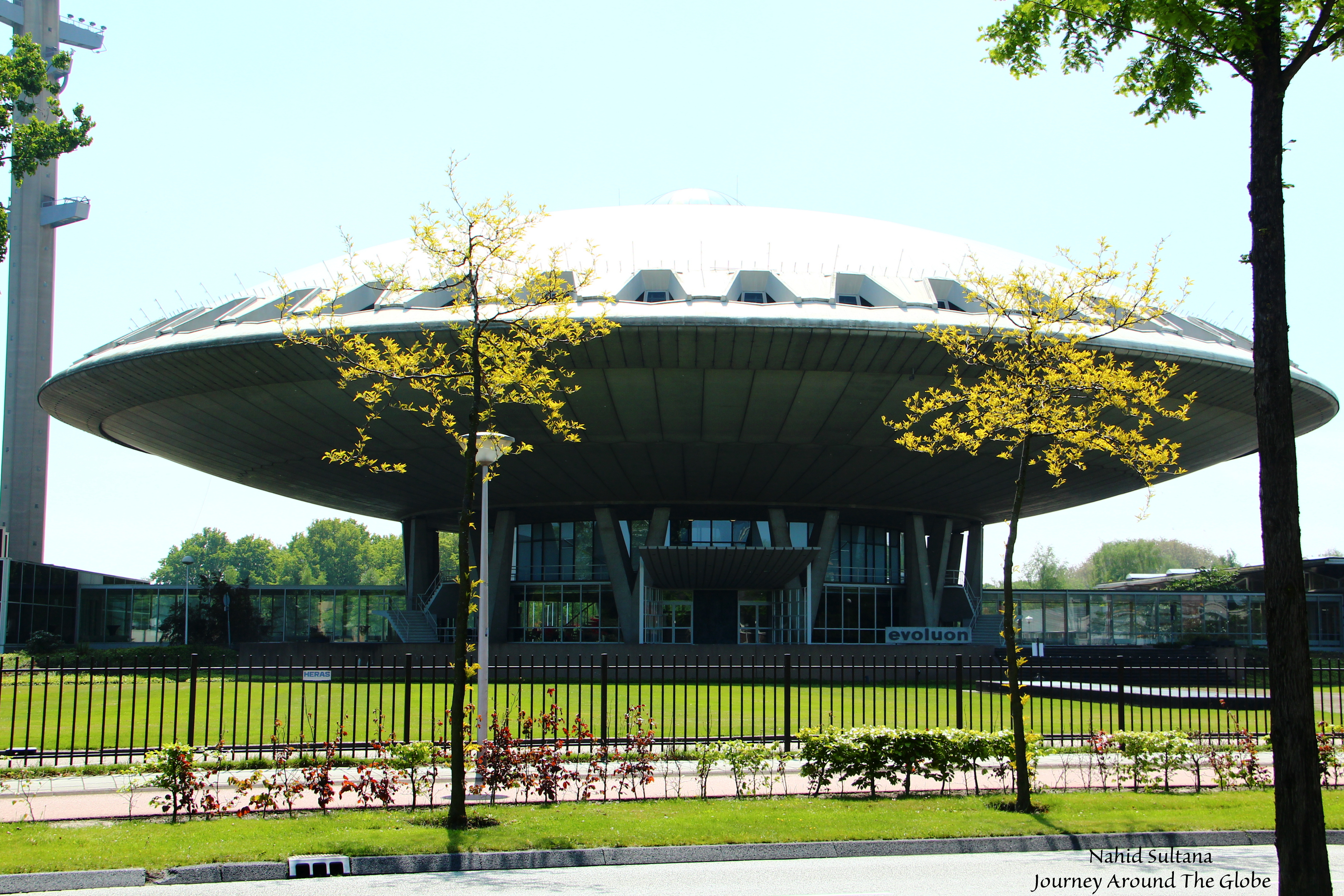
PLACES WE’VE VISITED: We spent only half a day in Eindhoven since everything was closed and crowdless, we decided to go to Antwerp in Belgium before heading back home. It seemed like there wasn’t anything to do except looking at some good-looking buildings and some squares. I think, the nightlife here can be very lively…but that didn’t suit us really. Some of the great buildings of this city are De Admirant (the highest building in Eindhoven), Evoluon – a mushroom/UFO shaped building from 1966, and more sexy architectures in “Around the Admirant” which are basically shopping area.
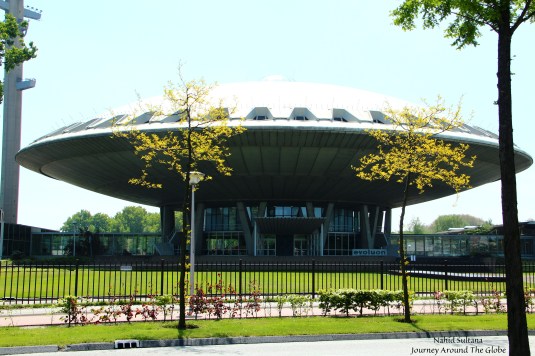
- Evoluon – a UFO shaped futuristic building in Eindhoven, The Netherlands
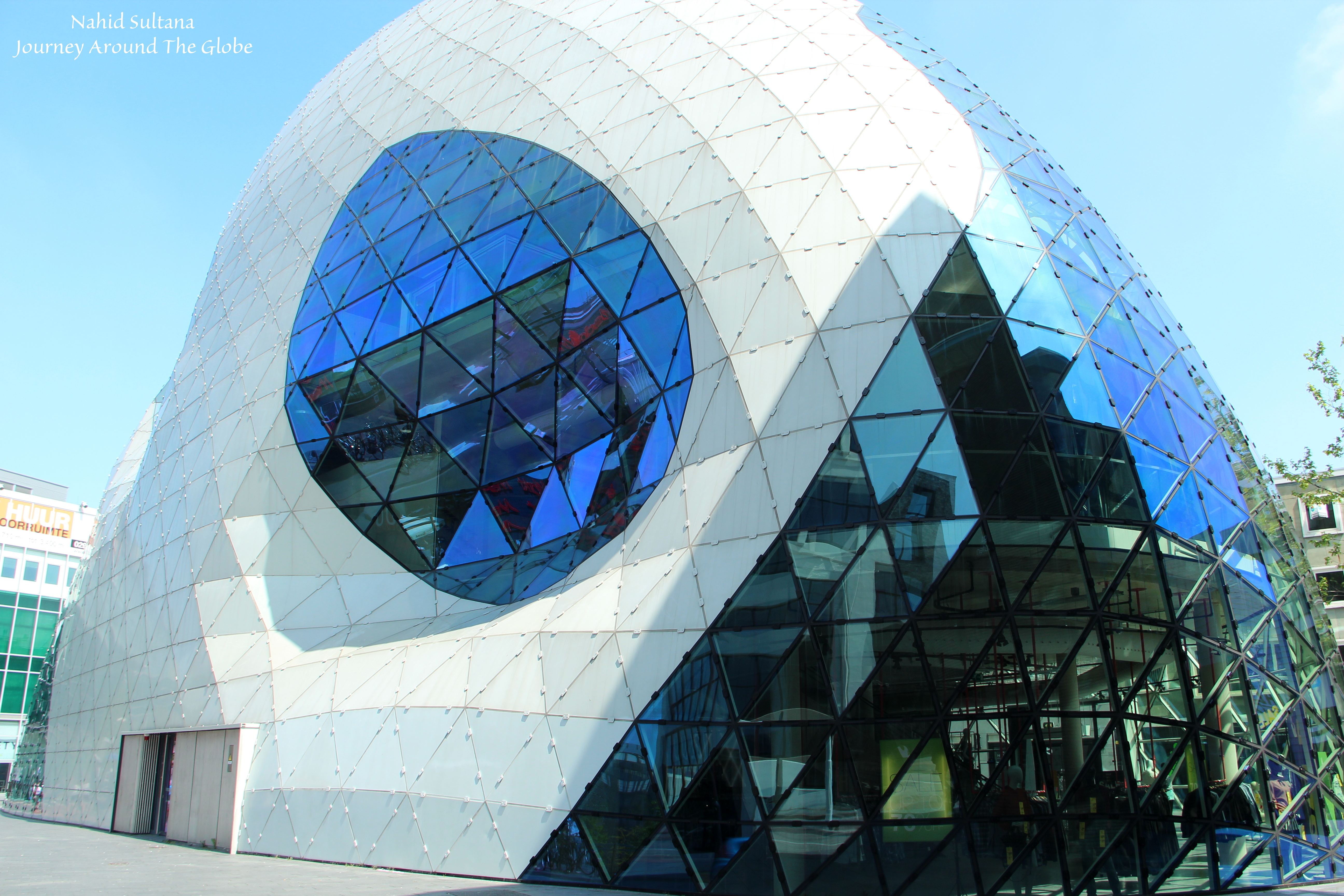
“Around Admirant” is one of the most stylish squares I’ve seen in whole of Europe with many creative looking buildings. Small streets from this square have many shops and some fast food places. I can’t imagine what it would be like on Saturdays when everything is open and people are gathering in to hangout in this cool place.
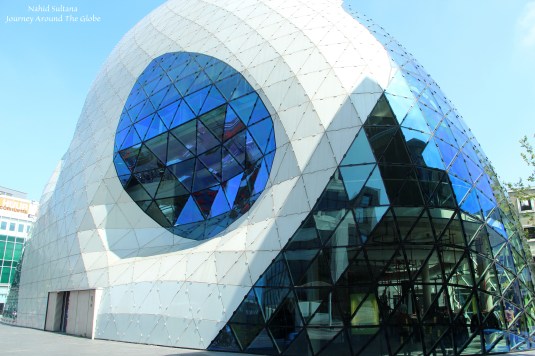
- Another cool architecture “The Blob” in “Around Admirant” in Eindhoven, The Netherlands
Sint-Catherinekerk located in Catharinaplein. Exterior of it looks fascinating but couldn’t go it (forgot that most of the churches in the Netherlands are closed on Sundays).
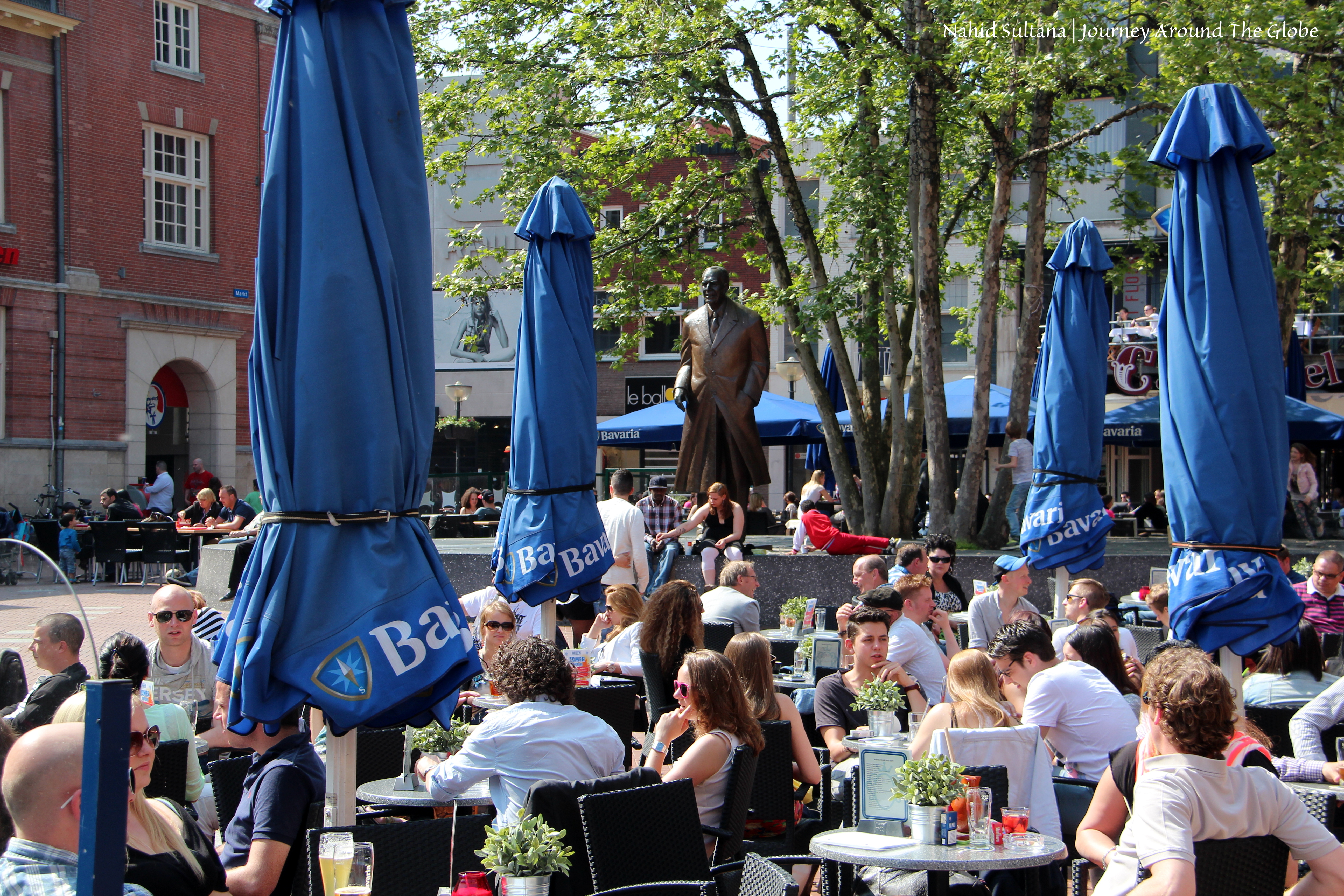
Markt looked the liveliest place while we were roaming around the city center. It is probably one of the best places for lunch with many options.
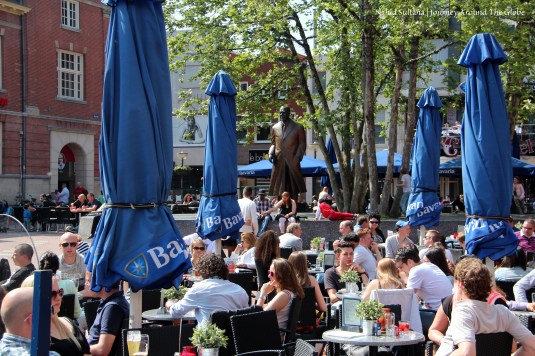
- Restaurants in the Markt in Eindhoven, The Netherlands
Share this:

A fairy-tale region of France – Alsace
ALSACE, FRANCE: I saw road side signs of Alsace Region in France when we were driving to Belgium from Basel, Switzerland about more than a year ago. The whole region looked so gorgeous from my car window that I came home and googled that place. I was thrilled by its amazing countryside looks and vast vineyards. My husband and I were planning to go to Alsace since then. After failing few times with our plans, we finally went to this one of a kind place in Europe. And believe me this is a little wonderland where I would love to go back again and again to get me out of the reality of life.
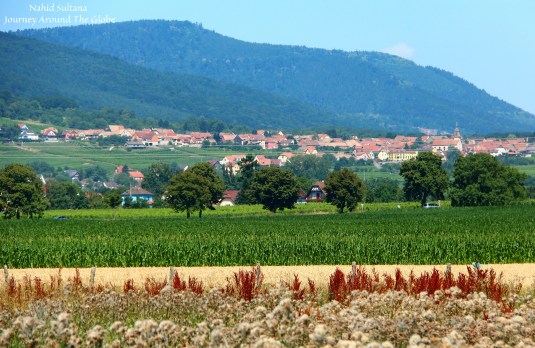
- Driving on highway in Alsace, on our way to Colmar on the 1st day
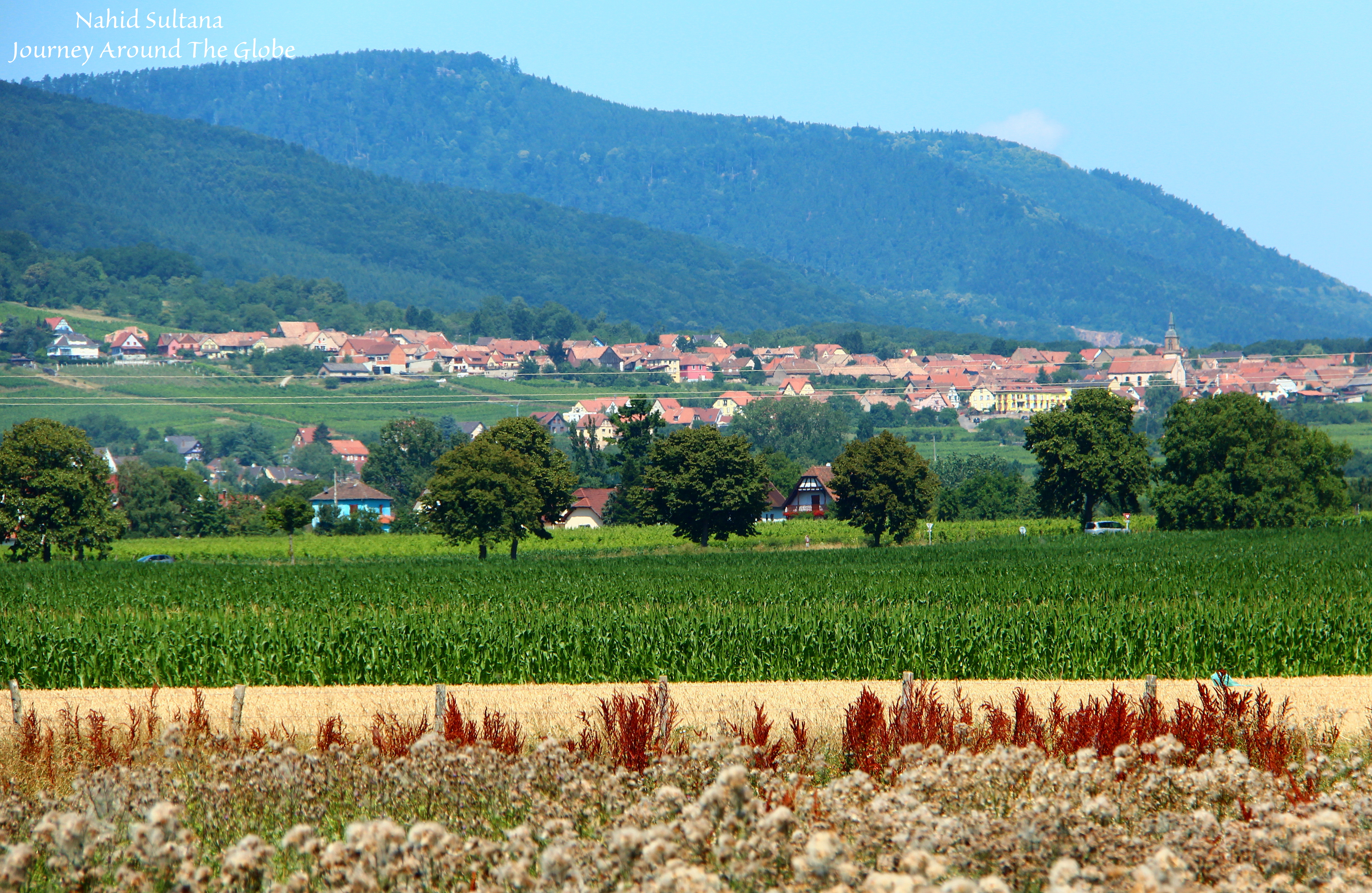
Colmar and Strasbourg are two big cities of Alsace, located about an hour drive from each other (via highway). But villages here are very close to each other surrounded by miles after miles of vineyards. Each village is more elegant and scenic than the other one. People usually come here and hop from one village to another and from one wine maker to the other…that’s where you can get the taste of real Alsace. The whole region is a fairy-tale place…you can’t go wrong with any city/village you visit.
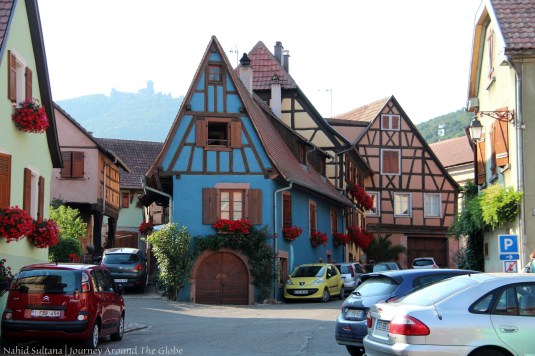
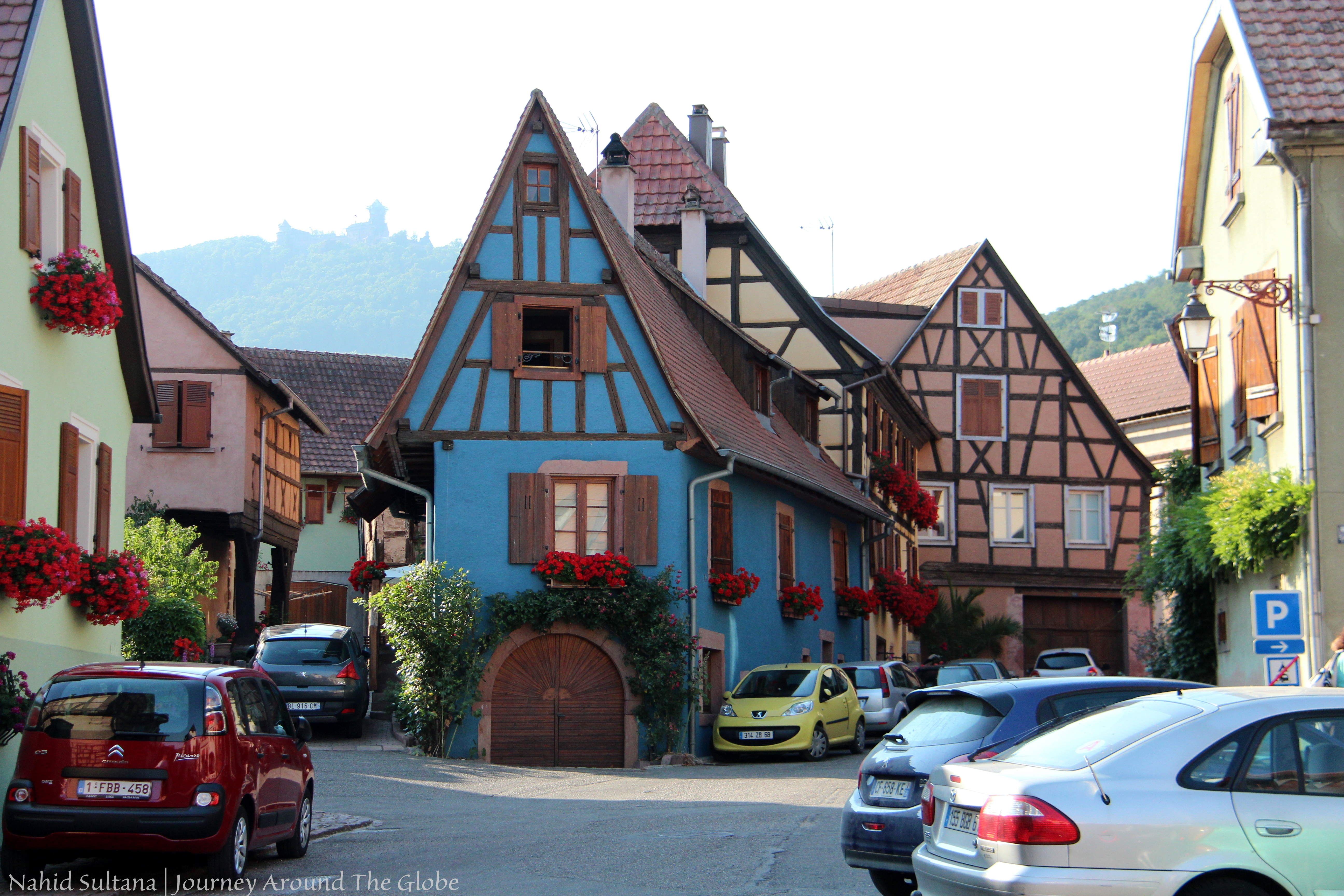
- Don’t know the name of this village in Alsace, just looked too pretty
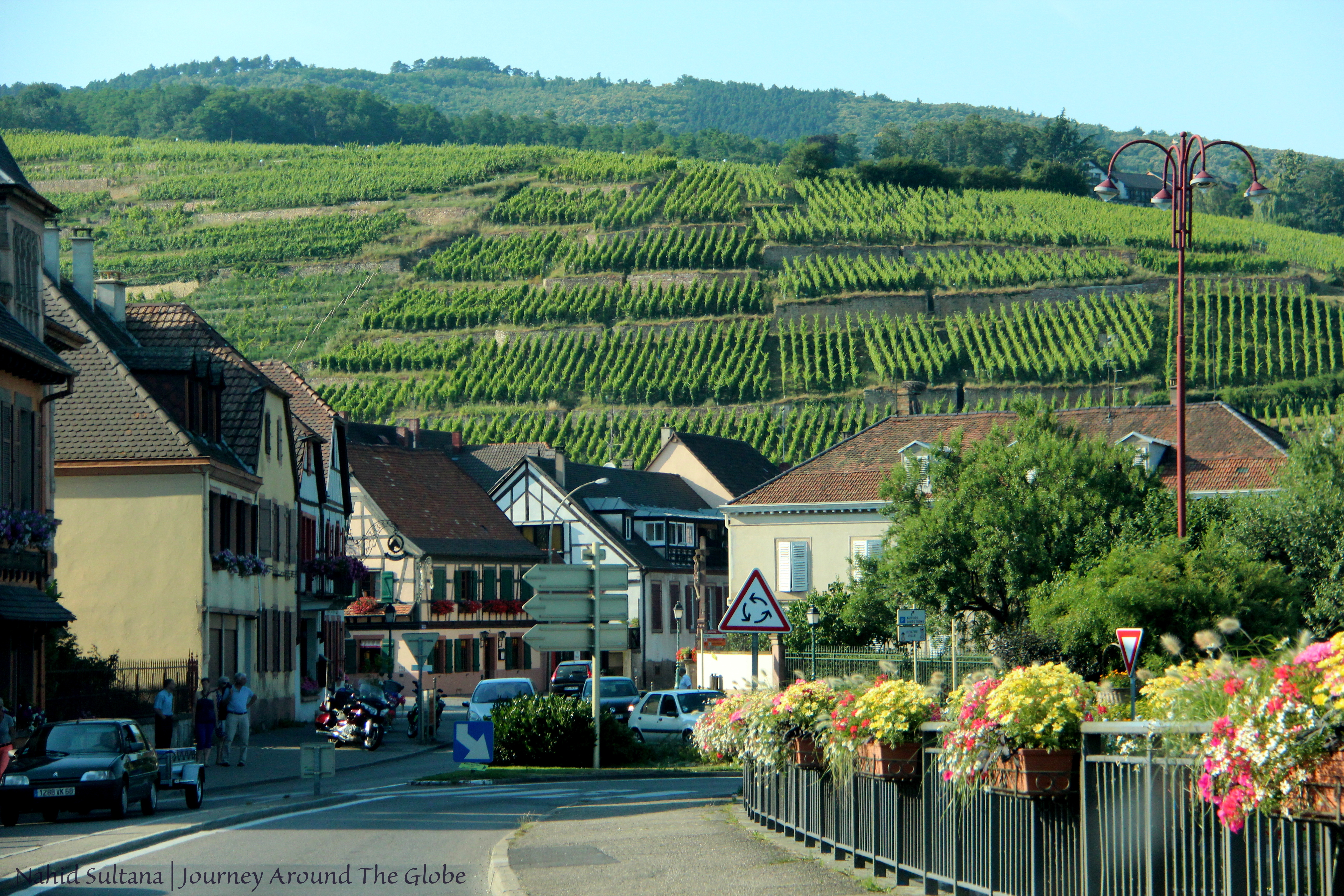
When we were coming back from Colmar to our hotel, we took the famous “Wine Route” of Alsace. This route is a crossroad at the heart of Europe and probably is the best way to discover this romantic region of France. Ruins of medieval castles, vast vineyards, and the Renaissance houses lined up by the flower decorated roads are just little things that make Alsace Wine Route the best known of its kind in France. The route is about 170km in length, running through a multitude of valleys and hills…making it a slower route than regular highways. But it offers a magnificent perspective of the region and its wine makers. Just follow the sign “Route des Vins d’Alsace” which indicates the Wine Route and all the winegrowing villages of Alsace. The route passes through more than 50 communes of Alsace from Marlenheim to Thann. It is much more than just a scenic journey for visitors to admire the countryside, the architecture, and the food: it also leads the way to the doors of many wine cellars and tasting rooms, most of which are open all year round.
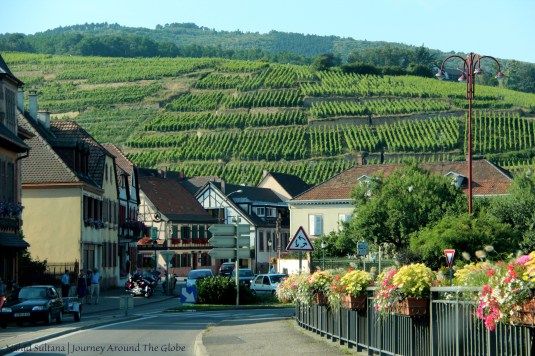
- Driving on “Wine Route of Alsace” in Alsace, France
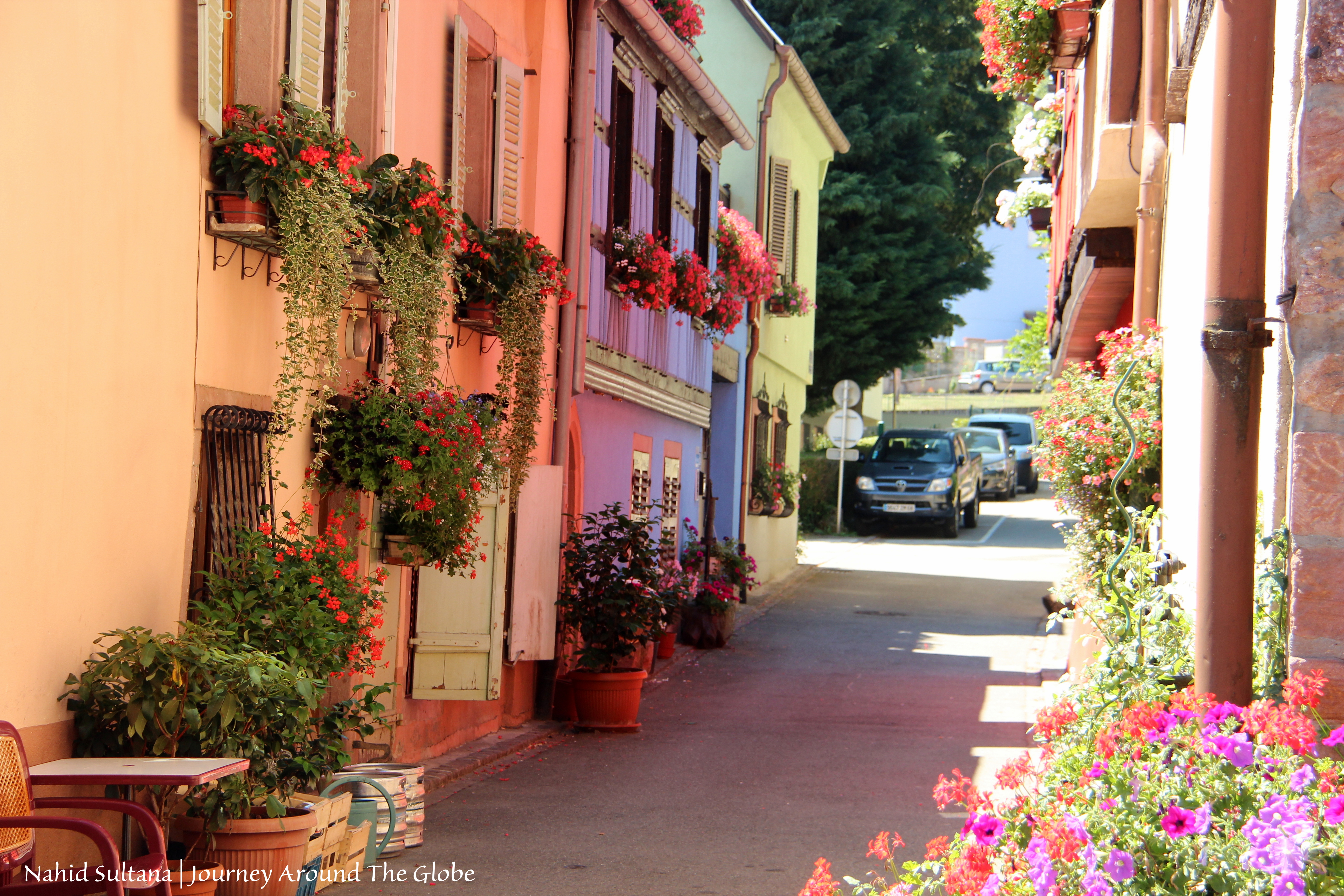
Summer is the best time to visit Alsace when you can see all villages are vibrantly decorated with hundreds and thousands of flower bouquets and baskets. If you take the “Wine Route”, do look for flower-rating of villages upon entering them. I think, the region rates each village with flowers (the way hotels are rated) on the level of decoration.
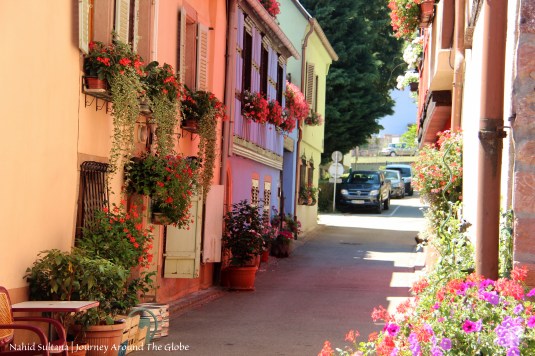
- Summer blooms in Kayserberg, France – a small village in Alsace
Grapes harvest normally takes place between mid-September and late October and it’s the busiest of seasons. There are many wine-festivals during this time. These are essential parts of Alsace Wine Route. When we were visiting in July, we saw many posters that some small villages were holding their own wine related events/festivals.
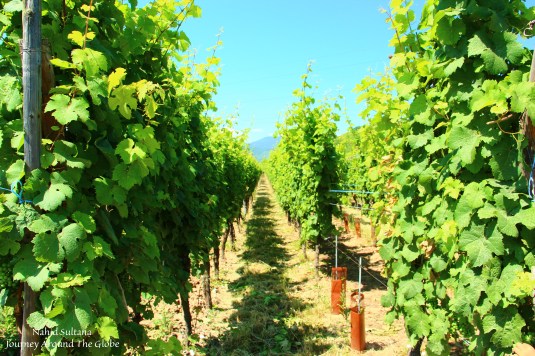
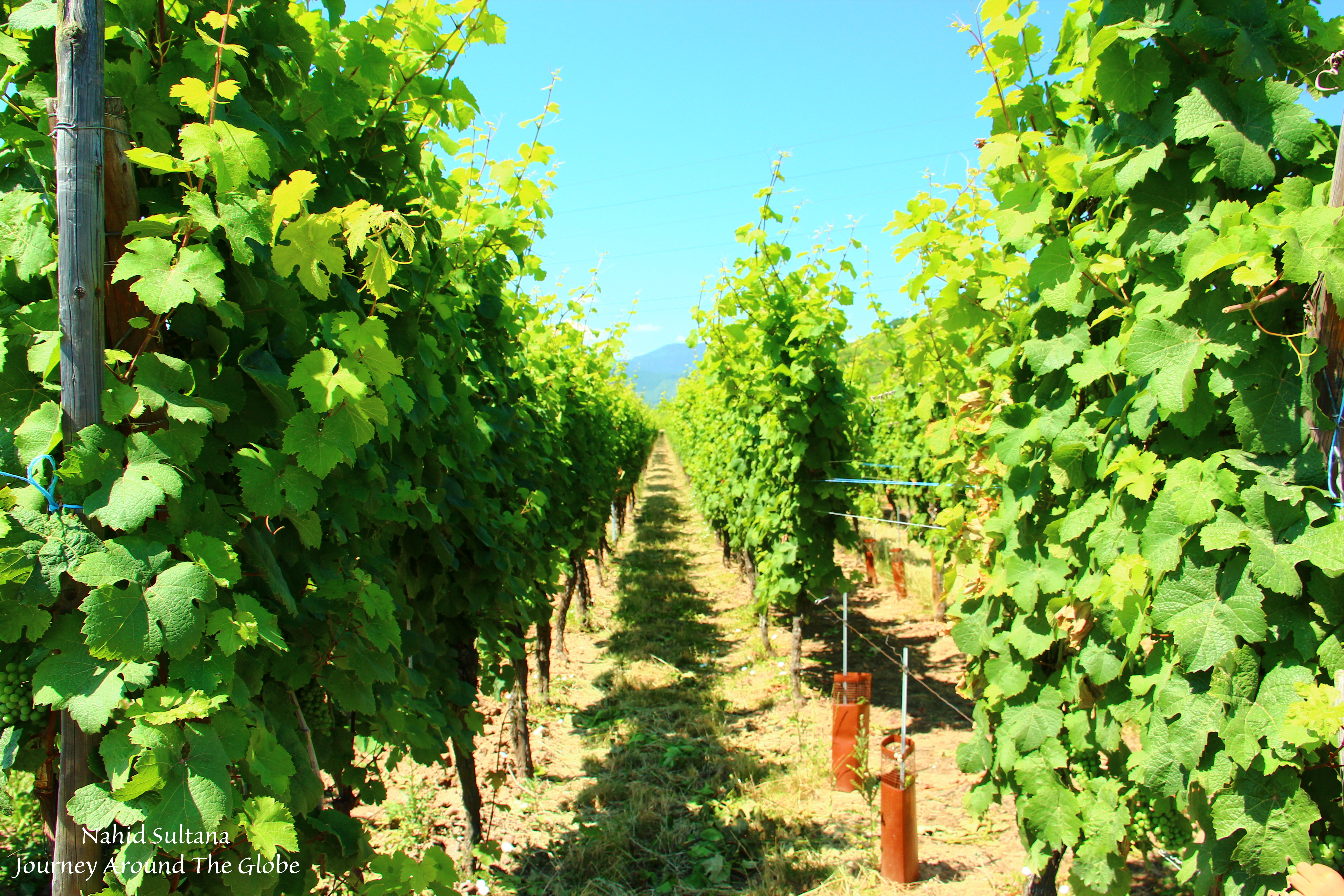
- Vineyards in Alsace, France
TIME of TRAVELING: We visited Alsace during a weekend in mid-July of 2013. It was very hot those few days…about 90 degrees F. But to see the colors of this region, better to come in summer when everything comes alive in every village.
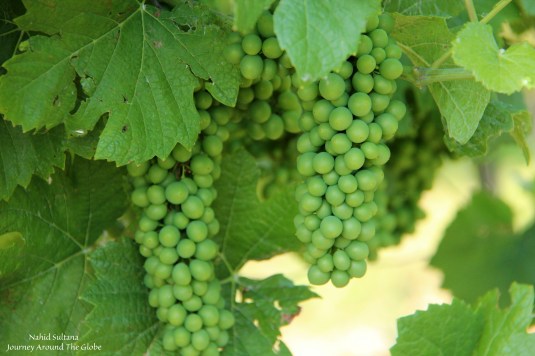
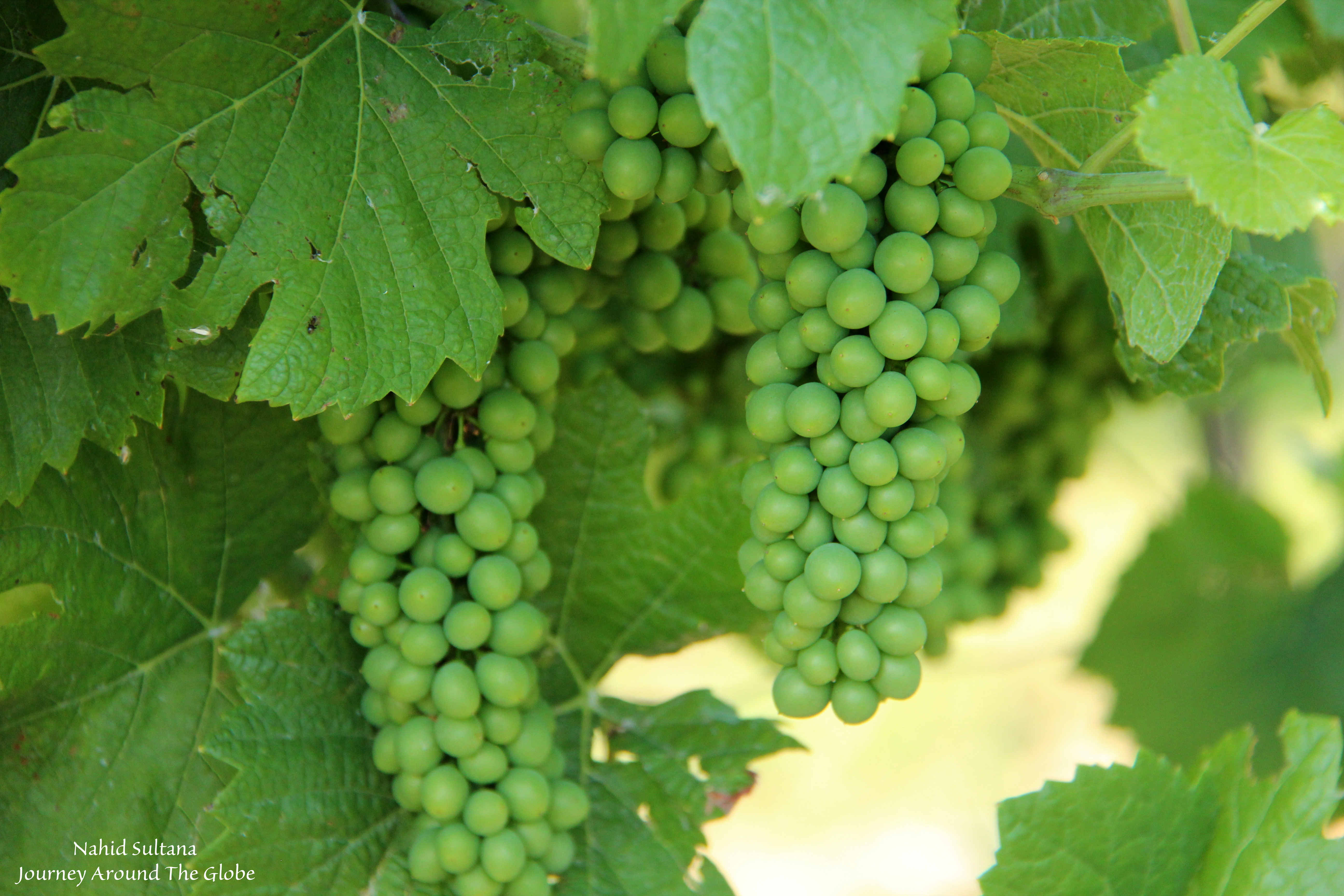
- Grapes weren’t fully grown in July…but looked beautiful
OUR HOTEL: We stayed in a budget hotel “Mr. Bed Strasbourg” in a small town, Ostwald, very close to Strasbourg. It’s probably the cheapest hotel in that area. The room was pretty small with a tiny bathroom. But the staff and workers were nice and helpful. There was a breakfast service for a minimal fee and free Wi-Fi in our room. But the main problem was that it was extremely hot that weekend and the hotel didn’t have AC. We could open our window only half way but no cross ventilation for the air to pass. Man oh man, four of us in that tiny room without air was a nightmare. I would recommend this place for anyone looking for a cheap place to stay but not in the summer time. There was a heater in our room, so winter shouldn’t be bad…but this place definitely is not for summer tourists.
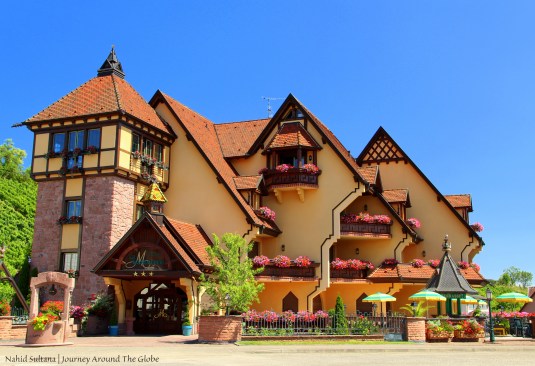
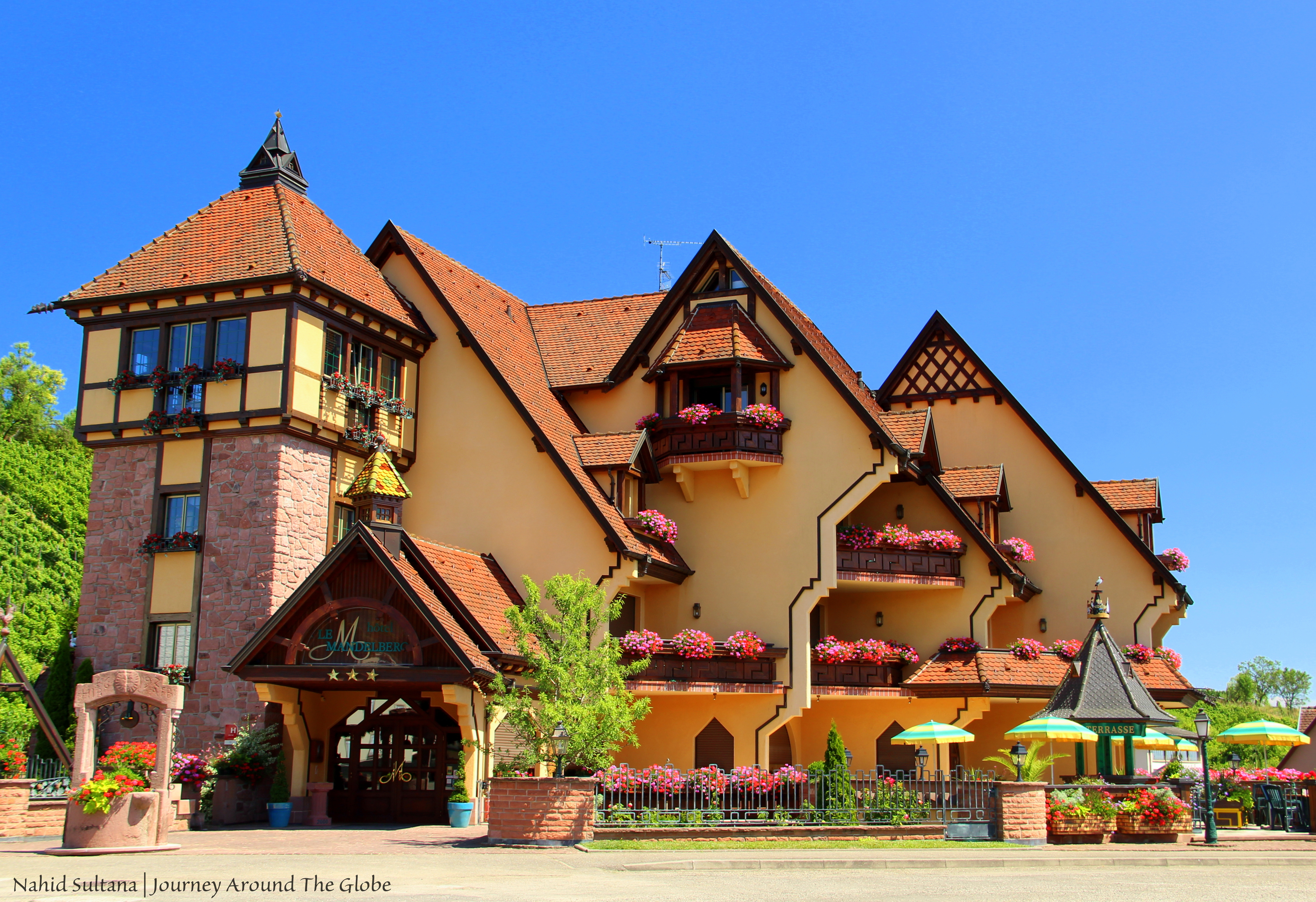
- Saw this beautiful hotel/resort while driving on “Wine Route” of Alsace, France
EATING and SHOPPING: First day we had regional lunch in old town of Colmar. The restaurant had variety of salads from different villages of Alsace which was great for me. Also when you are in Alsace, you have to try “Tarte Flambe”. It’s a popular pizza-like desert here which comes with fruits and other toppings. Savory tarte flambe usually comes with ham and onion. We ordered one tarte flambe that came with apple and banana…very light and yummy.

- Tarte Flambe – a very popular dessert of Alsace

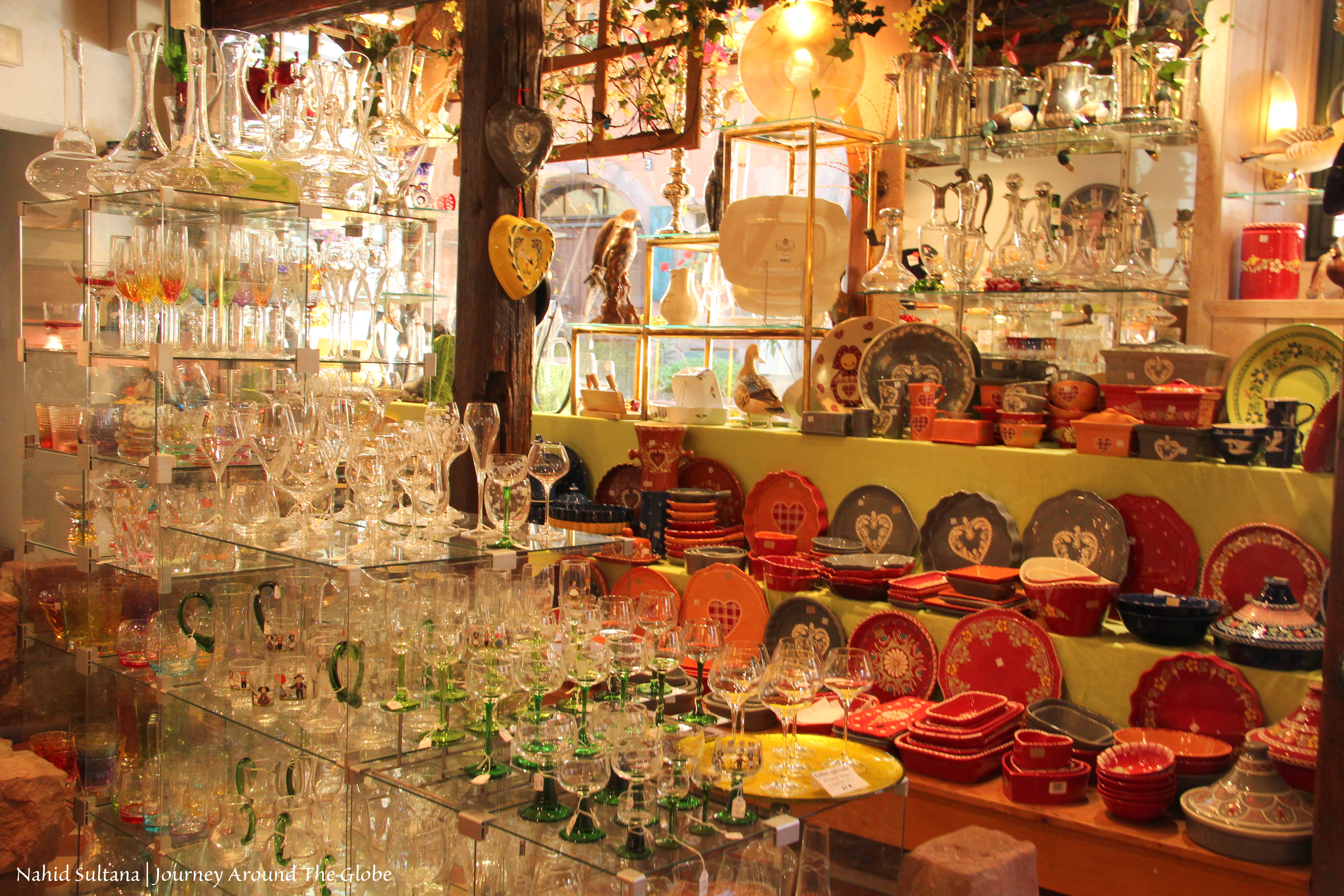
Most of the villages have countless souvenir shops in the old towns. Alsatian potteries and ceramics are very popular. They are all handmade and hand-painted in this region. Although they can be a bit pricey they are unique of this place. Stork is a regional bird of Alsace and you can find many things with its picture. Look at the cute metal signs on top of many stores as it was the old way of telling which store is selling what.
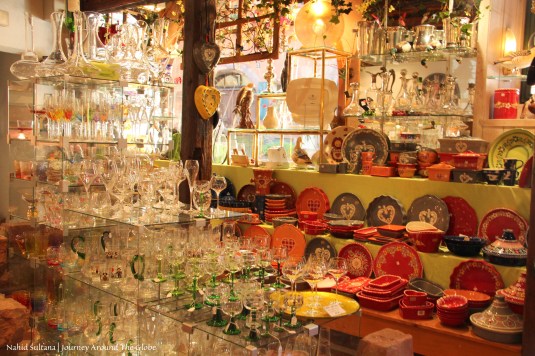
- Alsatian potteries and typical looking wine glasses in a souvenir shop in Riquewihr, France
PLACE WE’VE VISITED: We stayed three full days in Alsace visiting Colmar in one day, 2 villages on our 2nd day and Strasbourg for half a day before heading back home in Belgium. You can easily spend a month here exploring all the villages, castles, and wineries. We are planning to go there again probably in a cold winter season to see all the Christmas markets and decorations…let’s see. But it was surely hard for me to choose only couple villages this time out of some 40 or 50 picture perfect post-card looking villages. But as I mentioned above, the best way to get a quick glimpse of Alsace is to take “Wine Route”…then just sit back and enjoy the scenic views rolling by.
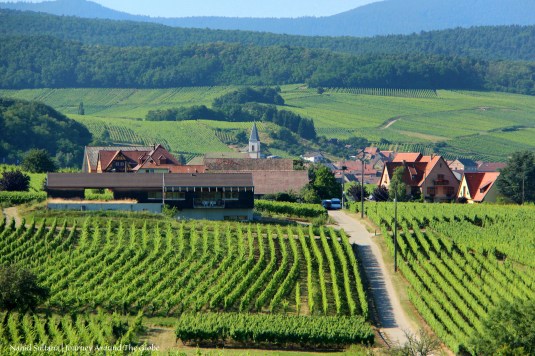
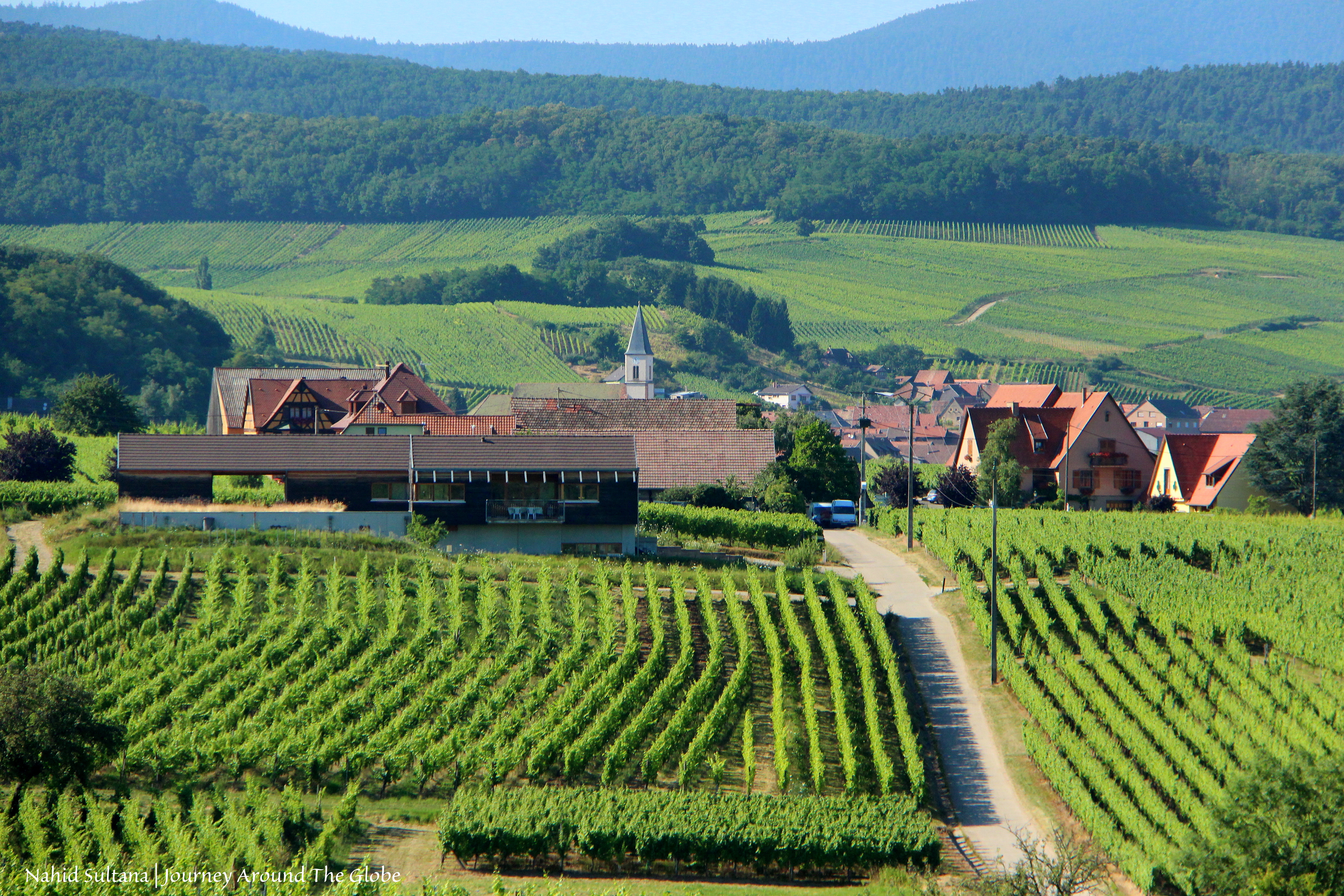
- Scenic Alsace – an enchanting region of France
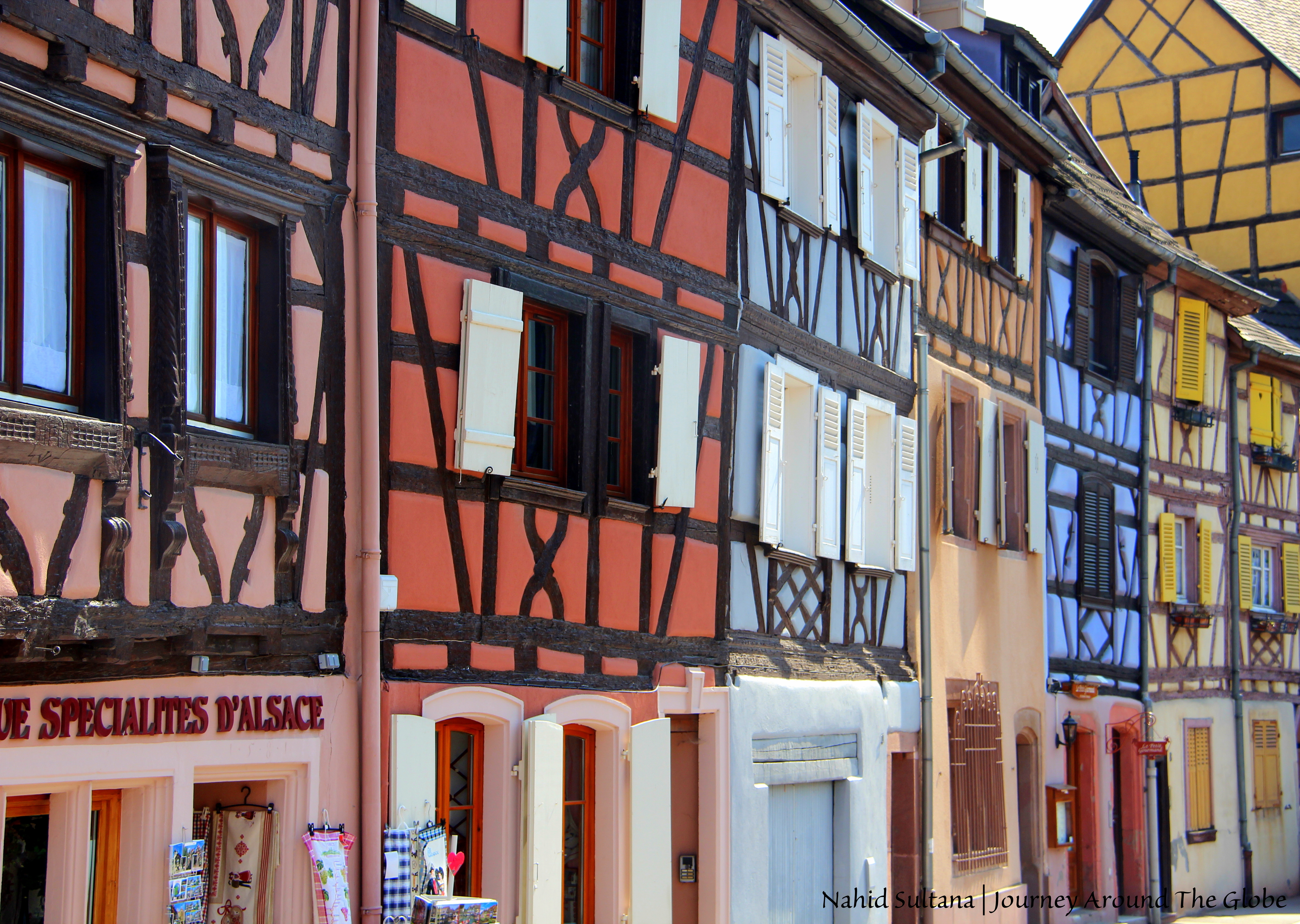
1) COLMAR: We visited Colmar on the 1st day of this journey. It’s the wine capital of Alsace. Old town is the main attraction and is very well-preserved where you can see countless half-timbered bright-colored houses with gorgeous summer blooms everywhere. Many shops, cafes, and old style decorations give this place its uniqueness.
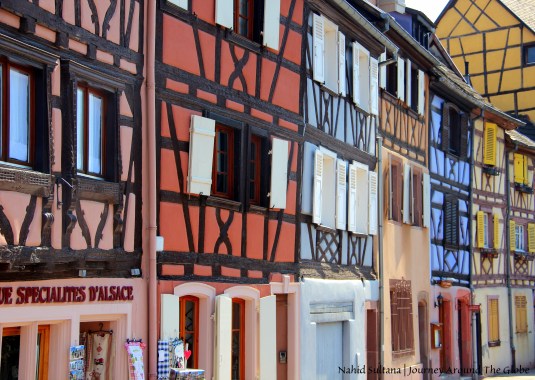
- Vibrant color buildings of Colmar, France
This is also the home town of Frederic Auguste Bartholdi – the sculptor of the Statue of Liberty. You can actually see a miniature version of the Statue of Liberty when entering the city from north (from Strasbourg). Old town of Colmar still has the house where Bartholdi was born (now a Museum) in 1834. Although we didn’t go inside, it has the largest collection of works, models, and souvenirs of the designer of the Statue of Liberty that was unveiled in New York in 1886.
Our first stop in Colmar old town was Saint-Martin Cathedral. Built in 1235, this is the most imposing Gothic church in Middle Alsace. It is definitely worth a visit for its oversized old paintings, stained glass windows, and massive exteriors. It was free to enter and located in Place de la Cathedrale.
Another monumental church in Colmar is Eglise des Dominicains or Dominican Church. The construction of it started in 1283. The present superb stained glass windows survive from that period. It’s a small church but is famous for “Virgin of the Rose-Bush” painting from 14th century. The church is about 10 minutes of walk from St. Martin Cathedral and we needed 1.5 euros per adult to enter the church.
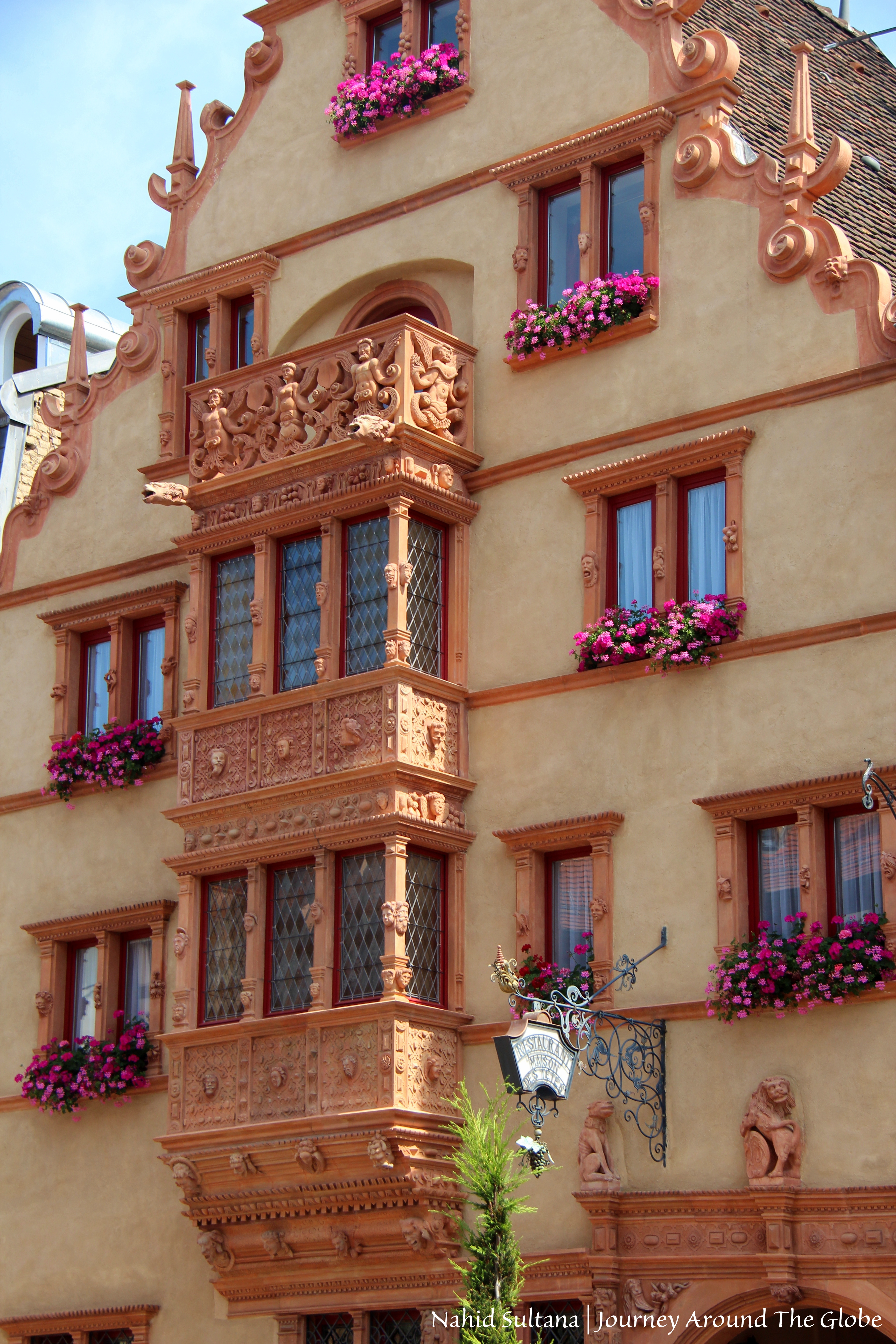
Maison des Tetes (House of the Heads) is a remarkable orange building in the old town of Colmar. It is a Renaissance building; exterior decorated with many heads and faces…very artistic.
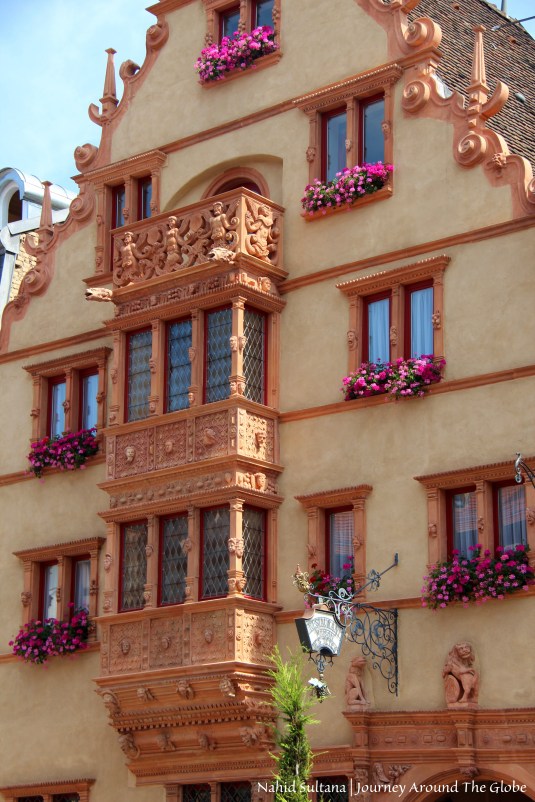
- Maison des Tetes (House of Heads) in Colmar, France
Maison Pfister (opposite of Bertholdi Museum) is a jewel of the Renaissance and one of the oldest houses in Colmar. This wooden residence was built in 1537 for a wealthy hatter. The façade is beautifully decorated with paintings allegorical figures, biblical characters, and scenes.
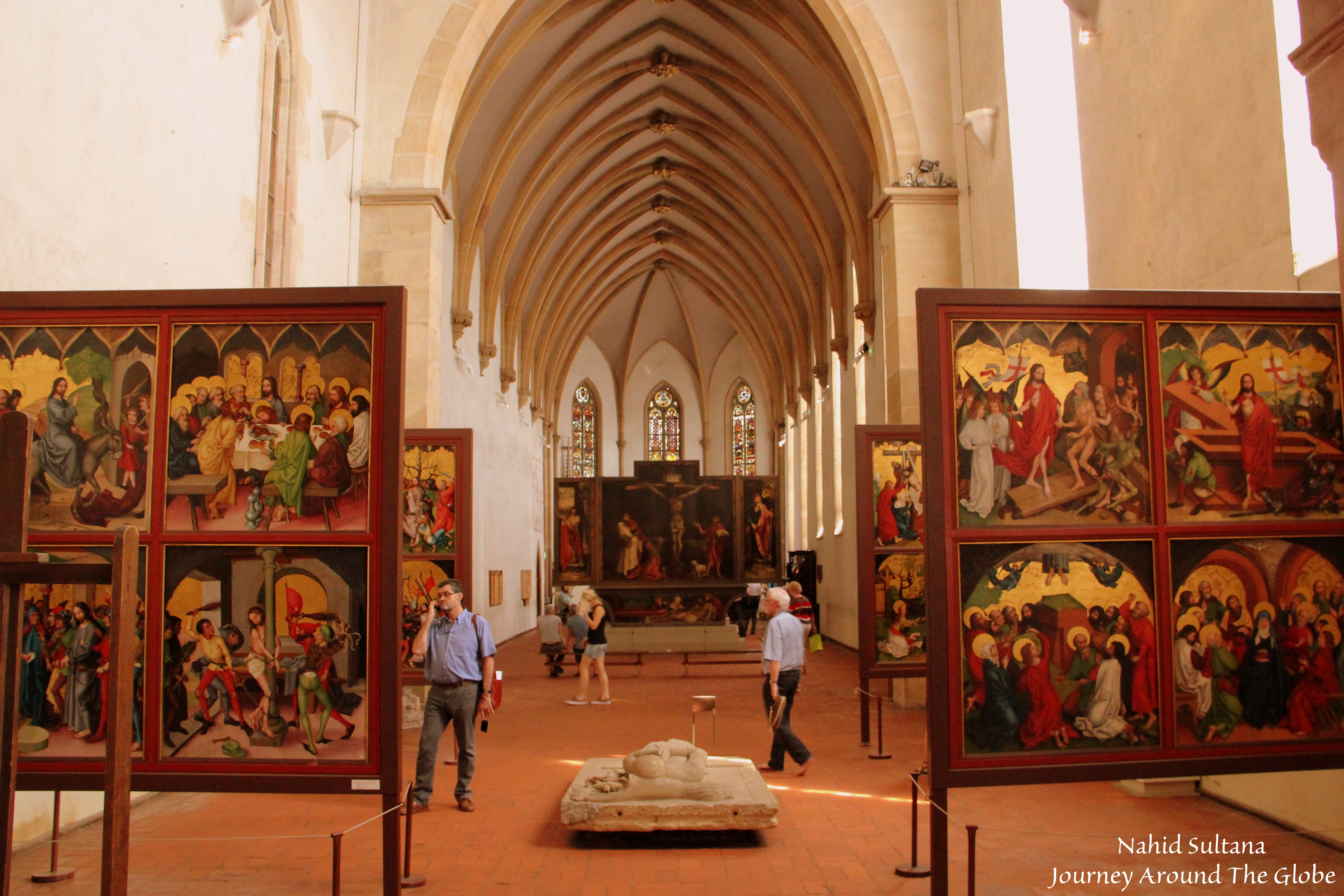
The only museum that I visited in Colmar was Unterlinden. This is a former Dominican convent with Gothic cloister which was built in 1289. The collection here provides a window into the Colmar region’s past and present through numerous objects recovered from dwellings and burial sites. Along with a vast collection of German arts, the museum boasts a remarkable collection of gorgeous paintings, religious arts, sculptures, furniture, and decorative art objects from the late-Middle ages and the Renaissance. Unterlinden features many talented artists from Alsace on popular art, medieval art, and traditional art including the statue of Colmarian painter and engraver Martin made by Bartholdi in 1860. One of the masterpieces that the museum holds is the Isenheim Altarpiece from 1512…celebrated its 500th anniversary in 2012. It was under major renovation during my visit, that’s why I couldn’t see some sections. The museum is located in the beautiful historic city of Colmar and charges 8 euros per adult. The museum is open daily (except Tuesdays from November to April) from 9 am – 12 pm and 2 pm – 5 pm.
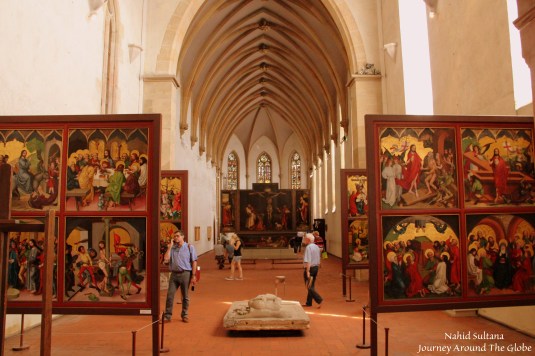
- Lots of religious paintings inside Unterlinden Museum of Colmar, France
“Petit Venice” is a historic quarter that is perfectly preserved in a little corner of Colmar that reminisces Venice, Italy. This picturesque neighborhood has many old houses, cafes by canal, and a perfect place to walk and get lost. Colmar visit is incomplete without a stroll in Petit Venice. You can catch a boat ride from Petit Venice through its canals which charges 6 euros per person for a 30 minutes ride.
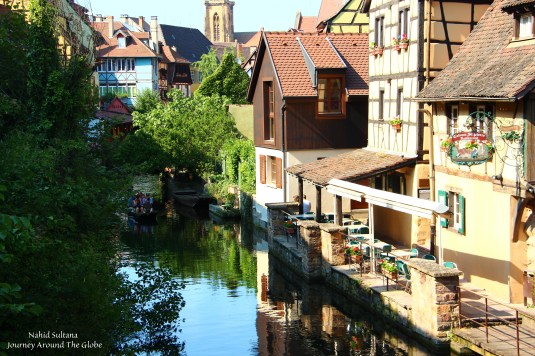
- “Petit Venice” in Colmar, France
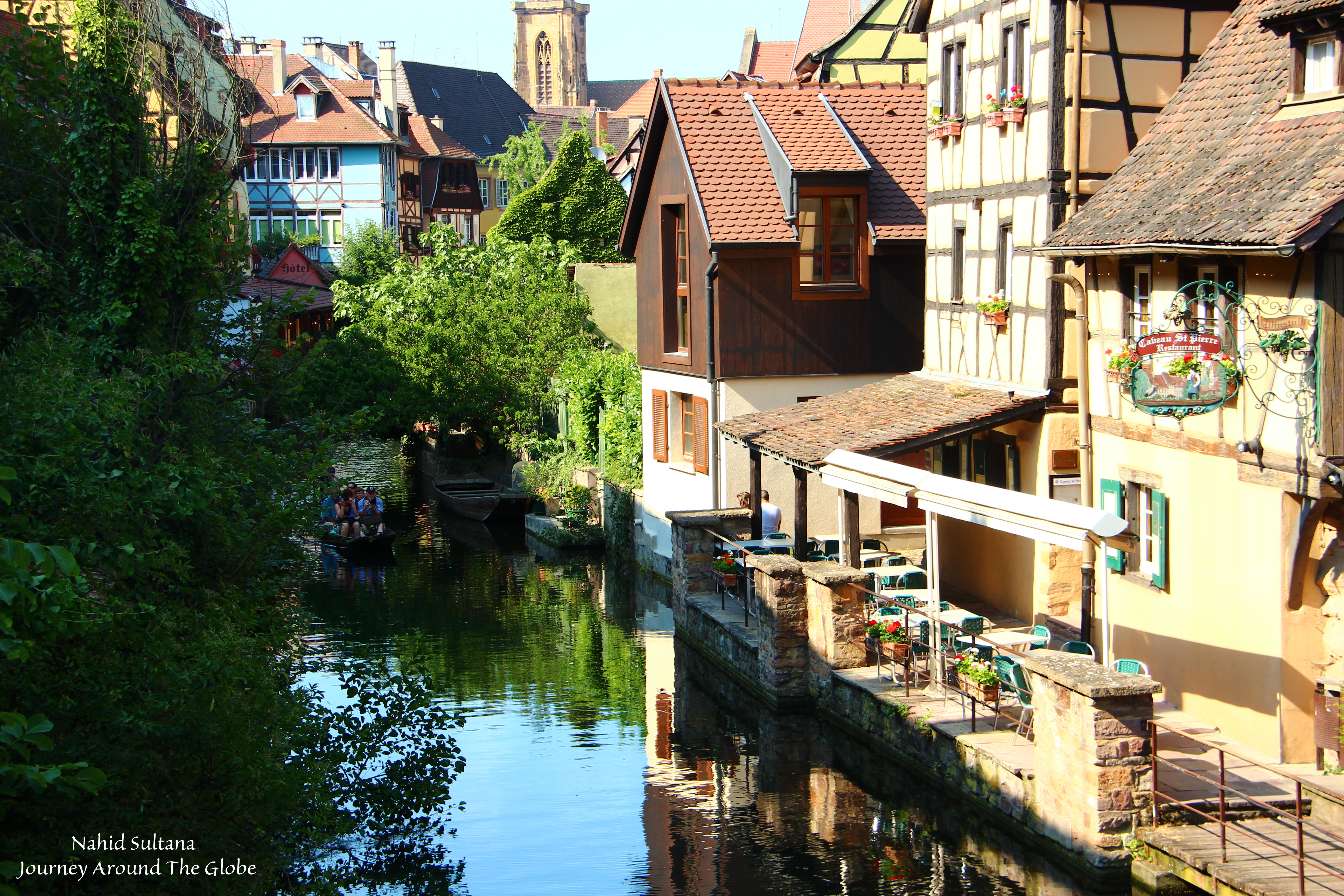
Most of the tourist spots of Colmar are within walking distance. Colmar is not a small village but a big city and needs at least one full day to stroll along its old streets. “Rapp” parking is the closest to old town.
2) KAYSERBERG: On our 2nd day in Alsace, we visited two villages: Kayserberg and Riquewihr. Choosing these two villages were the hardest part. All the villages that I saw online looked and sounded very charming. After many change of mind, finally narrowed down to these two villages.
Kayserberg is a popular tourist center with significant medieval and Renaissance influences. The village is famous for annual wine festival due to its typical Alsatian settings and charms. The village is very proud of its talented son Dr. Albert Schweitzer who was awarded Nobel Peace Prize in 1952. There is a museum (which was his birthplace) in the old town dedicated to Dr. Schweitzer’s work and life.
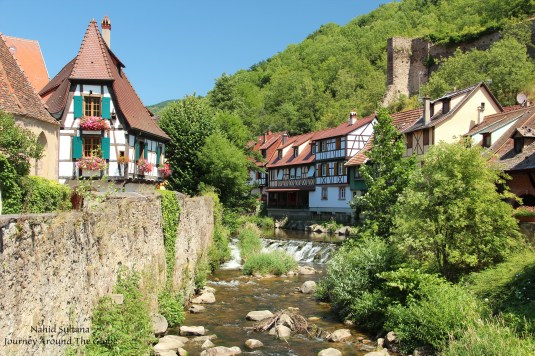
- Kayserberg – a small Alsatian village in France
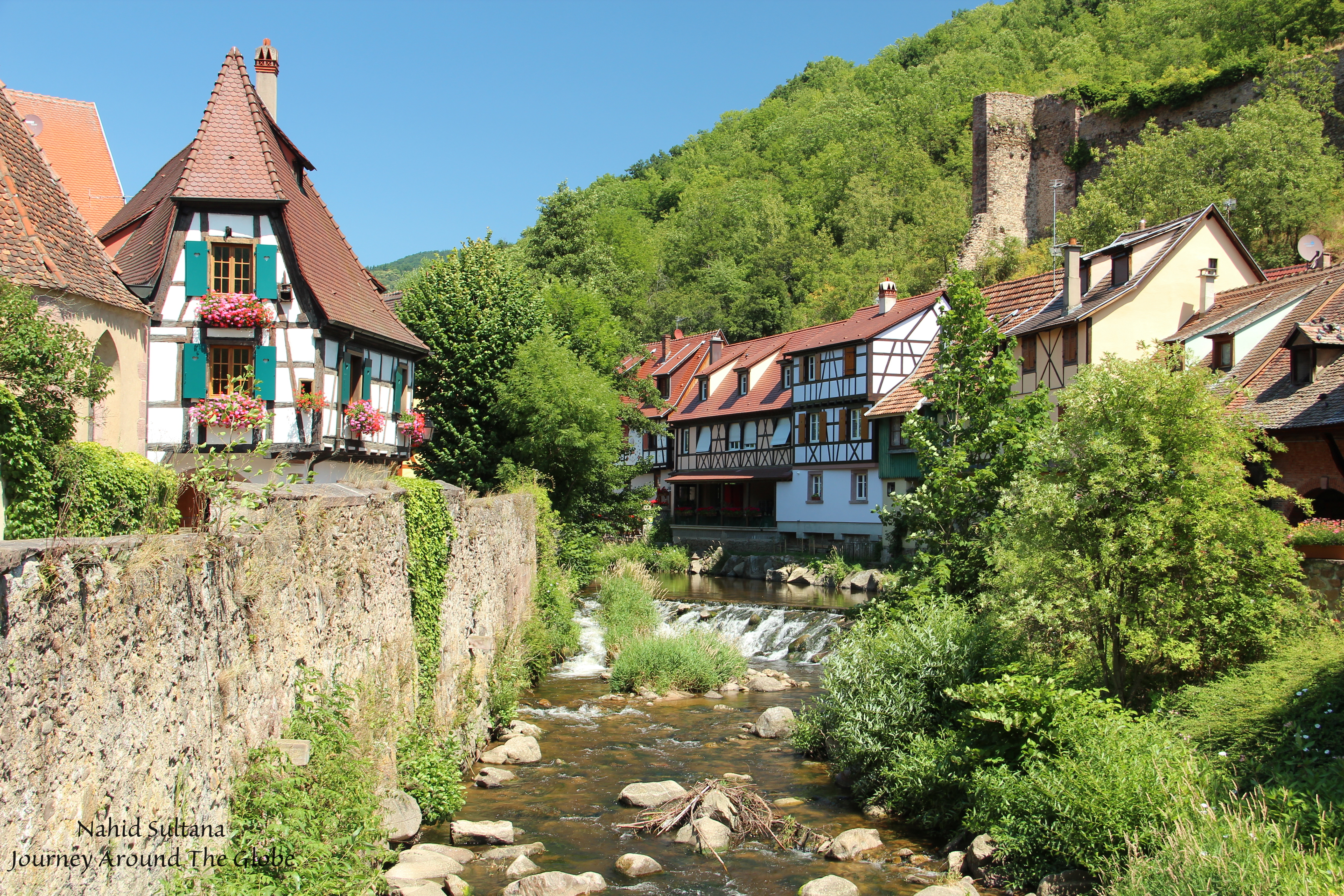
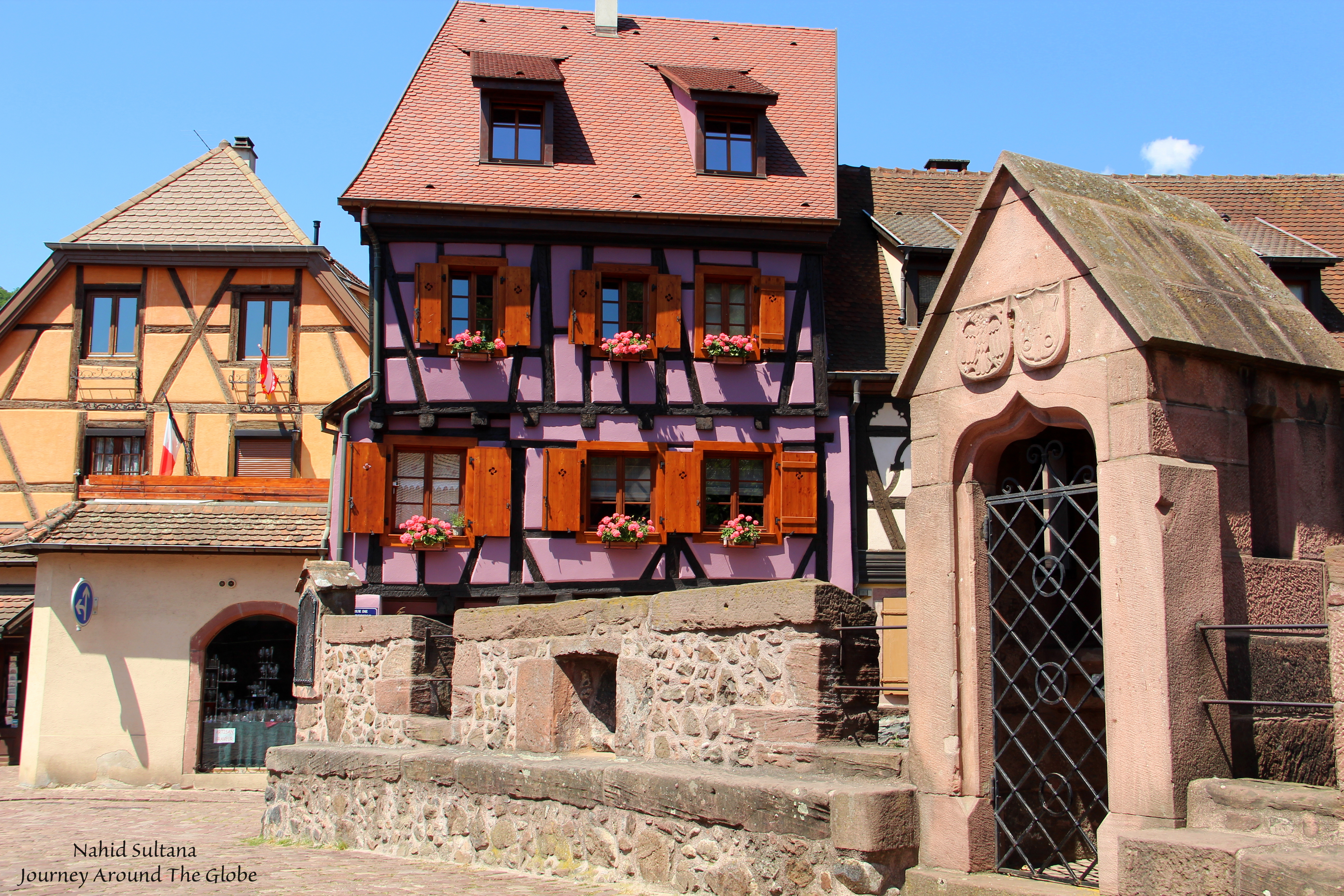
Rue du General de Gaulle is the most vibrant street of Kayserberg. It’s the main pedestrian path connects one end of old town to the other end. Many cafes, stores, old half-timbered houses can be seen here. Some of these houses are not just pretty…they look like picture perfect fairy-tale cottages from story books. Pont Fortifie on this small street dates back to 1514 and Town Hall in Kayserberg is also few centuries old from 1604 near the big church.
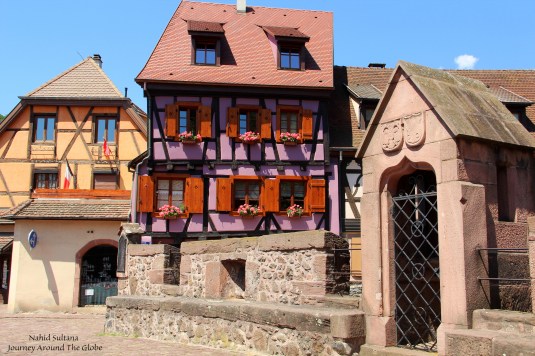
- Pont Fortifie from 1514 on Rue du General de Gaulle in Kayserberg, France
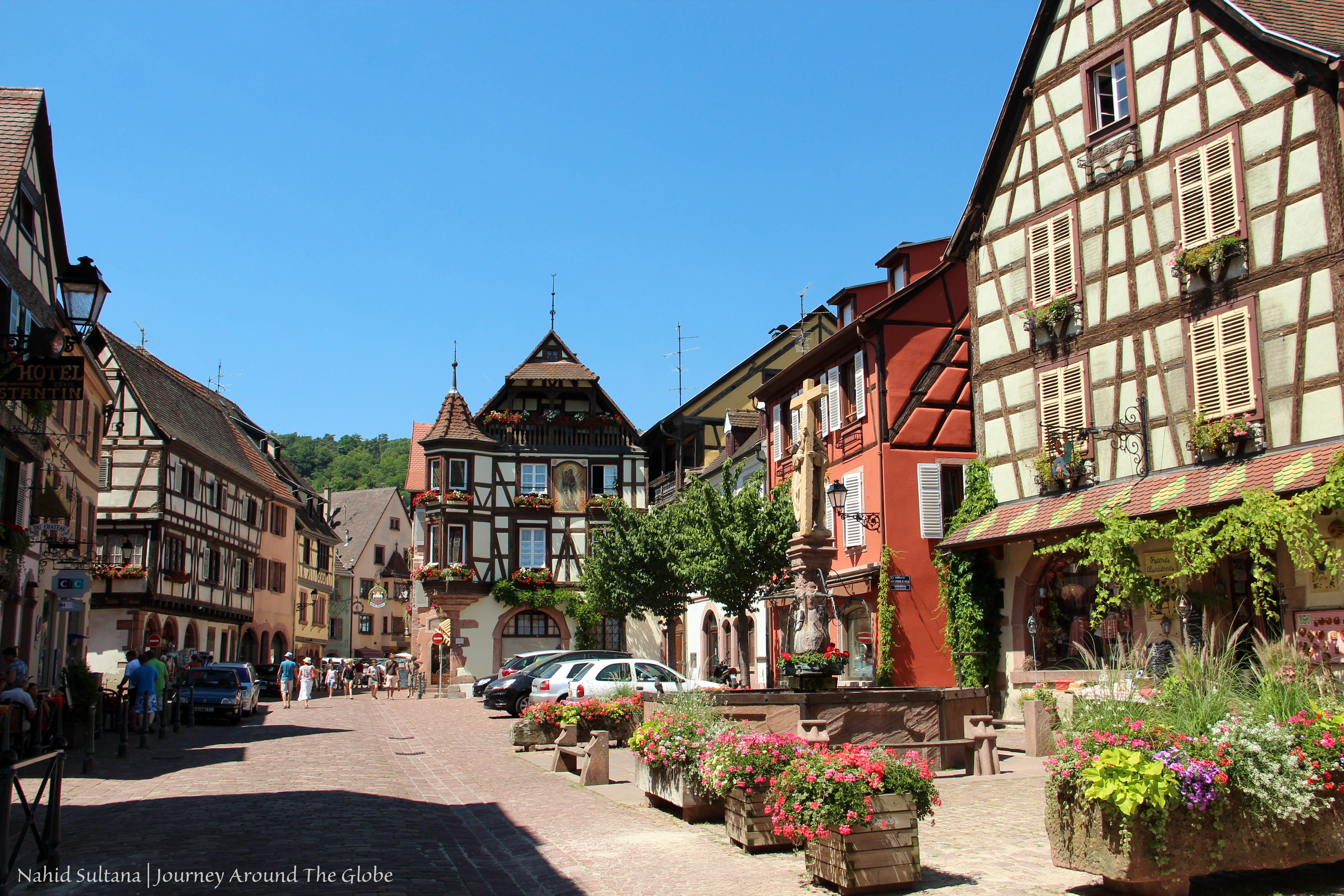
One of the remarkable architecture of Kayserberg is Church of St. Criox. It’s a Gothic church in the center of the village. Some of the remains of this Romanesque church still exist both within and outside the edifice such as remarkable carved doorway. It was constructed around 1235 and is very nicely decorated with eagles and mermaids. Fountain in front of the church is known as Fountain of Constantine which dates back to 1521.
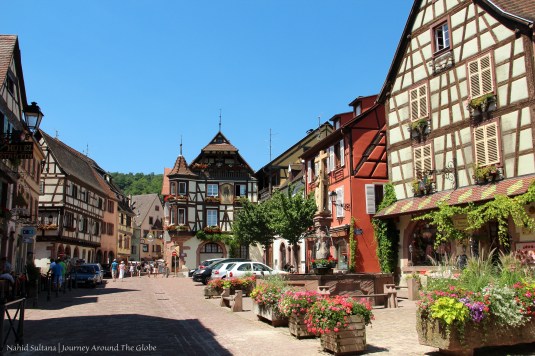
- Main square of Kayserberg in front of Church of St. Criox in France
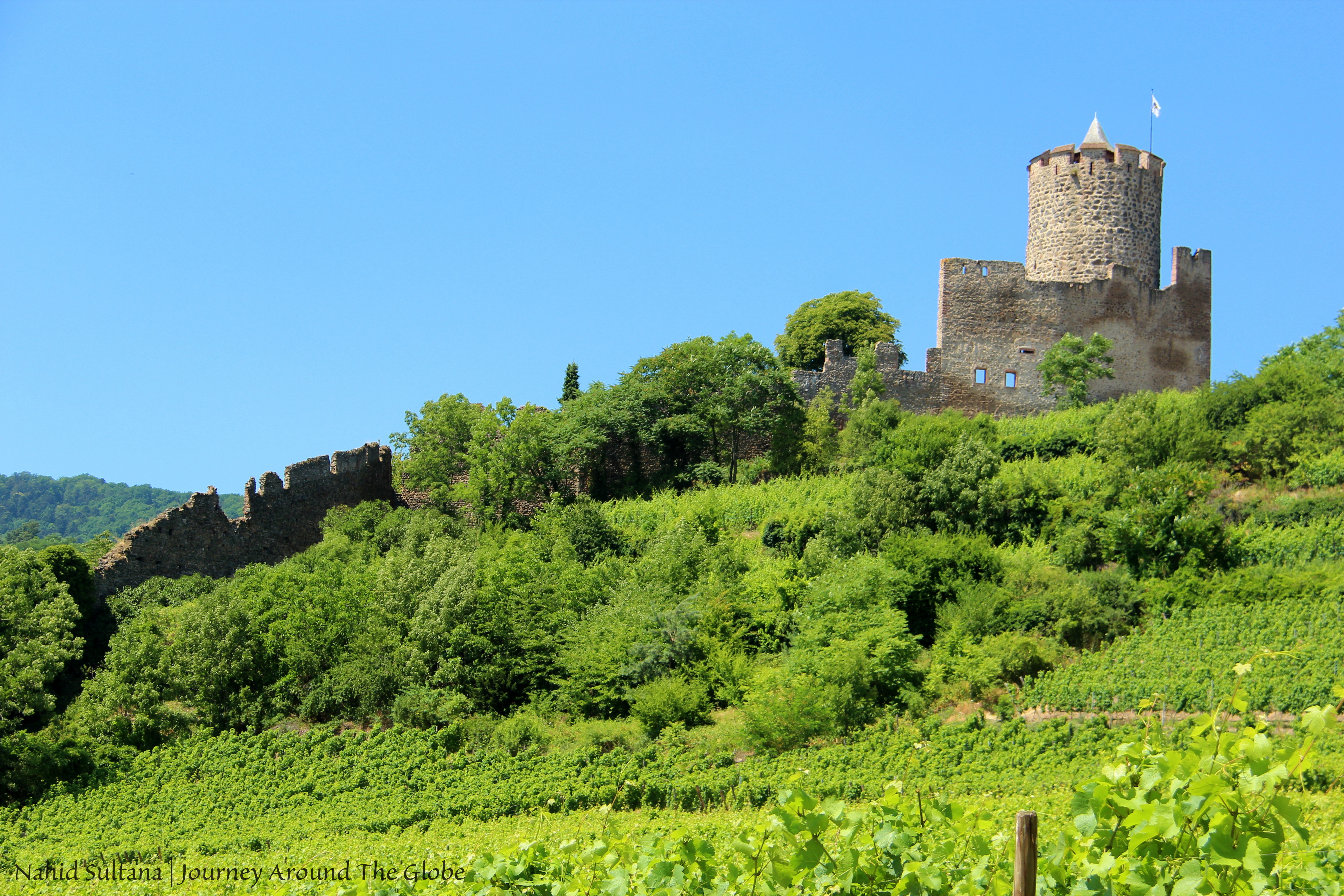
Ruins of Castle of Kayserberg from 1220 AD is magnificently located on top of a small hill. It’s about 15 minutes of walk from the old town. You can see the small vineyards, a nearby village, and Kayserberg from top of this hill. Overall, view from here was simply marvelous.
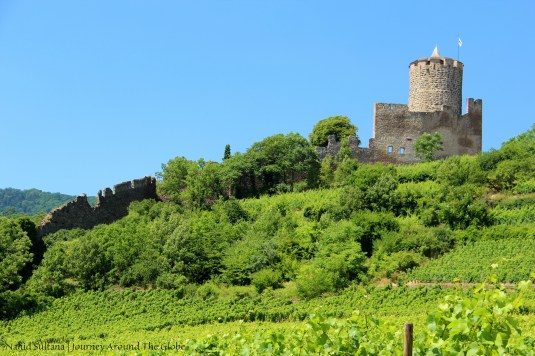
- Ruins of Kayserberg Castle in Kayserberg, France
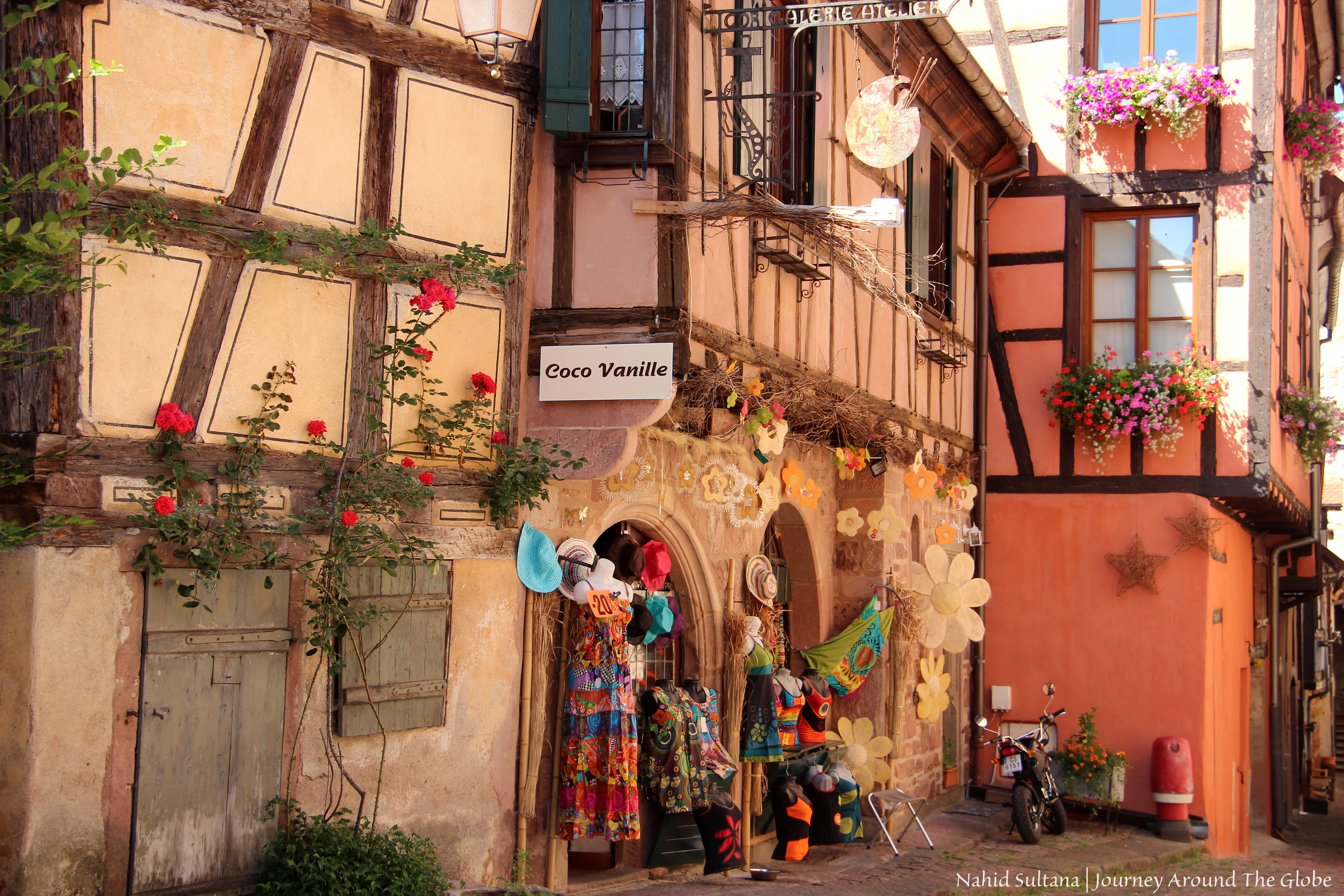
3) RIQUEWIHR: Riquewihr was rated as one of the prettiest villages of France according to an independent organization. This is an admirably well-preserved medieval and Renaissance place. There are fortifications, houses, and courtyards from 13th, 15th, and 17th century. Many old fountains still exist here and there. Setting of this village looks like an enchanting place and every corner is vibrantly decorated. Everything here is within walking distance and I would highly recommend discovering the village on foot. There is a tourist train that starts near Hotel de Ville (Town Hall).
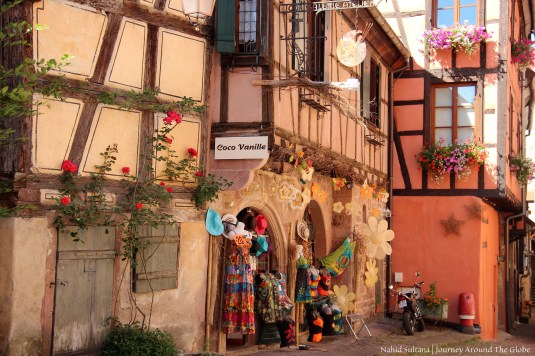
- Cozy old town of Riquewihr, France
Riquewihr also has a street called Rue de General de Gaulle which is a lively street with many cafes and craft shops. At one end of this street is beautiful Dolder belfry watch tower from 1291. It’s an eye-catching half-timbered architecture. There is a museum inside the tower and outside looked very attractive with colorful flower baskets.
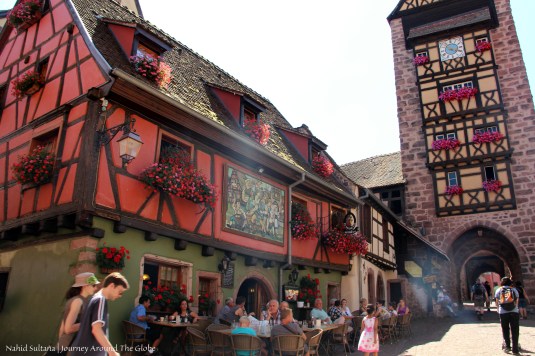
- Dolder belfry watch tower in Riquewihr, France
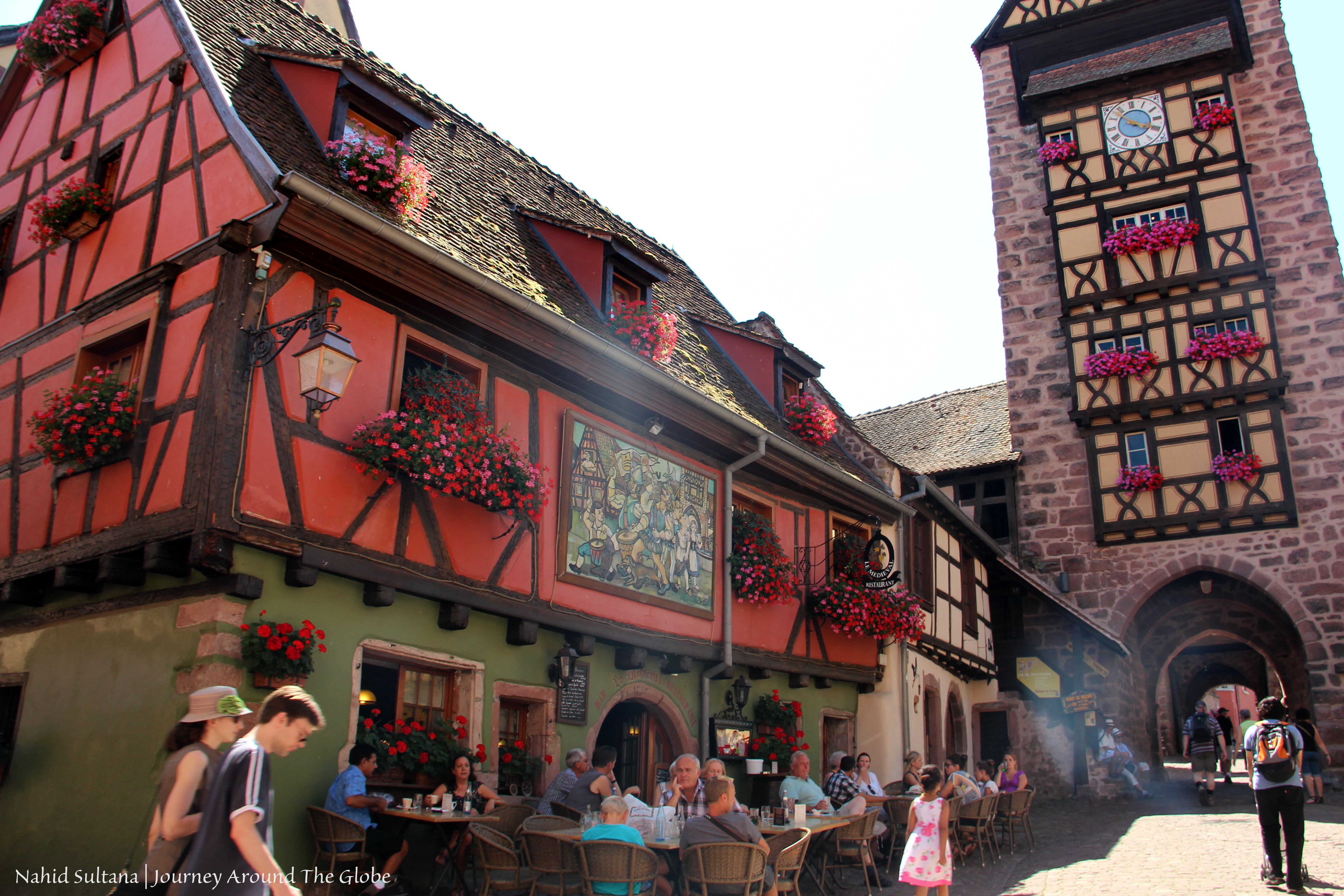
Thieves’ tower (with torture chamber) will amaze anyone. Original high gate to enter the courtyard of Thieves’ Tower and the well in front are very old, supposedly from the 16th century.
4) STRASBOURG: Strasbourg is a big metropolitan city, nothing like other Alsatian villages. Grand Ile area of Strasbourg was the first city center to be announced entirely as a UNESCO World Heritage Site. Gutenberg parking is the closest parking near Strasbourg Cathedral.
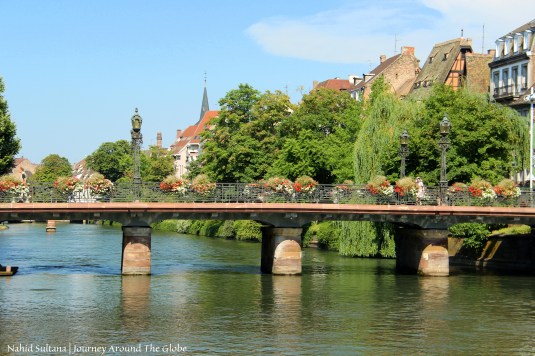
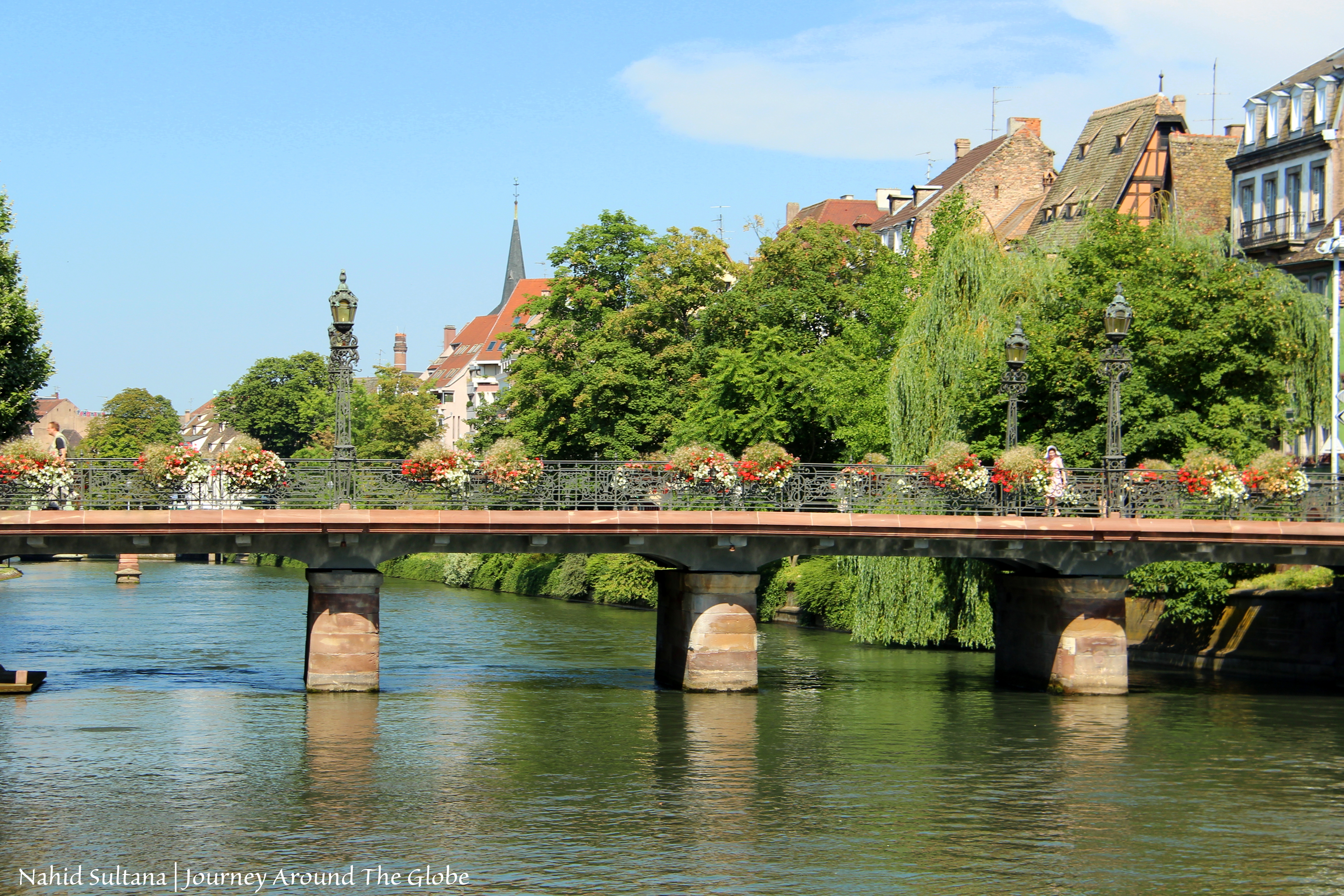
- A beautiful bridge on River Ill in Strasbourg, France
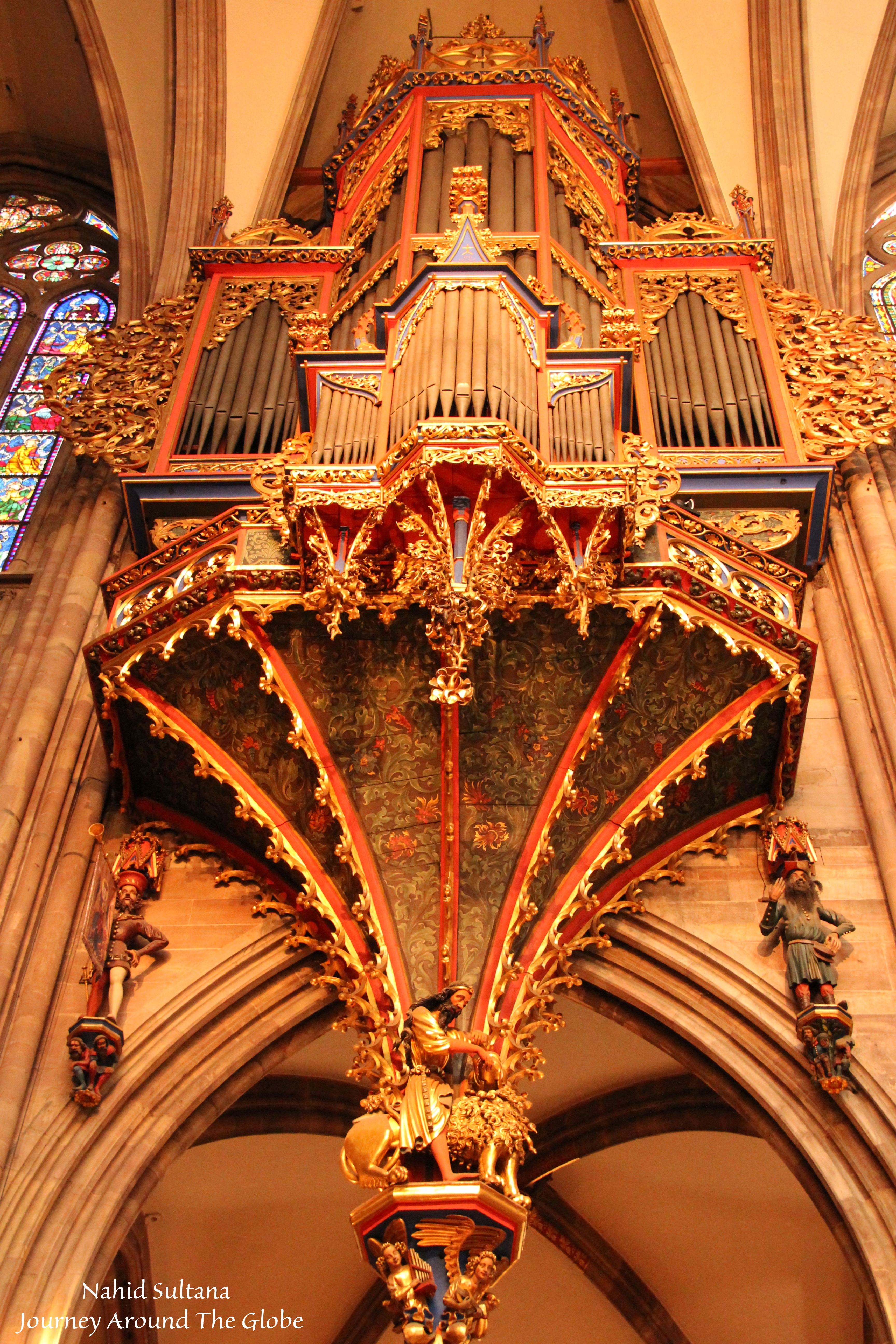
Strasbourg Cathedral or Cathedral Notre Dame du Strasbourg was our first spot. You can see its 142 meter soaring tower from distance (the highest cathedral tower in France). The construction started in 1176 AD and took couple centuries to finish it. This got to be one of the major highlights of Strasbourg and a finest architecture. Church organ is something unique, decorated elegantly with golden molding and bright color lines. There are many beautiful stained glass windows and monstrous stone pillars. Don’t miss the 300 years old Astronomical Clock at the back of the cathedral. Unfortunately we missed the Astronomical Clock show that takes place every day at noon.
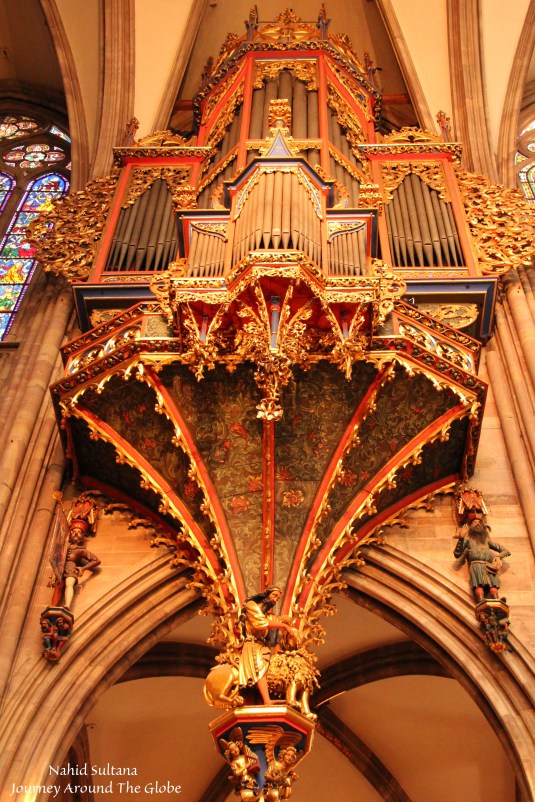
- Decorative organ of Strasbourg Cathedral in France
There is no charge to go inside the cathedral. It’s open from 7am – 11:15am and 12:45pm – 7pm. Daily at 12 pm (except Sundays and feast days), the cathedral offers visitors the chance to see a film lasting 22 minutes on the astrological clock. Anyone wishing to see the presentation of the astronomical clock (film + procession of the apostles) is able to purchase tickets from the clock ticket office at 2 euros for adults.
Right outside the cathedral on the left side (when you are facing it) is historic Maison Kammerzell. This is a residence of a wealthy family from the 15th century. We just saw it from outside…not sure if you can actually go in.
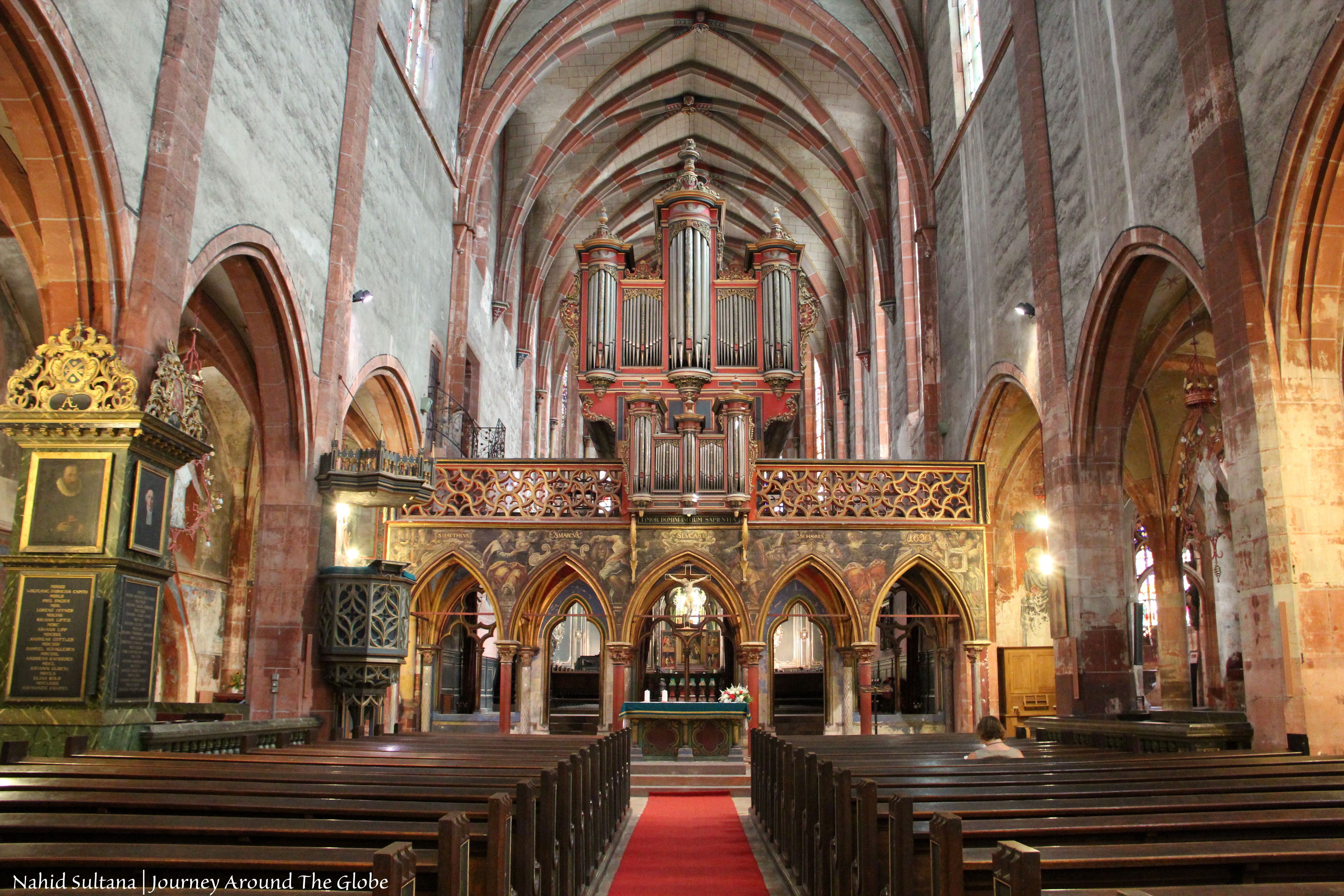
Protestant church St. Pierre Le Jeune is another marvelous historical monument of Strasbourg. Construction of the present church began in the second half of 13th century. Some of the old frescoes on the wall were revealed and restored in late 19th century. These medieval frescoes make this church worth a visit. There is a big fresco opposite of the organ depicting “Storm on the Sea of Galilea”. It’s free to enter and about 10 minutes of walk from Strasbourg Cathedral.
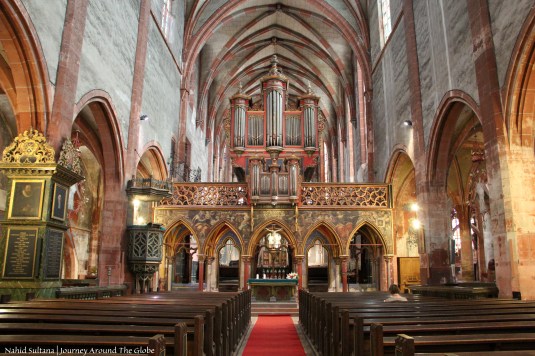
- St. Pierre Le Jeune in Strasbourg, France
St. Thomas Church is another Protestant church and a landmark of this city. Its origins date back to the Scottish monks who arrived in this country in 6th century. The original church was built somewhere in 833 but the present front of the church is from 1250. It is simpler than St. Pierre but numerous monuments and interesting flagstones with obituary inscriptions decoration make it a nice place to see. It’s free to enter.
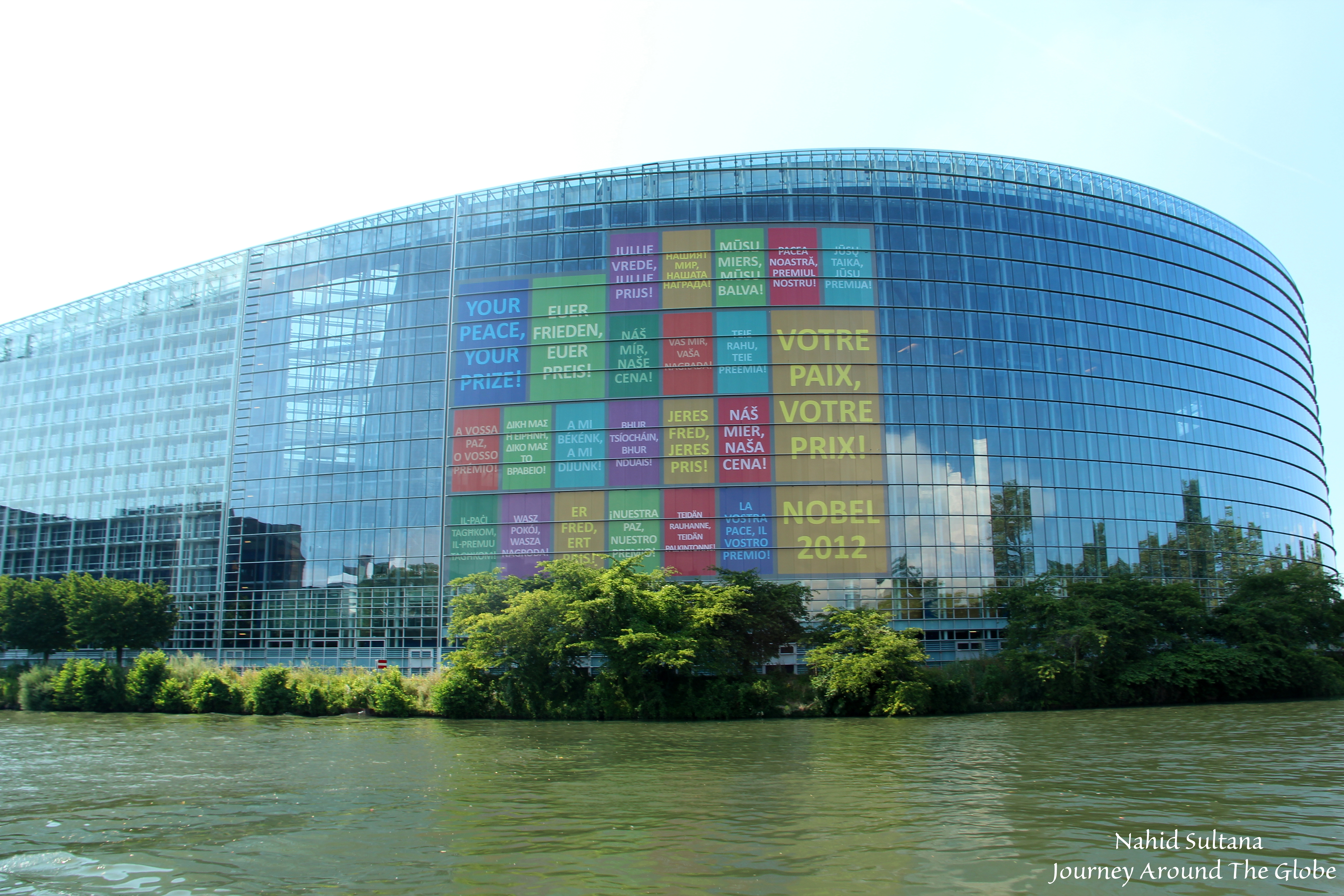
We took a boat tour in Strasbourg on River L’Ill as our last event here. “Batorama” organizes this tour for 1.10 hours (for 9.60 euros per adult and 5.20 euros for kids 3 -5 years of age) with audio commentaries of many languages. It departs from near Palais de Rohan by the promenade and is a great way to discover the city. Thanks to this tour, we saw Council of Europe, La Petit France (a picturesque neighborhood similar to Colmar), Palais des Rohan (now a museum), many of total 27 bridges on River L’Ill along with beautiful old buildings and other monuments by the waterfront.
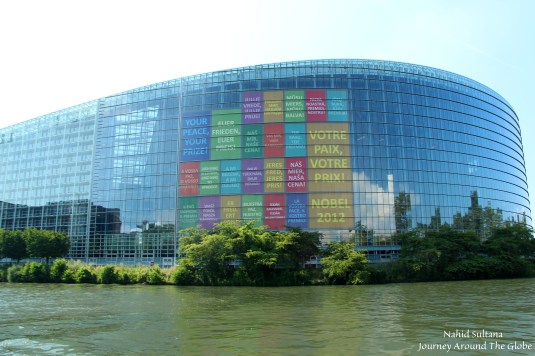
- Council of Europe in Strasbourg, France
Related articles
- Discover Why Riesling From #AlsaceRocks (winepredator.wordpress.com)
- Alsace¡¡¡ (pertus16.wordpress.com)
- Obernai, Alsace (thousandsky.wordpress.com)
- Route des Vins, Alsace (thousandsky.wordpress.com)
- Northern France – The Alsace region (moonofhoney.wordpress.com)
Share this:

Belgian beach town – Ostend
OSTEND, BELGIUM: It was a nice day here in Belgium last Sunday (of July 2013). Last few days were actually pretty good for outdoor activities. This weekend we decided to hit the beach with one of my husband’s colleagues. We drove about hour and fifteen minutes from Tervuren to Ostend.
Ostend is a nice beach town very close to Brugge or Gent. It was around 3pm by the time we got there, stayed for couple of hours and headed back around 7pm. We really didn’t do any research as what to do or see in Ostend. It was just a quick getaway with the kids to enjoy the sun.
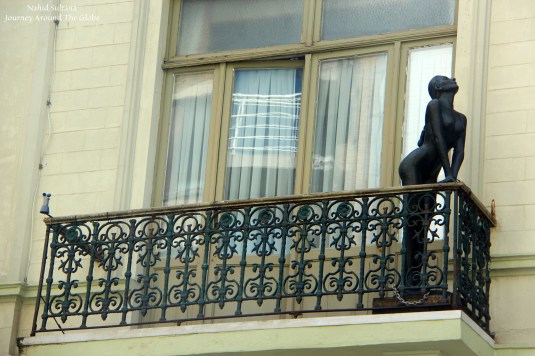
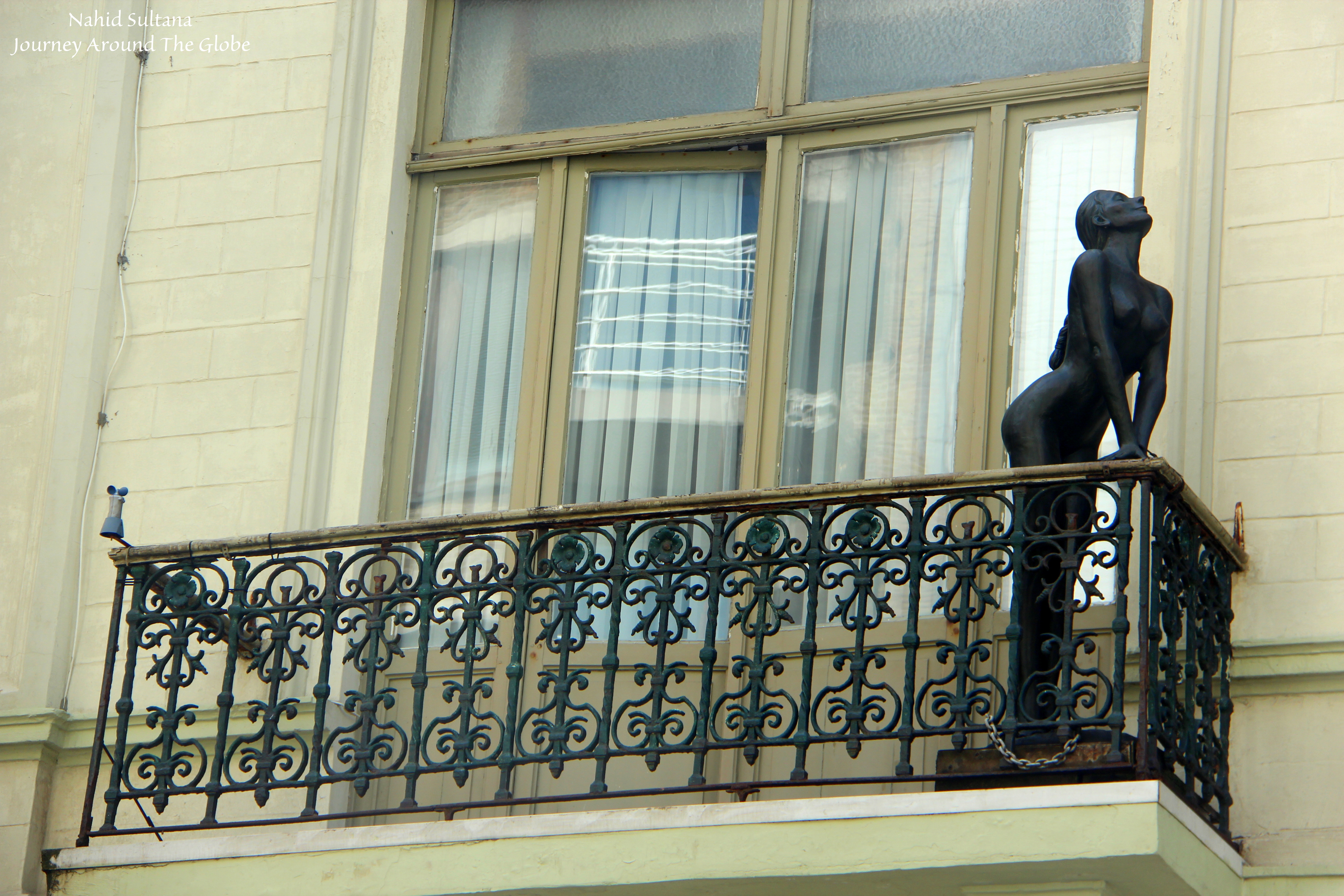
- Saw this unique statue while walking around Ostend, Belgium
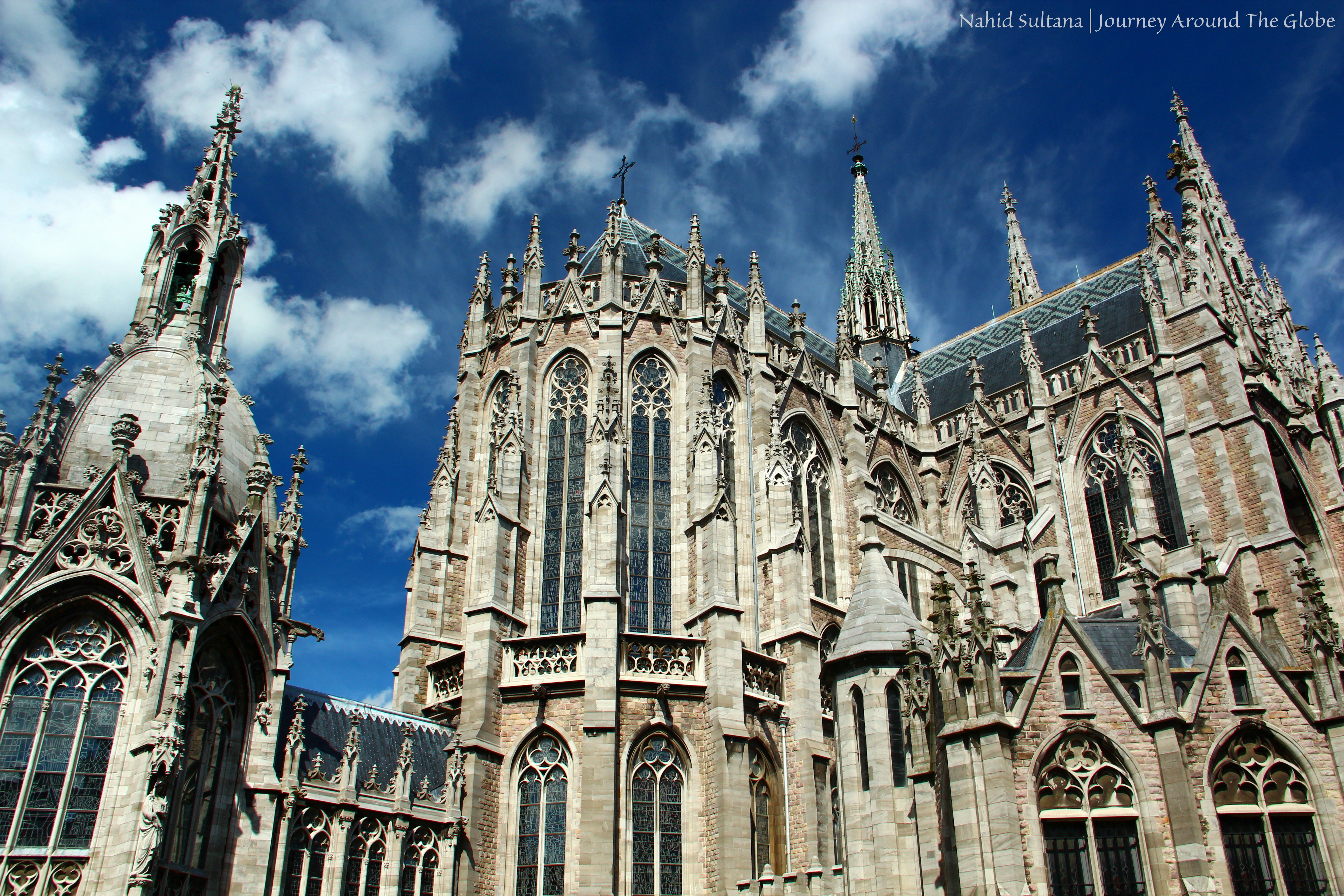
ST. PAUL and ST. PETER’S CHURCH: We saw the grand spires of this church when we entered the city. We left the beach area and started walking towards the city looking for those spires. I think, we walked leisurely for about 15 minutes looking for it and there it was…a magnificent edifice with gothic exterior. Interior wasn’t as nice as the outside, but definitely worth checking it out for there is no entry fee. Stained glass windows were beautiful as well as the church organ. There are two statues of Peter and Paul near the main altar.
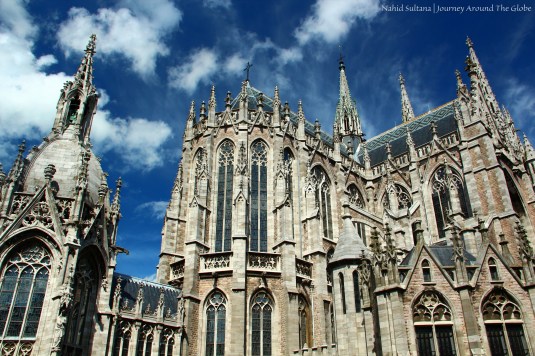
- St. Paul and St. Peter’s Church in Ostend, Belgium
There is a monumental belfry at one side of the church. You can see this type of belfry on many Flemish towns of Belgium.
BEACH and the PROMENADE: I think the whole town came to the beach today since the weather was so good. But the beach is so spread out that it didn’t look too crowded or anything. Ostend beach is more of a family place, great to take the kids to the sand and water. There are some museums and one aquarium very close to the shore too.
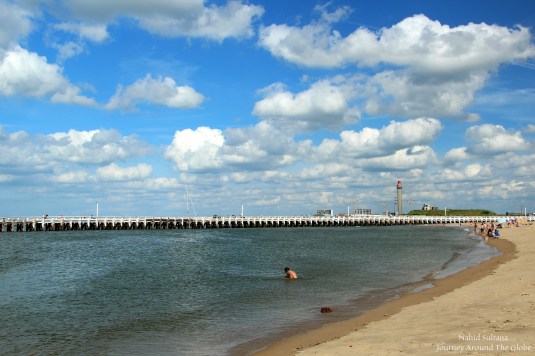
- Ostend Beach in Belgium
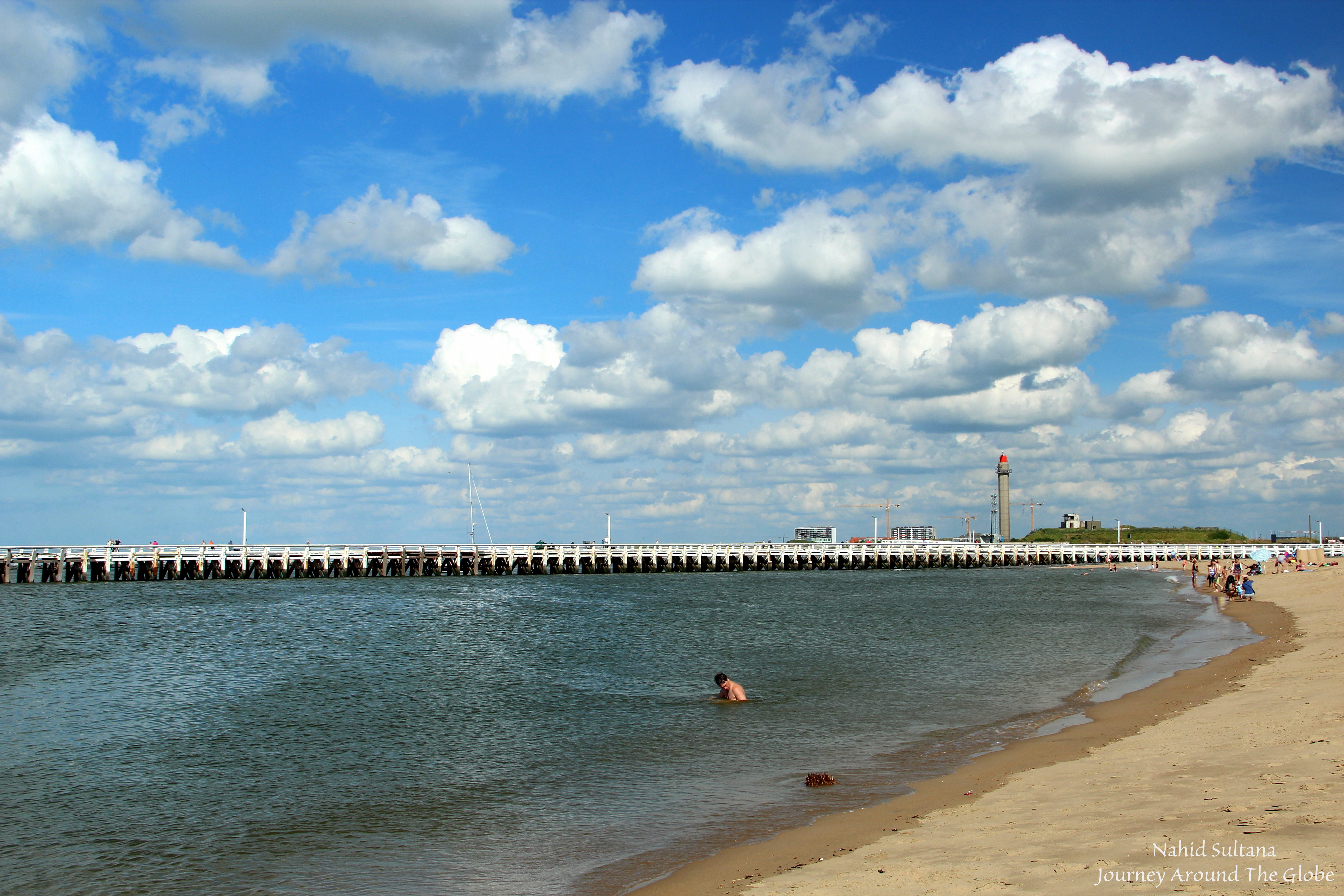
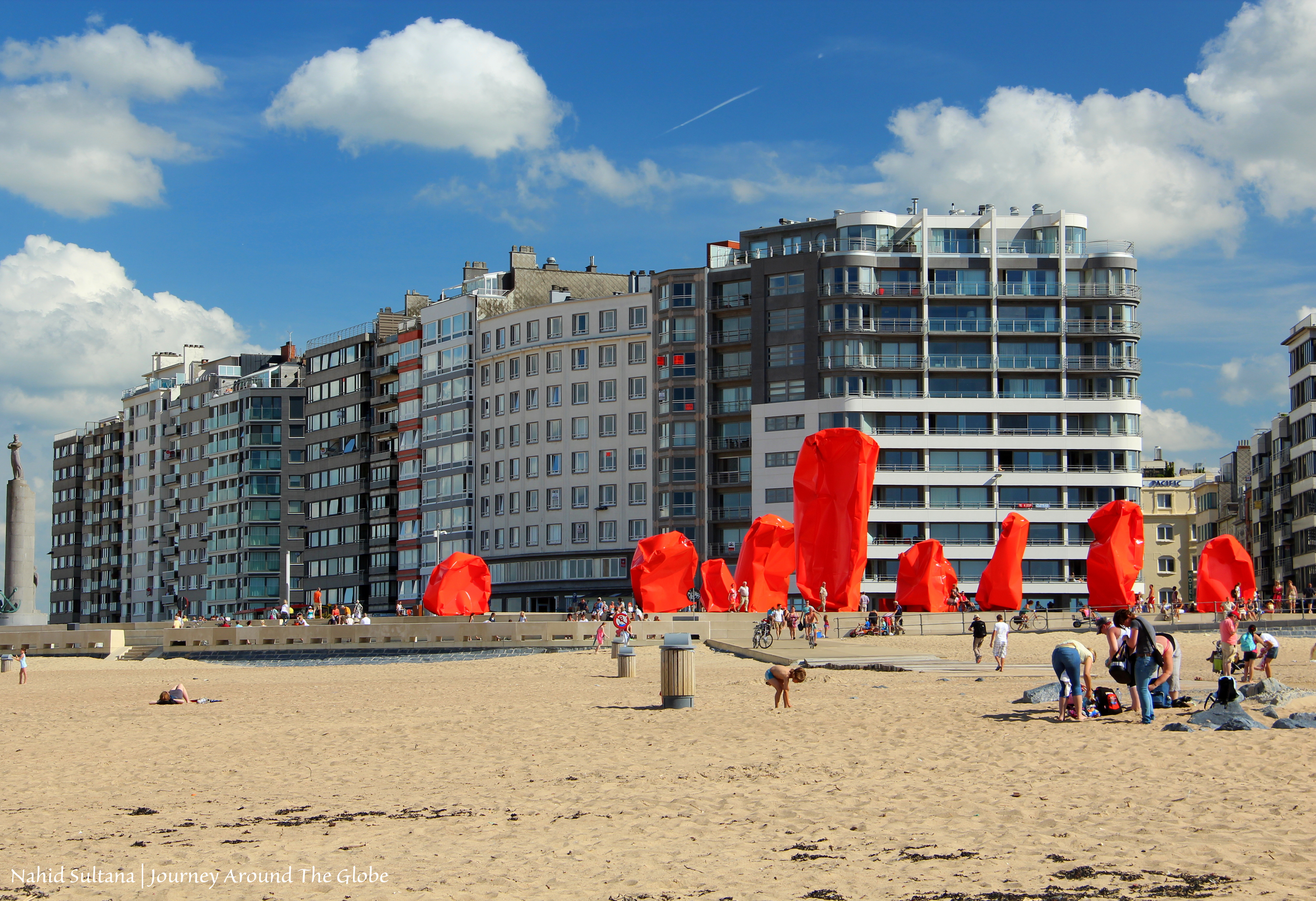
One side of the promenade had nice restaurants and cafes with some shops while the other side had some contemporary arts and sculptures. Tourist can find many hotels on the promenade with fantastic view of the ocean.
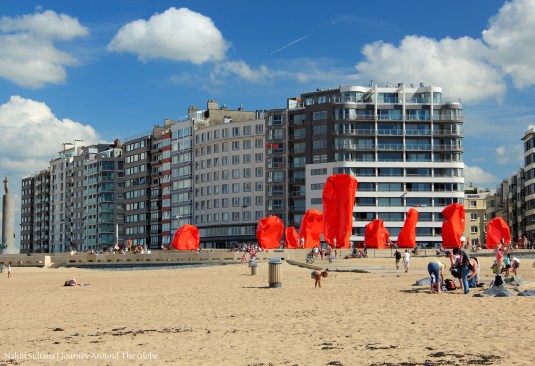
- Promenade of Ostend Beach in Belgium
Related articles
- Marvin Gaye in Ostend (ibrahcadabrah.wordpress.com)
- Never Mind (paintingsframe.wordpress.com)
- hemling hotel bruges (exavinse.wordpress.com)
Share this:

Business Excellence Award 2020 from AI Global Media for The Most Entertaining Personal Travel Blog – Pacific Northwest USA

Top Posts & Pages


Business Excellence Award 2020 for The Most Entertaining Personal Travel Blog – Pacific Northwest USA

 Globe Runner

