Journey Around The Globe
ready for the next destination
Pristina, Kosovo
PRISTINA, KOSOVO: Pristina is the capital of one of former Yugoslavian provinces, Kosovo, in the Balkan region. The first thing that came to my mind before reaching Kosovo was that how many of the innocent lives were murdered here in 1998 in the hands of Serbian army.
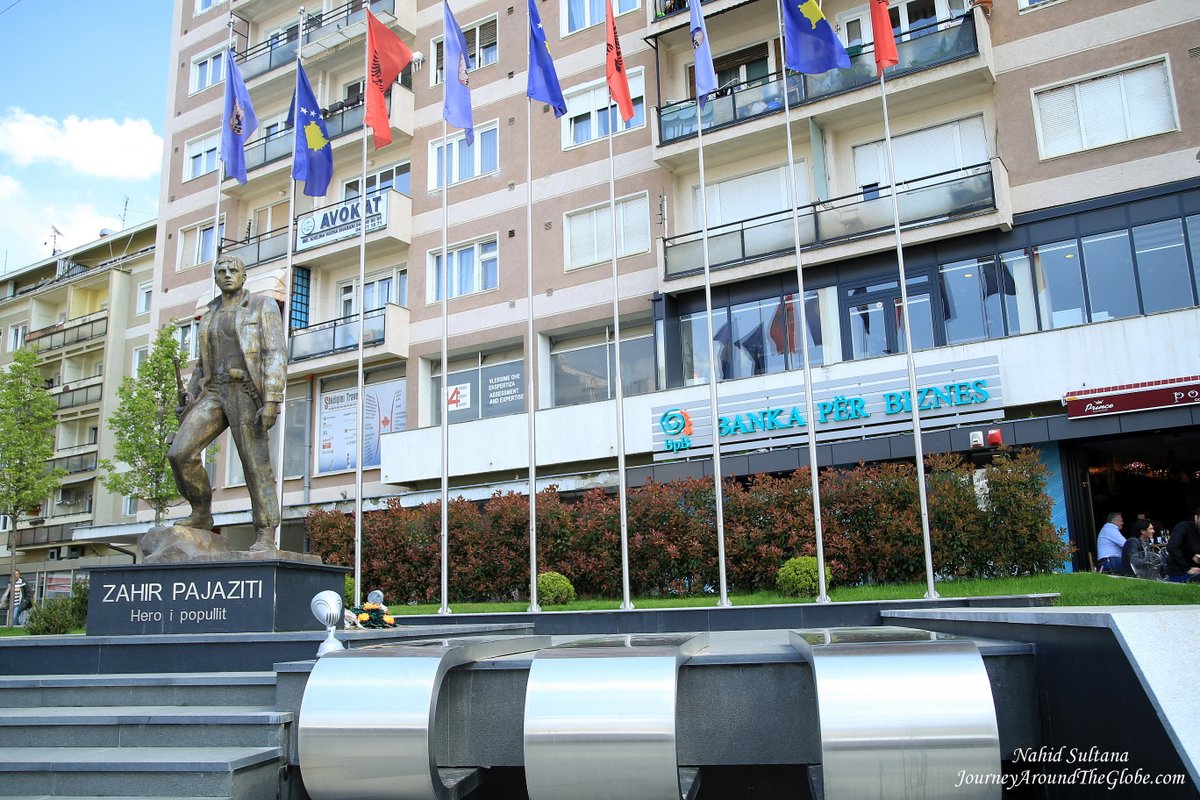
Kosovo is a country which is recognized by the USA and some European Union countries but it still needs more votes in UN to be recognized as an independent sovereignty. Serbian army killed thousands of citizens of Kosovo during the war and still doesn’t want to let go of it. Kosovo has its own border control, flag, and everything but officially it is still under Serbia (sad but true). They don’t want to be with the Serbs, they think themselves as Albanians and prefer to be with Albania because of their similar language, culture, and ethnicity. Albania can’t take Kosovo because of many political reasons. We saw more of Albanian flags in Pristina than their own blue and yellow star flags. Even in some government buildings and war memorials have Albanian flags. They went thru a tragic history against the Serbs and still suffering economically, politically, and culturally. Kosovo is one of the poorest countries in Europe with 80 – 85% population of youth (according to one of the staffs of our hotel, not sure how accurate the statistic is but it is true that there are way more youths in Kosovo). Kosovo is the poorest country in Europe and for the economic crisis, these young people may not have money in their pockets but have genuine friendly attitude towards foreigners. They speak somewhat good English and will help you whole heartedly just out of generosity. German is another language many locals speak here because of their ties with Germany and Switzerland.
TIME of TRAVEL: We made a trip to the Eastern bloc of Europe during Easter break of 2014. Our first destination was Podgorica, Montenegro. From there we drove to Albania and Macedonia before reaching Kosovo. The weather in the capital was pleasant but we got severe snow blizzard in the mountains the day we started driving towards Sarajevo, Bosnia & Herzegovina. It was a 7 hours’ drive, but we ended up driving about 15 hours all together in 2 days changing some routes to reach Sarajevo.
OUR HOTEL: Our hotel was a real fancy one in Pristina, called Nartel Hotel. It’s a 5-star hotel, about 15 minutes’ walk from the city center. The taxi is so cheap here that we took taxi on both ways, think it was only 3 euros for each way. We had a big room with a king-sized bed and a sofa bed. Parking, Wi-Fi, and grand breakfast buffet were all included. The staff here were very friendly too. Our trip to Prekaz, a small village in Kosovo, was taken care by an employee in this hotel. He provided the transportation and gave a tour in Prekaz for 50 euros. Pristina has some other high quality hotels (one of them is Swiss Diamond Hotel) but this hotel really has a homely feeling and smiley faces everywhere.
EATING and SHOPPING: Pristina has tons and tons of fast food at every corner. Although we didn’t try any, Kosovan burgers supposed to be very tasty and full of flavors. Two of our meals we had were in our hotel restaurant, Nartel. The day we were out in Pristina city center, we sat down in a Mexican restaurant near Mother Teresa Street. Food in Pristina is very cheap for a good portion. We didn’t have any traditional meal here and wasn’t sure where to get any. But I wish I could try their fast food burgers at least once. Pristina is also known for brewing best macchiato outside of Italy. Sit down in the one of the cafes and enjoy a cup while gazing over the locals and their lifestyles.
In the city center, Mother Teresa Street is a nice place to do some shopping. There is only one souvenir store at the beginning of the street towards the university. You can find both Kosovan and Albanian souvenirs here. Other than that we really didn’t see any other place where we could find some local signature items. We walked by tons of silver and gold jewelry stores in the old quarter, not sure about the quality of them but bargain works almost everywhere.
PLACES WE’VE VISITED: We had only a day in Kosovo, half a day in Pristina and few hour for Prekaz. We took a taxi to go to the city center and did everything on foot from there.
There is a tall statue of Bill Clinton somewhere not too far from city center that we saw from our taxi. Pristina Ethnographic Museum is something we really wanted to see but couldn’t find. Even the locals couldn’t give us any information on its location.
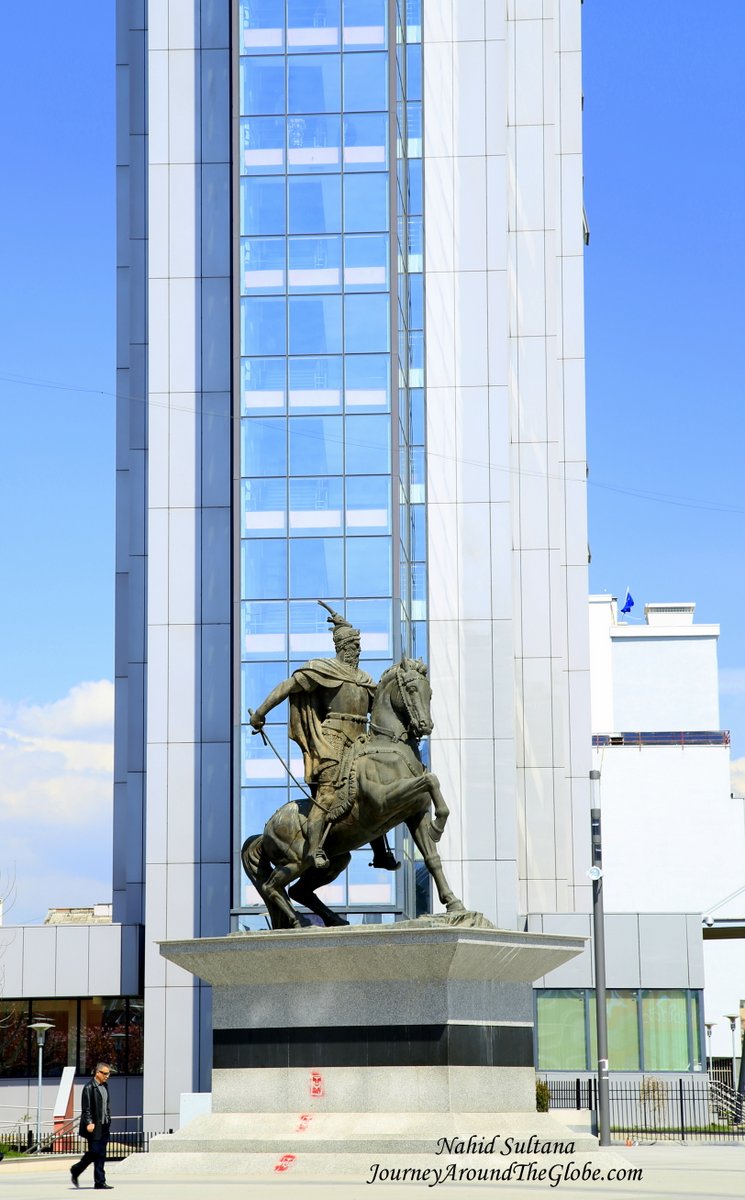
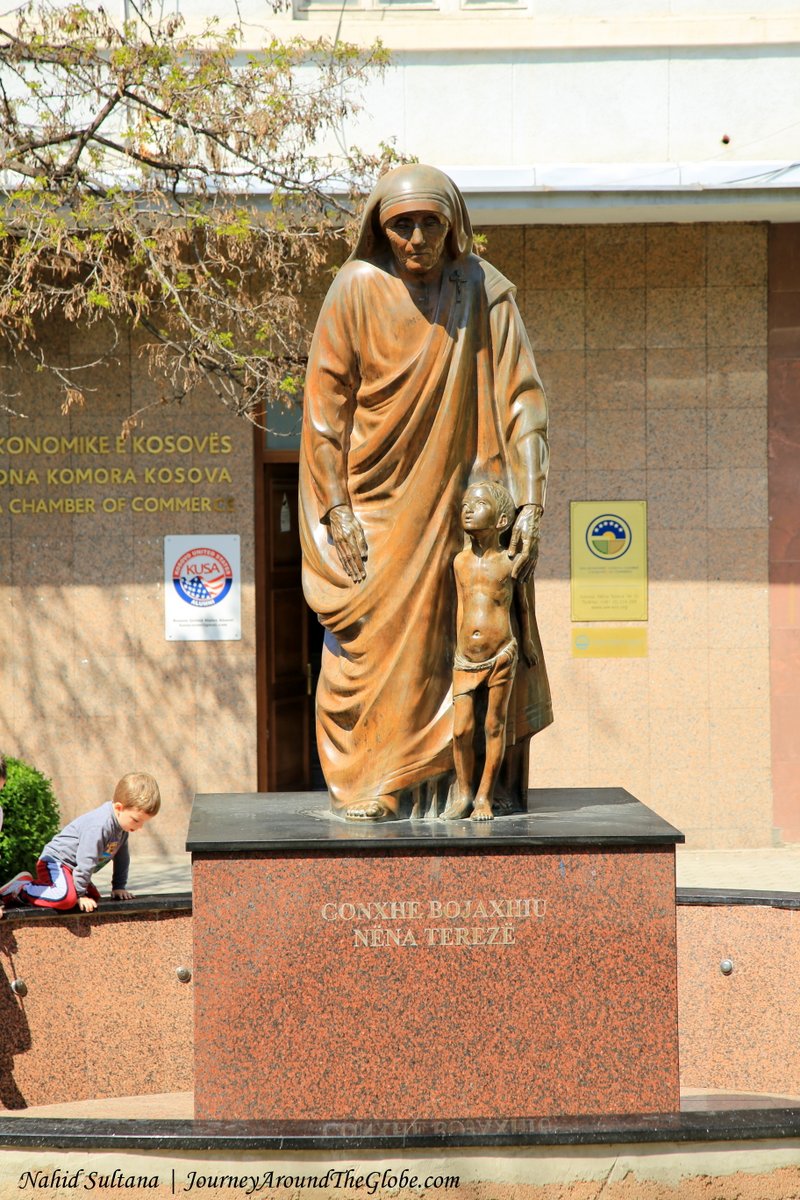
1) MOTHER TERESA STREET: This is the main pedestrian street that runs from near University of Pristina towards the statue of Iskander Beg. It’s a long stretch of wide cobbled street with trendy shops and restaurants. This modern pedestrian zone is the heart of Pristina and a perfect place to meet and watch locals or to hang out any time of the day. Look for the statue of Kosovo’s first president Ibrahim Rugova near Iskander Beg’s portrait on Mother Teresa Street.
2) MUSEUM of KOSOVO: Few steps from Mother Teresa Street, we came to this museum which was closed at that time but the care taker let us in for free just to check out the first floor. The museum building itself was nice but there wasn’t really inside to see other than some photographs. Upstairs has some historical artifacts which we couldn’t visit.
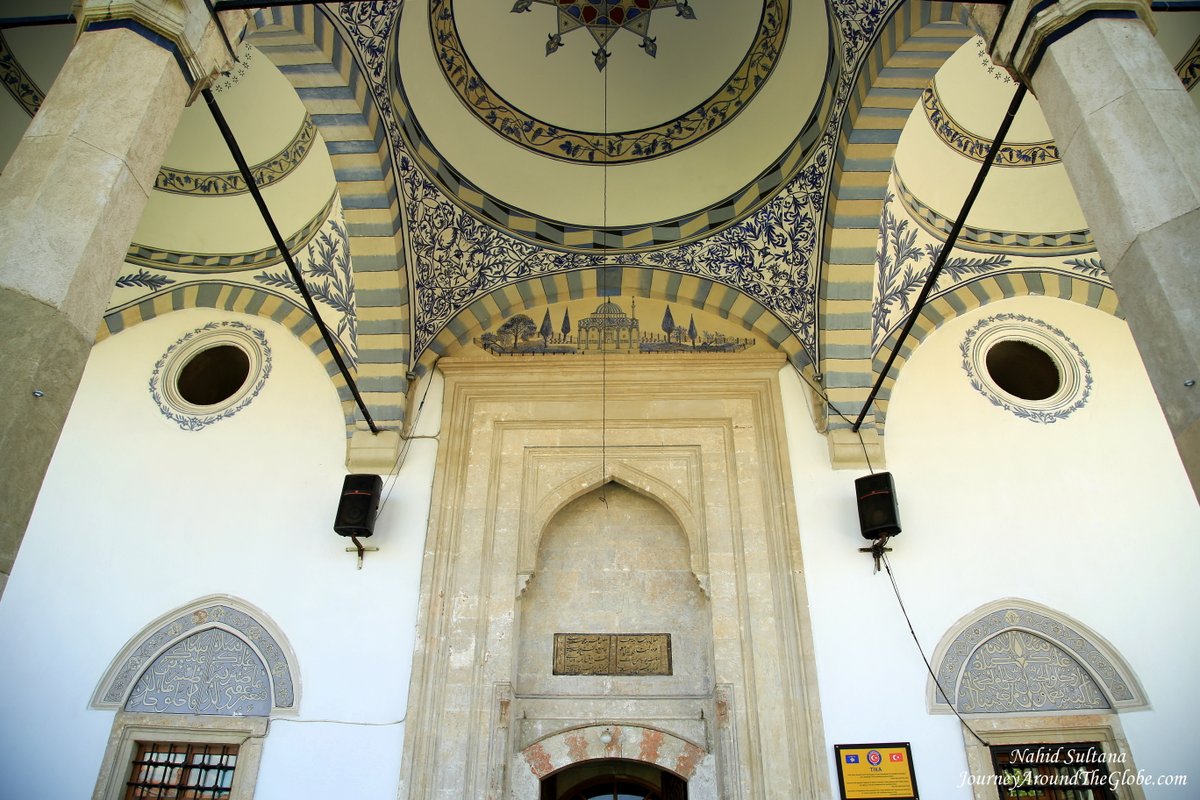
3) KING MOSQUE: This is an old mosque located in the old quarter of Pristina and is known as “Sultan Mehmed Fatih” Mosque. The locals don’t know this mosque as King Mosque and we had to ask few people to find it. It’s a spacious masjid with grand entrance and a calm courtyard. Don’t miss the tall minaret beside the mosque. Inside, you can see the high dome and decorative mihrab and windows. There is no entrance fee but since it’s an active mosque visitors are not allowed during prayer time.
There are couple other historic mosque on this street which were closed, one of them was Jashar Pasha Mosque and a clock tower.
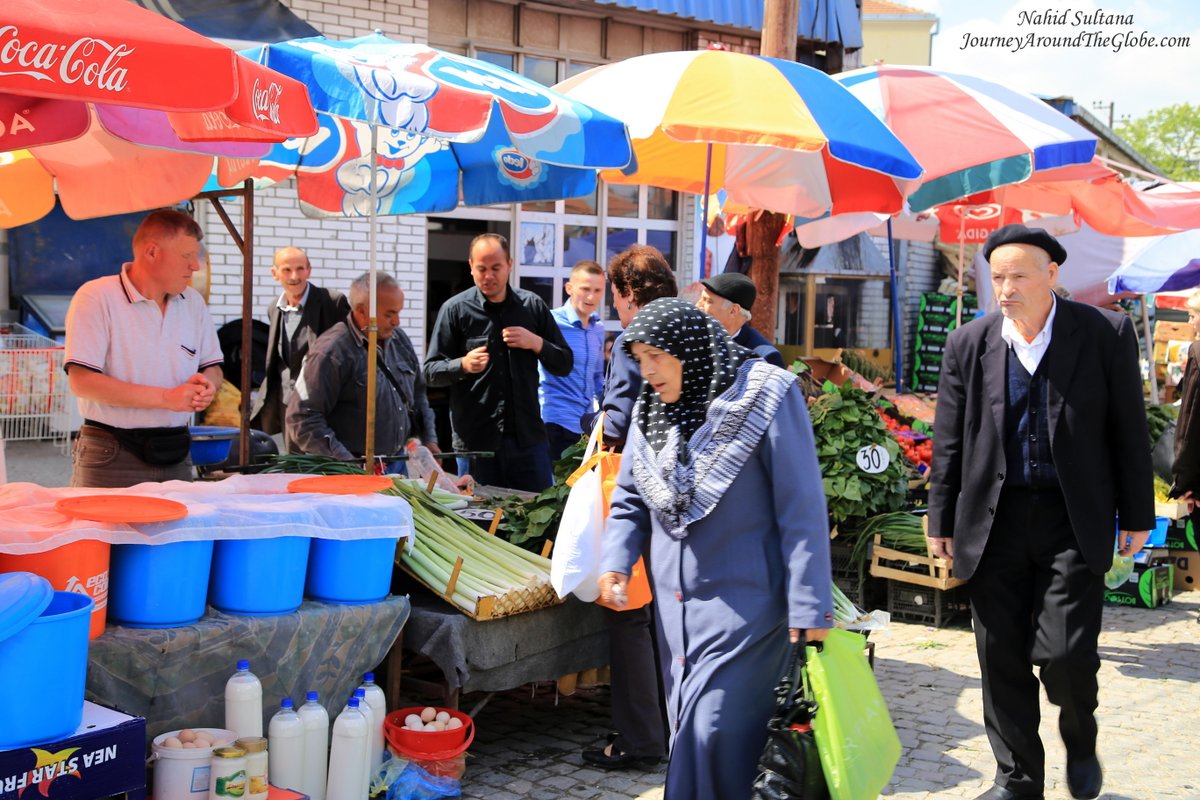
4) OLD BAZAAR: Old bazaar is an atmospheric place outside King Mosque where locals come for daily grocery. You can find almost anything and everything in this outdoor market from fresh produce to electronics to tobacco, clothes and etc. It was very crowded at noon with lots of shoppers and some cars trying to squeeze thru the narrow roads.
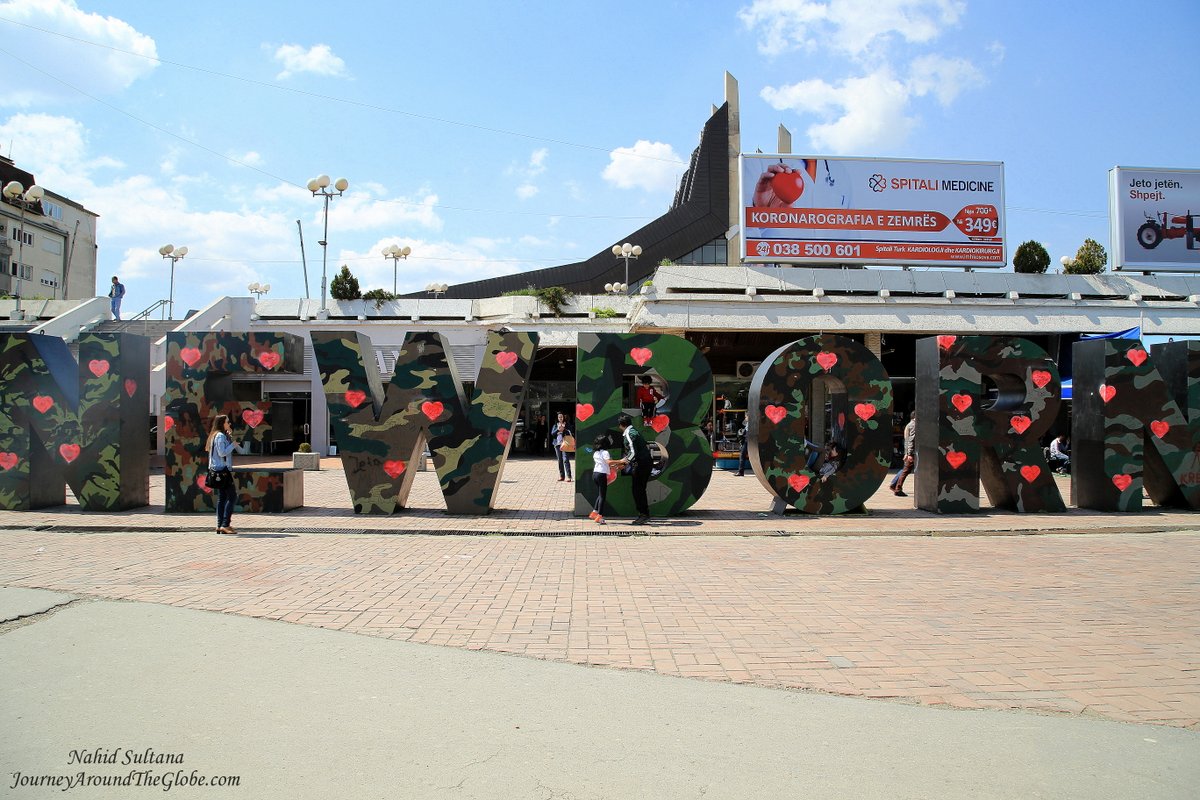
5) NEW BORN: This a big sign in front of American School of Kosovo to celebrate Kosovo’s freedom and independence. The letters are written in camouflaged green and black colors similar to army uniform. Lots of restaurants and shops surround this place.
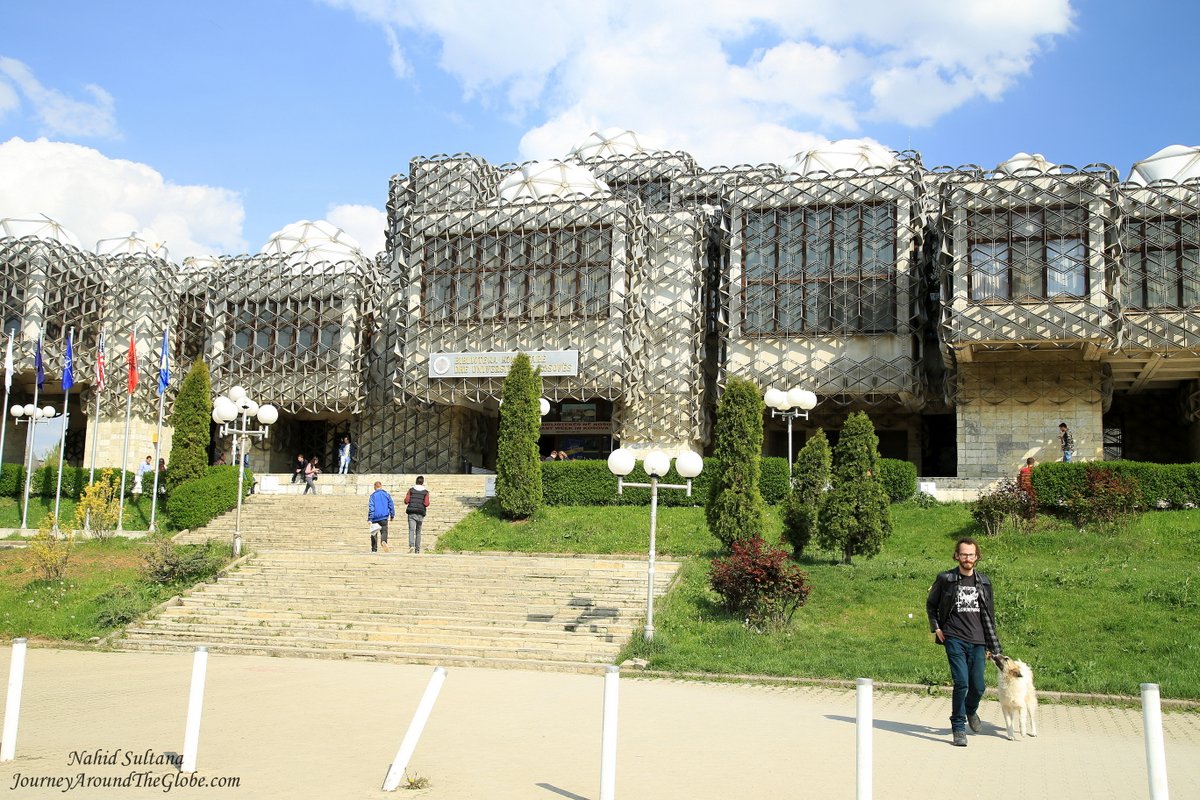
6) UNIVERSITY of PRISTINA LIBRARY: This library building is definitely worth a look. University of Pristina is located a couple of minutes’ walk from the city center opposite of Mother Teresa Cathedral. The huge blocks of bricks of this building is covered with massive chains. We didn’t go inside the library, just roamed around the university campus and walked past the library.
7) MOTHER TERESA CATHEDRAL: Opposite of University of Pristina is Mother Teresa Cathedral. It looked like a newly built place and lots more needed to be done. It’s a spacious church inside but very simple and empty.
8) TRIP to PREKAZ: So the idea was that we wanted to see some of the war time destructions during Yugoslav war in Kosovo from the 90s. We asked our hotel reception and one of their staffs offered to take us to a village, called Prekaz, for a short tour. He charged us 50 euros all together – car, fuel, and tour for total of about little more than three hours.
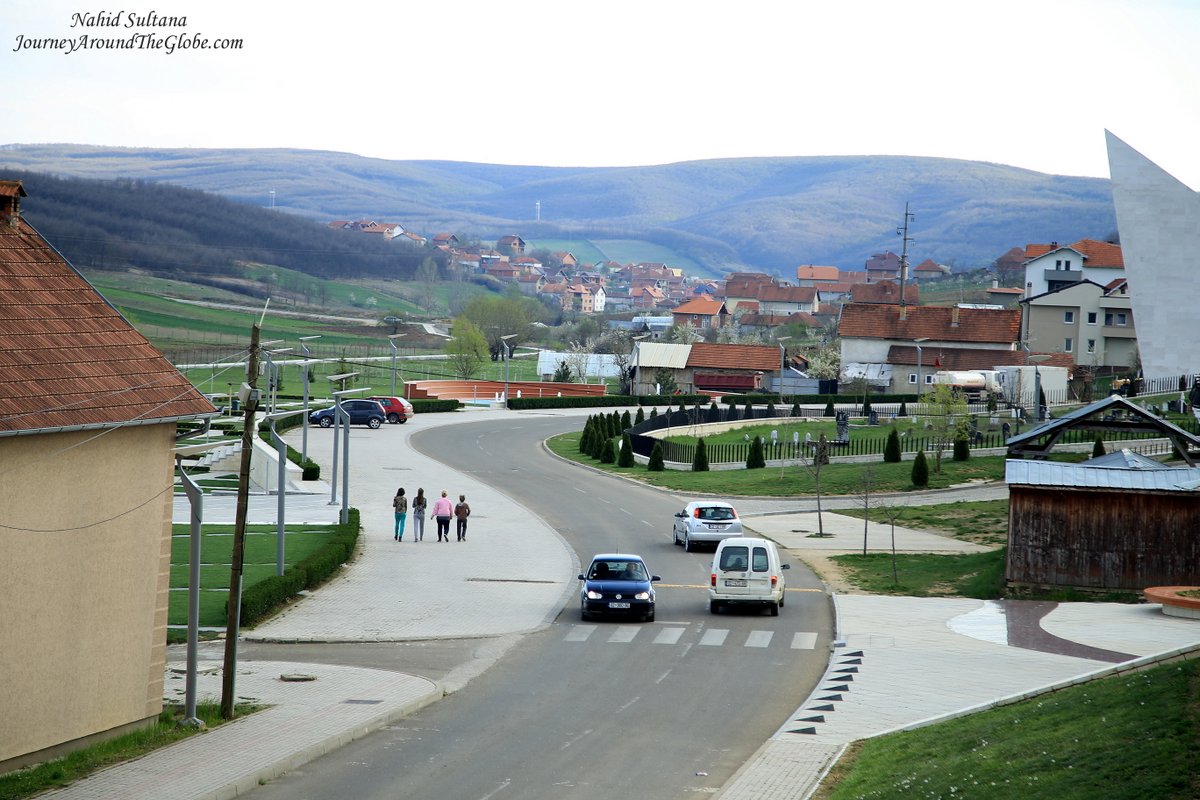
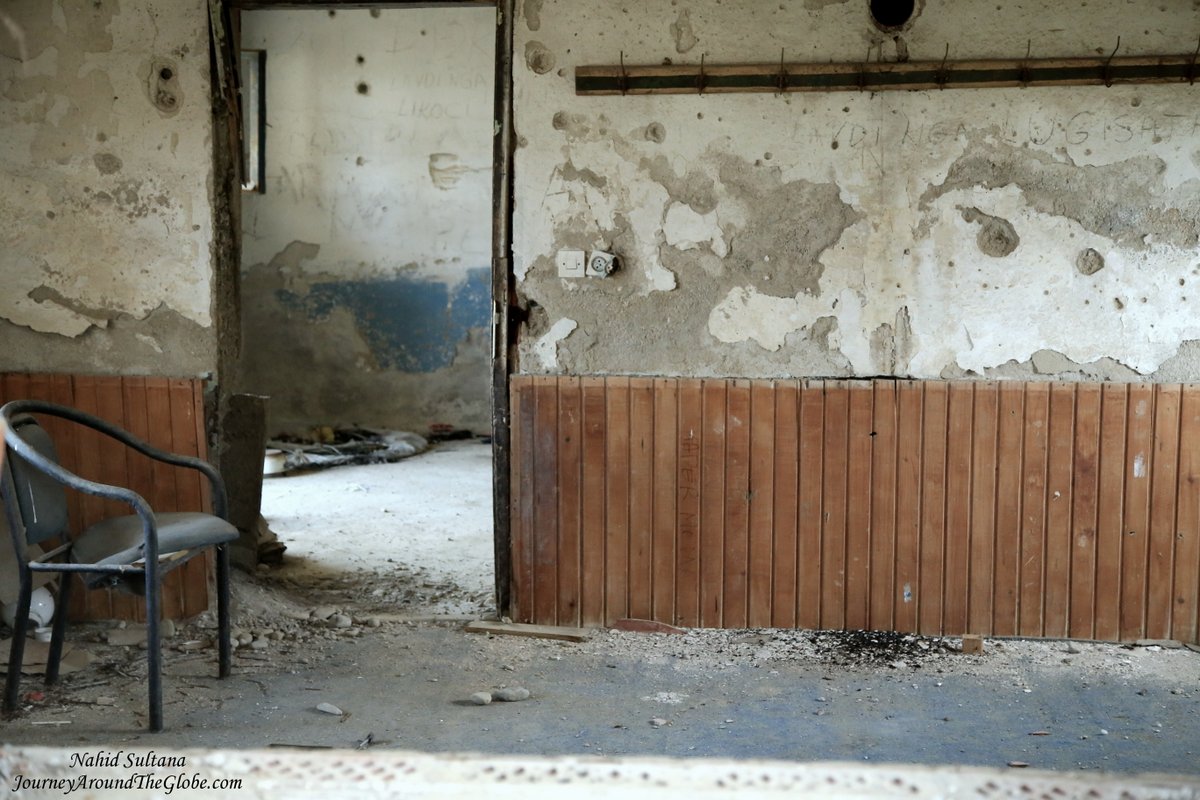
Prekaz is about 60 km from Pristina and took us about an hour each way. It’s located in the town called Drenica. This is a small town where 59 people from the same family died fighting the Serbian army in 1998. The house that still stands is the house where Jashari family lived. Adem Jashari and his brother Hamze Jashari lived in this 3-story house with their families. Both the brothers were members of Kosovo Liberation Army (KLS). They fought for three days on the 5th, 6th, and 7th March 1998 until every 59 family members were dead in the hands of Serbian army. The house is kept the way they left it. You can see the bullets and grenade marks on the walls and debris on the floor. The house itself is a memorial to the Jashari family to keep their legend and sacrifice alive in Kosovo.
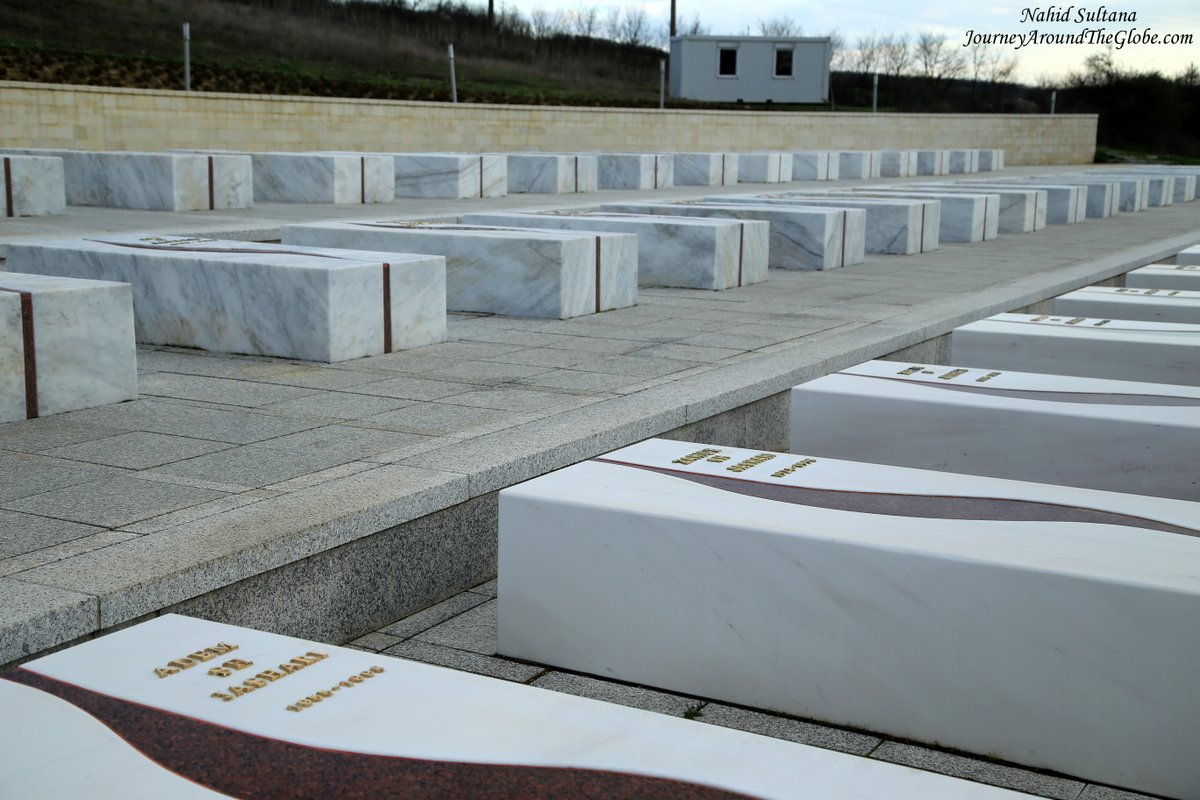
Opposite of Jasharis’ house, is the memorial for this family that was built in 2013. Our guide was saying there are yet more things to be added to it later. It is a nice and big park/memorial for the 59 members that died in 1998. You can see the marble tombs of those braves on the slope of this memorial. Kosovan army guards this area in honor of the deceased Jashari family members. Some of the other family members of Jashari family is located opposite of the park across the street. Another interesting thing to see here is that you see an Albanian flag flying at the corners of this memorial and not a Kosovan flag.
Share this:

Macedonia in 2 days – visiting Skopje and Matka Canyon
SKOPJE, MACEDONIA: Situated by River Vardar, Skopje is the capital, the largest, and the most diverse city of Macedonia. It gave birth to some of the greatest people of the history, like Mother Teresa and Alexander “The Great”. Historically, the earliest traces of life in Skopje Valley are from the early Stone Age around 5000 to 3000 BC. From then on, Macedonia came under many rulers, empires, and kingdoms since its foundation, from the Byzantines, Romans, Ottomans, Serbians, then became a republic of Yugoslav Federation. However the Ottomans left the most and greatest marks on Skopje than any other rulers. Ottomans ruled Macedonia for many decades until the 20th century and built a large numbers of mosques, Turkish baths, and other architectures. Even now, Ottoman’s legacy is extremely visible in all over Skopje. Overall, there are 40 mosques in Skopje and more than 100 mosques in Macedonia. This is a city where you can see a harmonic and peaceful combination of Christianity and Islamic culture side by side.
Unfortunately, a major earthquake in 1963 destroyed about 75% of the city in just few seconds. Many of Skopje’s historic and important buildings were leveled to ground that day. But the city did great job pulling itself back to its original look with more modern and futuristic style.
River Vardar runs thru the city and can be seen from the city center. The capital is surrounded by mountains in all directions and you can see them in the far distance. Skopje is a clean and tourist friendly city. It’s very well-marked and organized with information boards and signs near all the sites…small or big. Walking is the best way to get around but taxi is much cheaper than other parts of Europe if you need them for further distance.
TIME of TRAVEL: Skopje was one of the destinations we covered during our Easter Break Trip of 2014. After visiting Podgorica in Montenegro and Tirana in Albania, we drove more than 4 and ½ hours to reach Skopje. I know it may sound like a long one, but when you are driving thru hills, snow-capped mountains, blue lakes, small villages, and pretty valleys the few hours in the car is nothing. We entered in Kosovo for a short time too before entering Macedonia. Just an FYI, if you have a rental car and don’t have insurance to drive in Kosovo (most rental companies’ insurance doesn’t cover damages occurred in Kosovo), drivers have to buy car insurance for 15 euros at the border. From Skopje, our next stop was Pristina, Kosovo.
OUR HOTEL: The hotel we stayed in Skopje, Hotel Victoria, was a family run place with luxurious rooms and excellent customer service. The owner himself gave us some ins and outs of the city and recommended us a nearby traditional Macedonian restaurant “Macedonian House” on the first night and to Matka Canyon and lake for the day we checked out to go to Pristina, Kosovo. The hotel had free breakfast buffet, Wi-Fi, and parking. It’s located in a quiet residential neighborhood, about 15 minutes of walk from the city center. We really got a homely service from the owner, his wife, and their daughter here, and our kids got some special treats before leaving the hotel.
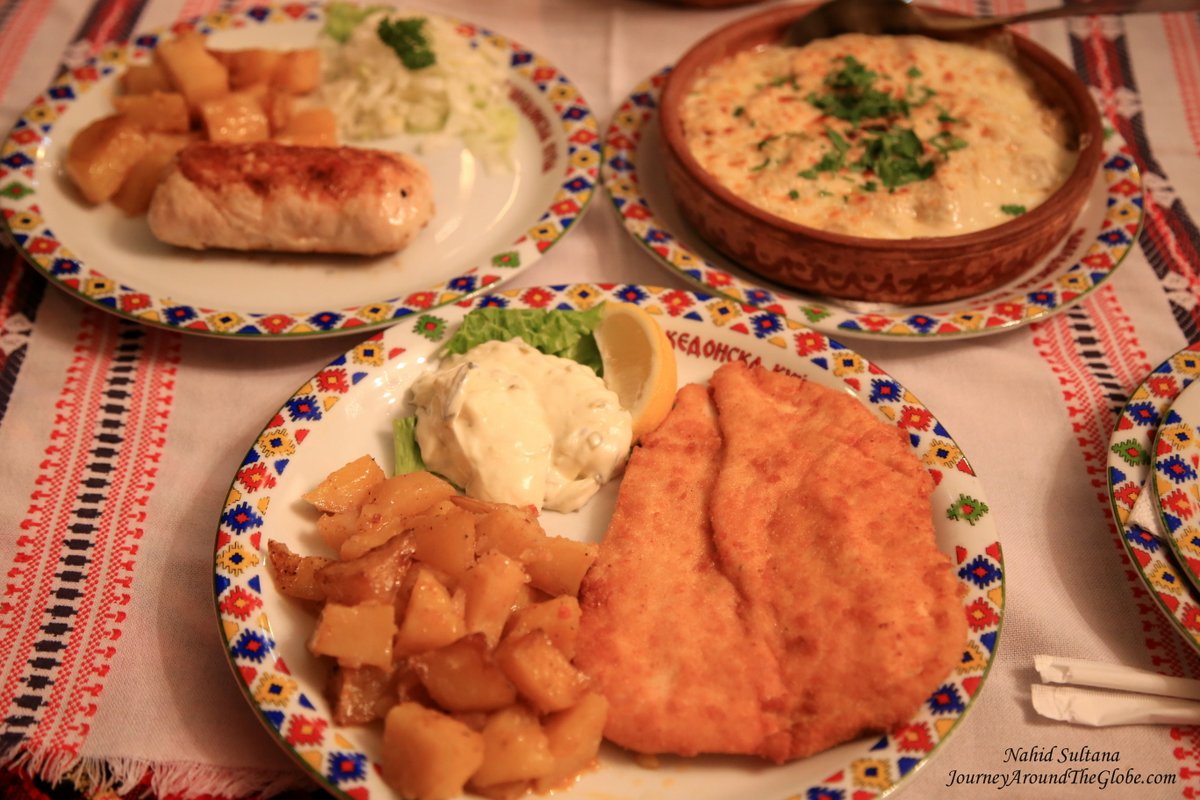
EATING and SHOPPING: “Shkembe” is somewhat popular here since I’ve seen it in the menu of few restaurants. This soup is made with cow intestine (may be lamb too, not sure)…didn’t dare to try it. Other than that fried cheese or Greek salad are also common in many restaurants. We had our first dinner in “Macedonian House”, a place which was recommended by our hotel owner. This is a top class place to try some traditional dishes. It is a big place decorated with traditional and handcrafted items from the locals. We had breaded cheese, chicken casserole, rolled chicken with cheese, eggplant with feta, fried zucchini, and onion soup. The price was way less than our expectation and the service was fantastic. There was also some live piano at the end. Next day lunch was in the old town opposite of Daut Pasha Double Hammam. This was a small street-side place with good food. We had some hot dogs, Greek salad, and breads. Again, price of the food here is a lot cheaper than Western Europe. Next day we had lunch in Canyon Matka Hotel and Restaurant when we went to see Matka Canyon and Lake. This is a pleasant place for meal by the lake. It’s a bit pricey but the food was great. There were more options near the entrance of this canyon.
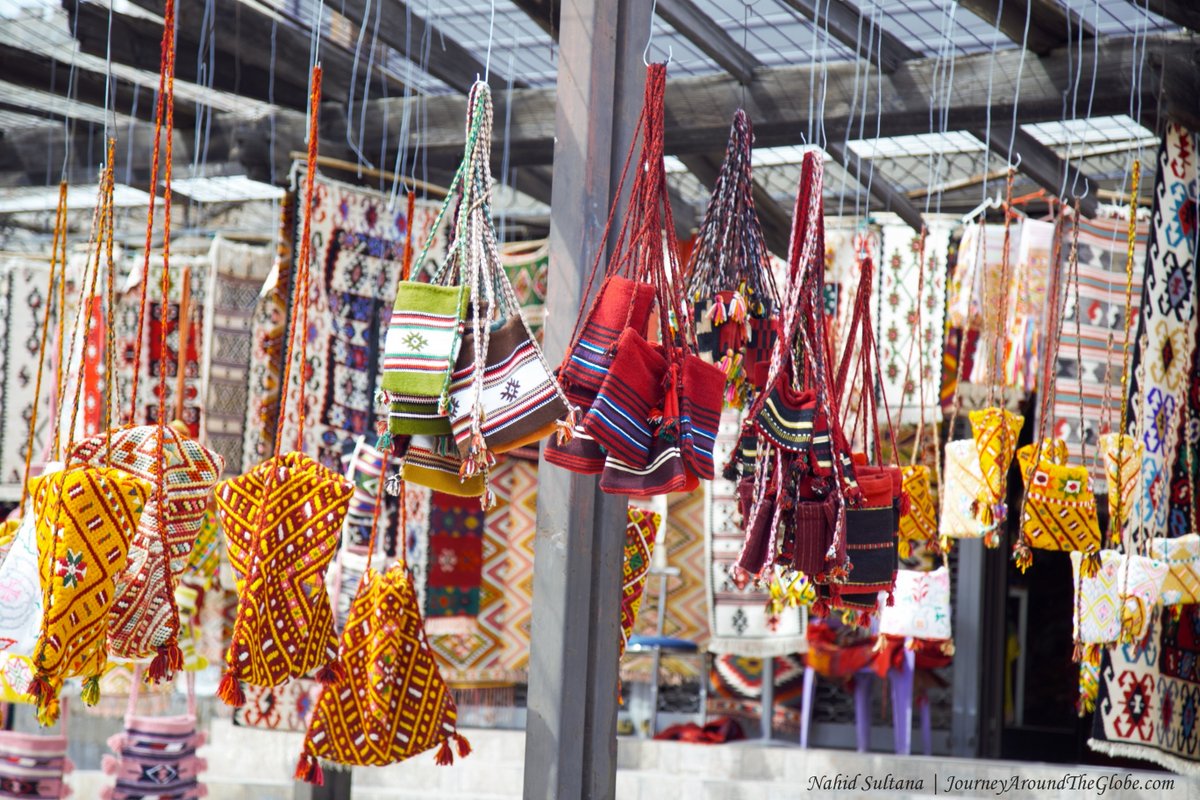
Old Bazaar of Skopje is a very good place for those souvenir hunters. Many Turkish stores sell traditional and handmade goods. You can find carpets, Macedonian dolls, home decors, and almost everything else in this market.
PLACES WE’VE VISITED: Skopje is a city where you can do and see countless things and you won’t get bored for a single moment for a long time. We had only a day in the city of Skopje and about half a day in Matka Canyon which is less than an hour drive from city center. We only saw the highlights of this capital in a day. Some of the places we didn’t visit but sounded interesting are Holocaust Memorial Center, Macedonian Revolutionary Struggle, some old Turkish inns – like Kapan Inn and Suli Inn, Daut Pasha Hammam, and tons of museums all around the city. Most of the main attractions of Skopje are close to Macedonia Square and are within walking distance.
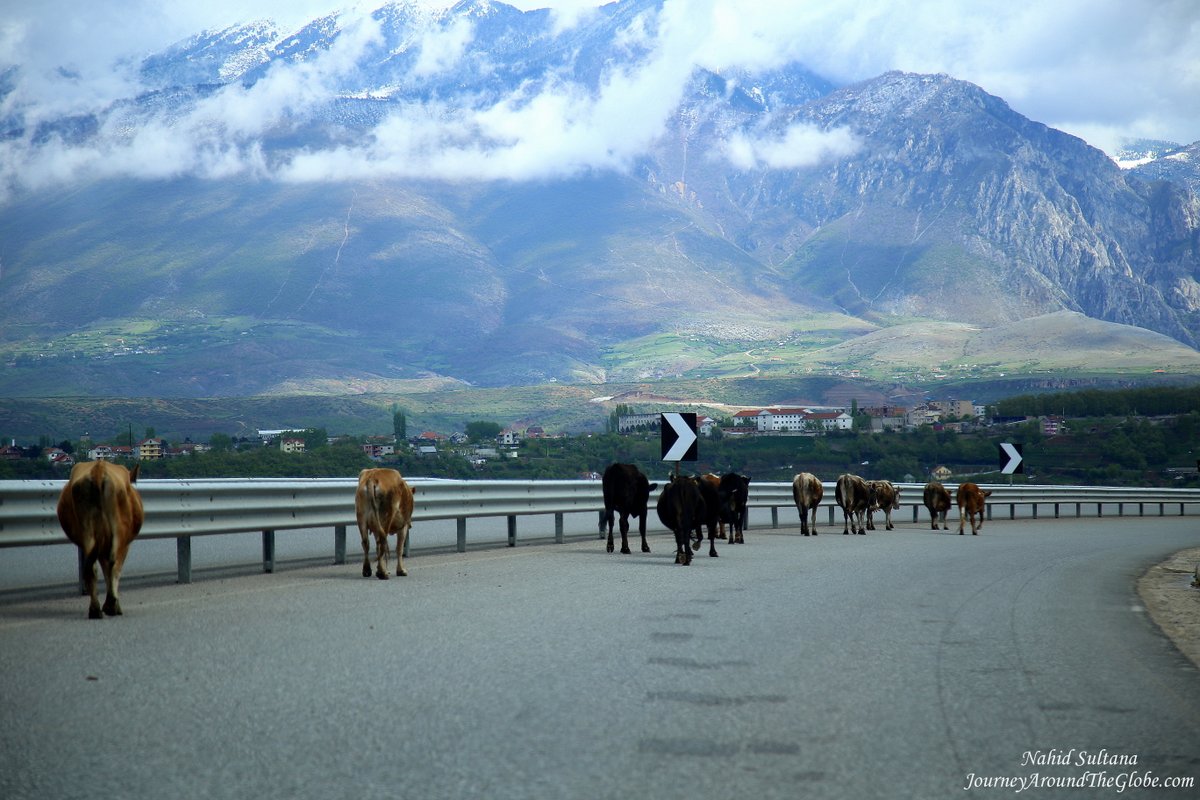
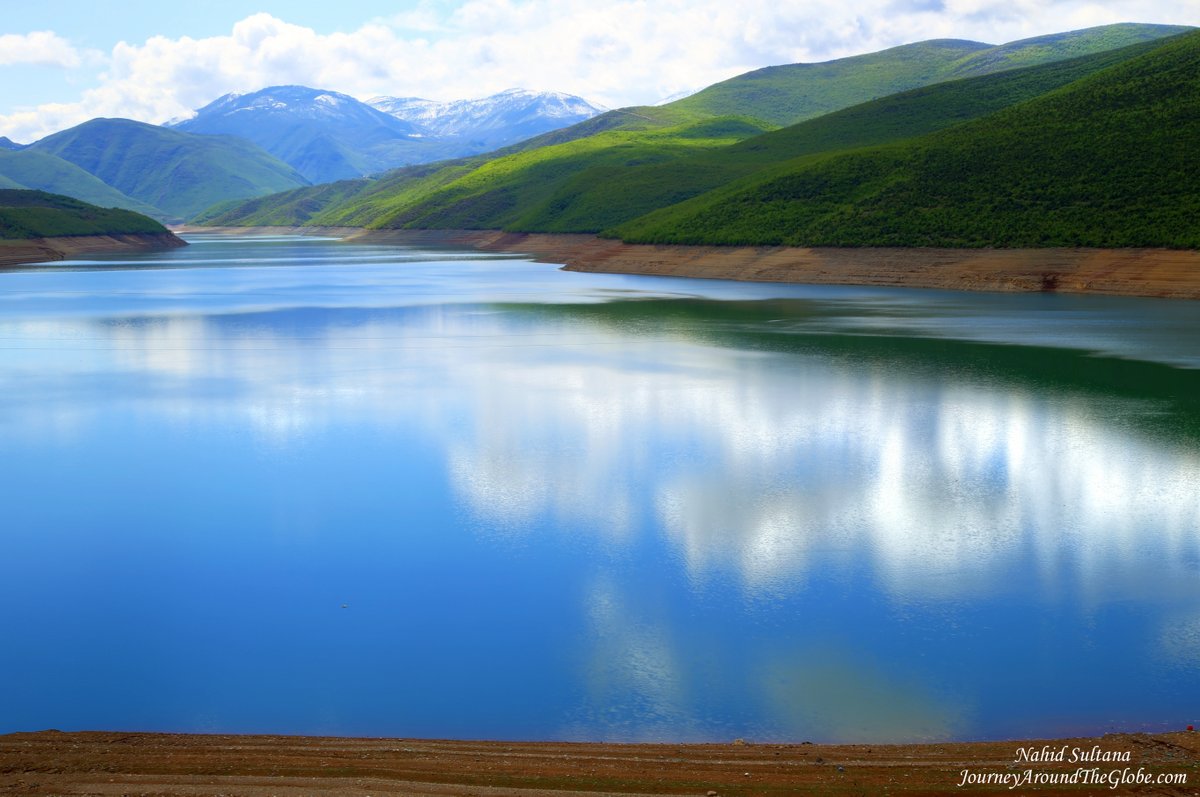
The scenic highway from Tirana, Albania to Skopje, Macedonia (thru Kosovo)
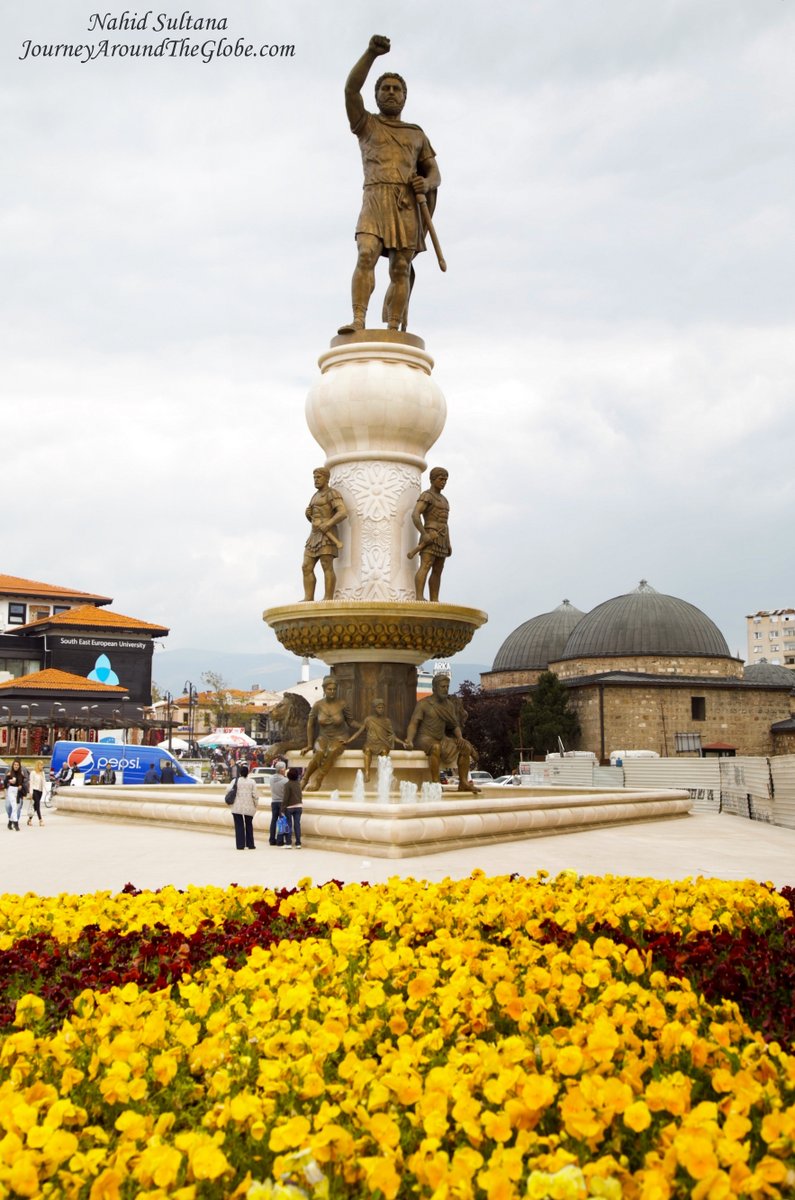
1) MACEDONIA SQUARE: This is the main and the liveliest square of Skopje. I just loved its big space and energetic atmosphere. There are countless interesting statues and sculptures all over this square, mostly of Macedonian revolutionary figures. But the grandest sculpture is the one in the middle with the prettiest fountain of this city. This is the statue of Macedonia’s bravest son, Alexander the Great on his horse-back (though some say it depicts a Macedonian warrior on horse). This 26 meter statue was built not too long ago in 2011 to commemorate 20 years of independence of Macedonia. At the base of the sculpture are 8 bronze soldiers and 8 bronze lions. The fountain plays classical music with the water show every now and then, not sure of the time interval.
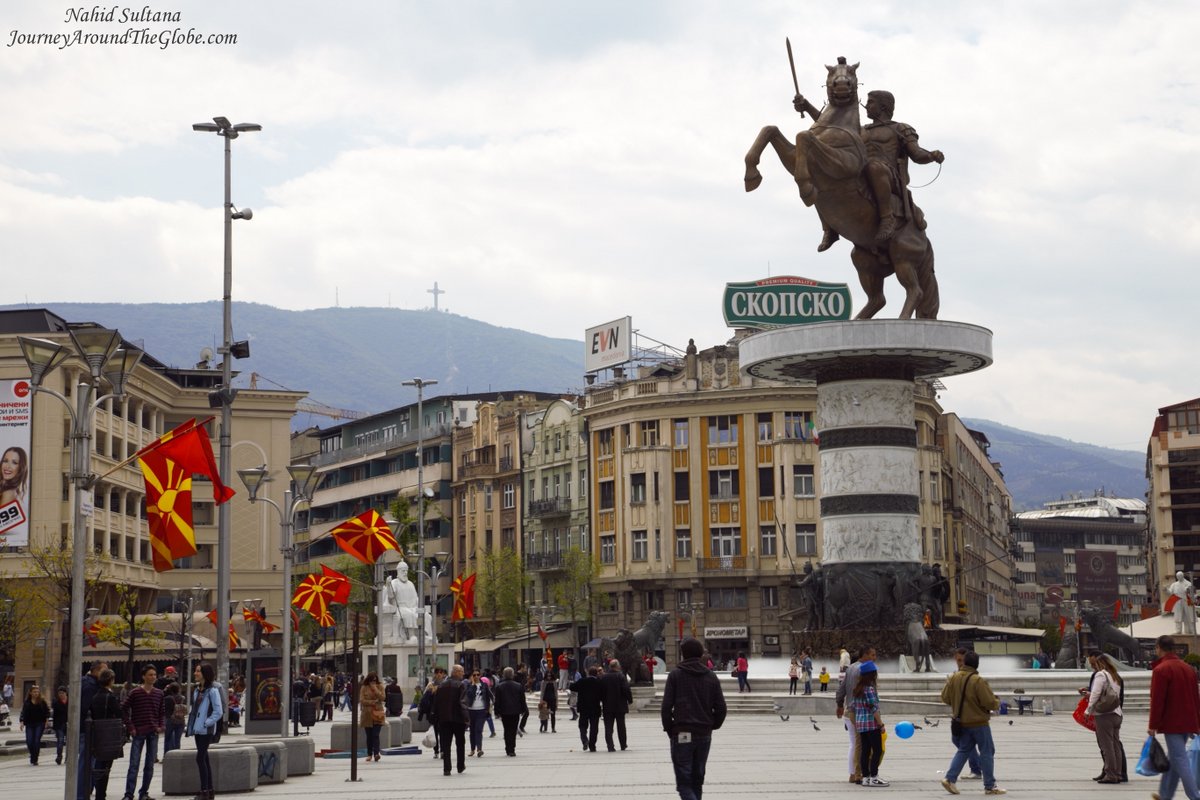
Stone Bridge and Porta Macedonia can be seen from this point. Lots of grand buildings surround the square. There are many cafes, hotels, restaurants, and bars here. The place really comes to live in the evening. This is a just a fantastic place to hang out in the heart of the city.
2) MOTHER TERESA BIRTHPLACE and MEMORIAL: Mother Teresa is the most renowned woman of Skopje who was born here very close to the city center in 1910. After spending 18 years in this house, in 1928, she left her native town and went to India, where she dedicated her life to the missionary work, selflessly caring for the sick and the poor. This Memorial Home was built in her honor, on the occasion of her 100th birthday.
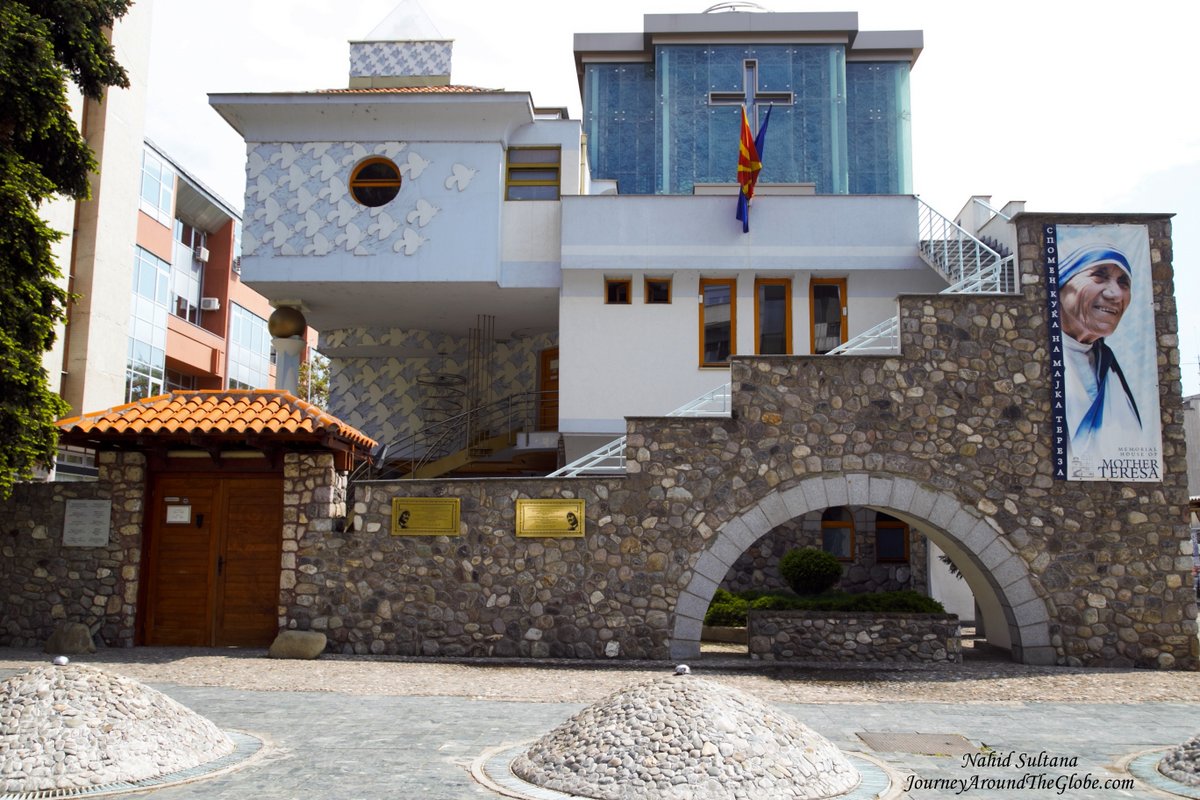
The memorial represents a modern and transformed version of the house where she was born. It was erected on the spot where a Catholic Church used to be. The new building is a tranquil place that depicts her entire life and represents a temple of spirituality, humanity and charity, as well as an eternal memory of her noble mission. Part of Mother Teresa’s remains was transferred to her sanctuary, consisted of many rooms: music room, private room, prayer room for Mother Teresa, multimedia room for chamber music and souvenir shop.
We didn’t go inside the memorial or the museum. Museum is little bit further, this particular building is just a memorial.
Feudal Tower is a 17th century tower from the Turkish era behind Mother Teresa Memorial which once served as a defense tower.
3) MACEDONIAN PARLIAMENT: We walked a bit from the memorial to come here. Macedonian Parliament is a pretty nice rustic orange building. In front of this modernistic style parliament stands a statue of Nikola Karev on the back of his horse – a Macedonian revolutionary and socialist who perished in the war with the Turks. Opposite of the parliament, on the other side of the street is like a big memorial park – a complex of many statues. The biggest one there, facing the parliament is known as “Monument to the Fallen Heroes of Macedonia”.
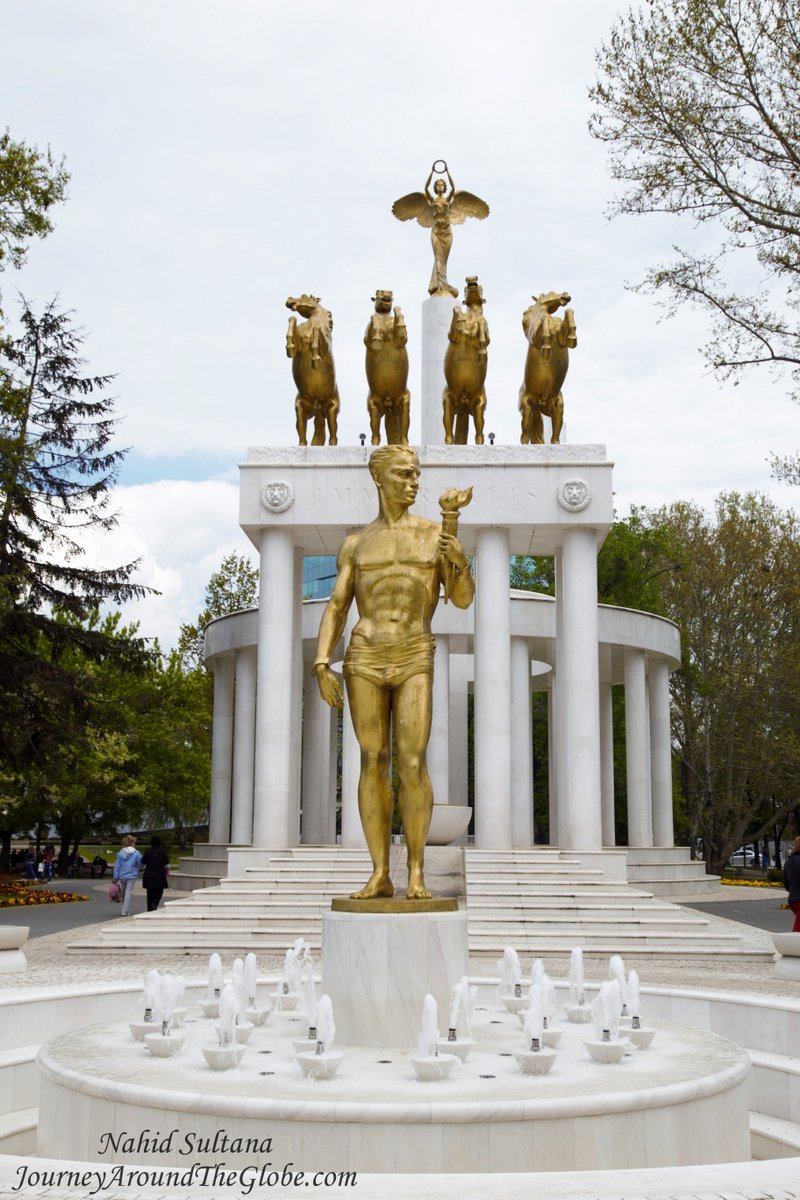
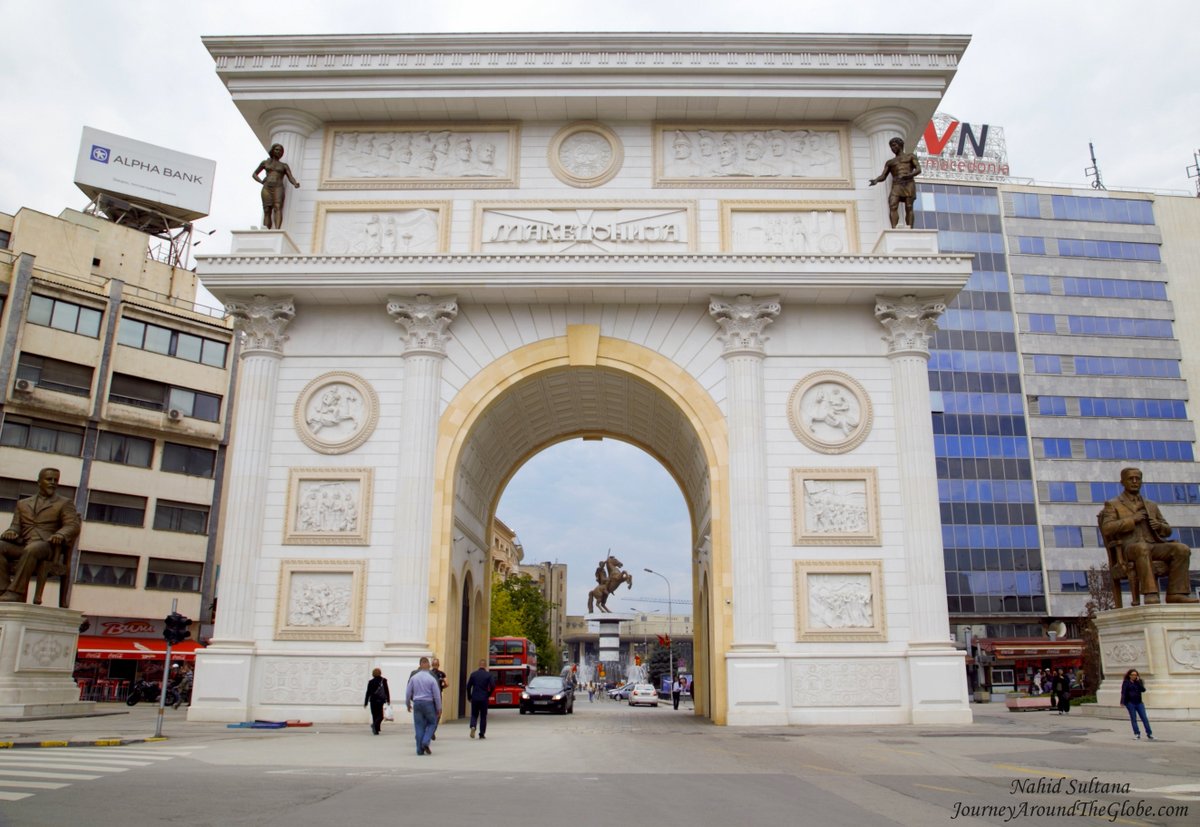
4) PORTA MACEDONIA: After visiting the parliament and the big park in front of it, we entered the city center again thru the grand Porta Macedonia. This is a white triumphal arch gate in between the parliament and Macedonian Square. The gate is dedicated to the 20 years of independence of Macedonia. Not sure of the statues of two gentlemen sitting on the two sides of the gate…may be two Macedonian heroes.
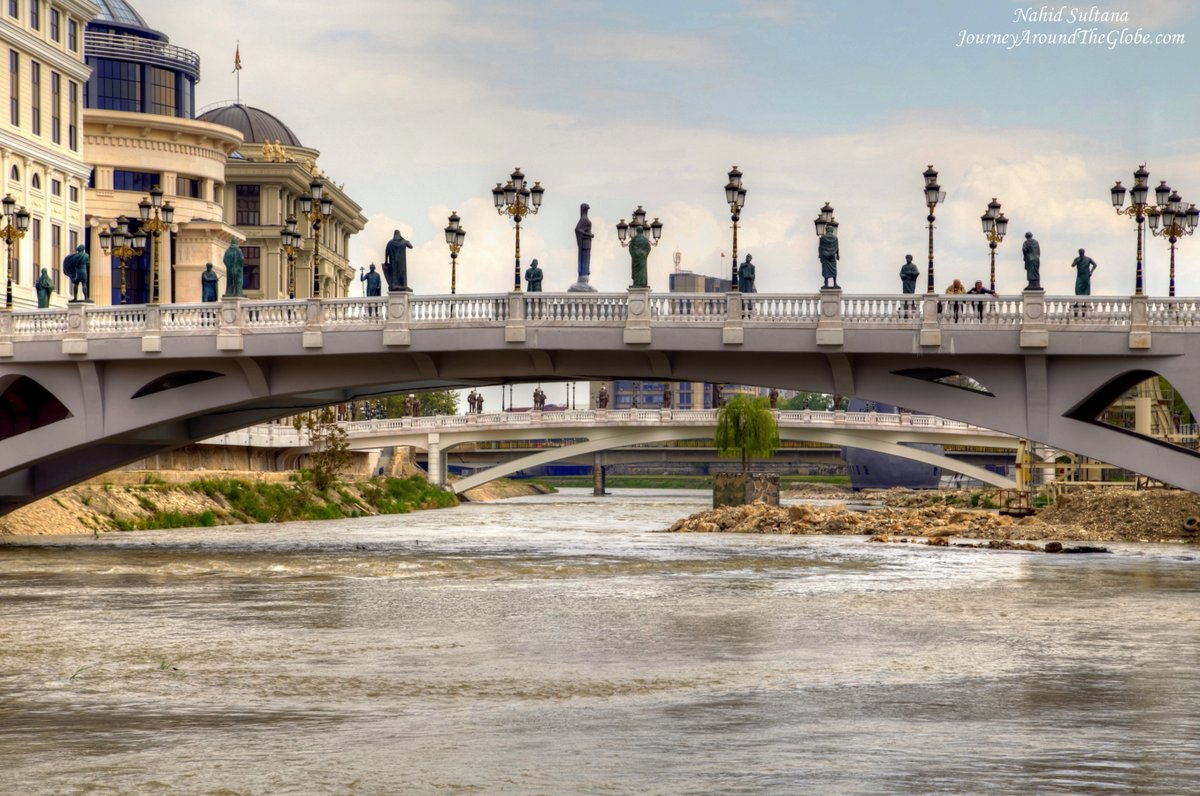
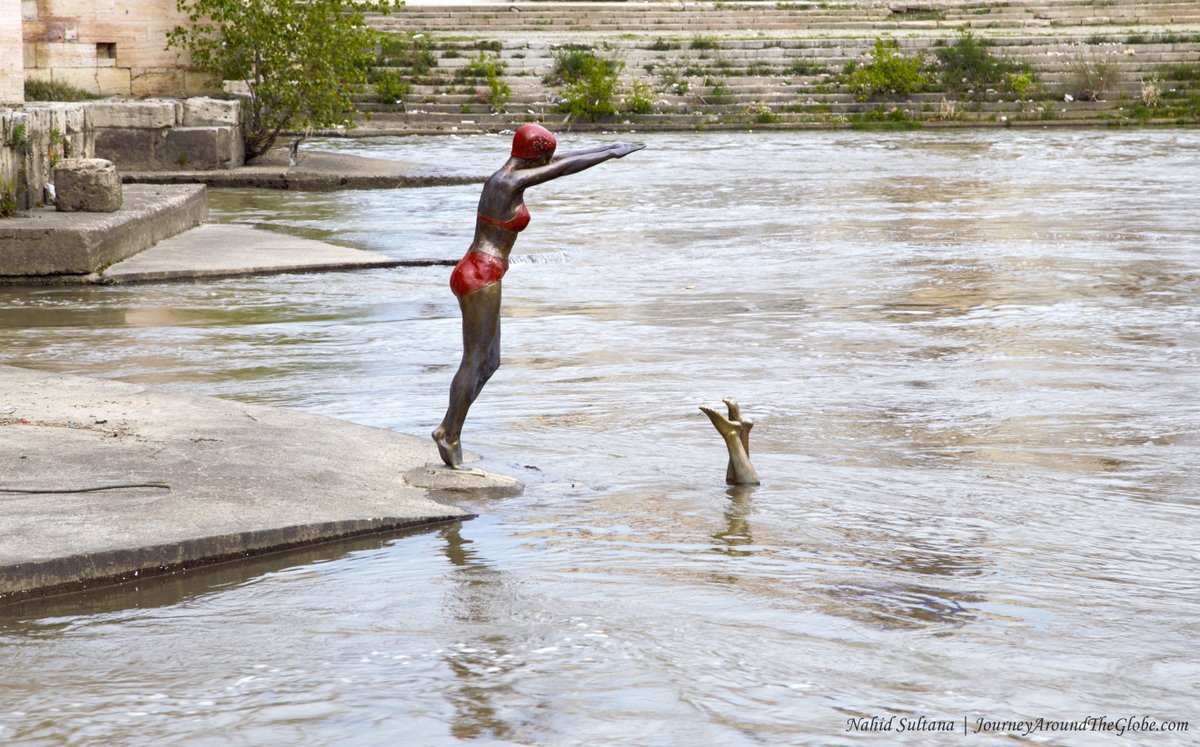
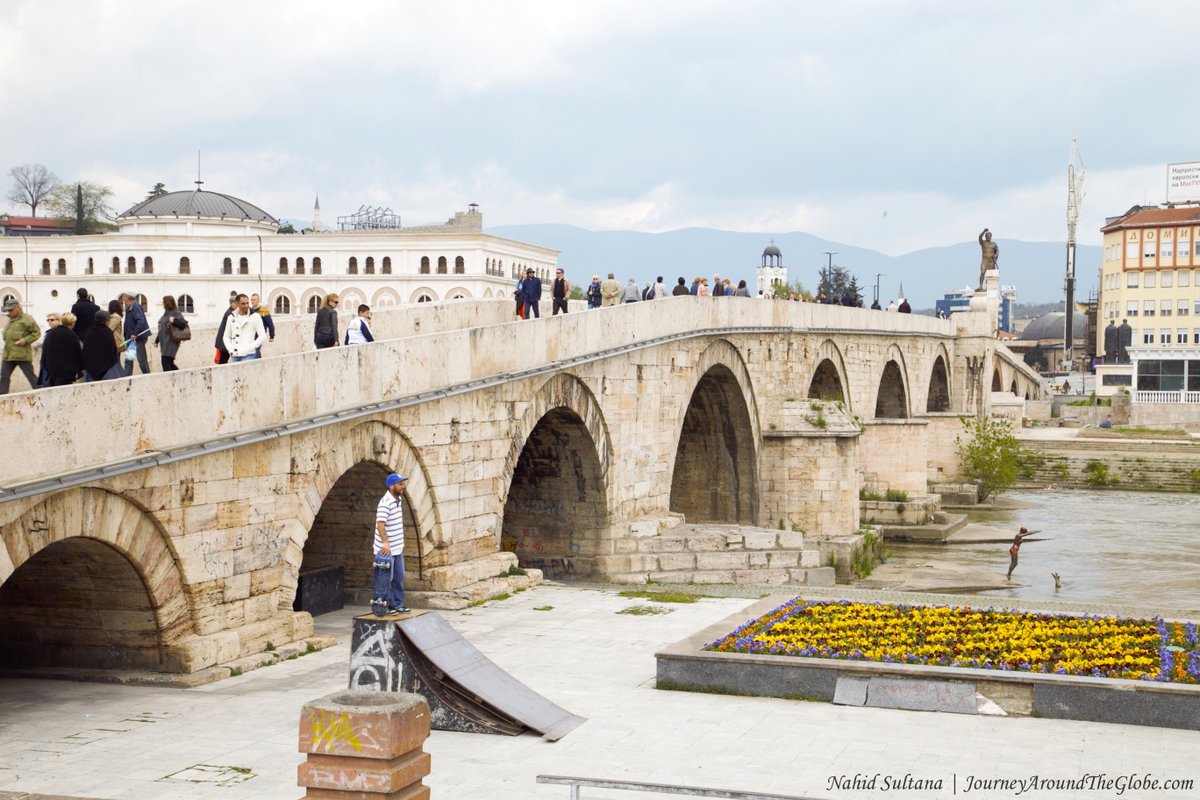
5) STONE BRIDGE and RIVER VARDAR: Another beauty of Skopje is their old Stone Bridge on River Vardar that connects old bazaar and main square. The original bridge is from the 6th century, from the Byzantine’s period; different reconstructions and renovations took place in the later centuries. The Watch Tower shaping like a Mihrab was reconstructed in 2008. You can see the original 6th century stone block and 13 arches of this bridge from the sides. Many important and historic buildings stand by the river bank. River Vardar cuts thru the city here and creates a pleasant place to hang out at any time of the day. There are tons of interesting statues on the both sides of the bridge and near the water. Look for the statue of a lady posing to dive into the water.
6) OLD BAZAAR: This is an old bazaar in the heart of Skopje and when I say old, it’s from the 12th century. But the bazaar had its greatest rise in the period between the 15th and the 19th centuries. This significant town site, where the narrow paved streets form a labyrinth, possesses a distinct oriental look. The stores, although situated between somewhat civilized frames, still nurture the traditional form of organization. They are attached to one another and most of them share identical minimalist dimensions. Apart from the numerous jewelry stores, taverns, tearooms, pastry shops, and other types of stores, in the Skopje Old Bazaar you can see the most important monuments of the sacral Islamic and profane architecture. You can find a big community of Muslims in or around this bazaar.
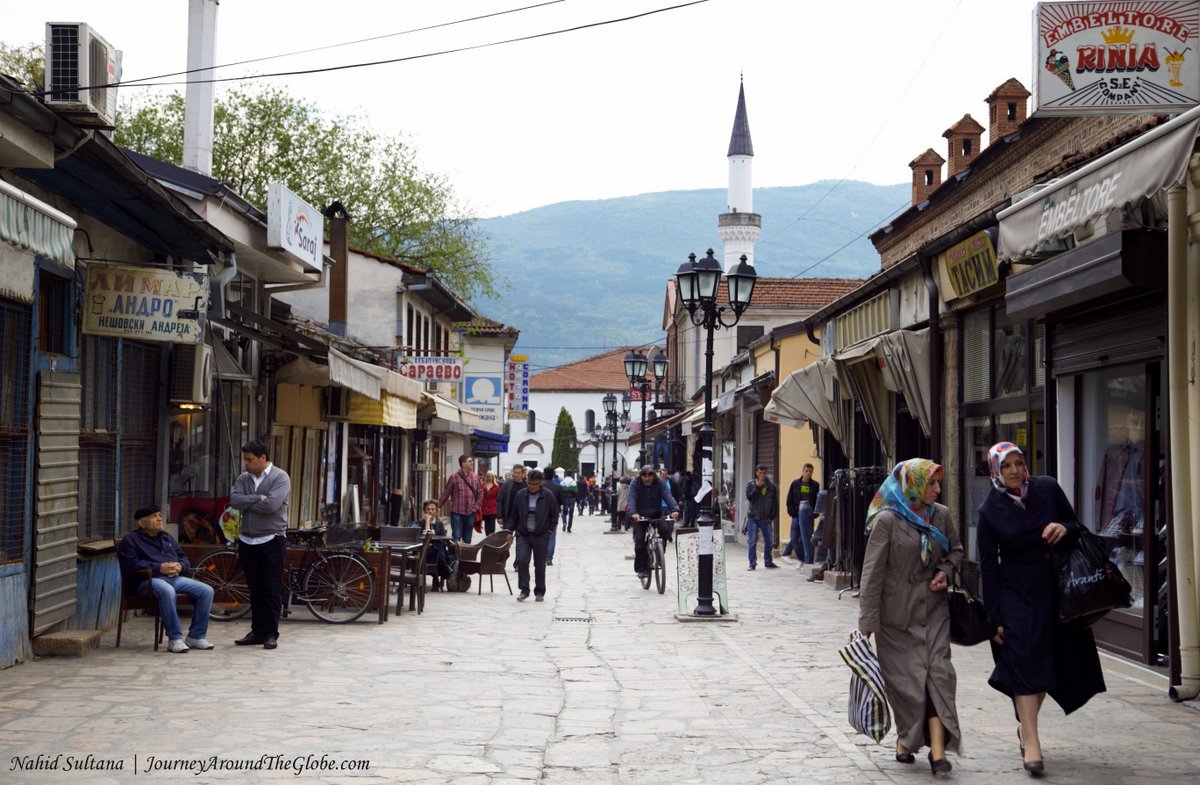
This is a good place to buy Turkish or Macedonian trinkets. It is quite big in size with countless small alleys. There are plenty of traditional cafes, restaurants, and bakeries at every corner of this bazaar.
7) SULTAN MURAT MOSQUE and CLOCK TOWER: Also known as Sultan’s Mosque, this is the biggest mosque in the Balkans and the main mosque of old part of Skopje. It was built in 1463 by Sultan Murat II on the foundations of an older monastery.
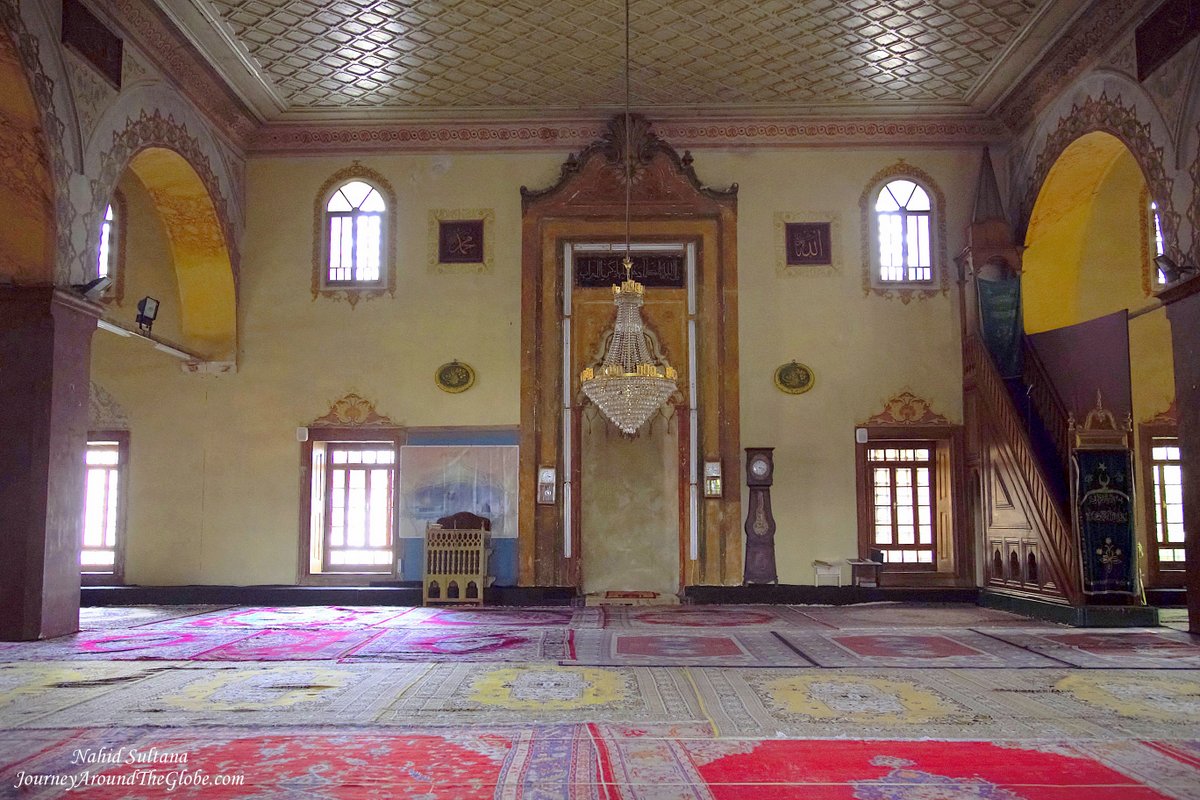
The mosque stands next to a Clock Tower, dated from the 16th century. There is a wash area in front of the building and a tall minaret beside the mosque. Sultan Murat Mosque is still active and holds daily prayers. Visitors are to respect the worshippers and need to take off shoes before entering the prayer area.
Sultan Murat Mosque is a bit away from the center. We asked some young men about its location and they were kind enough to actually take us, which took about 10 minutes. Opposite of Sultan Murat Mosque is another 15th century mosque, called Isa Beg Mosque. You don’t have to pay anything to visit these mosques but donation is always appreciated.
8) CHURCH of the HOLY SAVIOUR: According to some historians, the original church dates from the 14th century. It is the oldest preserved church in Skopje. The church suffered a great deal from a fire in 1689. The church itself is tiny but has a pleasant courtyard.
The sarcophagus of Macedonian’s greatest revolutionary hero Goce Delchev (who fought against the Turks) lies in the church courtyard. His remains were transferred to this church in 1946. There is also a museum dedicated to the life and revolutionary activity of Delchev. I loved this small but calm courtyard with trees and a small gardens.
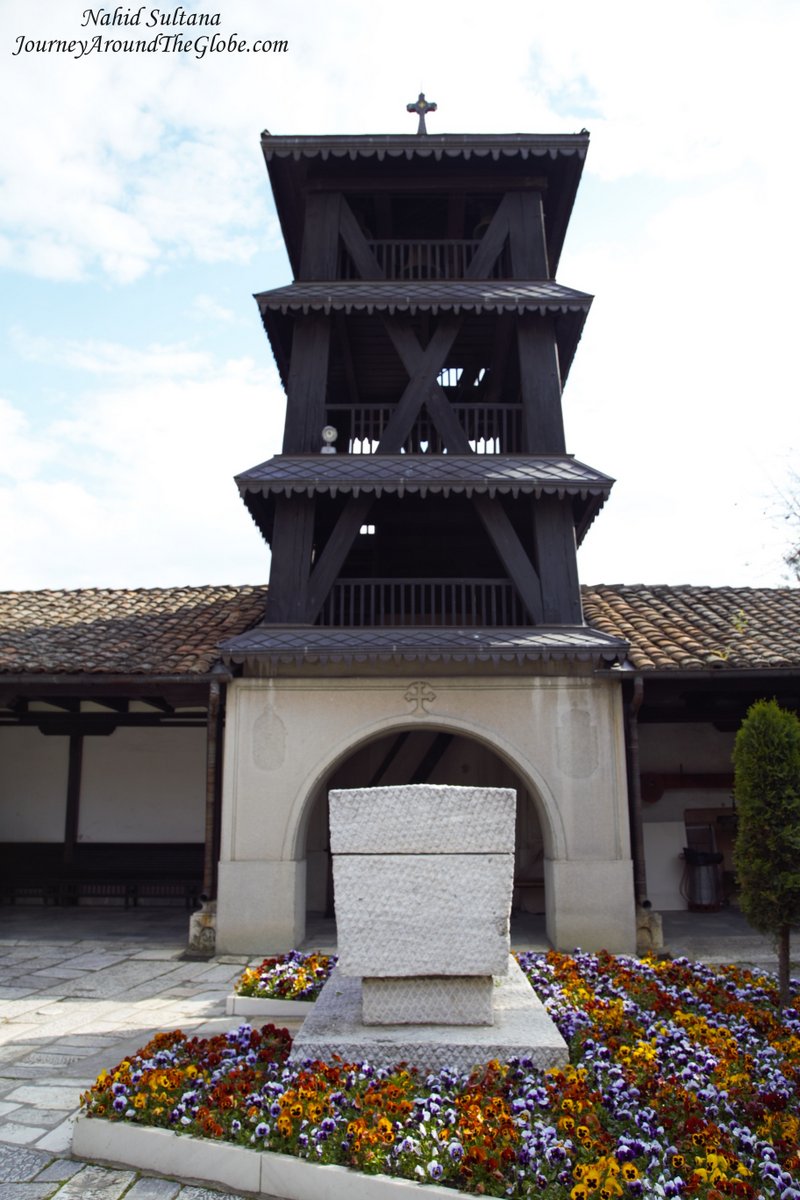
The church is interesting for its specific structure. Having been dug into ground to the depth of about 2 meters, it is a silent witness of the subordination of Christian edifices to Turkish dominant religious structures at the time. Inside the Church of the Holy Saviour, you can see an impressive iconostasis on the altar – a masterpiece of Macedonian woodcarving. This deep wood carving was done from whole wood boards and is not covered with golden paint. It is 10 meters wide and 6 meters high. It was handcrafted in the 19th century and took 6 years to finish this art. The earthquake of 1963, the south wall collapsed and unveiled a fresco dated from the 17th century.
The church is located in the Old Bazaar, near Fortress Kale. It was 120 Denar per person to go inside the church but no fees to look around the courtyard or Sarcophagus of Goce Delchev.
9) MUSTAFA PASHA MOSQUE: This significant monument of the Islamic architecture is located on a plateau east of the main entrance to the fortress Kale. This historic mosque was built in 1492 by Mustafa Pasha, an Ottoman commander of Skopje. It was severely damaged by the earthquake in 1963. Currently TIKA, a Turkish organization, is conserving and taking care of Mustafa Pasha Mosque, a beautiful example of common historical and cultural heritage.
Mustafa Pasha is one of the most beautiful Islamic buildings in Macedonia with vibrant blue and white interior. Inside the mosque is very elegant, spacious, and well-preserved. The mosque has a square plan and it’s covered with a dome elevated on three-centered arches. Inside the mosque, there is a mihrab with plastic decorations carved in marble, and above the entrance door there is a gallery for muazzins (man who calls for prayer 5 times a day). The minaret of the mosque is built of freestone, and the extended part is built of marble decorated with ornaments. An ablution fountain, former structures, and several tombstones are part of this complex too.
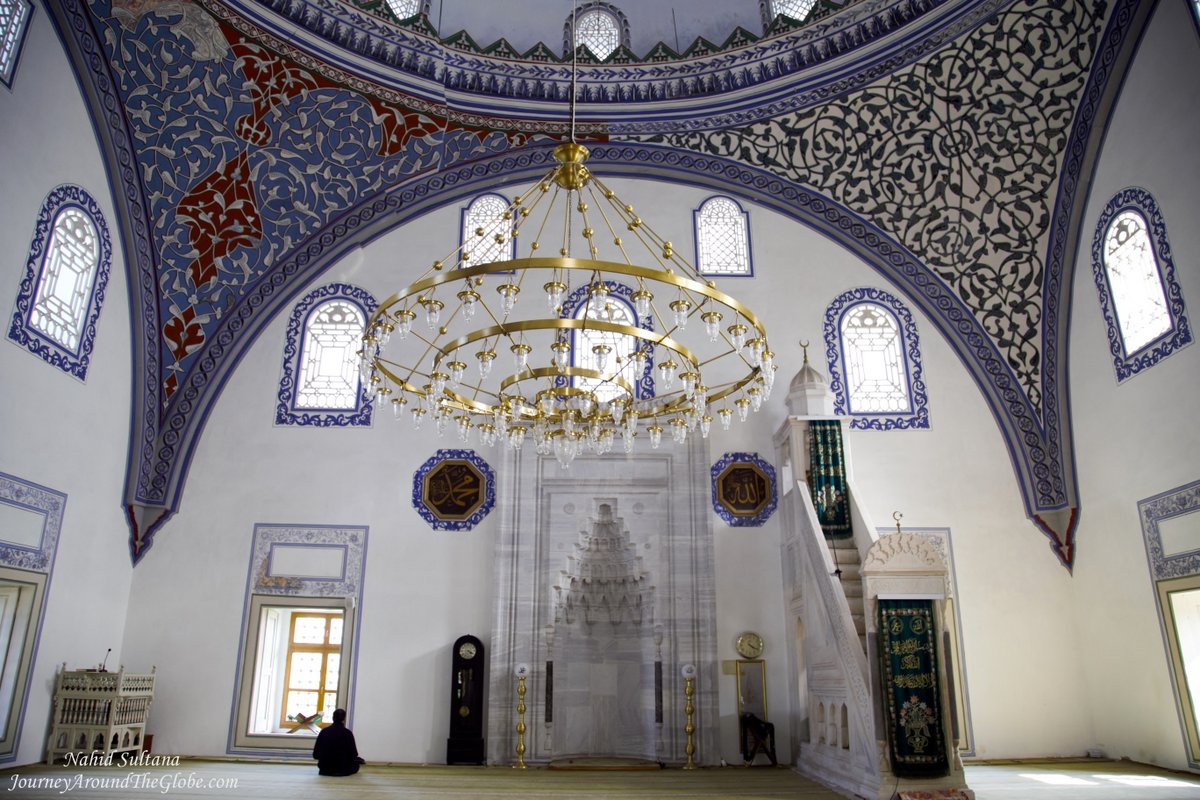
This old mosque is still in use, therefore visitors need to take shoes off before entering the main prayer area to respect the place and worshippers. There is no fee to enter but donations are appreciated. It’s located opposite of Kale Fortress.
10) SKOPJE FORTRESS: The Skopje fortress Kale, also known as Upper Town, dates from the 4th century BC and is the oldest known settlement from the Copper Age. It sits on the highest hill in the Skopje valley. The construction of the enormous ramparts on the Kale are mainly from the 6th century by the Byzantines. However, the fortress experienced its largest growth in the 10th century. In 1391, angered by the strong resistance of the people in Skopje, the Turks destroyed the city and parts of the city ramparts. But it was during the Turkish rule when the number of towers was up to 70, now only 3 remains. After that Kale continued to function as barracks. As a result of the disastrous earthquake in 1963, a large part of the Kale was completely destroyed.
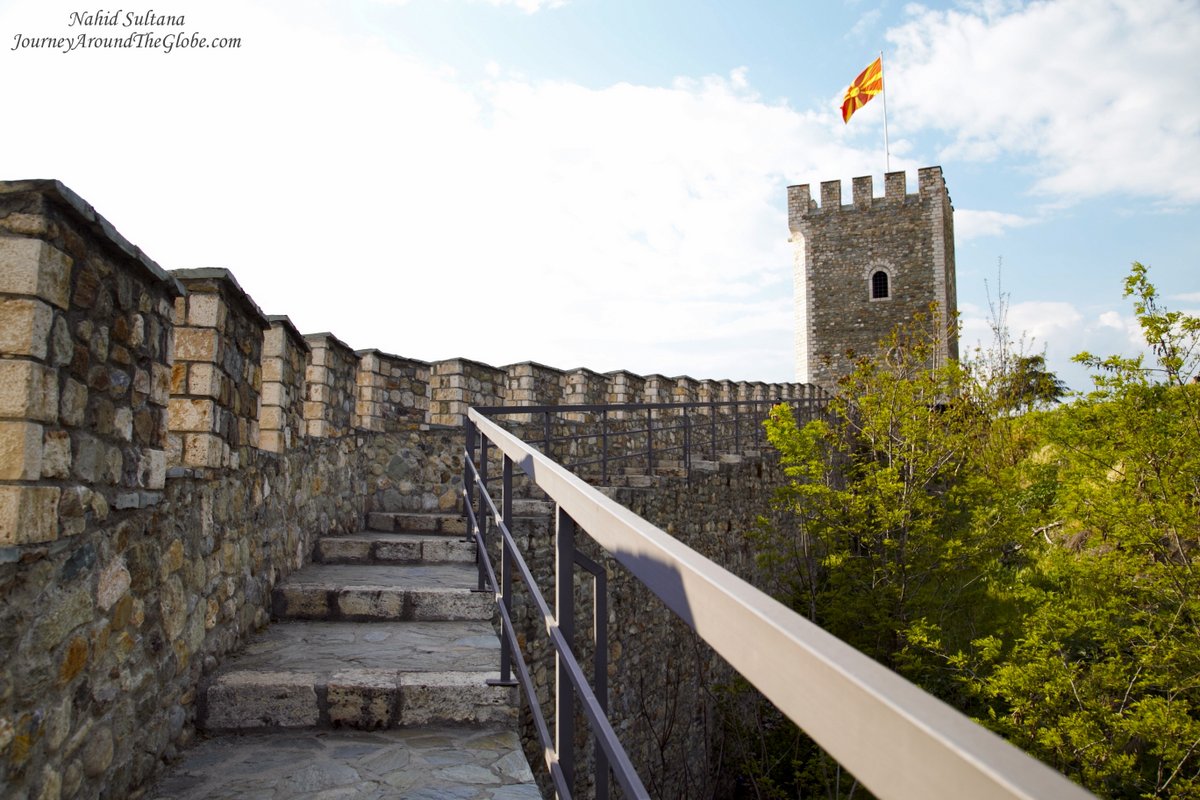
From the ancient impressive fortress today are preserved only one 121 m long rampart, three towers, and an enormous treasure of archeological finds. Among the find there are also remains of a number of churches, craftsman workshops and forges, and from the 12th century there are rare luxurious dinning dishes ornamented with painting, engraving and enameling. Some of the excavated dishes are true works of art, and the entire collection of such ceramics is one of the richest and most valuable in the Balkans.
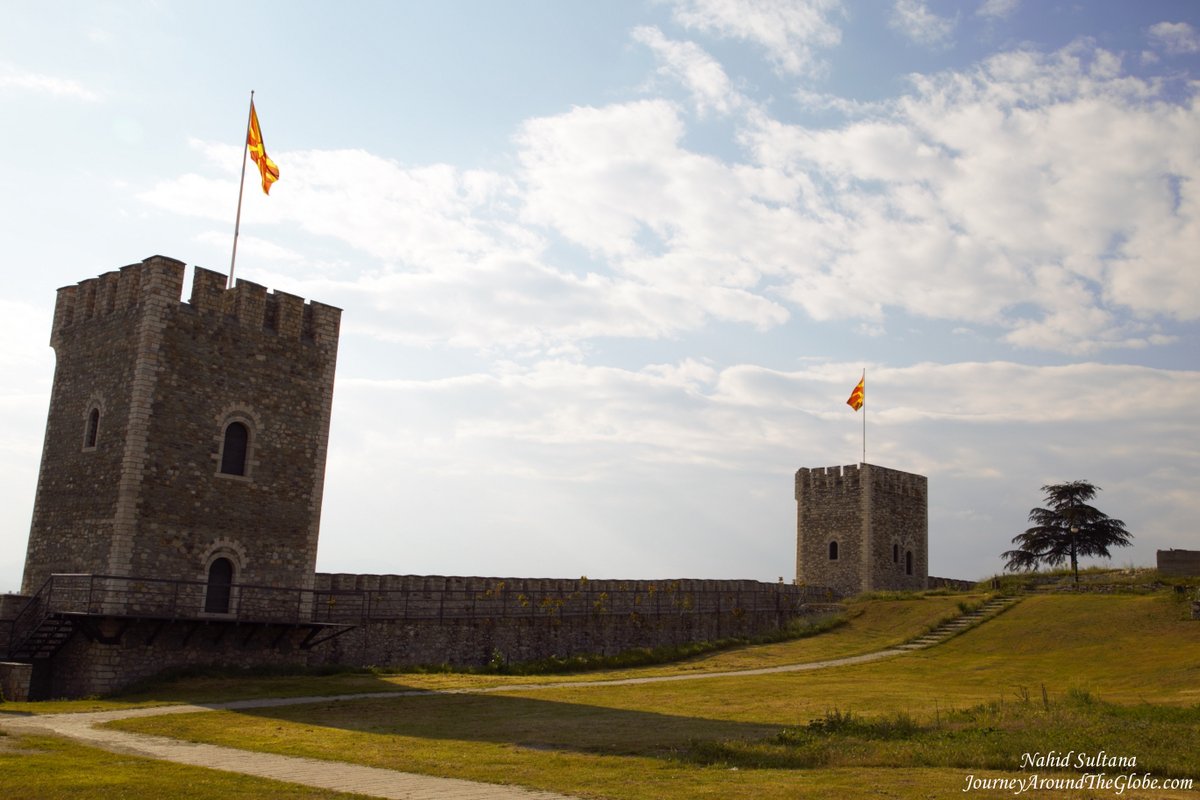
Kale Fortress is only in ruins now. But you get a fantastic view of Skopje from the castle hill and it is very attractive. We spent about little more than hour walking on its ground and on the old defense wall. There isn’t much to do other than enjoying the view and surroundings. A lot of spots were under restoration when we went, some new excavations were taking place on some spots too.
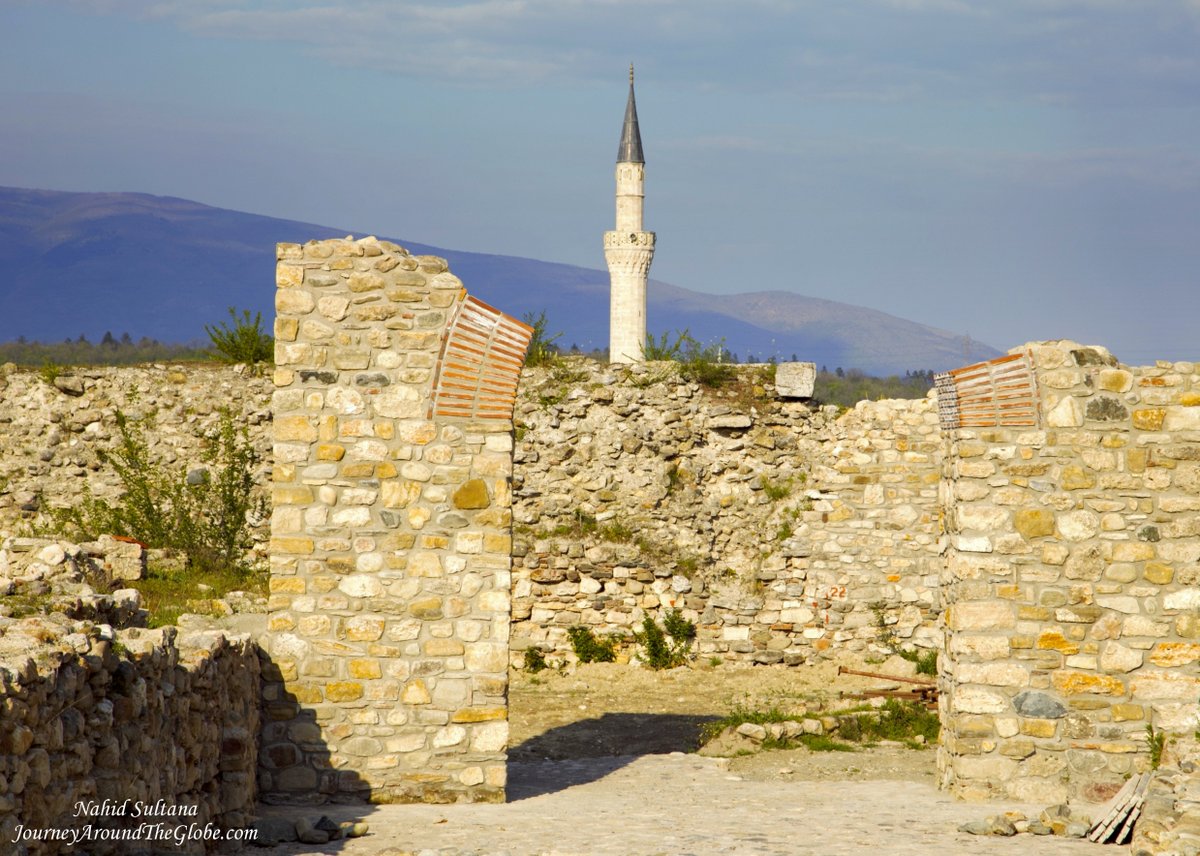
There wasn’t any fee during our visit and it is right opposite of Mustafa Pasha Mosque.
11) MATKA CANYON and LAKE: This was recommended by our hotel owner in Skopje. Next day, we checked out from the hotel and drove about half an hour to come to this beautiful gorge before heading towards Pristina, Kosovo. Matka Canyon is a fantastic place for the nature lovers, hikers, climbers, or even some expert scuba divers. This place is surrounded by mountains, lake, caves, monasteries, and appealing views. The long and snaky Matka Lake is about 35 meters deep.
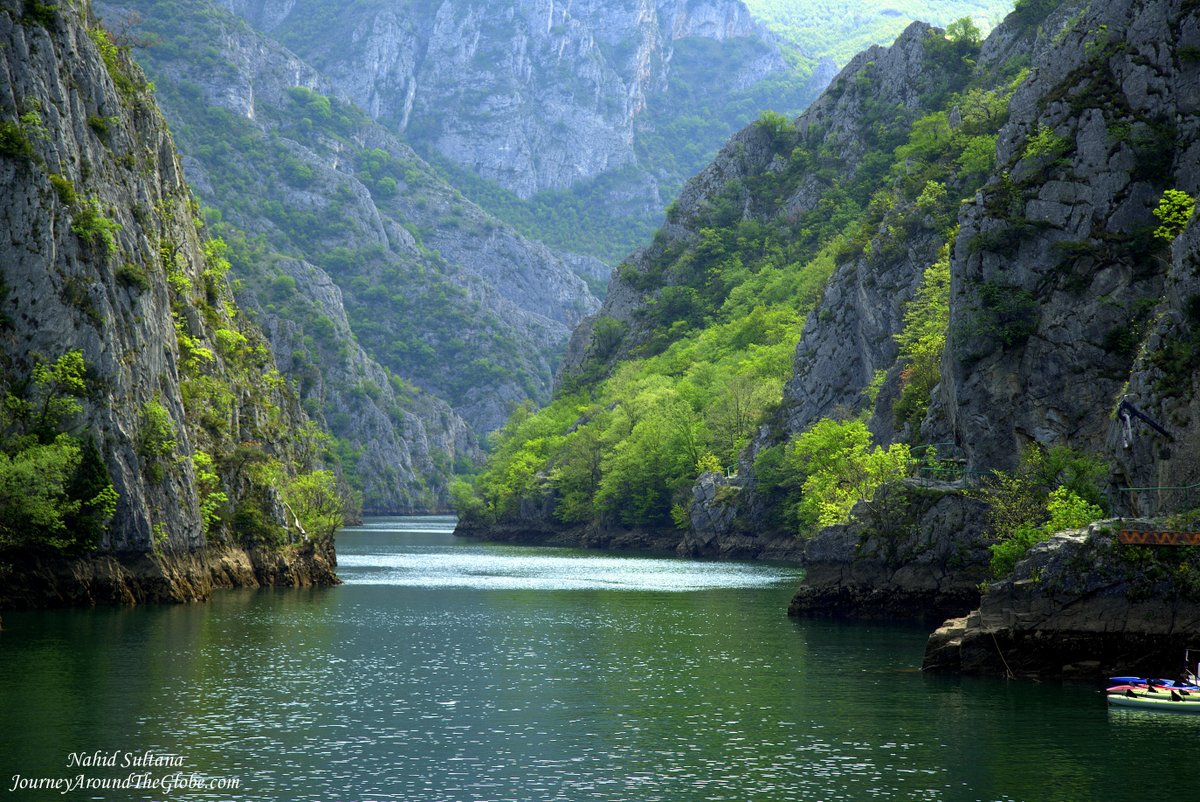
We hiked more than 1 km to the boat rental station. The boat takes you to a bat-cave, called
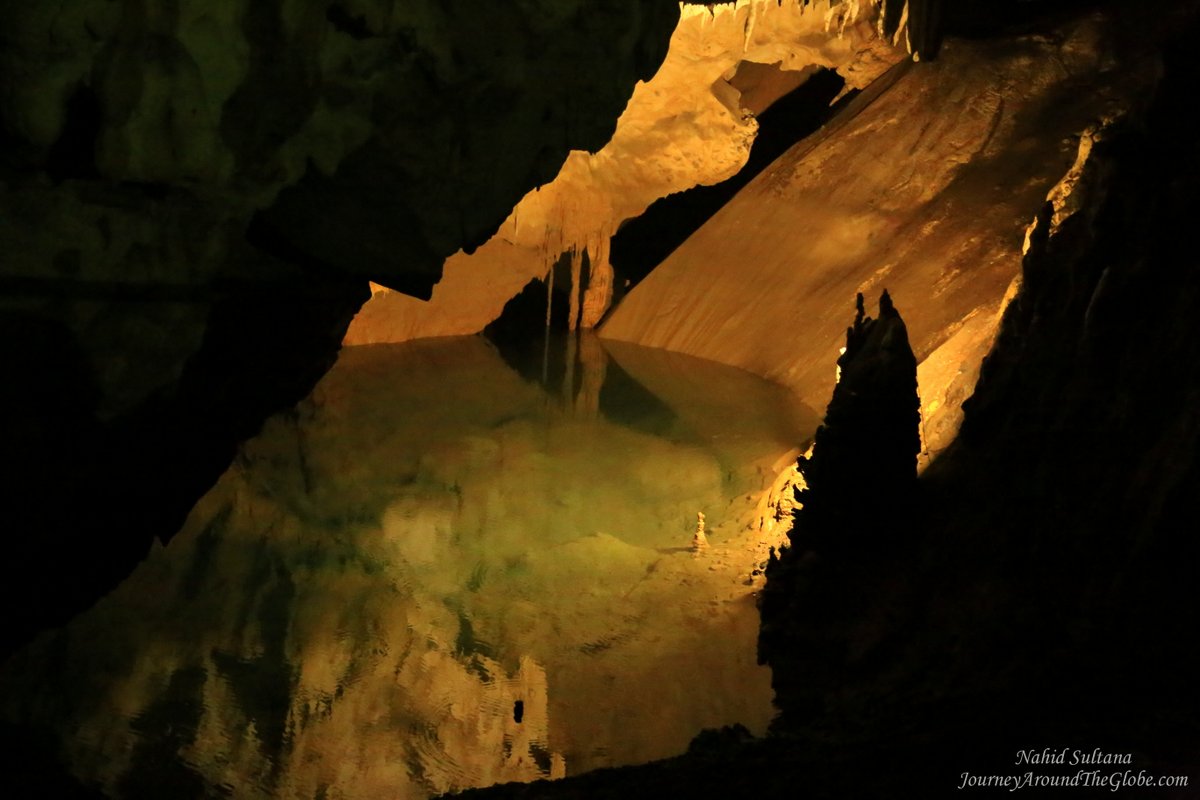
“Vrelo” (means “Spring”) where hikers can’t reach without crossing the river to the other side. You can hike more after the boat station if you don’t want the boat ride or not interested in cave. It’s 400 Denar per person to take a one hour ride on a small engine boat. It took us about 15 minutes to get to this cave which is about 6km from the boat dock. This 3000 years old cave was discovered only 35 years ago. We could hear the bats screeching and smell their poops. But the best part is that it is kept in its natural state. There were some light bulbs and some wet stairs to guide you thru. Surprisingly, there is a small lake inside the cave which you can see from few meters away.
After the boat tour we sat down for lunch at Canyon Matka Hotel and Restaurant in a nice setting by the green lake and hills. This is the only eatery near the boat rental. There is an old monastery, St. Andrew’s Church, very close to the boat station and this restaurant. It was built in 1389. It’s a tiny place but has beautiful original frescoes on its old walls. It was free to enter.
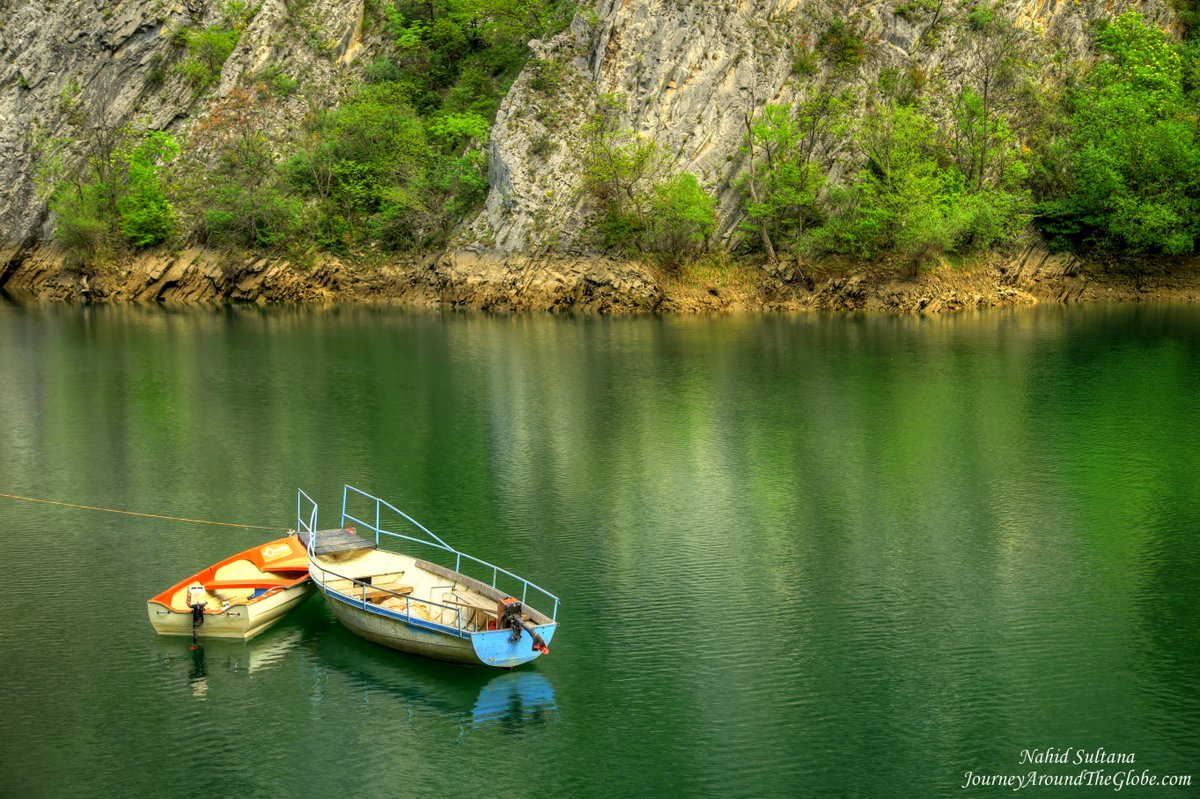
There was a kayak competition that day we visited this canyon. Therefore we couldn’t park closer to the lake. We had to park near an old monastery on a slope. There is no entrance fee to check out the canyon and lake.
Share this:

Albanian beauty – visiting Tirana and Kruja
TIRANA, ALBANIA: Tirana is a flourishing metropolis and the capital of Albania. It is an interesting and charming city with hospitable and helpful locals. Tirana is considered a relatively new city, although antique monuments and artifacts can be found here and there. City’s buildings got new facelift recently with splashes of colors in a modernistic style to distinguish themselves from other grey ex-communist capitals.
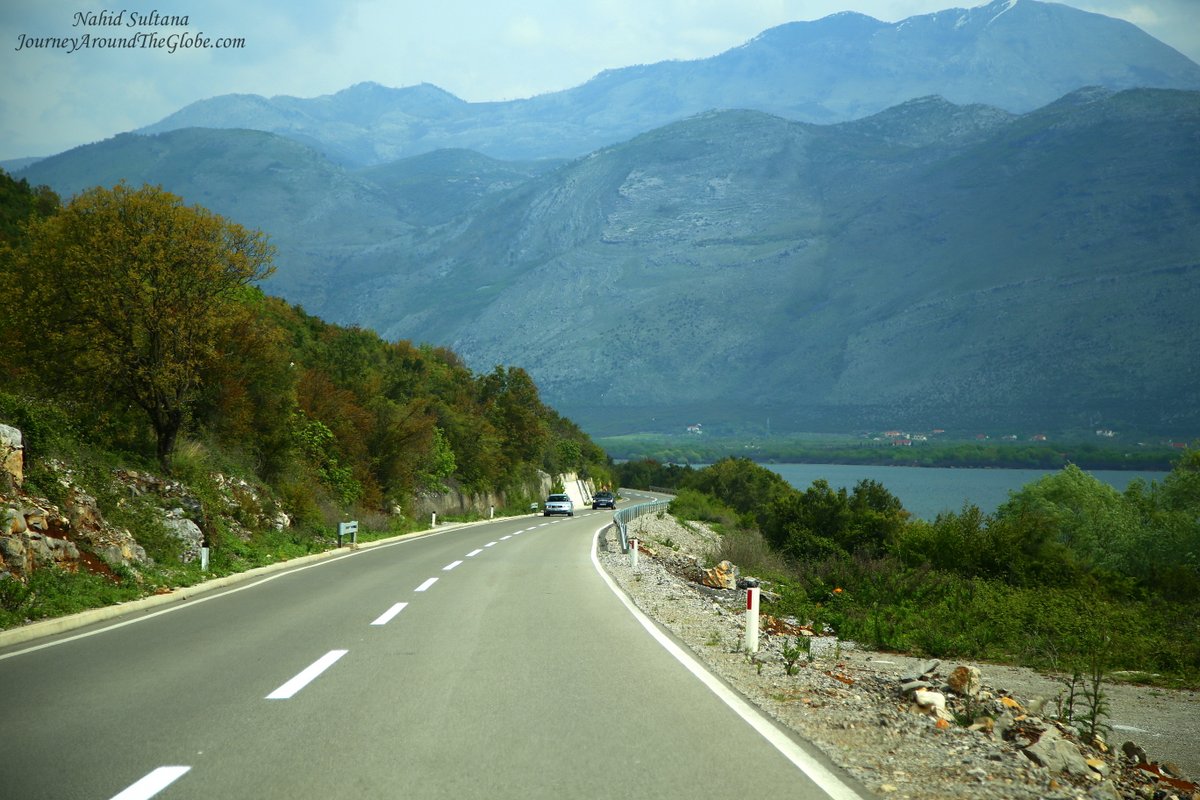
To my surprise, locals speak very good English and are willing to help any tourists with questions and concerns. If you are driving in to the city, just be careful of lots of traffic and crazy drivers. One problem you may face is that there are many beggars on the street near the city center. Little boys or girls may come running to you if you are in a car or on foot, especially if they know you are a tourist. They don’t mean any harm. What we did during this trip was that we used to box our left over food from the restaurants and give it to those hungry people who were in need.
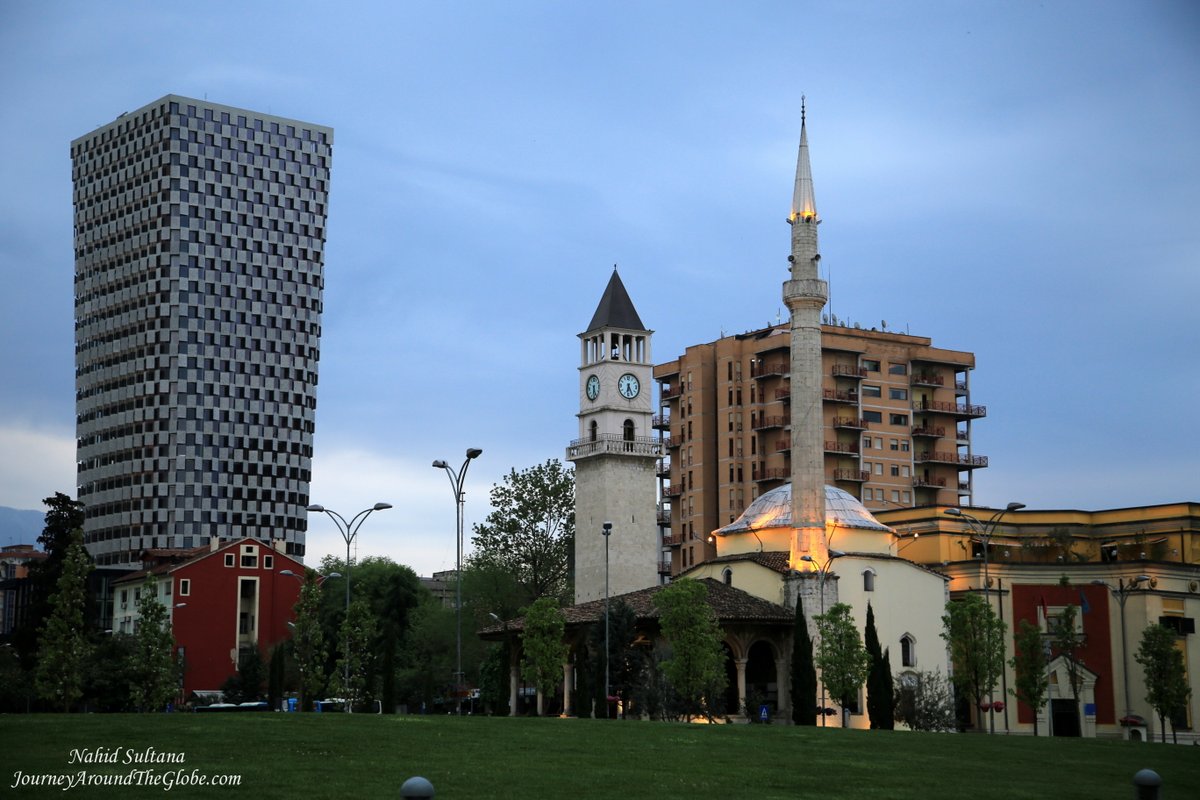
TIME of TRAVEL: We took a 2-weeks’ vacation to Eastern Europe during the Easter break of 2014. We first flew to Podgorica, Montenegro, stayed there for 2 nights, and drove about little more than 3 hours to reach Tirana. Again, we stayed here only 2 nights before heading out to Skopje, Macedonia. The weather was very mild, not hot, not cold…perfect for sightseeing. But Kruja can be a bit chilly because of its elevation, but we carried light sweaters everywhere and they really came in handy sometimes.
OUR HOTEL: We stayed in Hotel Tafaj, very close to the heart of Tirana, Skander Beg Square. It may not look all that from outside because of its congested location in front of a busy street. But once you are inside the hotel, it is a gorgeous and luxurious place for accommodation. Our room was a family suite and we had free breakfast, Wi-Fi, and parking with the price. Their restaurant is also very good with traditional Albanian food and international cuisines. But there were plenty of other restaurants and sport-bars near the hotel.
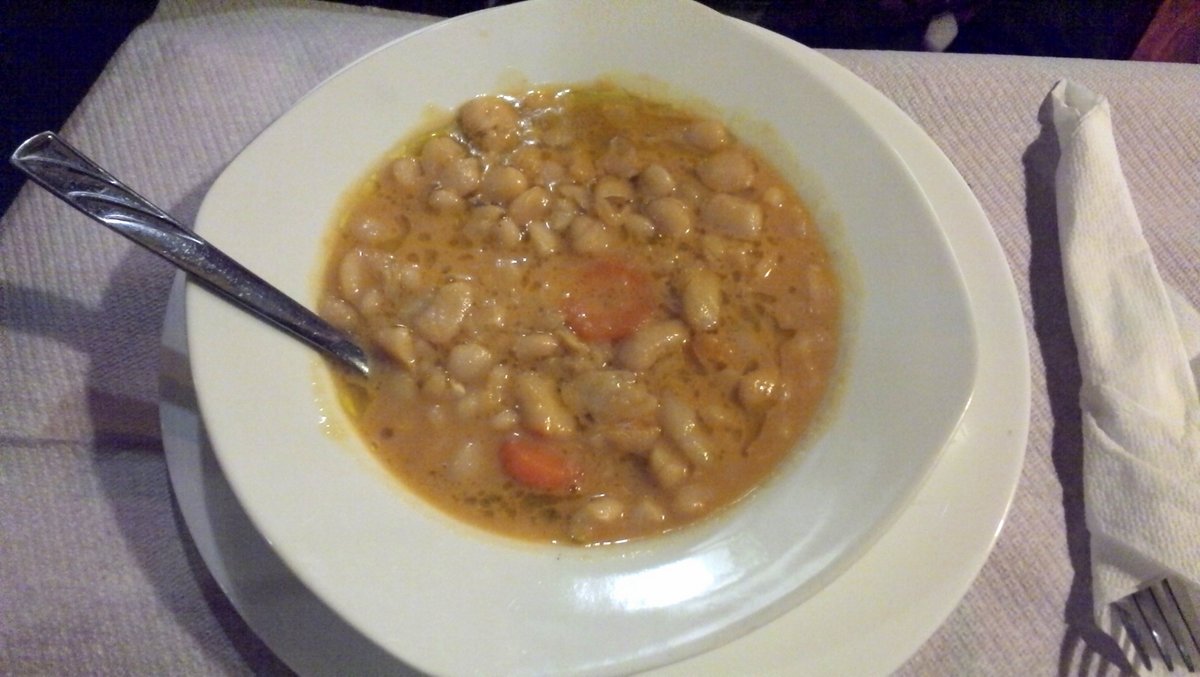
EATING and SHOPPING: Food is very cheap in Tirana and very tasty too. Albania has good quality road side restaurants and inns. After crossing the border from Montenegro, we saw at least one restaurant every few kms in Albania. We stopped at one of those service places where we had Greek salad (very popular in this region), tender kebabs, and hot bread for less than 15 euros for four of us. 1st dinner was at a local restaurant close to our hotel, called Kroce. It’s a traditional Albanian restaurant with extremely tasty food. I had “Fasule” – a bean soup, my husband and kids had “Kernace” – spicy meatballs with “Simite” – fresh oven baked bread. The total bill was less than 10 euros for all of us…totally satisfied. 2nd day we were in Kruja. We had some doner kebab and Greek salad in a kebab place in the center of Kruja. There are many restaurants from all ranges here, but again, food is very reasonably priced here and you can get good portion of food for only few euros. The last dinner in Tirana, was at our hotel restaurant. They also had local dishes with some international plates.
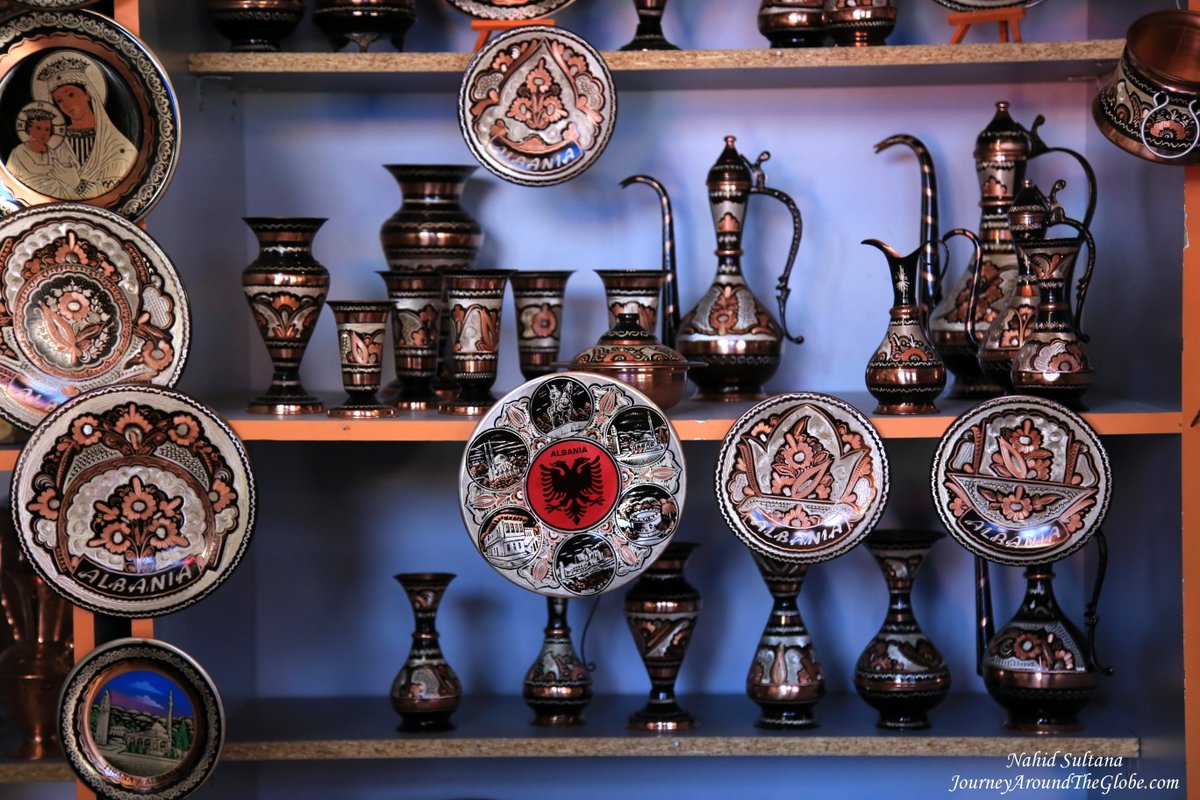
We didn’t really see any souvenir shops in Tirana. We did most of our souvenir shopping in a village, called Kruja where you can get authentic Albanian hand-crafted items. Handmade items, Albanian dolls, carpets, teapots, jewelries, and lots of other things are some good choices to take back from Albania. There were one or two souvenir shops that I saw in Tirana when we were driving by, but nothing really in the center.
PLACES WE’VE VISITED: Originally, we were thinking about spending a day and half in Tirana. But after visiting Skander Beg Square on the 1st day, our hotel lady suggested that we go out in the small villages or coastal cities or to the mountains to see the real beauty of Albania. We took her words and spent the next day visiting Kruja and Petrela. But if you are spending more days in Tirana, you can visit lots of other nearby historic cities and villages. Albania is a beautiful country and you won’t regret exploring its every corner. It has something for everyone’s taste.
1) SKANDER BEG SQUARE: This big plaza is the main square of Tirana. It’s a lively and crowded place with some important and historic buildings surrounding the square, like Opera building, National History Museum, and some government buildings. National History Museum is the main museum in Tirana. The building is easily spotted because of a huge mosaic on its front façade. We didn’t go inside the museum or the opera building, just took a stroll in the square on the first evening. A statue of Albanian hero Skander Beg in horseback stands in the middle of the square on a grassy field.
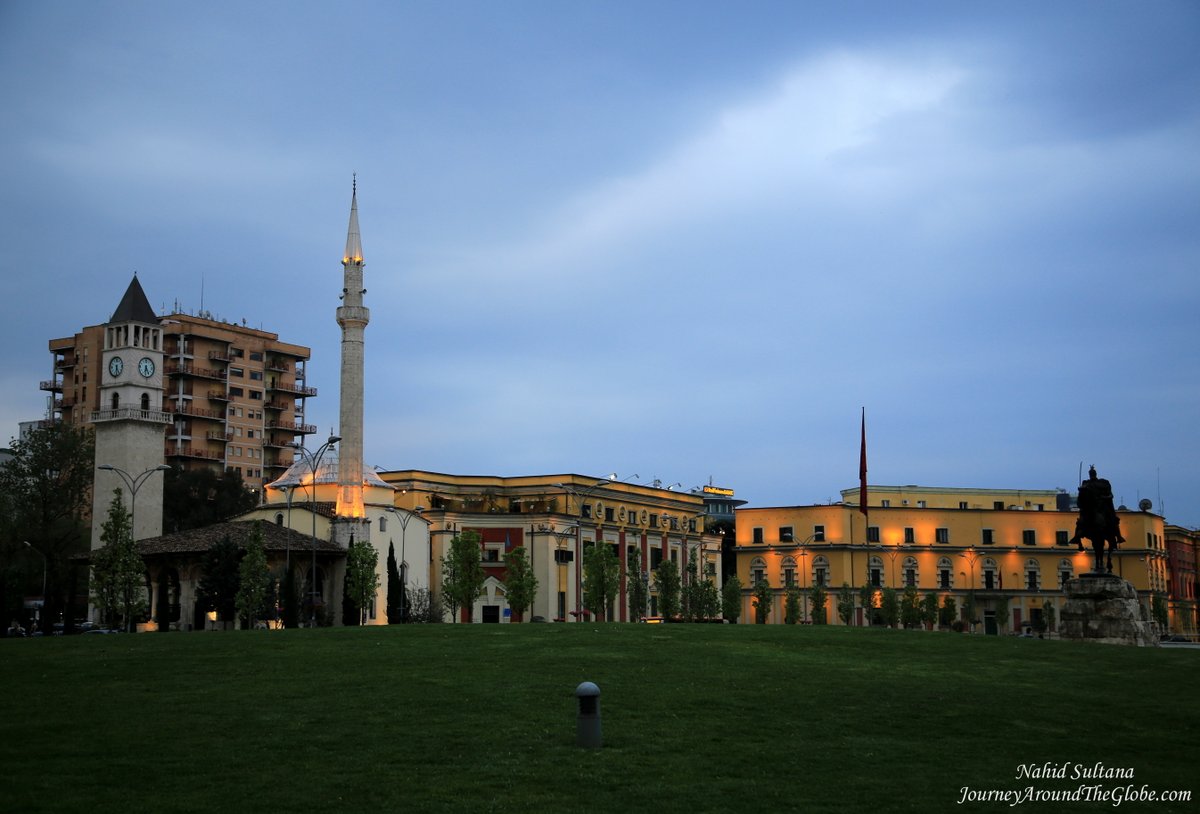
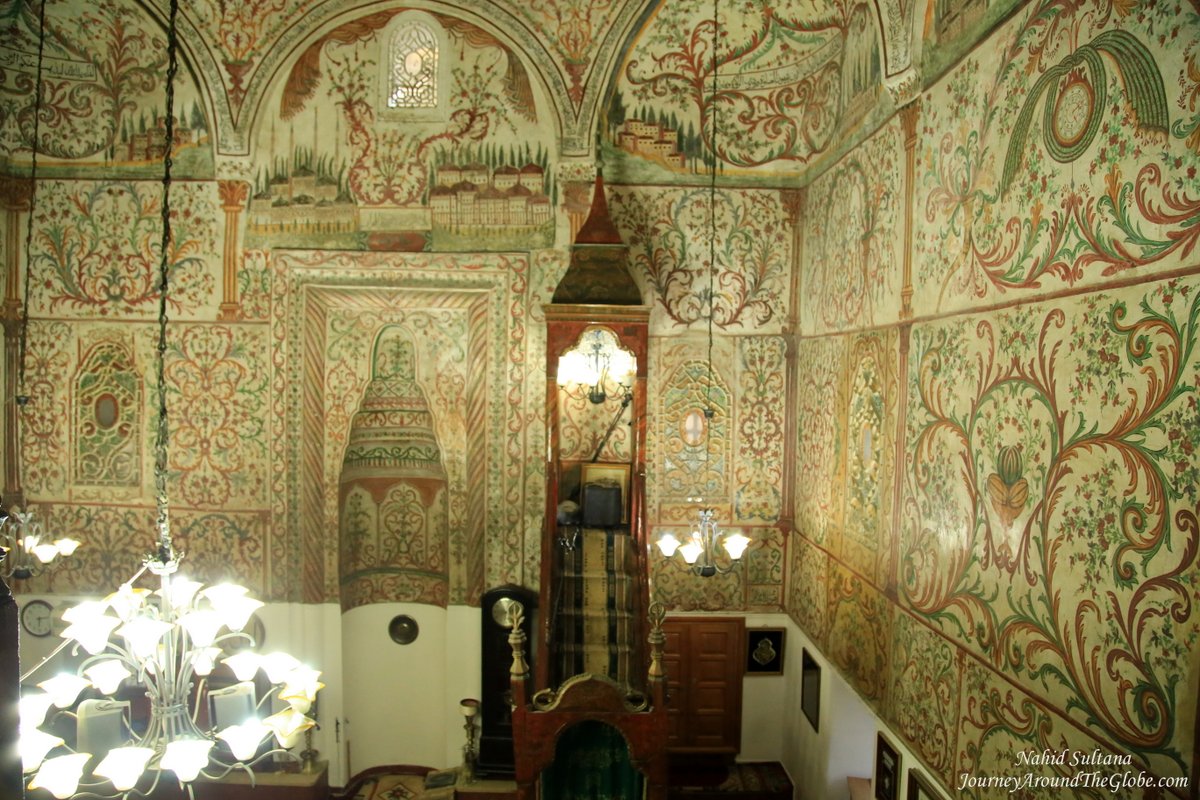
2) EH-TEM BAY MOSQUE: This is a small but very beautiful mosque with a tall minaret in Skander Beg Square. It’s located right beside Tirana Clock Tower, which is the symbol of this city. The mosque was built in 1793 and is considered as one of the most beautiful mosques in Albania. The care taker of the mosque took me inside and told me to go to 2nd floor to get a nice glimpse of the whole interior of the mosque. It’s not that big but has an artistic dome as well as interestingly decorated walls. Tomb of Eh-Tem Bay is at the entrance of this mosque. It’s free to go inside.
3) KRUJA CASTLE: On our second day in Tirana, we drove to another historic town of Albania, called Kruja. It’s a small town about 35 km northwest of Tirana and rises 560 meters above sea level. It makes a perfect half a day trip from the capital if you enjoy nature and fresh air. The drive from Tirana to Kruja was very pleasant and scenic. The town of Kruja sits on a hill and is known for its hand-crafted items, such as things made with olive trees, traditional Albanian dolls, hand-painted copper items, carpets, and etc. Most of these are hand made by the villagers of Kruja. You can bargain on the price and may get a good deal if you buy more than one item from the same seller.
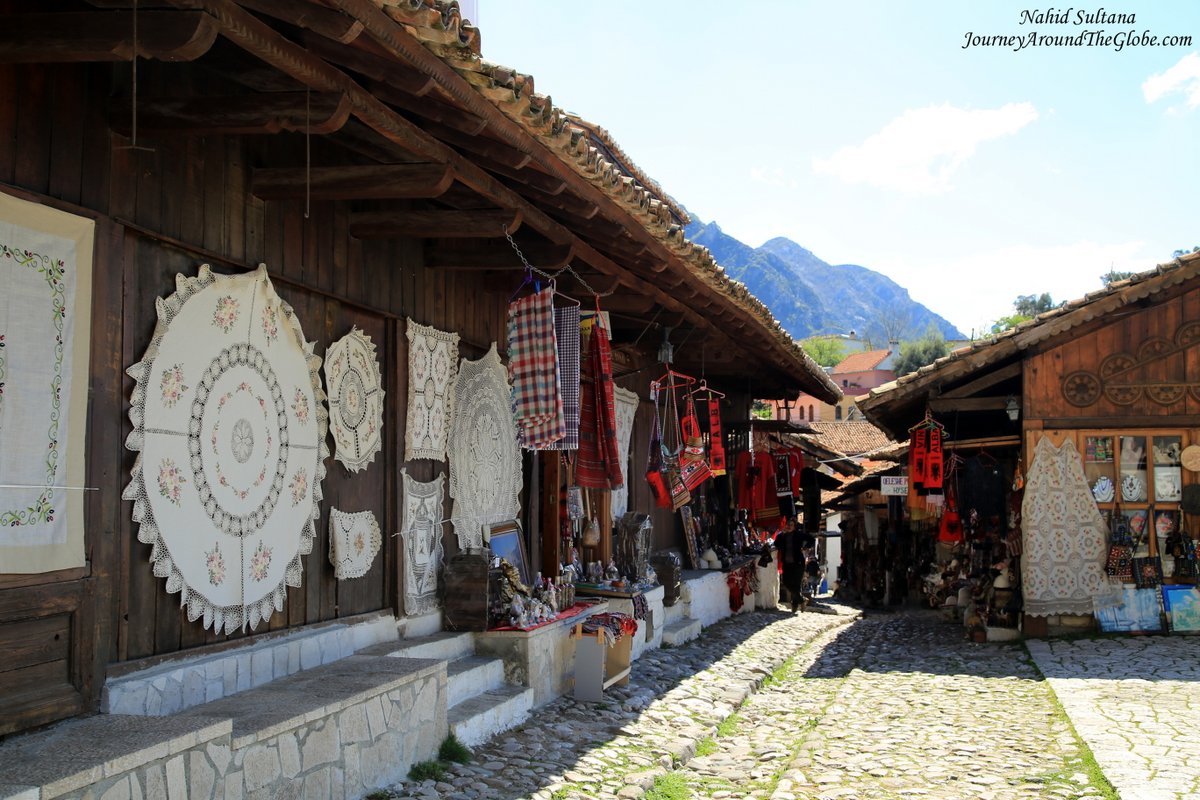
Before reaching the castle, we passed by the old market of Kruja where you can buy all those above local trinkets. It’s a long stretch of shops on cobbled street. There were plenty of restaurants and cafés too. The market was so colorful and lively that even if you don’t buy anything taking a walk thru it is a must. I found the people very friendly and helpful here. They will come and start conversations if you look like a tourist.
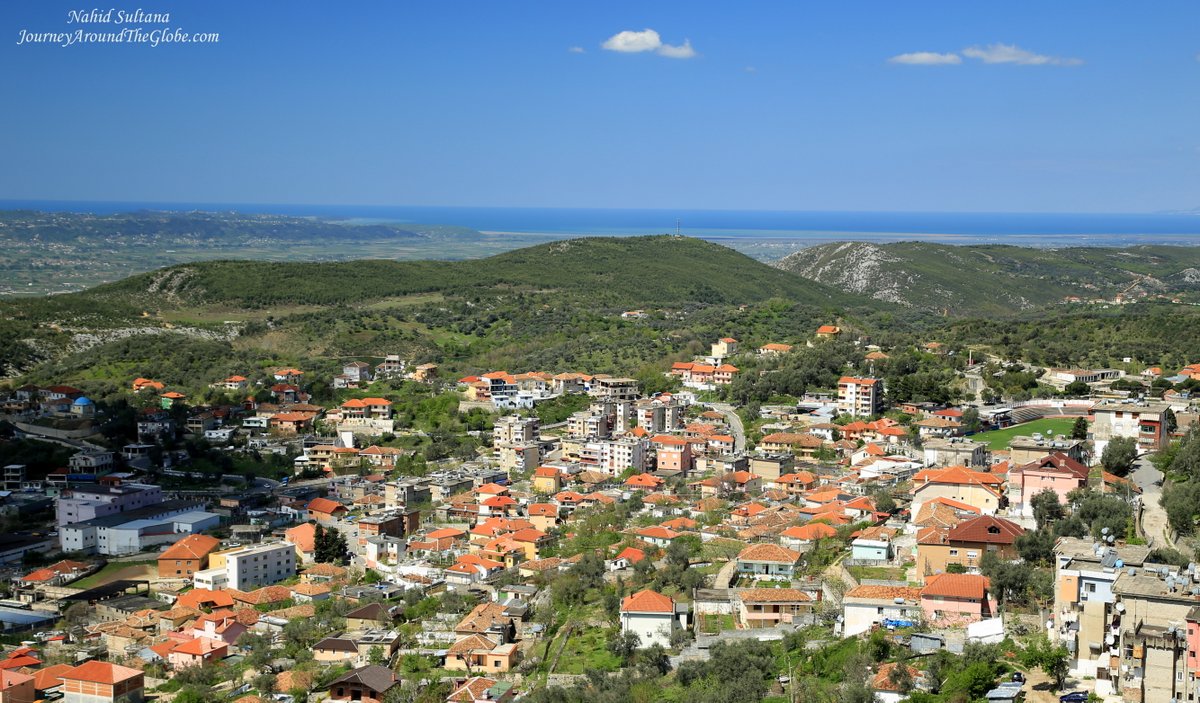
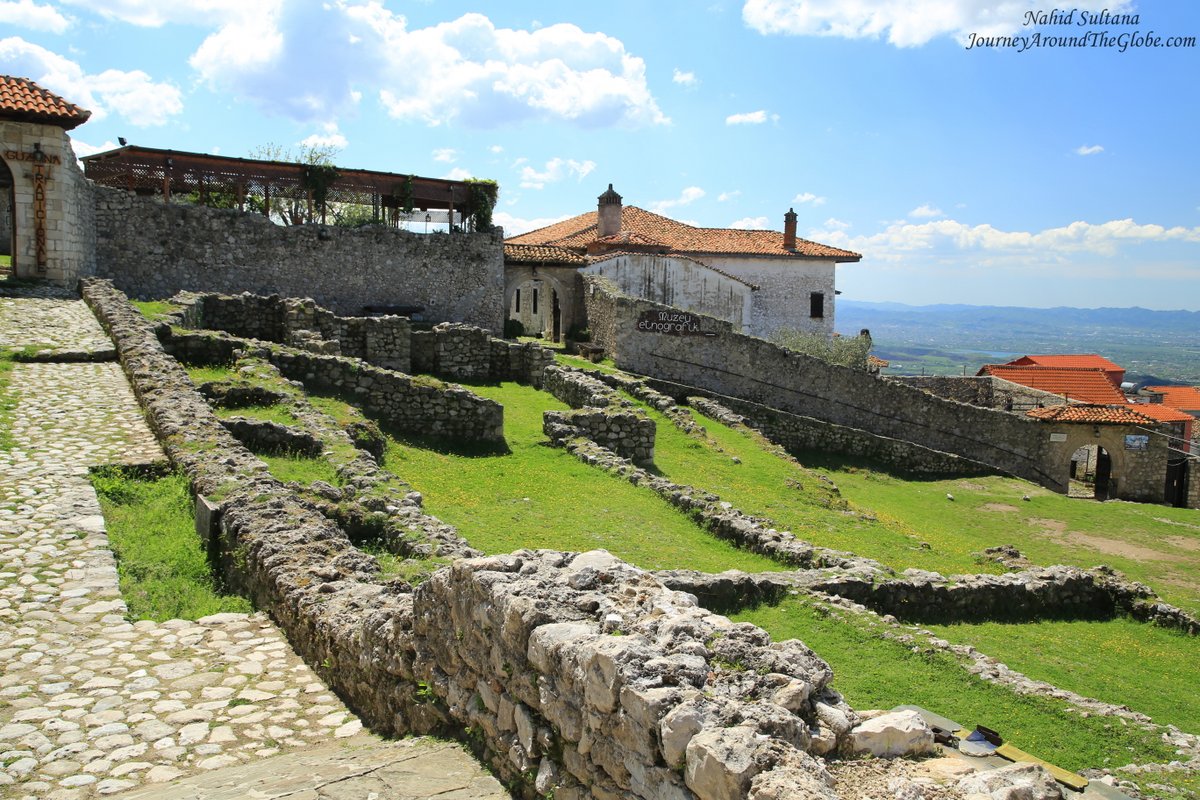
After passing the market and Skander Beg Museum, we saw the tower of Kruja Castle on a small slope. The castle is in just ruins now. But it provides a great view of majestic landscape to the visitors. The castle was built during the 5th and 6th centuries and has an elliptical shape with a total area of 225 hectors. The surrounding walls are reinforced by nine towers, which served as an observation and signaling post during the times of war. Within the walls of the castle some remains of few houses can still be found.
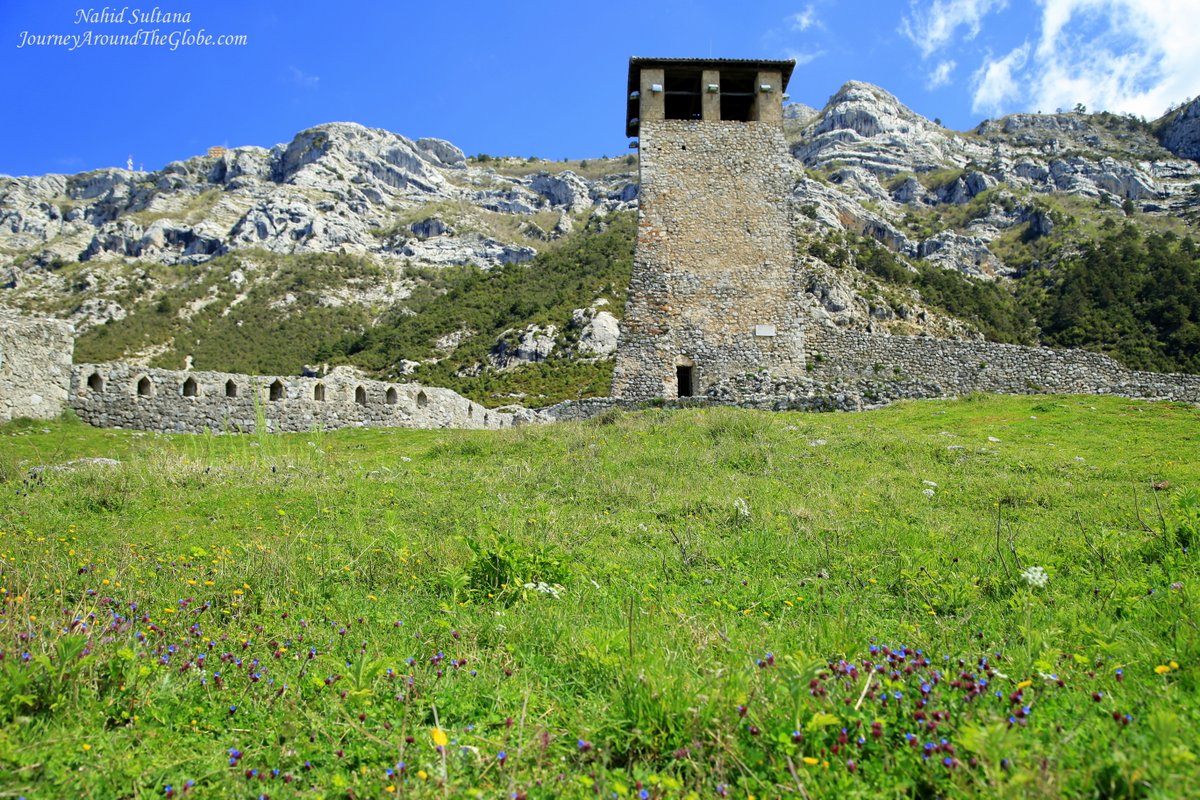
Although we didn’t visit Skanderbeg Museum, it is a well-known museum in Albania. Kruja has a rich collection of historical and cultural objects. For me, the old bazar and view from the mountain were the highlights of Kruja. There is no fee to see the castle. You can enjoy the view and some hot drinks or meal in the café on the hill.
4) PETRELA CASTLE: This is one of Albania’s best-preserved castles, sitting picturesquely on a steep slope overlooking a river and the nearby small towns. On a clear day, you can see all the way to Kruja. The tower in the center dates back to 500 AD, surrounding it are walls from the Byzantine period, laid out in a triangle, with round towers at the corners. This castle was used during Skander Beg’s war against the Turks.
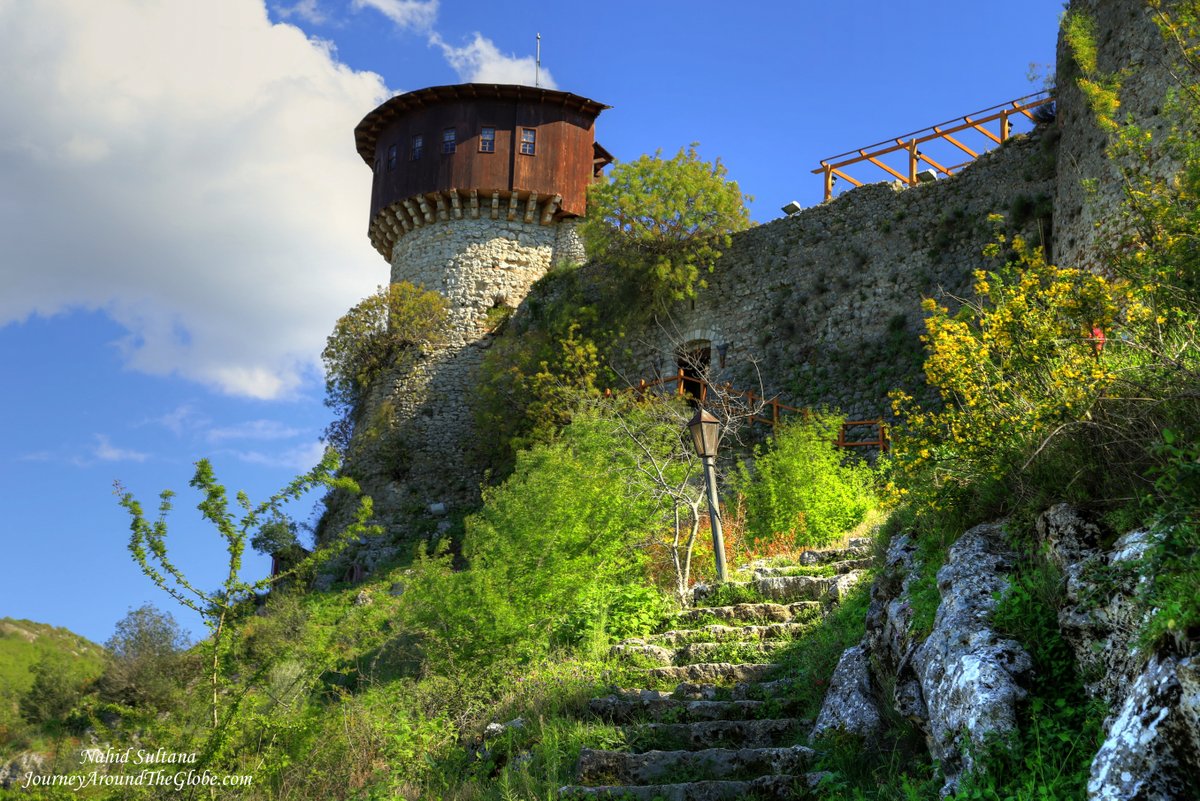
There are many uneven stairs to climb to up to the castle. Only the skeleton of the castle stands now, but the gorgeous view of the valley and mountains are worth all the hard work. It is not stroller friendly and there is no place to keep the stroller for a while. There is a cozy little restaurant all the way up in the castle. It was empty but open and serves local delicacies.
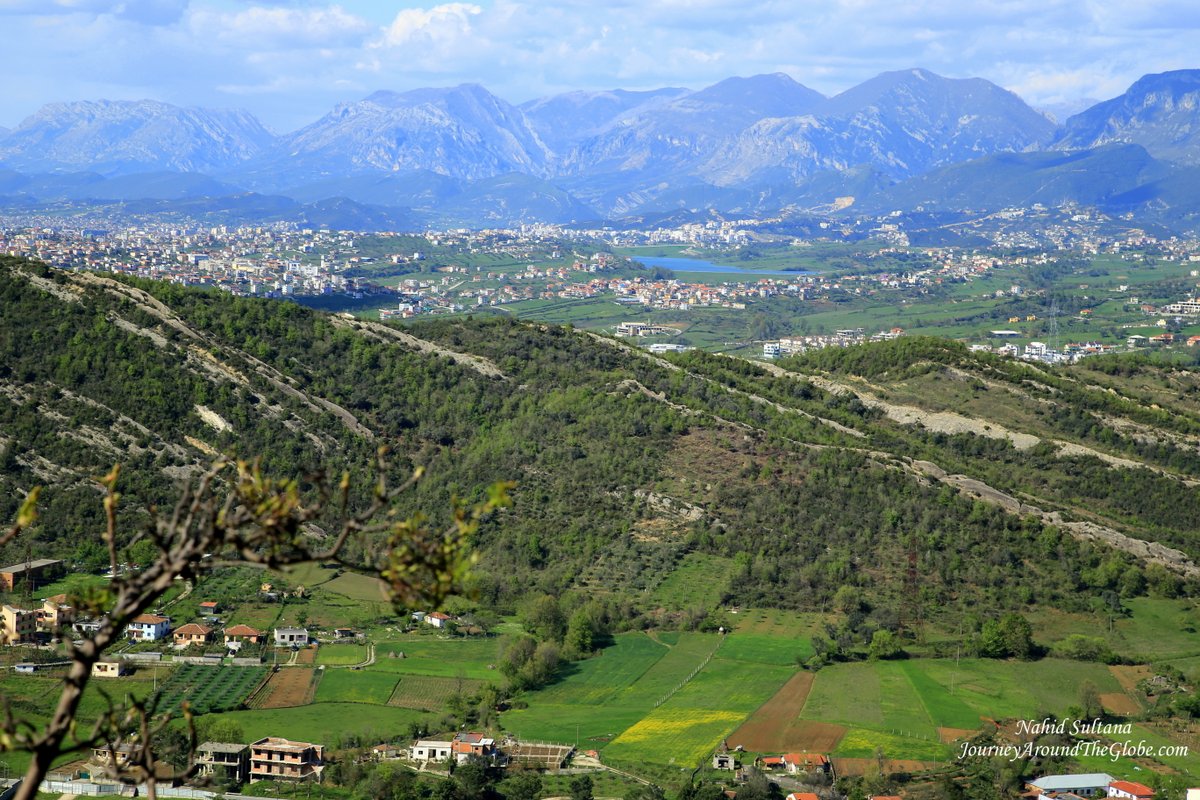
It’s free to enter the castle complex as well as the parking was free. Petrela Castle is about 15km southeast of Tirana, takes about half an hour from the center of Tirana. I saw only one souvenir shop at the bottom of Petrela and some snack places.
Share this:

Highlights of Podgorica, Montenegro
PODGORICA, MONTENEGRO: Podgorica is the capital of Montenegro and it has been the capital of Montenegro since the time of Socialist Yugoslavia. Podgorica’s aerial view looked absolutely stunning from the plane as we were getting closer to the airport. We could see Dineric Alps and Skader Lake from the cabin. It was a beautiful landscape overall. But the city itself is not at all a typical European destination that tourists would visit. The lady in our hotel was asking us why we picked Podgorica as there isn’t much to see or do. But there are lots of Montenegrin coastal lines and mountain resorts that attract many tourists in this country. World War II left the city in great destruction and much of its historic Ottoman architecture vanished with bombings. Now it’s a modern planned city with laid back atmosphere.
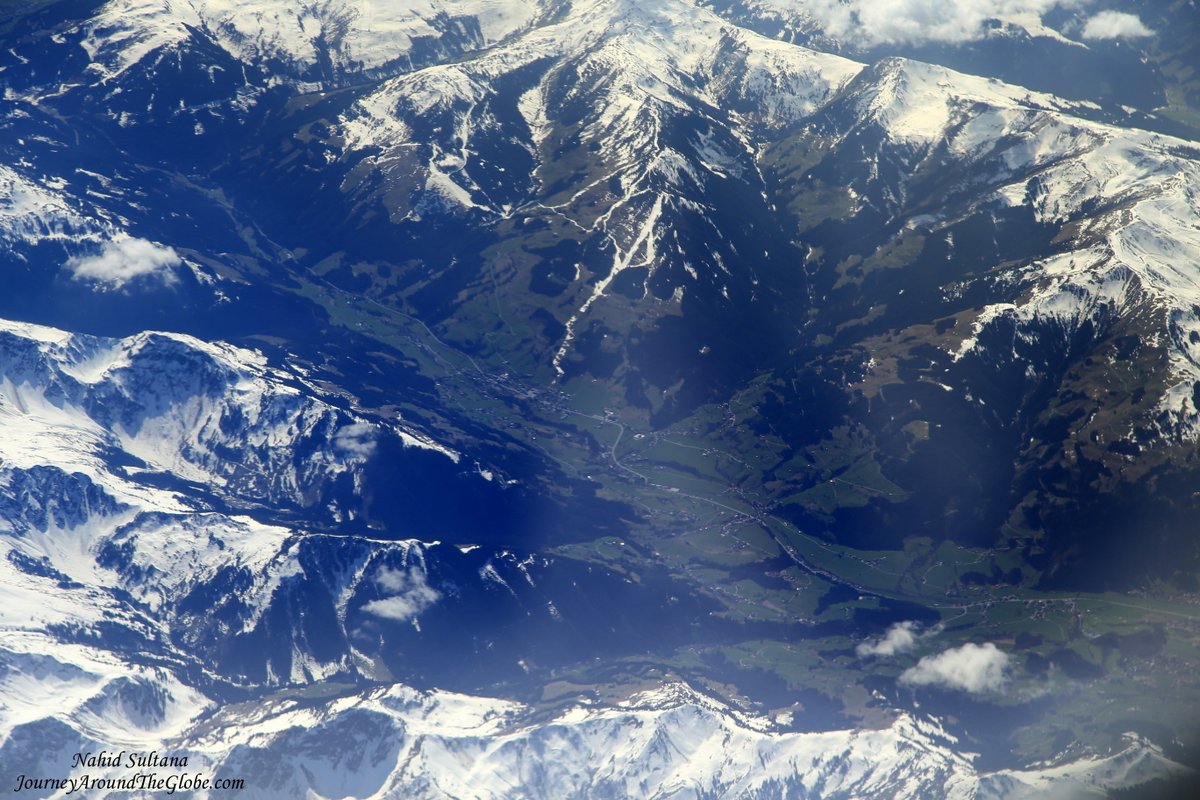
Podgorica city center is about 45 minutes of drive from the airport. The airport is very small and everything is very conveniently located very close to each other, like customs, baggage claim, and rental car etc. The city doesn’t get lots of tourists since it’s not a typical European tourist destination with many sightseeing spots. Lots of people were looking at us interestingly when they saw we were walking with camera and maps; some groups of kids were very happy to see our daughters and were very friendly with them. They even tried their best to speak in English with us.
Transportation here is very cheap. We had our rental car but since taxi is so cheap, we used that to get to the center all the time, didn’t have to worry about parking and stuff. Food is also cheaper here if you compare with rest of Europe or other Eastern European cities.
TIME of TRAVEL: We flew to Podgorica during the Easter Break of 2014 in the 1st week of April. Our plan was to mainly explore all the small countries of former Socialist Yugoslavia and Albania.
OUR HOTEL: We stayed in Hotel BaMBiS in Podgorica. It’s not really in the city center but taxis used to charge use around 2 euros to get to the center point which was about 3kms away. The neighborhood is a quiet one without any restaurants close by. We had to take taxi to the main square for dinners. But it has free parking, Wi-Fi, and excellent breakfast…all included in the price. It’s a 4-star hotel with above average customer service. I would highly recommend to anyone and would stay here again if I ever go back to Podgorica.
EATING and SHOPPING: Since Podgorica doesn’t receive many tourists; we didn’t see any souvenir stores here in the city center or anywhere. I saw in our hotel some beautiful Montenegrin dolls in display but none elsewhere. There are many shops in the pedestrian zone of old town, just be careful when you buy brand name items here, many are not authentic ones.
We had our first dinner in a pizza place by the pedestrian street in old town. There were lots of teenage boys who were asking for food or money from here when we sat down to eat. But the restaurant lady told us not to give them anything; they eventually spend it on drugs. Anyways, our next day lunch was at Carine near Trg Republic. Thanks that it was a pleasant day and we could sit outside. The place had big collection of soup, salad, pasta, and ice cream, cake, and pastries for dessert. Another good place for any meal would be going to Skader Lake. We went there one late afternoon and had some pastry and hot drink by the lake in a restaurant called “Jezero”. You get a very nice view of the lake and mountains.
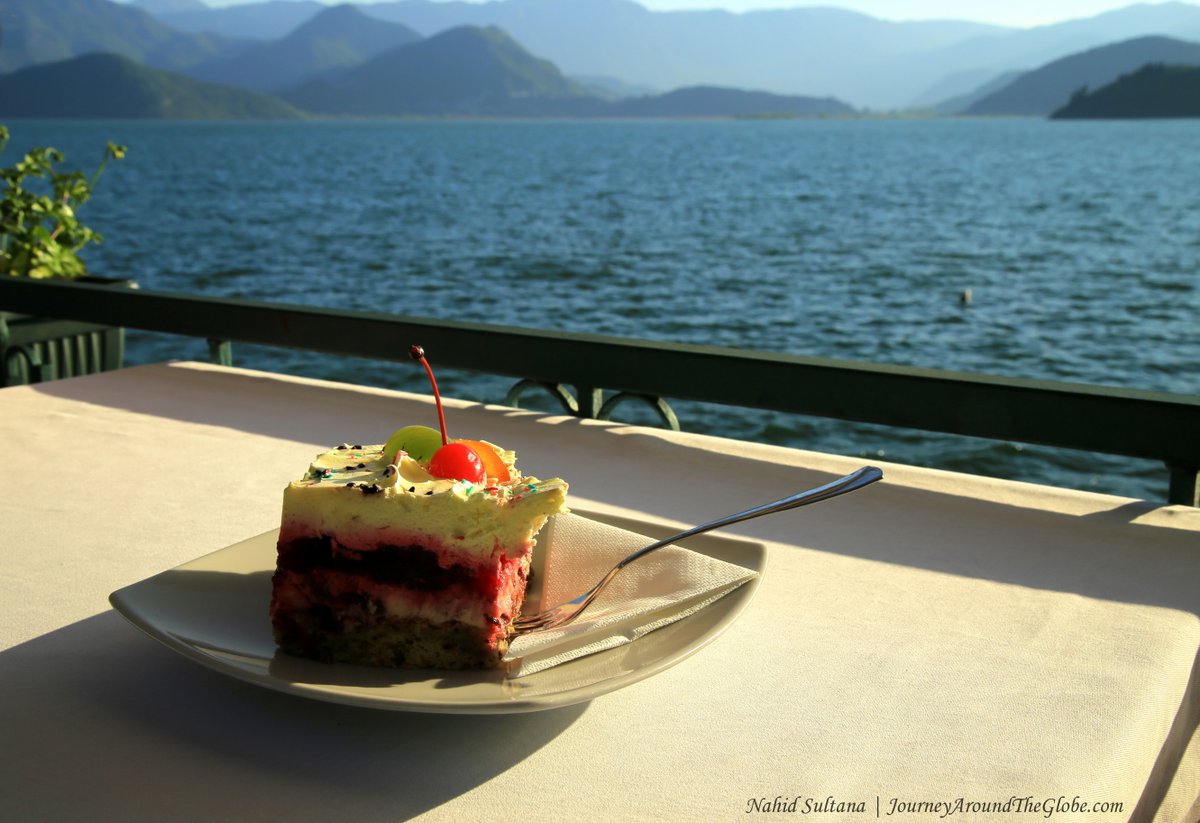
PLACES WE’VE VISITED: Most of the points of interest in Podgorica are near the city center and can be visited on foot. We had roughly a day and half for this city. Without the museums, it took us about couple hours to visit everything in the center. We kept half a day for Skader Lake and that was one good spot not to be missed here.
1) TRG REPUBLIC: It kind of disappointed me but Trg Republic is the main square of the city. It’s a big gathering spot for the locals. Square doesn’t have much to see other than a big fountain in the middle. There are few restaurants at the corners of this square. Haven’t been there at night, may be, the places comes to live at night.
2) MOSKOVSKI BRIDGE and MILLENNIUM BRIDGE: From the pedestrian old town, we walked little bit further towards the river and reached Moskovski Bridge over Moraca River. It’s for pedestrian and people can take the stairs beside the bridge to go down to the river bank. The beautiful modern bridge adjacent to it is the impressive Millennium Bridge. Millennium Bridge looks very photogenic at night when it’s lit up. It’s a nice place to take a stroll at late afternoon.
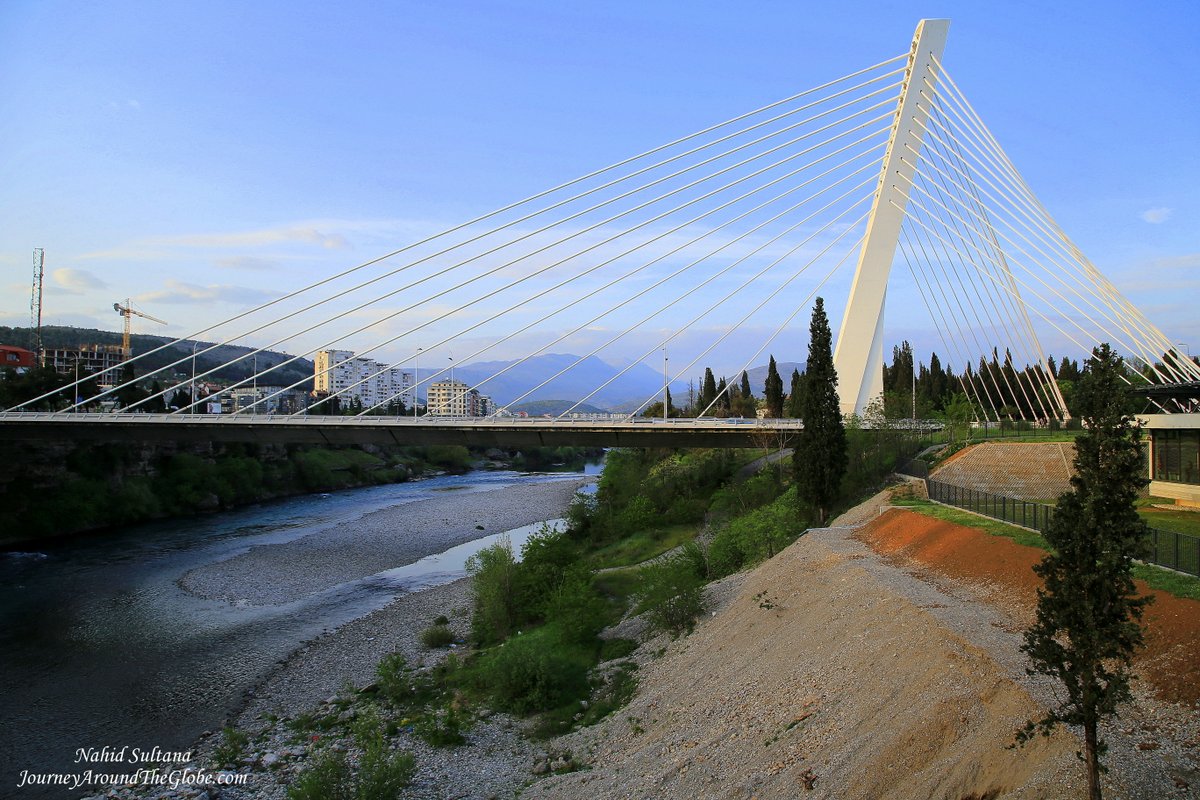
3) OLD CLOCK TOWER and TURKISH TOWN: The little Turkish town in Podgorica is an old residential place with couple mosques and narrow, curvy streets. An old clock tower also stands at one starting point of the Turkish neighborhood. These mosques are quite old, one we saw from outside was not a working one but the other one was still active. There isn’t much to do here. I was hoping for some Turkish markets but saw nothing other than some old houses and few locals. One local mentioned, about 30 – 40% Muslims of Podgorica live in this neighborhood.
4) SKALINE: This is a really picturesque place and is the confluence of River Ribnica and Moraca. An old Turkish bridge is there over a little stream of Ribnica. There are also some ruins of an old town, some steps, and sitting area near the rivers…a pleasant atmosphere all around. This is definitely a place worth visiting.
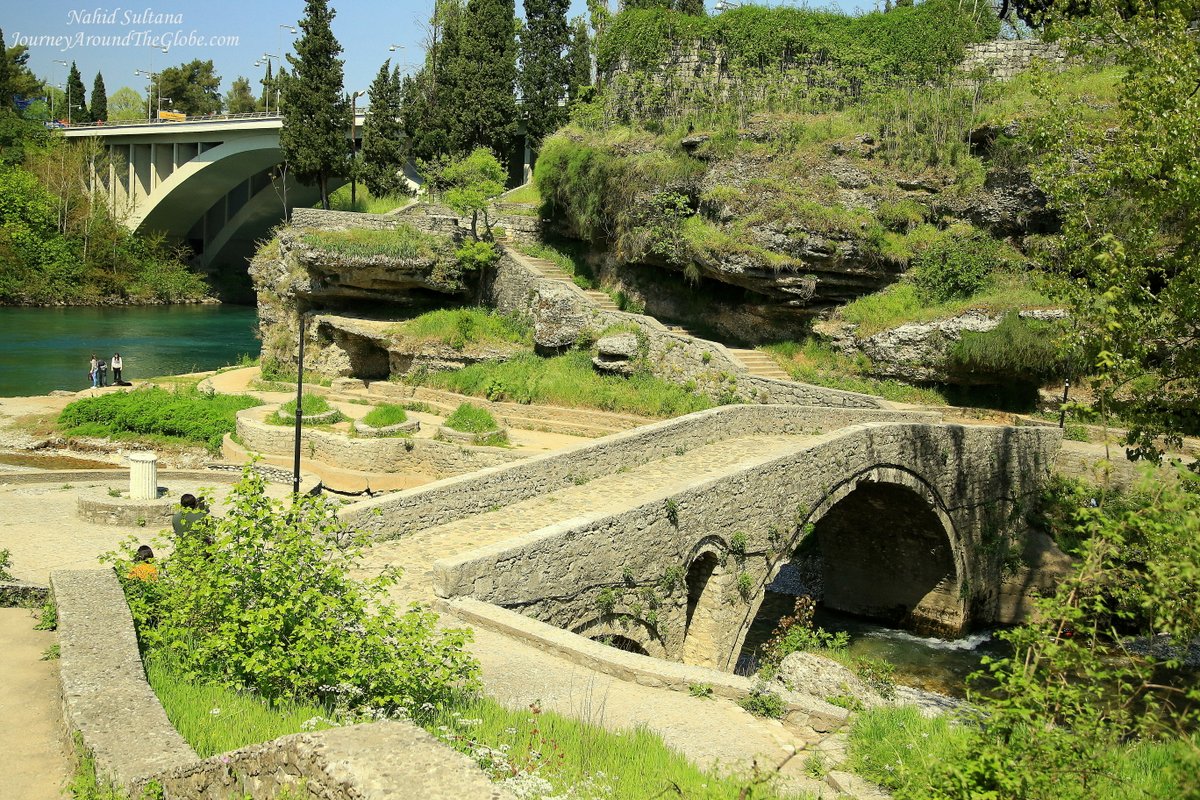
5) PARLIAMENT and MONUMENT to KING NIKOLA: Montenegrin Parliament is very close to city center. The Parliament building is not that impressive but the park opposite of it is a lovers’ point and a nice place where locals come for picnic or to relax. Monument of King Nikola stands in that park opposite of the parliament.
6) ST. GEORGE’S CHURCH: This Serbian Orthodox church is located on the slope of Gorica Hill where the city got its name from. It’s a 10th century church. Inside is pretty small but nice; loved its peaceful surroundings.
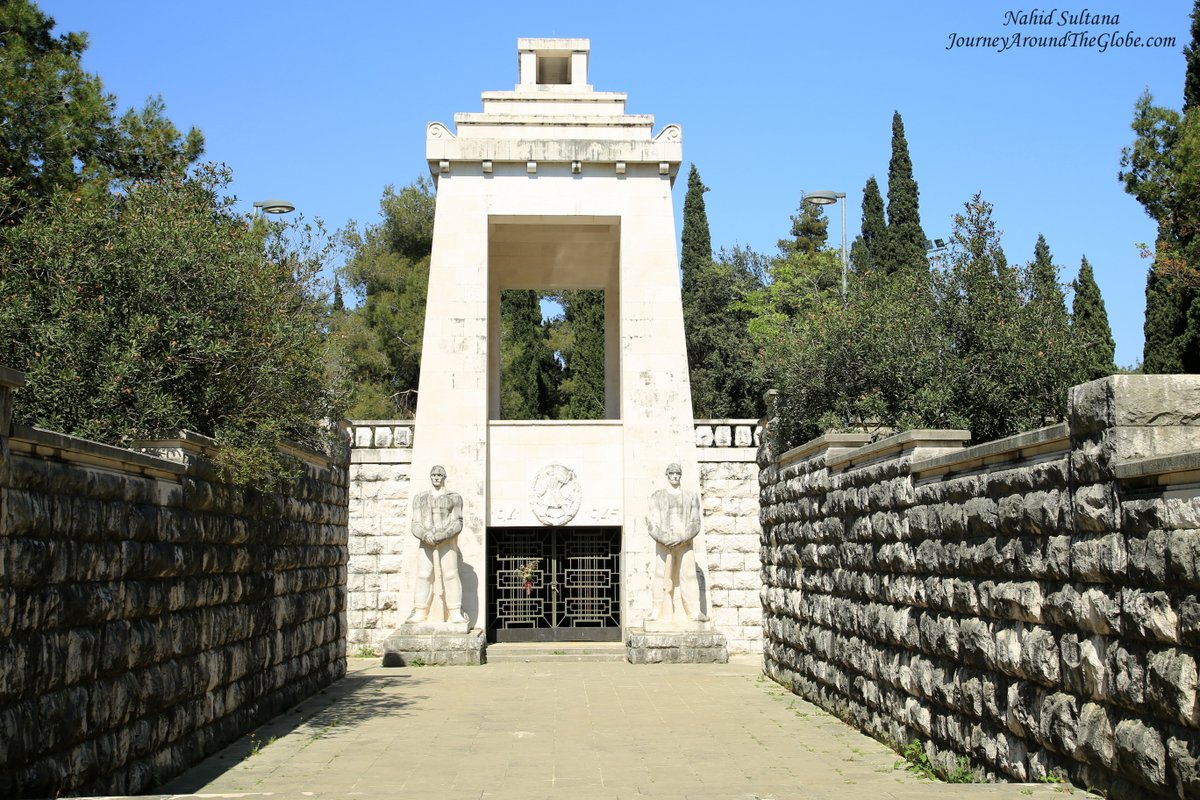
7) WAR MEMORIAL on GORICA HILL: after visiting the church we started climbing the hill little further. It’s a beautiful natural park with lots of trees and bushes. This whole area is a natural reserve, a great place for nature walk, bird watching, and enjoying some moments outside the busy city life. We even saw a little turtle walking on the ground. Little bit more into the park, is a WWII War Memorial. The memorial is not a flashy one; it’s hidden at one side of Gorica Hill where no one really goes. But check out the small hill if you like hiking or taking leisure walks.
8) SKADER LAKE: This is the largest lake in the Balkans. It took us little more than half an hour to reach a panoramic view point from Podgorica city center. The lake shares its border with Albania too. There is a restaurant called “Jezero” by the lake and opposite of an old monastery. We had some hot drinks and pastries here with an excellent view of the lake and mountains. The restaurant can arrange boat tour on the lake and the visitor center is there too. The water was rough that afternoon, so we skipped boat ride and just sat down by the water for long time enjoying its stunning view.
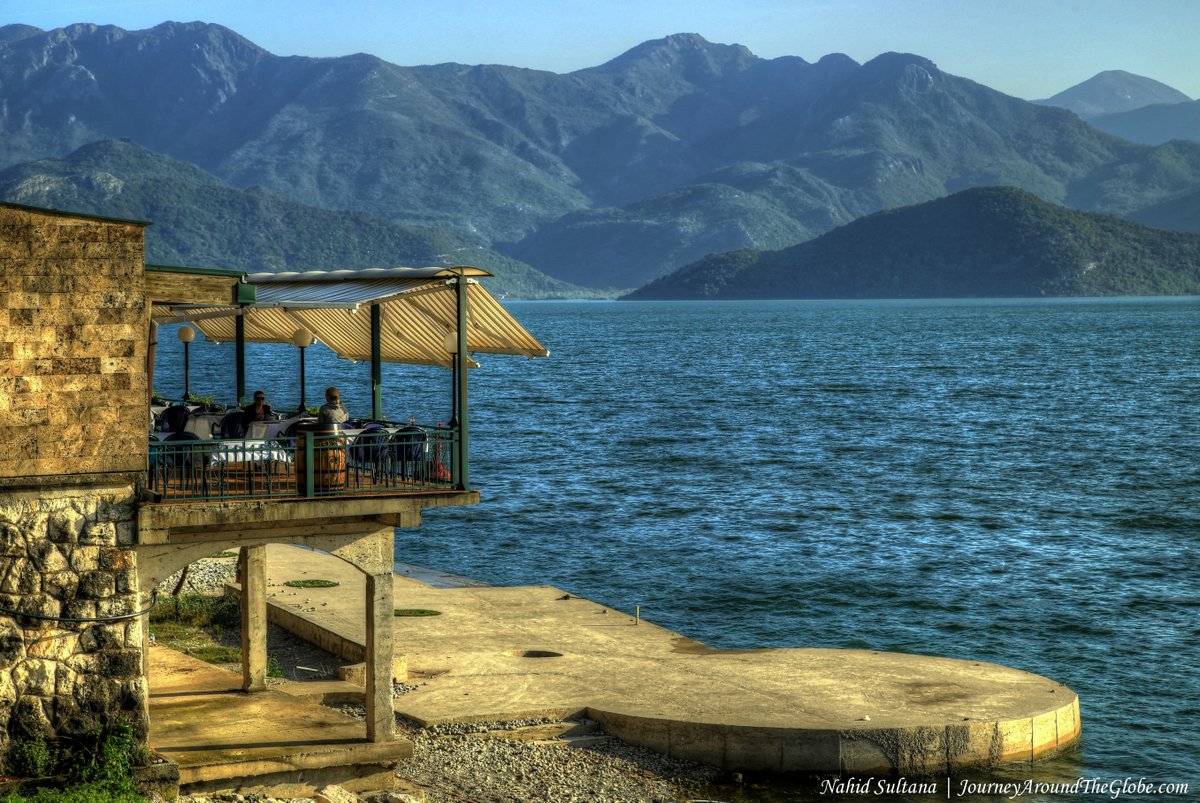
Lessandra Monastery is opposite of this restaurant but we couldn’t make it there because of the road condition. But there are lots of things to do in Skader Lake National Park if you have time and like outdoor activities.
Share this:

An Overseas U.K. Territory – Gibraltar
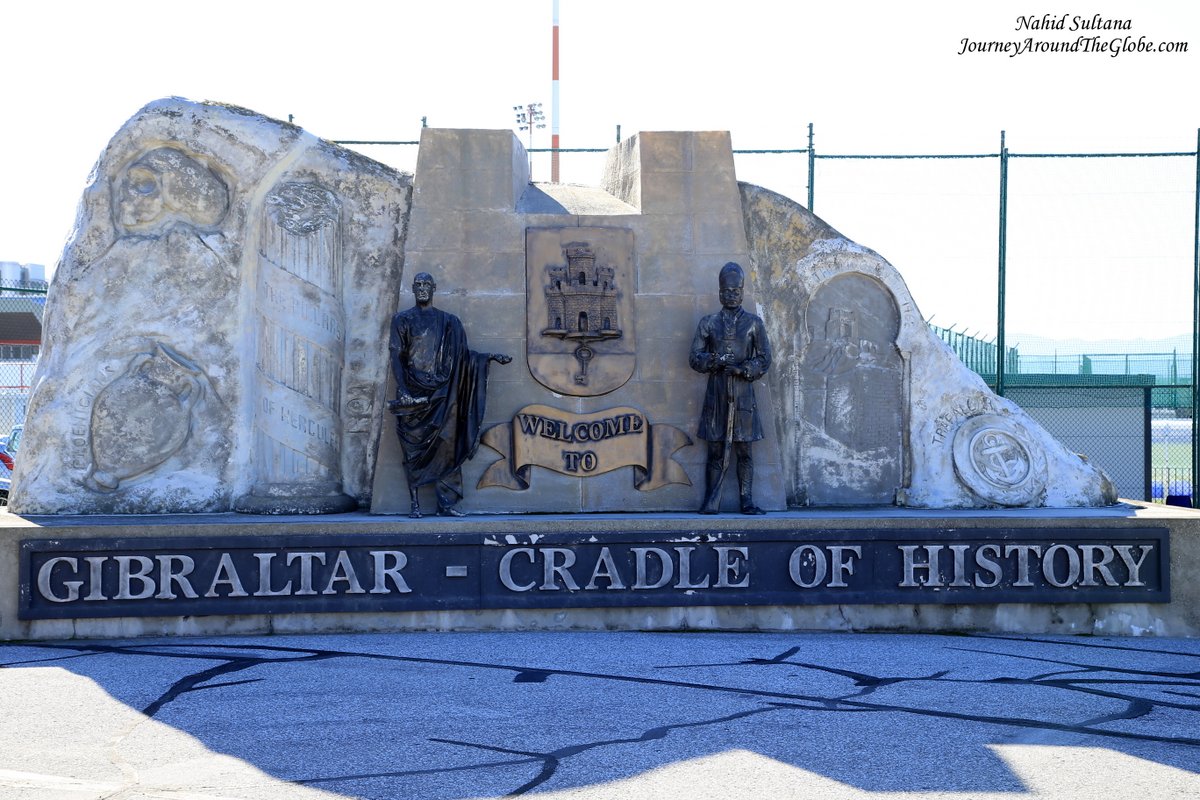
GIBRALTAR: Gibraltar is truly a unique place for those curious travelers. It’s an overseas U.K. territory by the breathtaking Mediterranean Sea. The land is bordered with Spain in one side and therefore the Gibraltarians are fluent in both English and Spanish. Speaking of language, we came to know that interestingly, may be the word “Gibberish” came from Gibraltar where they sometimes speak a mixed dialect with English and Spanish that sounds a bit like…Gibberish.
The name “Gibraltar” arrived from the man who came to this rock from Africa many centuries ago. His name was Tariq. So the place came to be known as “Jabal-Al-Tariq” which means “Mountain of Tariq” in Arabic. In 1704, it became a British territory. Currently, around 30,000 people live in Gibraltar and it gets as many as 7 to 8 million tourists every year.
Gibraltar is surrounded by water from three sides with both Atlantic and Mediterranean and Spain on one side. Africa is only 14 miles away from here. You get stunning views from most of the corners of Upper Rock of Spain, Africa, Atlantic, and Mediterranean…it can’t get any better.
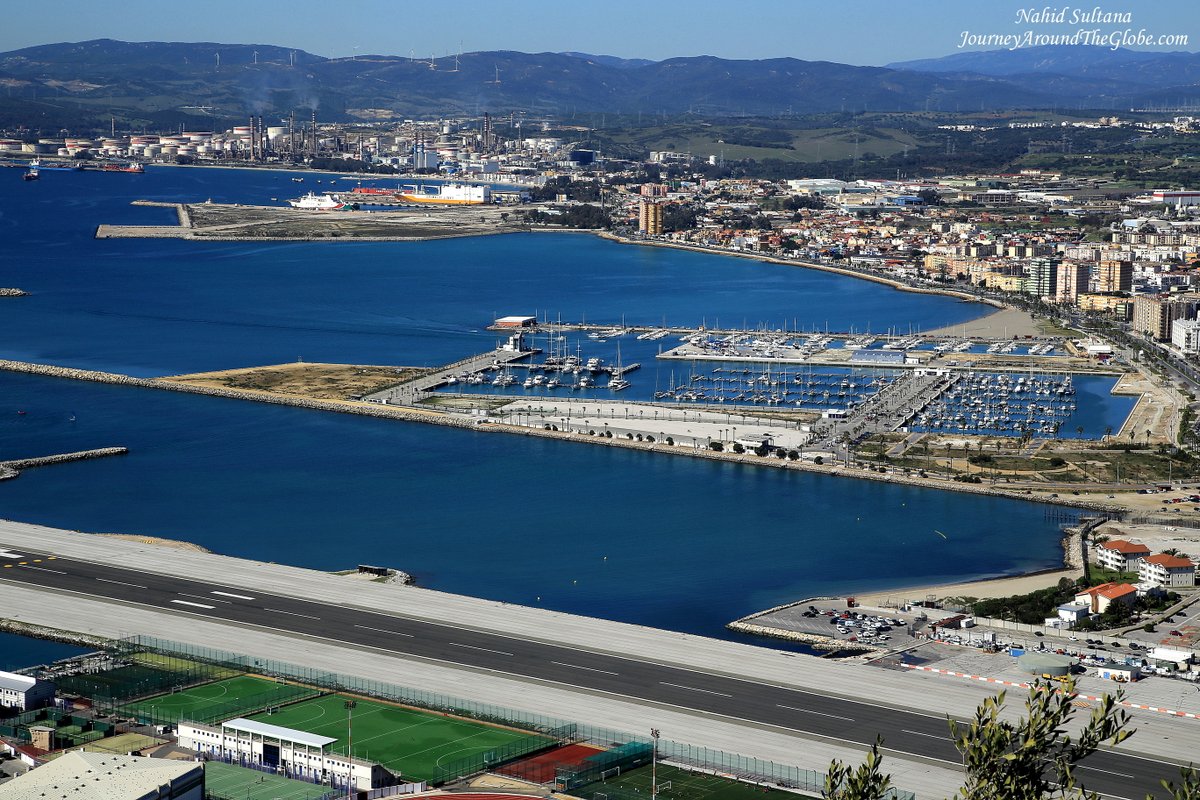
Gibraltar doesn’t have any sales tax on any items. Therefore, lots of tourists come here to do major shopping. While local pound is the official currency, they also accept British pounds issued by Bank of England (not the ones from Bank of Scotland and Northern Ireland). Most of the places accept Euros too but your changes will may very well be in pounds.
Driving in Gibraltar may not be that easy for new-comers, especially when going to top of the rock. Good part is that, they drive like the rest of Europeans and not like U.K. on the right-hand side. We left our car on the other side of the border in Spain and crossed border-control on foot. This was a better idea since there were couple big car garages on the Spanish sides and we didn’t have to worry about parking our car in Gibraltar. Another disadvantage of bring the car to the English side is that on our way back the queue to cross border check-point to Spanish side was huge, I mean…humongous. But those of us who were walking, the police didn’t even check our passports.
TIME of TRAVEL: Gibraltar was the last destination of our Andalusian trip in Spain that we took in February of 2014. We checked out from our hotel in Seville on the 2nd morning and drove about 2 hours on scenic highway to get to Gibraltar. When I say scenic, yes…it was a very beautiful drive by the mountains and meadows and countryside. Weather in Gibraltar was mild, not too cold or too hot. But may get a bit windy when you are on top of The Rock of Gibraltar.
OUR HOTEL: We didn’t stay overnight in Gibraltar. We spent the last two nights in Hotel Petit Palace Santa Cruz in Seville. From Gibraltar, we drove back to Malaga where we started our journey from to a catch an early morning flight back to Brussels. Last night in Spain, we stayed in Holiday Inn Express which was very close to Malaga Airport. I think it took us more than an hour to find this hotel, not sure if our GPS is to blame or the fact that you can’t really see the name of this hotel from the road.
EATING and SHOPPING: By the time we reached Gibraltar from Seville, Spain it was already lunch time. We grabbed something quick from McDonald (there was also a Burger King) before crossing the border. In Gibraltar, the main city center has lines of many restaurants and shops. We picked up some finger-foods from an Indian places while walking back towards the border. City center is also a good place to pick up souvenirs and do shopping, as I mentioned above, there is no sales tax in Gibraltar.
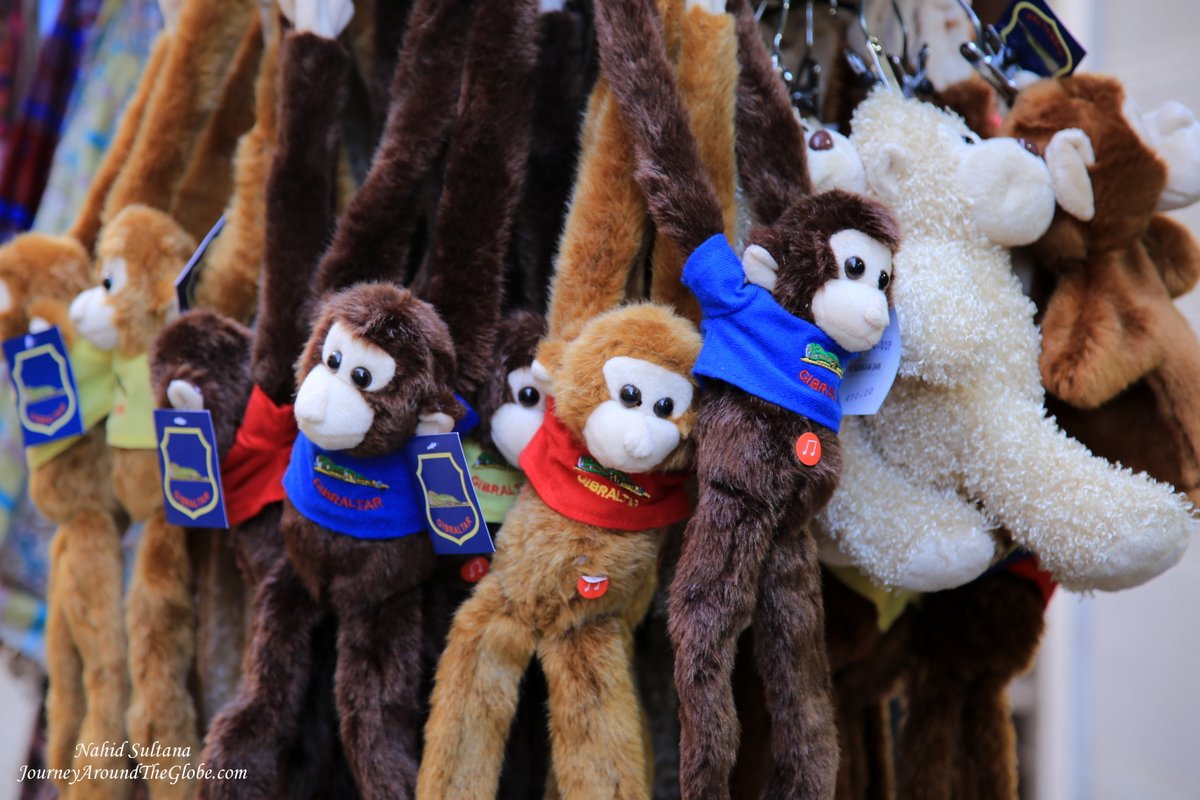
PLACES WE’VE VISITED: We hired a taxi from the first bus station right after crossing the border. It was for about 2 ½ hours guided tour for 80 euros for the whole mini-van which seats 6. We had it for four of us. But you can share a ride like this and share the cost. This was a quick and easy way to explore this place. Of course there were time limits with taxi but we did get to visit all the main spots and their highlights. You can walk up to the rock or take a cable car but with the kids, taxi was much smoother. Walking can be fun if you are fit to climb hilly road and the weather is good. Some people take the cable car up and walk down slowly and take time visiting all the attractions.
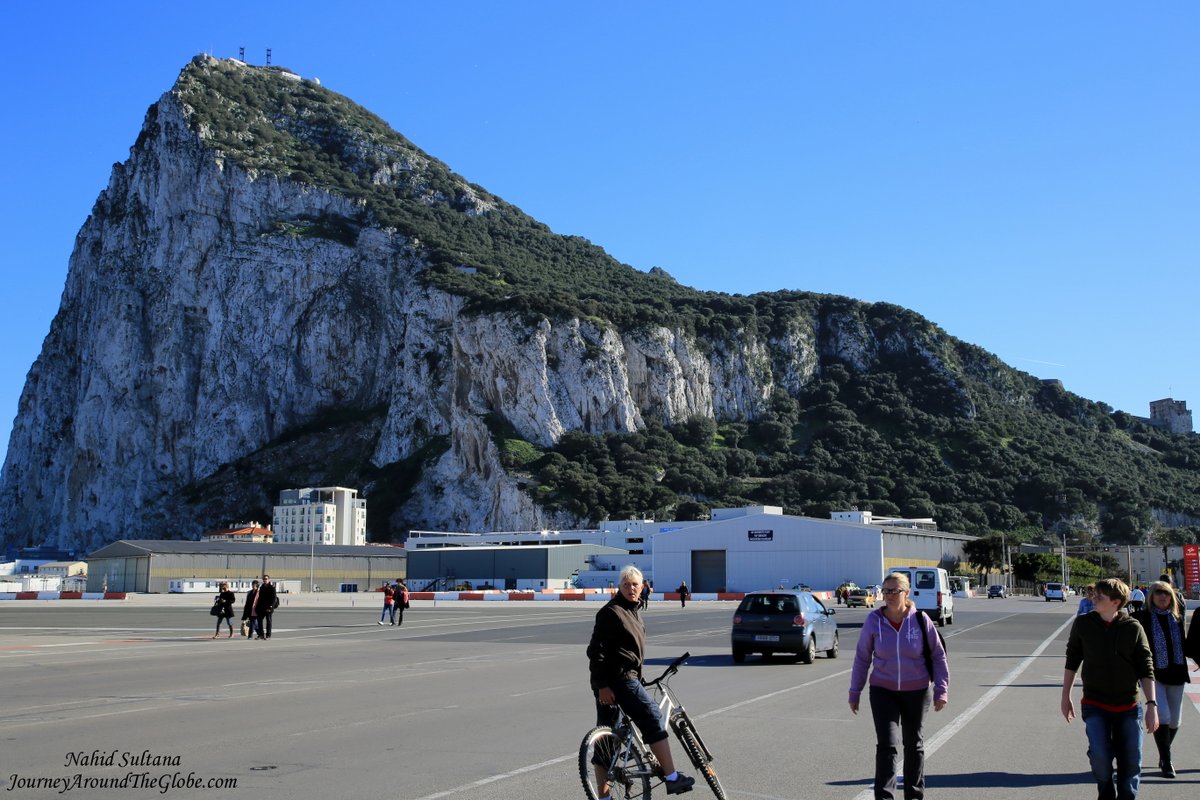
If you have spare time, may be two other significant places here to visit would be the Moorish Castle and Europa Point. We couldn’t go to any of them because of time. Moorish Castle, from the 1300s, currently, is nothing but in total ruins. You can see the skeleton of it and the tower almost from anywhere. Europa Point is a military base which offers a fantastic view of the bay and continent of Africa on the other side. I don’t think tourists can go all the way to the tip of the Europa Point, but some people do go there as far as the officials allow. Other than these two, there are tons of tunnels in Gibraltar that enthusiastic tourists may find them interesting to discover. Casemates Square is a lively that we passed before walking back to the border control…a great place to hang out and watch world go by.
1) PILLARS of HERCULES or JEWS GATE: This is where our taxi took us first. This is a view-point from where you can see Gibraltar Strait where Atlantic Ocean and Mediterranean Sea come together. Europa Point and Jewish cemetery are also visible from this spot. The best part of it is that you get to see Morocco on the other side in the coast of Africa.
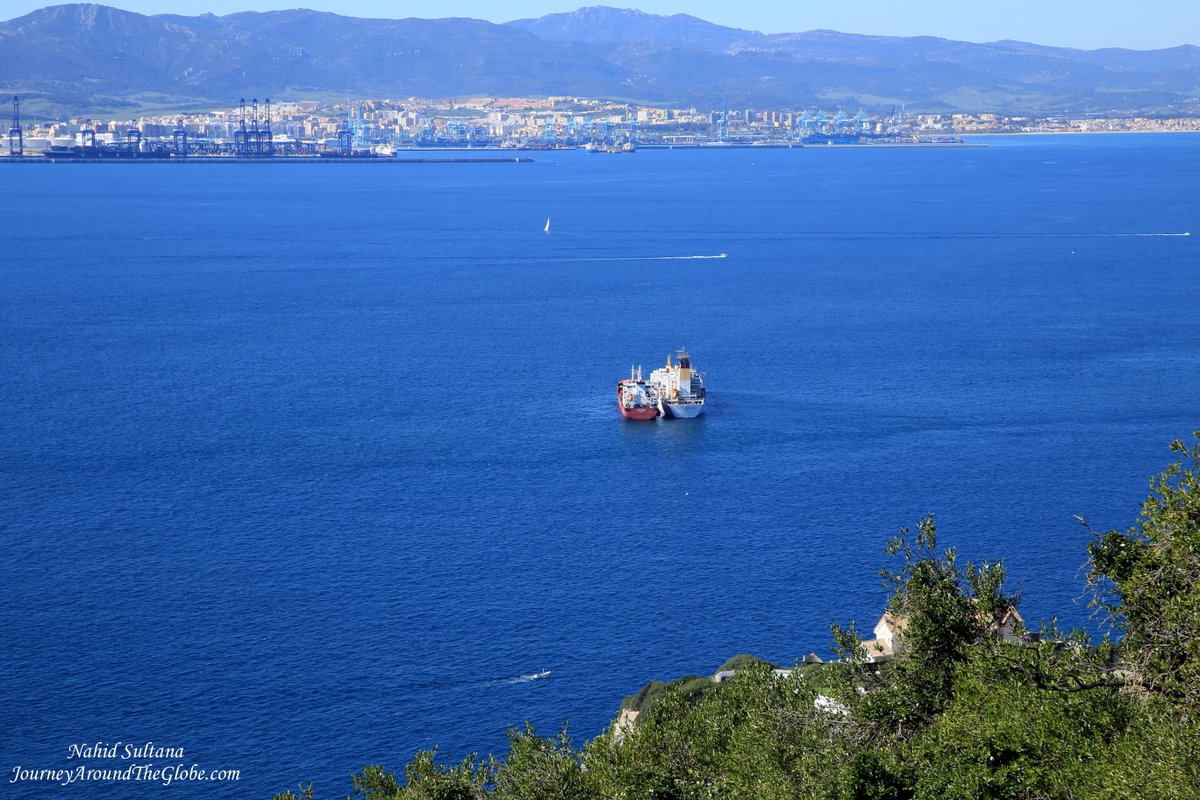
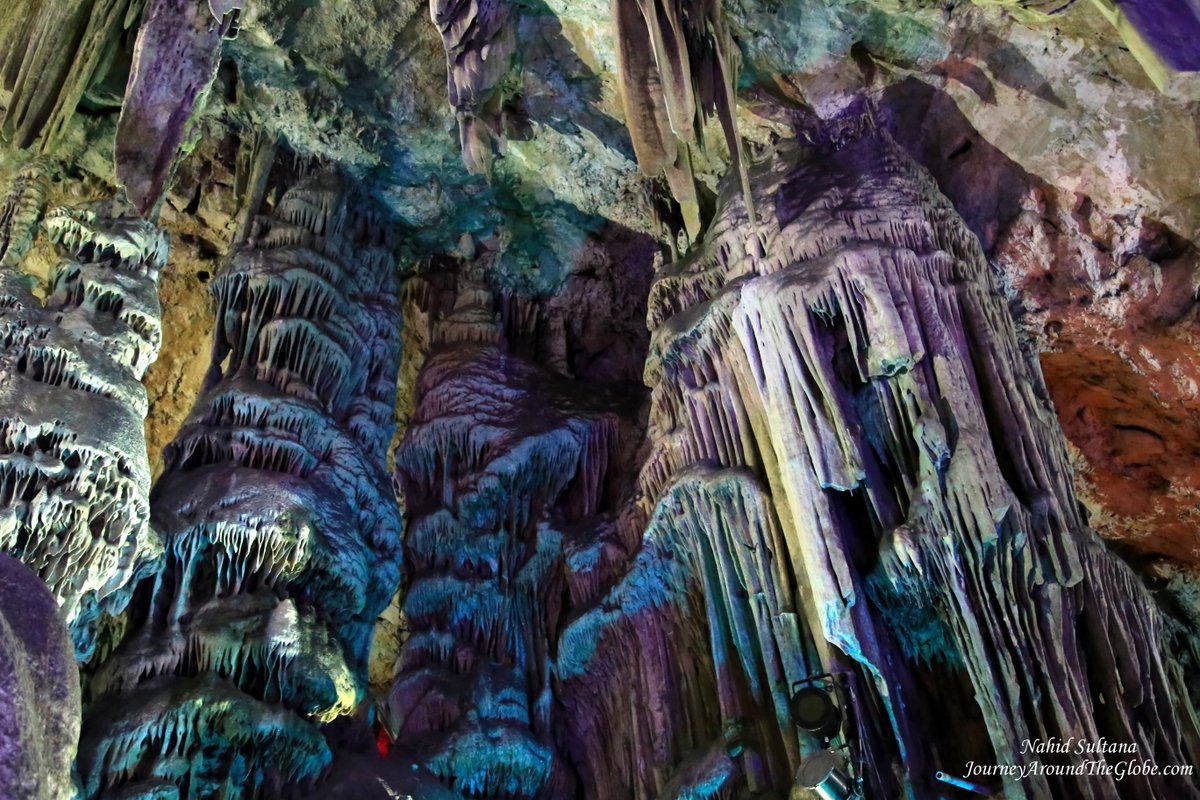
2) ST. MICHAEL’S CAVE: We drove up little more towards the tip of the rock and St. Michael’s Cave was our next stop. This is a gorgeous natural cave and definitely worth a visit. Just to give you an idea of the size of this cave, the visitors’ area is much smaller than Luray Cavern in Virginia, USA.
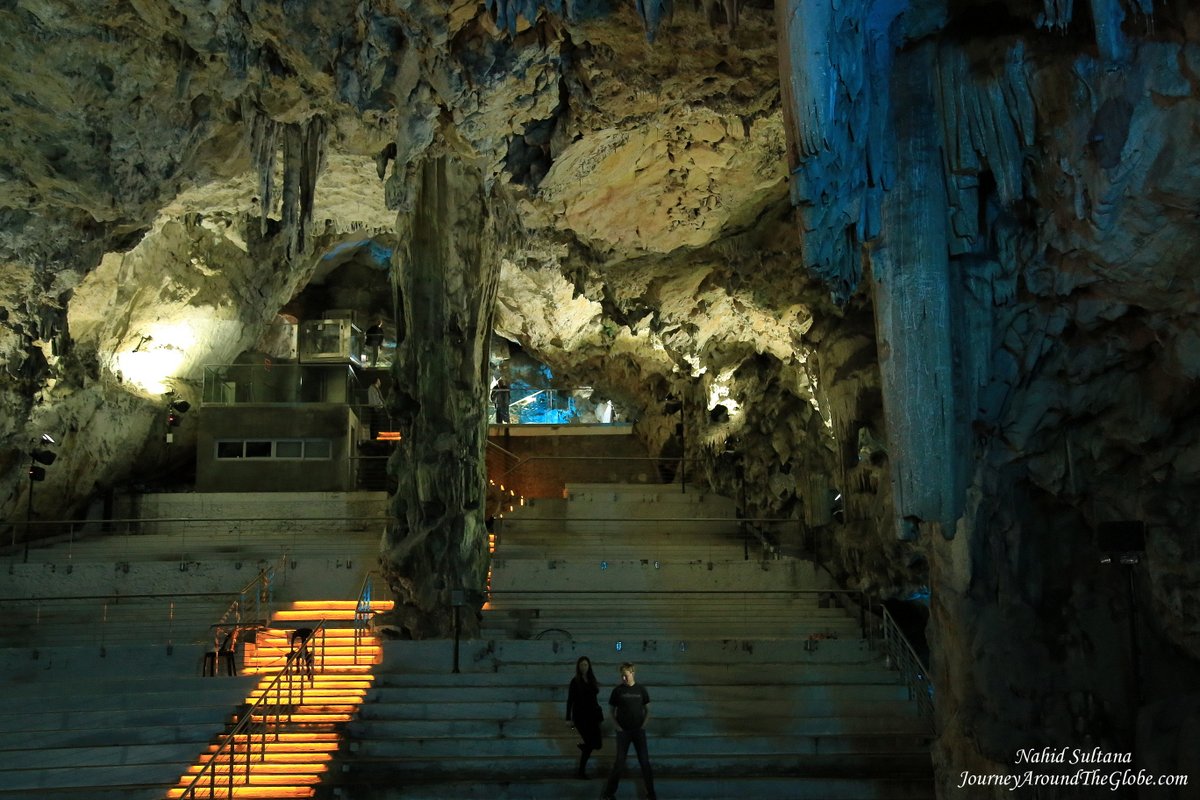
The impressive natural grotto of St. Michael’s Cave was long believed to be a bottomless cave. It winds downward some 700 feet into The Rock. The Upper Hall, fitted out as an auxiliary hospital in during WWII in 1942, but was never used, now it is used for concerts. It took us about 20 minutes to visit the cave.
By the way, the cafeteria here is the last one to grab some food in the nature reserve of Upper Rock. It’s better to finish your food before hitting the road again, monkeys here can be notorious and may attack or take away your food if they can smell it.
3) A MONKEY FEEDING STATION in UPPER ROCK: Drive from St. Michael’s Cave up to here was very scenic, after all, Gibraltar is surrounded by water on three sides. There are few of these monkey feeding stations all around the Upper Rock. These monkeys, Barbary Macaque, were brought here from Africa many centuries ago. They are used to seeing people all the time, but be careful…they are wild animals on loose. If you are driving your own car, it’s better to roll your windows up when you start climbing the rock.
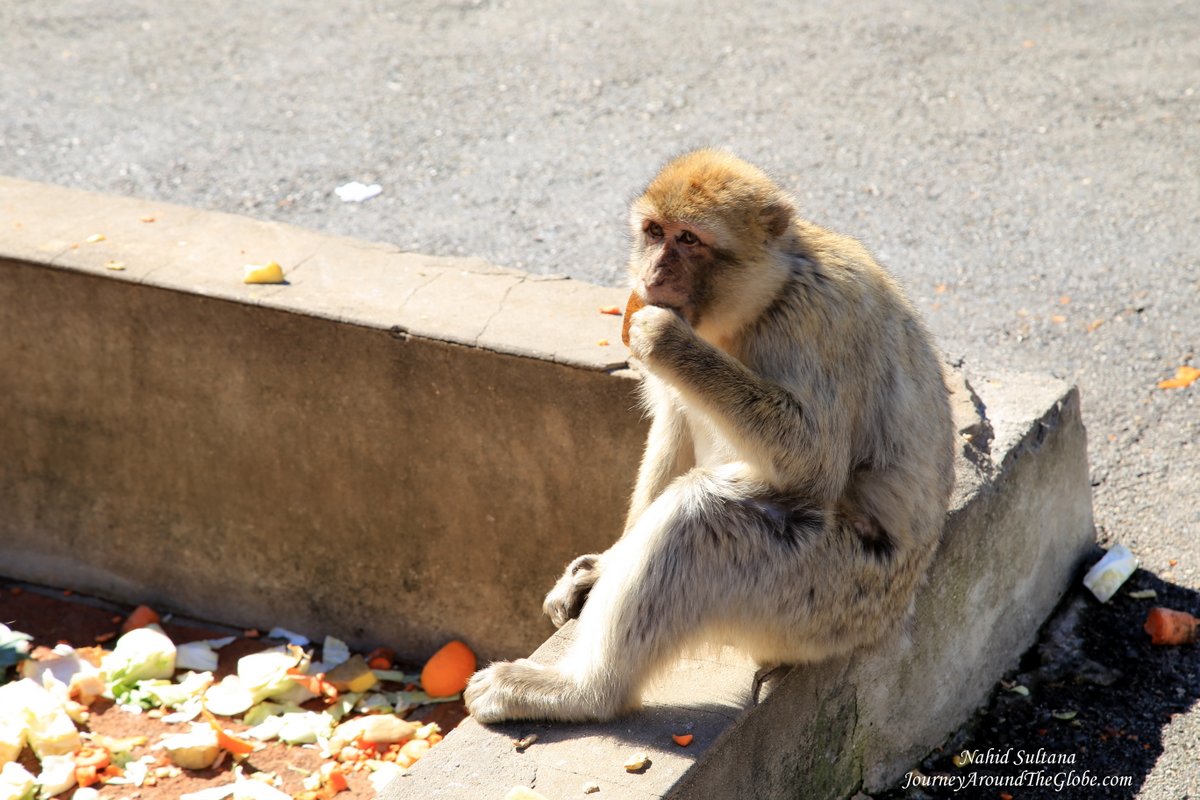
People of Gibraltar love their monkeys and the government actually takes care of them and feeds them at these stations. My girls took few pictures with these cute apes.
4) GREAT SIEGE TUNNEL: This was our last stop with the taxi and on The Rock. You get a fantastic view of Gibraltar, Spain, and all the other surrounding as you stand at the entrance of this tunnel. By the way, there is total of 33 miles of tunnels all around Gibraltar. Interestingly, British army hand dug this one, a 600 meter tunnel, from solid limestone.
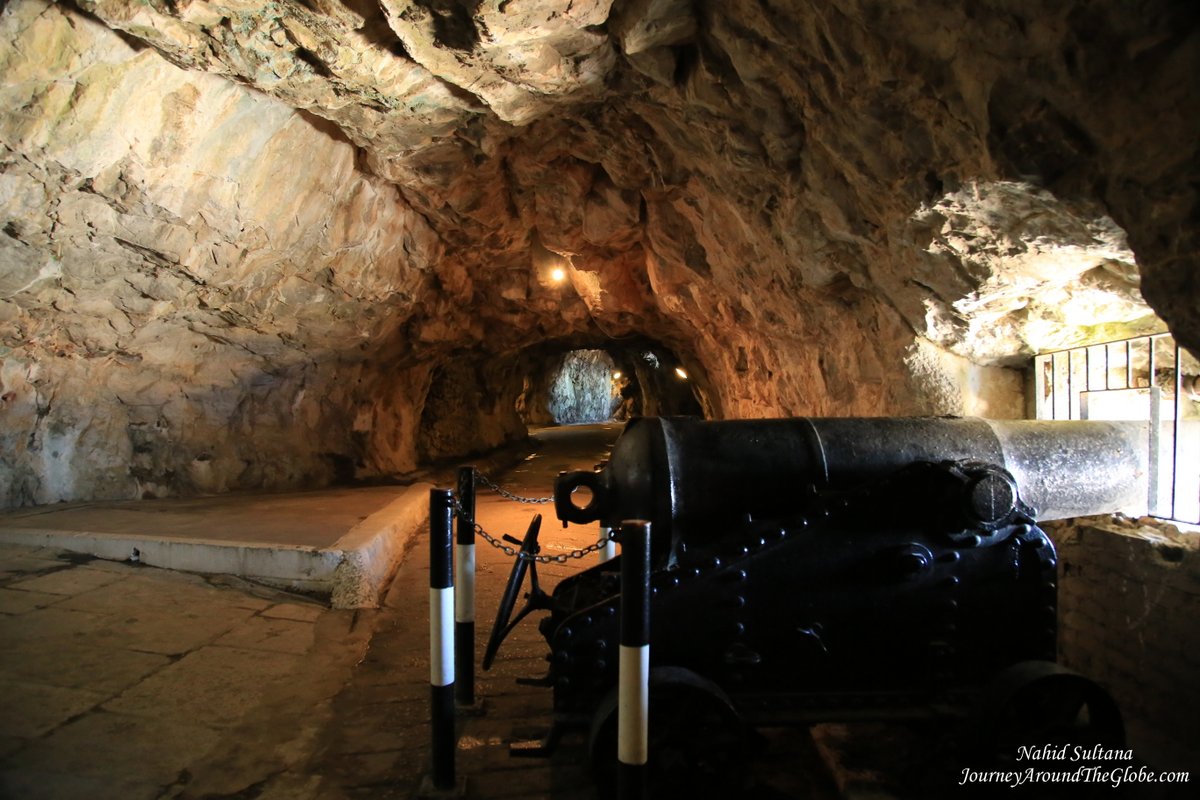
The tunnel was built in the 1700s to defend Gibraltar from the Spanish and French troops during the Great Siege. When the Great Siege ended in February of 1783, the original gallery was 370 feet long. After the end of Napoleonic War in 1815, the risk of war still remained in Europe. So British continued to improve the fortifications of the Rock by including an additional 7 miles (12km) of tunnels. Overall, this is a long snaky tunnel to discover with detailed information about events during the Great Siege and the usage of the tunnel during WWII.
We stayed here about little less than half an hour. After the first part, you may need extra 30 to 45 minutes to go further deep into the tunnel where the gradient becomes steeper and some visitors may find the climb back quite tiring (don’t worry, there is a clear sign in the tunnel with this message). We came back from this point to catch the taxi…the girls were a bit scared too to go further.
5) CITY CENTER: We were dropped off here by our taxi after our short tour of Gibraltar. This is more like a shopping alley with many fancy stores and local boutiques. There isn’t much to do here other than doing some tax-free shopping or having a good meal. There were some point of interests we saw in the information board, like a cemetery, museum, and other landmarks. We didn’t go to any of those place, just took a leisure stroll to both sides and started walking towards the border.
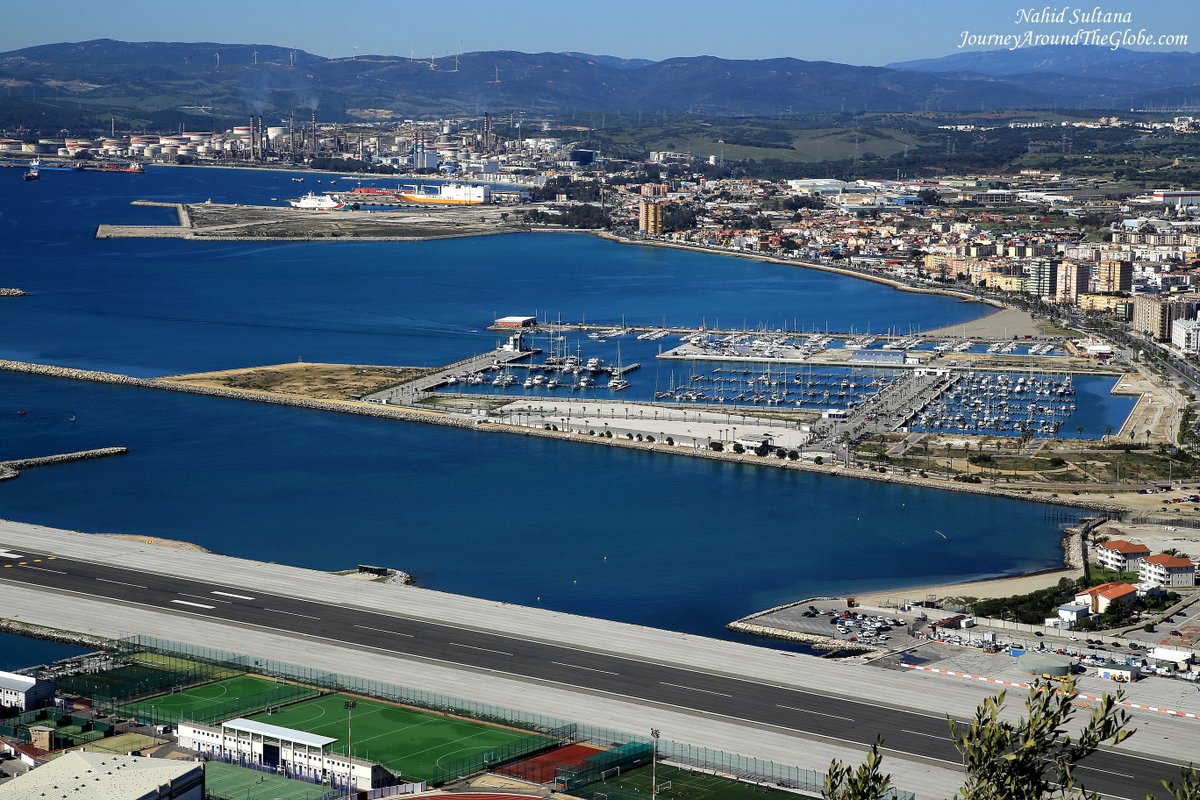
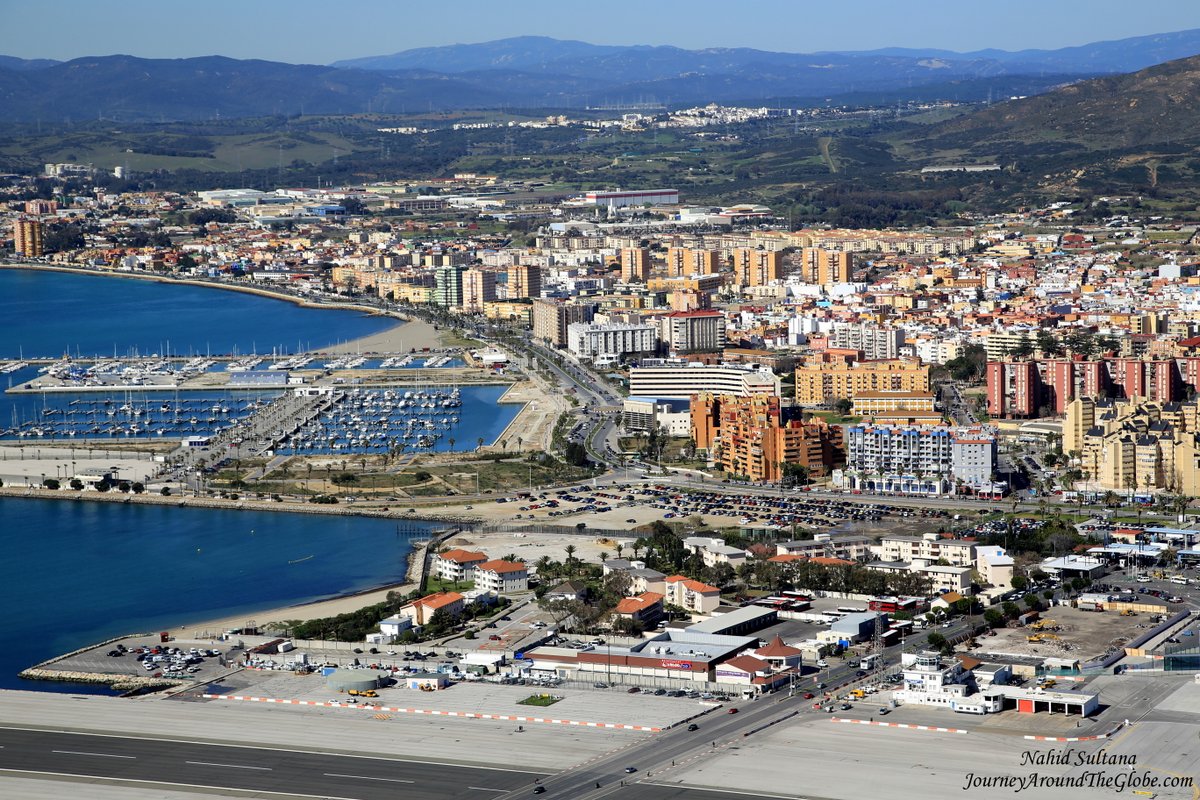
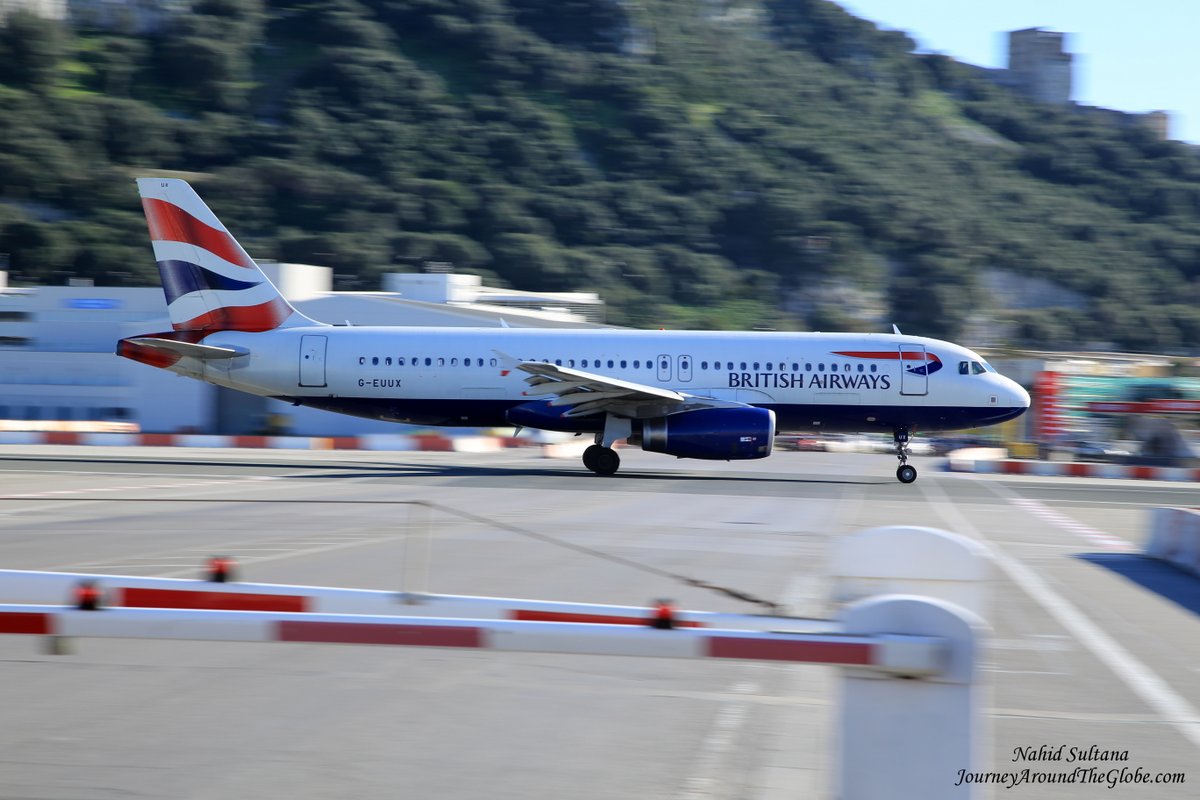
6) GIBRALTAR AIRPORT: Gibraltar Airport has a live runway, meaning it sits on a local street and general public can actually cross this stretch of road on foot or by car. The airport is only few steps from the border on Winston-Churchill Avenue. Fun part of crossing this street was, we were told by the airport securities to hurry up and cross the road quickly because a plane was about to take off and they are clearing all the people from the runway. So we hurried to the other side as a bar came down to stop all the pedestrians and traffic lights turned red to stop all the vehicles. In about couple minutes, we got to see a British Airways making its way to the runway and took off from that runway as all the audiences were going “wow”. We were lucky to see this site, not many people crossing this runway actually get to see an airplane taking off few feet away from them.
Share this:

Business Excellence Award 2020 from AI Global Media for The Most Entertaining Personal Travel Blog – Pacific Northwest USA

Top Posts & Pages


Business Excellence Award 2020 for The Most Entertaining Personal Travel Blog – Pacific Northwest USA

 Globe Runner

