Journey Around The Globe
ready for the next destination
Wadi Rum, Jordan – Journey to the moon
WADI RUM, JORDAN: Journey to Wadi Rum was like journey to another world or another planet. Wadi Rum, meaning Valley of the Moon, is the largest and most magnificent of Jordan’s desert landscapes. Vast scenery of Wadi Rum is endless and is at everywhere you look. This silent and timeless place is still untouched by humans although it has been inhabited by many cultures since prehistoric time. This is a vast wilderness that holds spectacular treasures from as early as 4000 years ago. Wadi Rum was added to UNESCO World Heritage site for its natural and cultural significance in 2011.
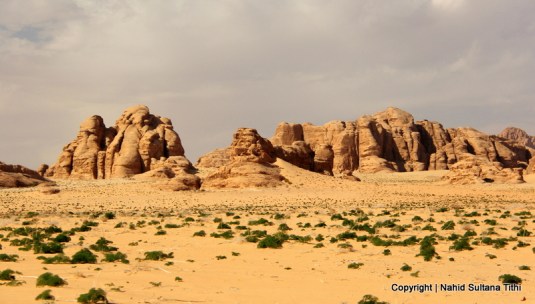
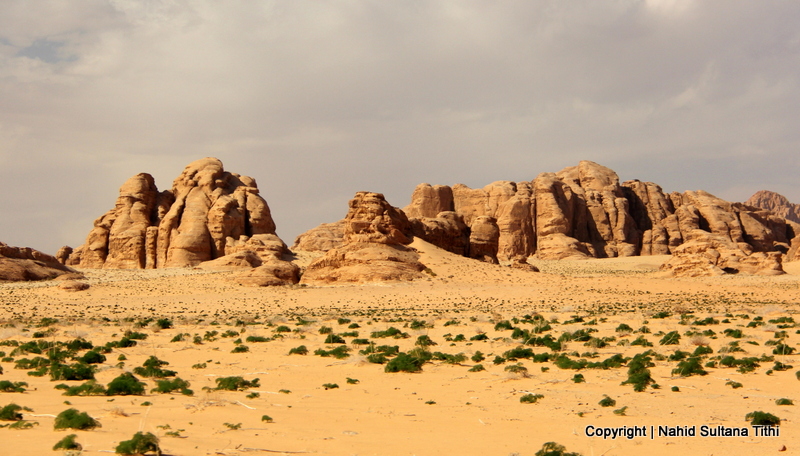
- Vast and empty land of Wadi Rum, Jordan
This makes a great day trip from Petra or Aqaba. Many people come to Wadi Rum for overnight or weekly camping. There are some designated areas where they can stay like the Bedouins, roam around in camels, horses, or donkeys, and eat meals prepared by the Bedouins in traditional style. Trekkers, hikers, and rock climbers come here to enjoy the tranquility of the boundless empty spaces. This place can also interest professionals like geologists, scientists, and historians. To the west, this became very well-known after the epic movie “Lawrence of Arabia” in 1962. It was also used as the surface of mars in the movie “Red Planet”.
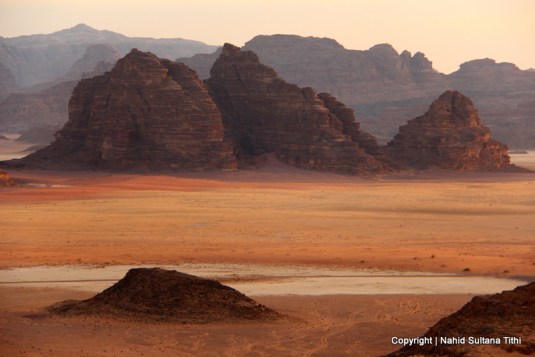
- Amazing landscape of Wadi Rum, Jordan – it does look like the surface of the moon
It took us about hour and half from Petra to reach Wadi Rum. We paid 150 JD (50 JD per person & my 3-yr was free) for all four of us for about 5 hours of stay in Wadi Rum. The price included the tour and Bedouin-style lunch. Our guide met with the Bedouin in a spot near Wadi Rum, not near the Visitors’ Center. So, we avoided paying the entry fee there. But usually tourists have to pay about 50 JD to enter the valley and pay separately to the Bedouins for tour and everything else. There are many options to choose from to explore the desert and they can be arranged by the Visitors’ Center or your hotel beforehand.
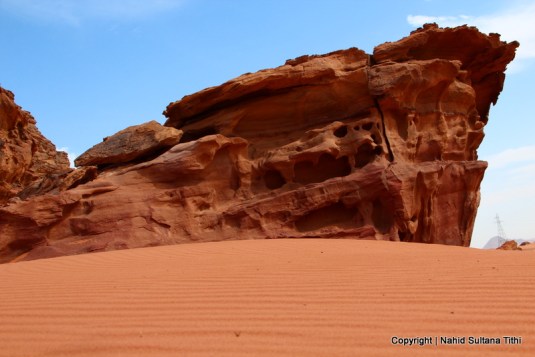
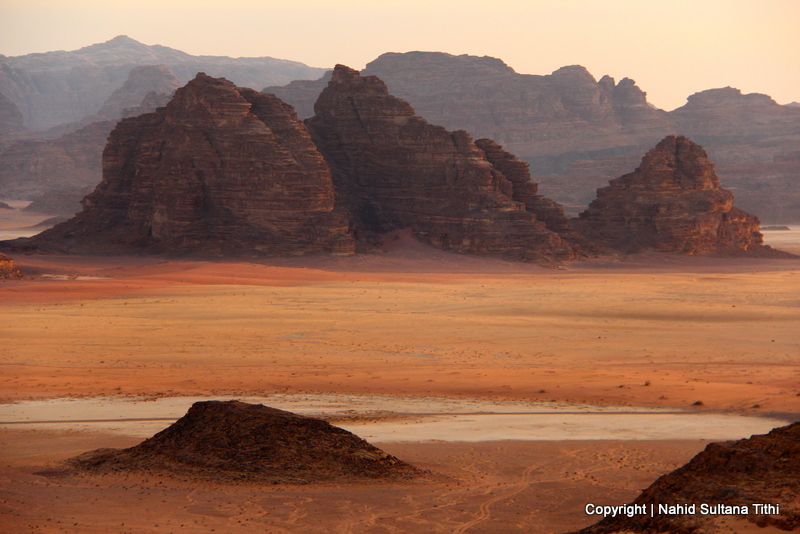
- Beautiful Wadi Rum, Jordan
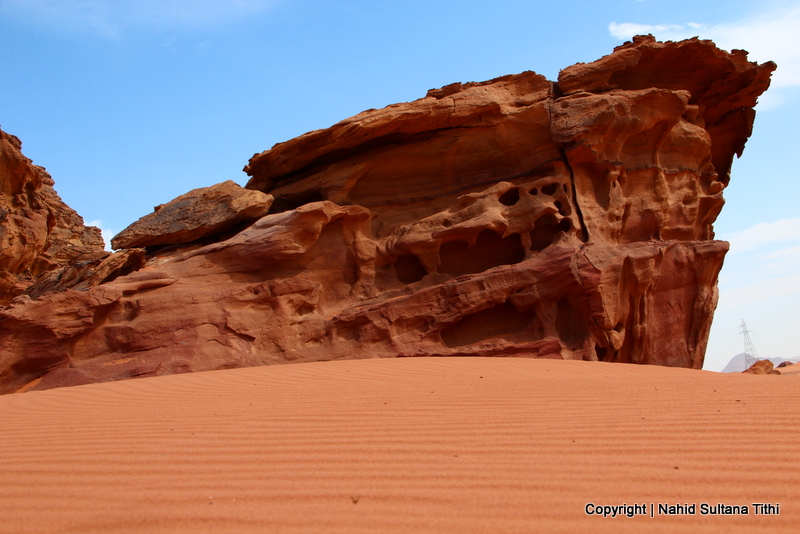
TIME of TRAVEL: We flew to Jordan in mid-February in 2013. Wadi Rum was our last trip there after Petra. It was slightly chilly in the city, but once we were in the desert…it was really pleasant. Try avoiding going there during summer…it can get crazy hot. Even most of the Bedouins move off the desert to elevated mountains in hot summer months.
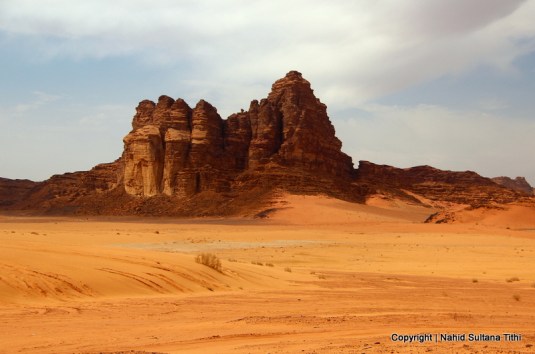
- A nice afternoon in the desert of Wadi Rum, Jordan
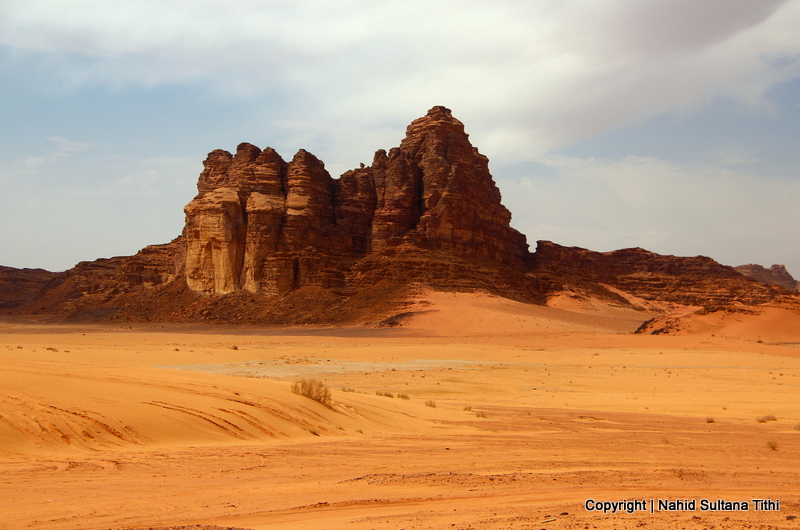
OUR HOTEL: We stayed in Movenpick Resort in Petra, right outside the Visitors’ Center. I don’t think I need to say much about Movenpick, it’s a 5-star hotel…very luxurious rooms with excellent customer service. Wi-Fi wasn’t free but breakfast buffet, with variety of different items to choose from, was free for its customers. We checked out of the hotel in the morning and headed straight towards Wadi Rum on the last day of our trip and checked in Arab Tower Hotel in Amman at night.
PLACES WE’VE VISITED: Wadi Rum is a classic picture of sandy desert. Whole area is 280 sq. miles (780 sq. m.) of natural scenic site. Visitors can spend days or weeks exploring its mountains, hills, vast landscapes, sand dunes, many natural rock bridges, sandstone and granite rocks, Bedouin inhabitants, natural and hand-cut caves, inscriptions and petroglyphs, and many other wonders of nature and pre-historic time. Our Bedouin guide brought an old white 4×4 SUV to take us around the desert. Adventure is having your SUV stuck in the sand or taking a ride thru the empty path of desert without following any signs or paved road, and sliding down small sand-dunes with the vehicle.
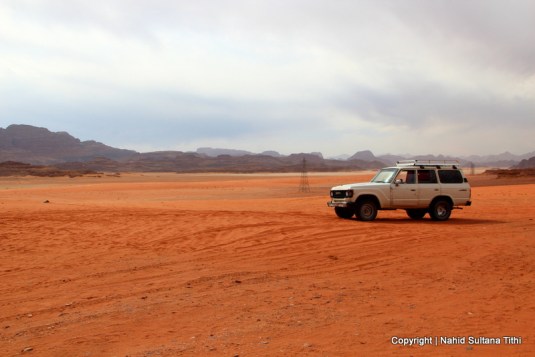
- Our 4×4 transportation in the desert of Wadi Rum, Jordan
1) Mushroom Rock: This was our first stop in the desert. Our Bedouin guide has a small shop of his own and a place for tea and coffee (only open after dark) inside a tent. There is a natural rock formation close to the tent, looks much like a mushroom in a way.
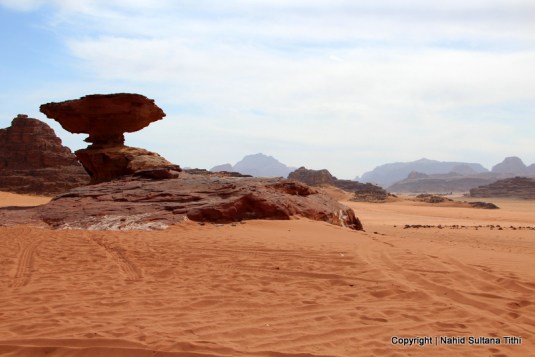
- Mushroom rock in Wadi Rum, Jordan
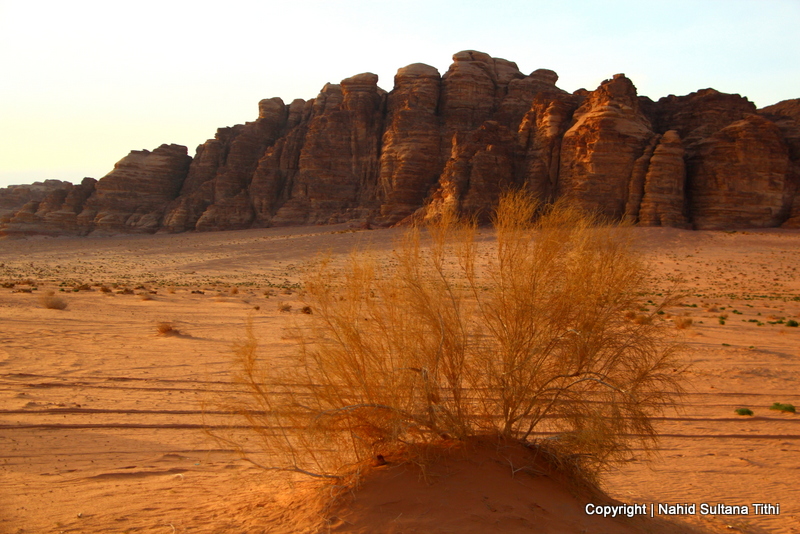
2) Seven Pillars of Wisdom: We saw this bold rock formation almost right after we entered the valley. The name came from T. E. Lawrence’s book although name has nothing to do with the valley.
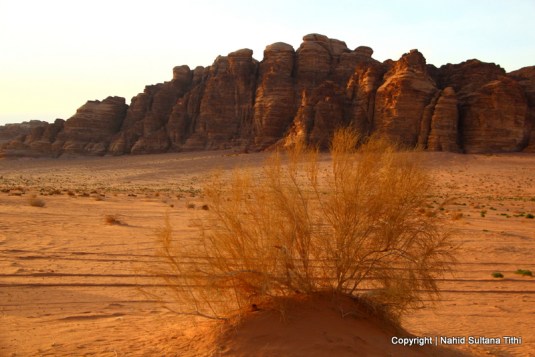
- This amazing columns of rock is known as Seven Pillars of Wisdom in Wadi Rum, Jordan
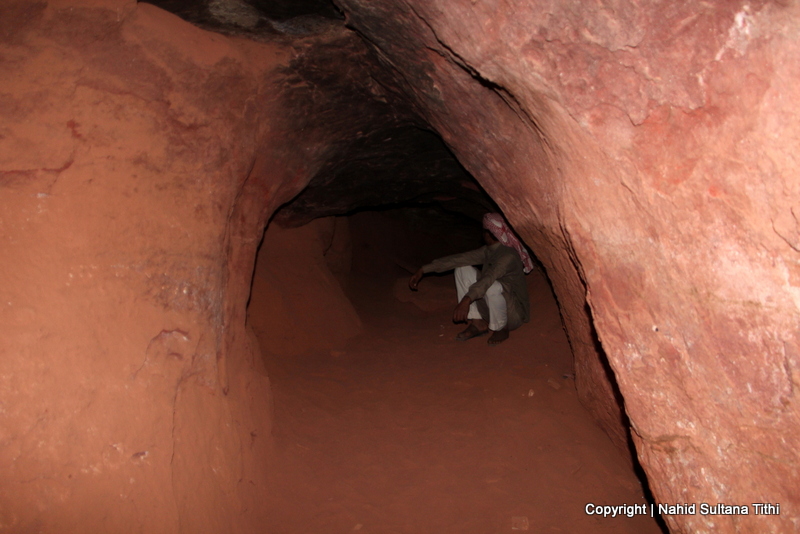
3) Caves and Lifestyle: Many natural and hand-cut caves can be found in Wadi Rum. Some of them are from the time of Nabataeans. We stopped at two of these caves (one from Nabataean period) where no one lives anymore.
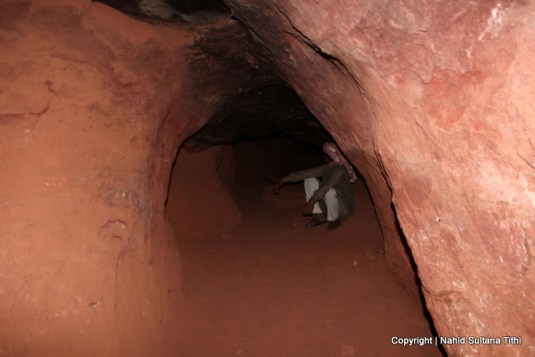
- One of many natural caves of Wadi Rum, Jordan
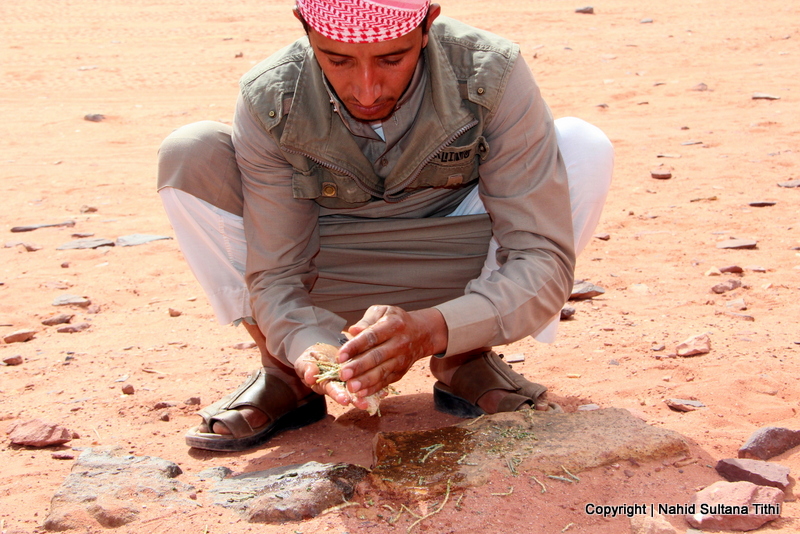
Another interesting thing he showed us was how Bedouins used to wash their hands or body in the old times before soaps were available. I don’t know the name of the plant, but he took some branches, tore them in small pieces, smashed with rock, added some water, and started to rub in his hands then bubble started to form…a natural anti-bacterial soap.
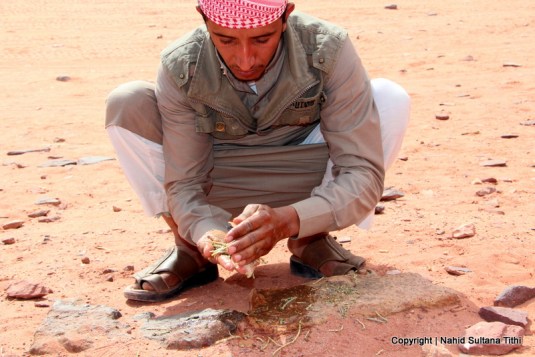
- Our Bedouin friend is showing how they used to use plants to clean their hands in the old time – Wadi Rum, Jordan
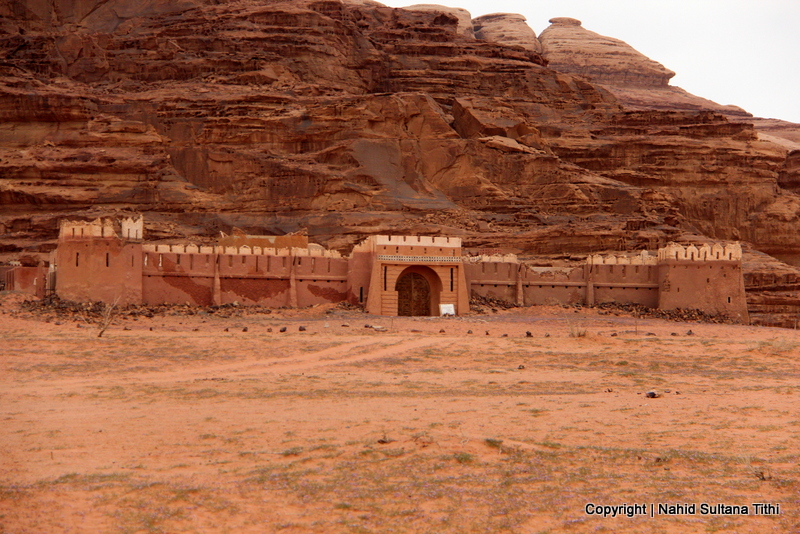
4) Castle from “Lawrence of Arabia”: There was a castle built in Wadi Rum during the shooting of the movie “Lawrence of Arabia”. The sandstone castle is still standing in one part of the valley. We just drove by the castle without stopping.
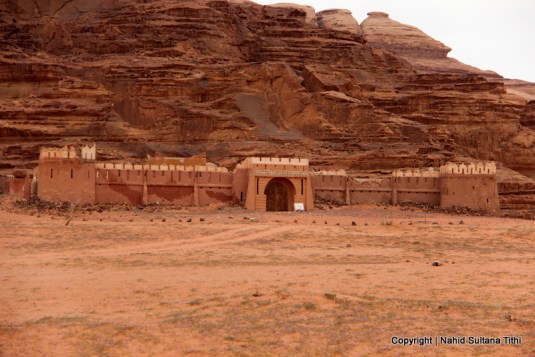
- Castle that was built for the movie “Lawrence of Arabia” in 1962 in Wadi Rum, Jordan
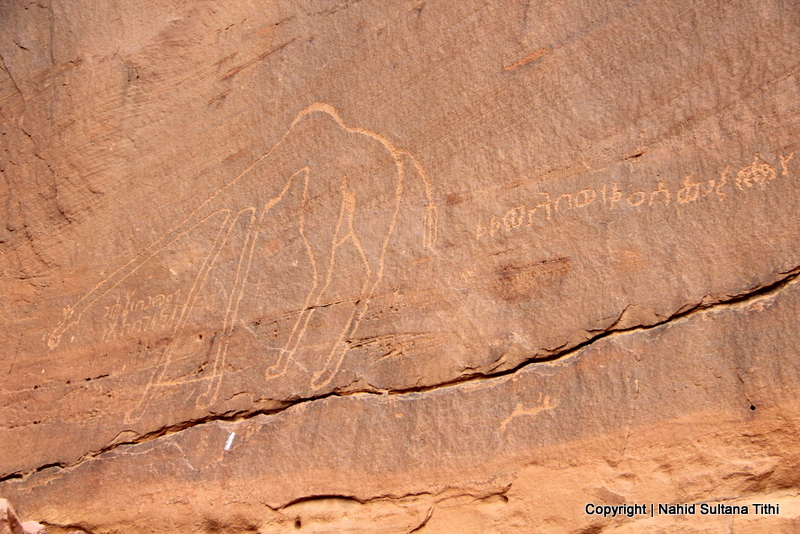
5) Inscriptions on rocks: There are many sites in Wadi Rum where you can find etched inscriptions, paintings, graffiti, and petroglyphs. They are usually from Nabataean or Thamudic periods. We stopped at 2 places and climbed up small hills to see them.
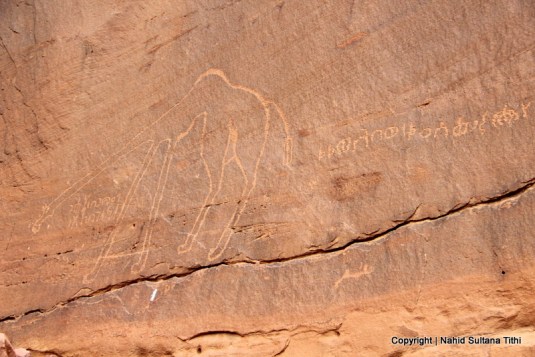
- Etched inscription on mountain walls in Wadi Rum, Jordan
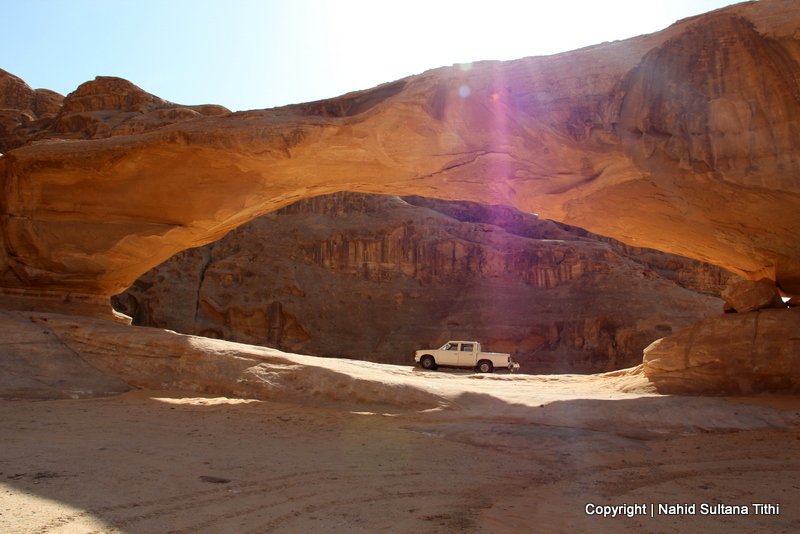
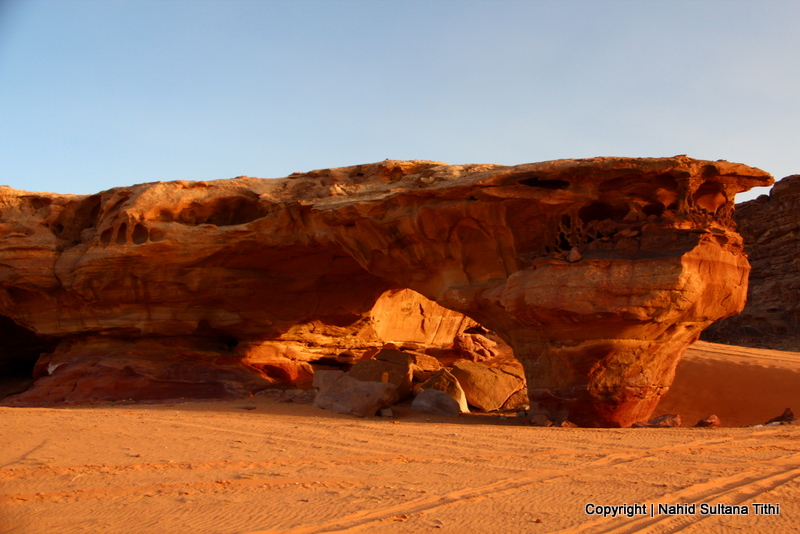
6) Natural rock bridges: Natural rock bridges are also very common in this Wadi. We saw total of 4 of these bridges in the middle of the valleys. These arches are absolutely sexy and can be climbed to the top to get a view from high above.
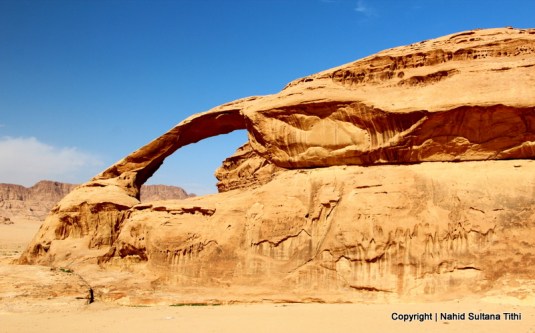
- A natural rock bridge in Wadi Rum, Jordan
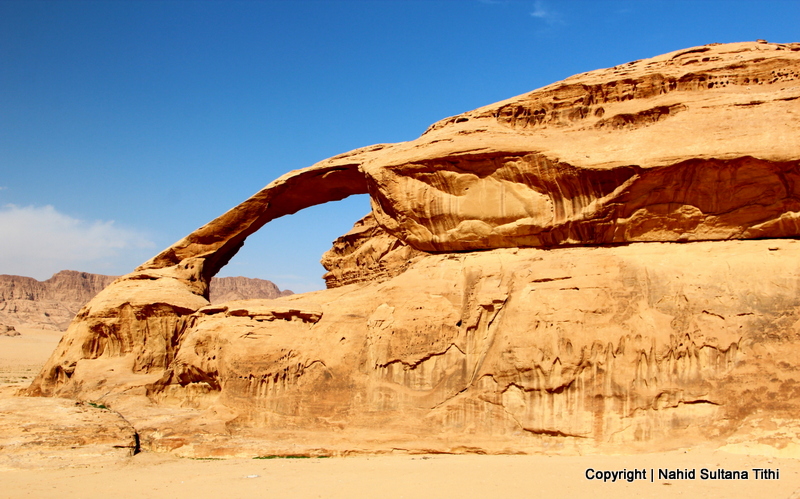
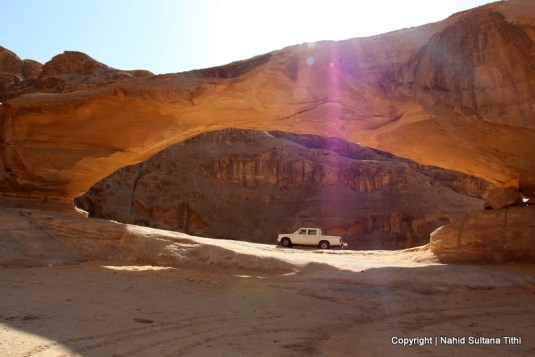
- Another natural bridge of Wadi Rum
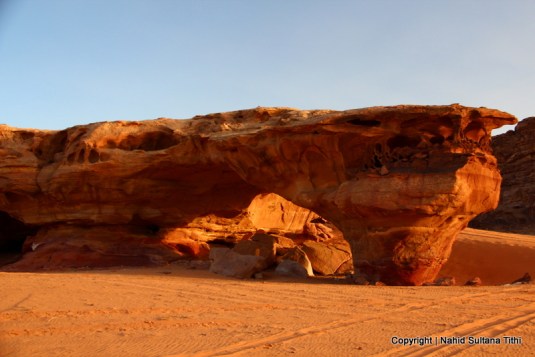
- A stone arch in Wadi Rum
7) Our Lunch: After about 2 hours ride in the SUV with our guide and the Bedouin driver, we stopped at a nice picnic spot with awesome “backyard” view for lunch. The Bedouin had our lunch marinated and foiled beforehand.
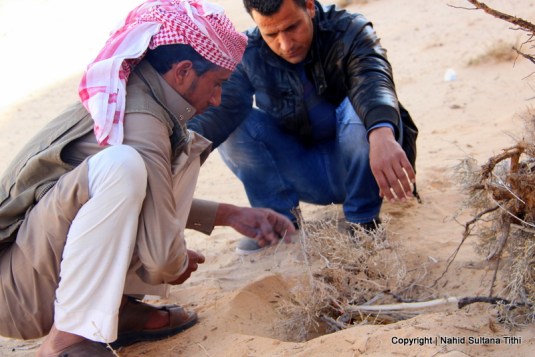
- Our Bedouin guide is trying to light the fire up to cook our lunch
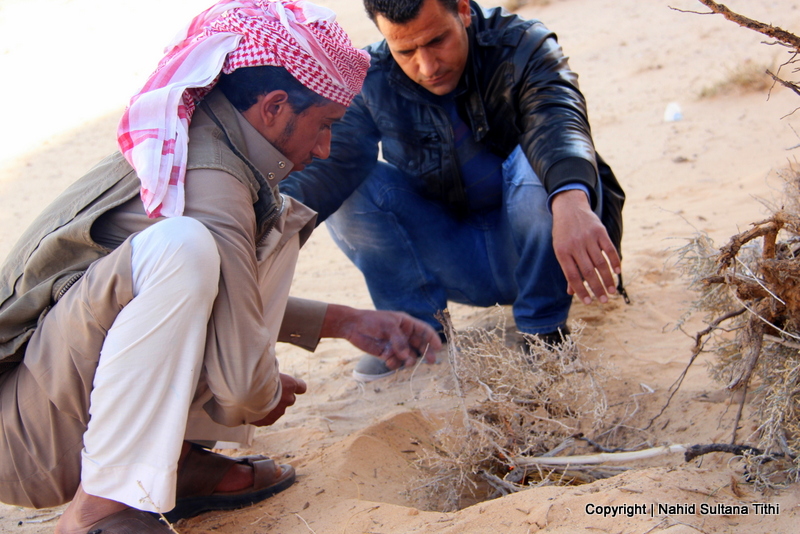
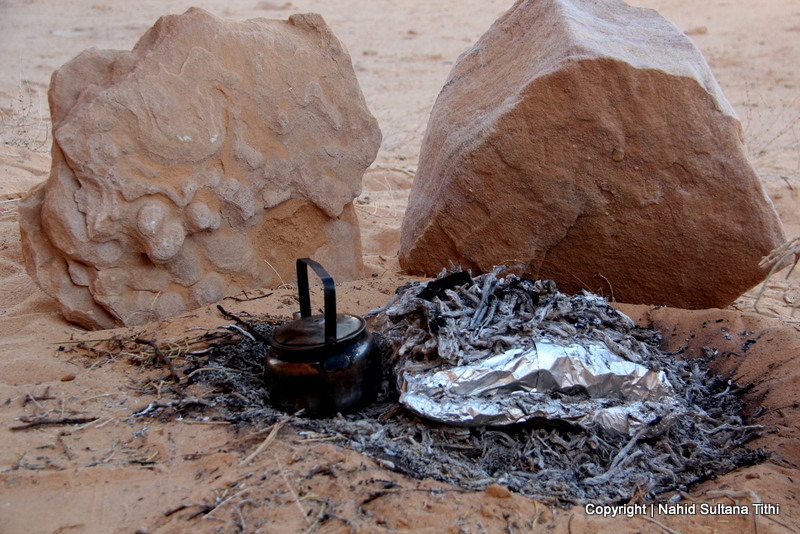
Both of them collected some dry branches to cook the food on. Then lit up fire and placed foiled meal on it. It took about an hour to cook that chicken. In the mean time he put some Bedouin music in his radio-looking machine, placed small mattresses on the sand for us to sit or lay down, and put a pot of water on fire to have some tea after lunch.
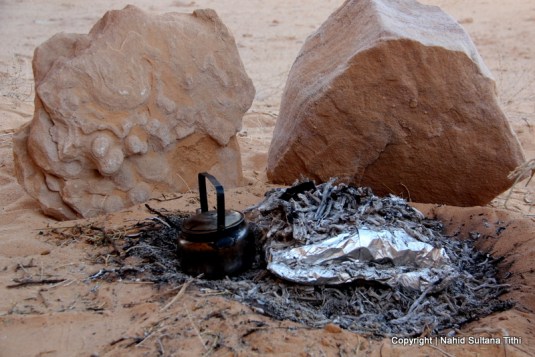
- Lunch is cooking on hot sand and ashes
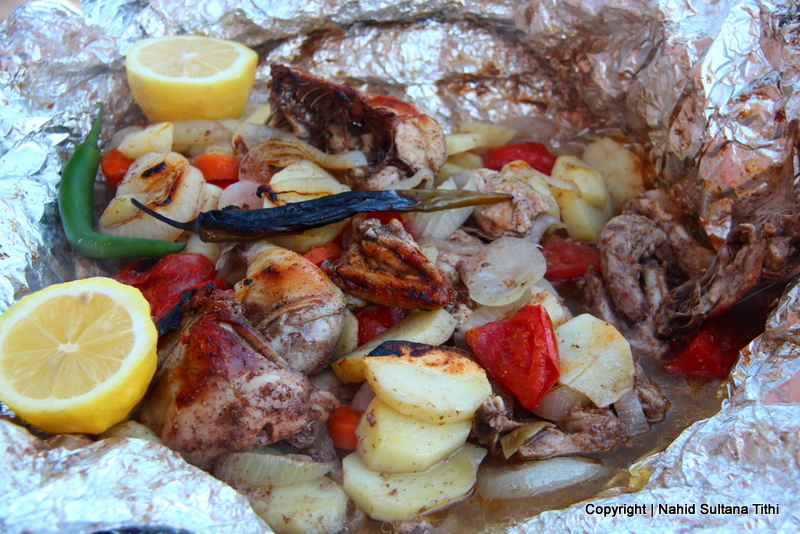
It was about 4 pm when the food was ready. He had everything very well planned …brought some breads, yogurt, even a bottle of coke, and some disposable utensils for lunch. The smell and look of our lunch looked oh-so-good. The dish is called Madfouna…a chicken dish with potatoes, carrots, peppers, lots of lemon with salt and pepper. We sat on the mattress with our food in our hands and some sand on our food (couldn’t help it, there were some whirling sand around us, they kept flying on our plate). But either way, that food was delicious. After lunch, it was time for some hot tea. I never had sage tea before. Usually people here drink lots of mint tea. But he made some sage tea for us…tasted very refreshing in the hot desert.
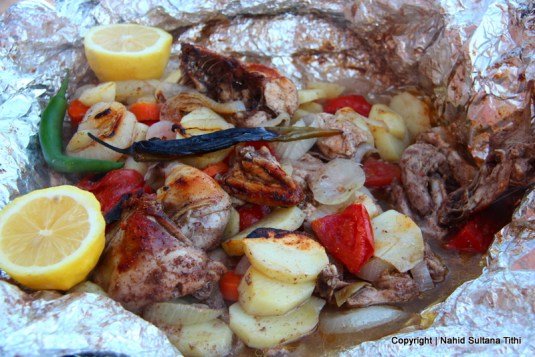
- Our lunch in Wadi Rum, called Madfouna
By the time we were done with our lunch it was about 5 pm and very close to sunset. On the SUV again and to the unknown…
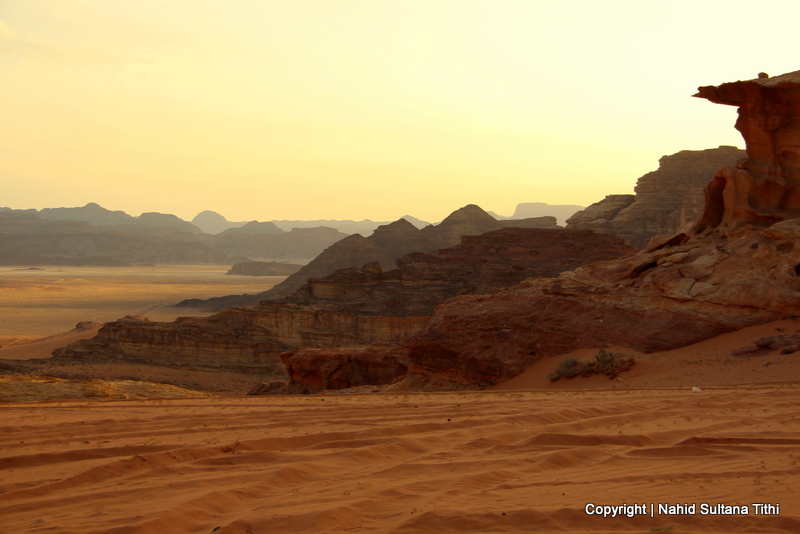
8) Panoramic Site: This was the best part of the tour for me. The color of desert started to change its shades near the sunset time. Nature looked more mystical and astounding. Our Bedouin friend took us to a panoramic spot where we were amazed by the beautiful atmosphere. We were on top of a small hill surrounded by some sand dunes, a lower valley view, and uniquely cut rocks and hills. It was immense and boundless.
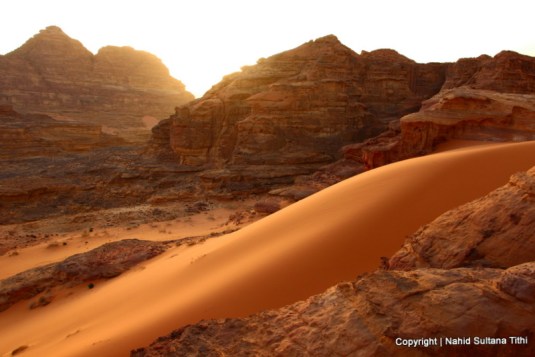
- Sunset in a panoramic spot in Wadi Rum, Jordan
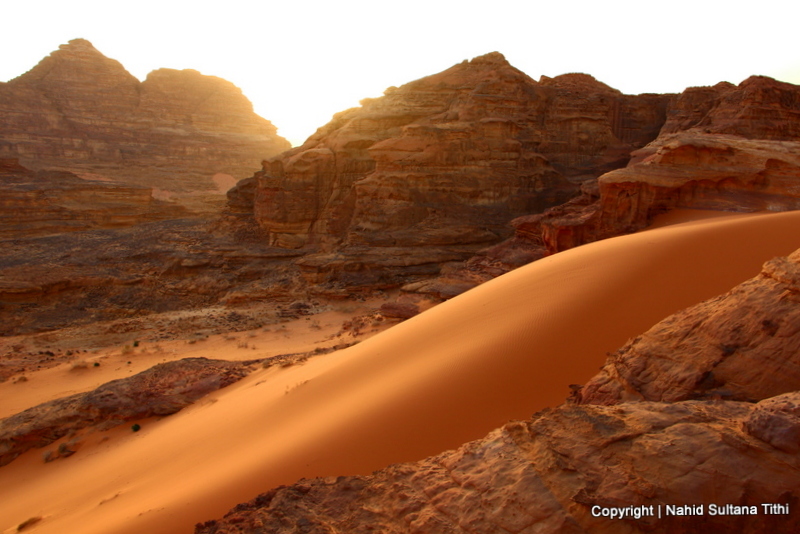
After all the traveling I did in my little life, Wadi Rum is the only place where I truly left my heart. I kept going back to its enormous and ageless place of beauty in my thoughts every now and then…thinking about miles after miles of its gratifying look. It truly felt like I was on the moon for the first time in my life.
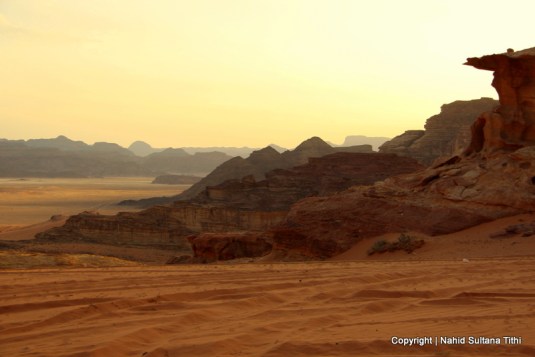
- Best sunset I have ever seen in my life was in Wadi Rum, Jordan
Related articles
- Jordan Trip 2013 – Wadi Mujib, Karak, Dana, and Shobak (journeyaroundtheglobe.com)
- Amman and Back (journeyaroundtheglobe.com)
- The Rose-Red City of Petra, Jordan (journeyaroundtheglobe.com)
- When the West Won (edwardbedinghaus.wordpress.com)
- From Nebo to Petra………… (antheaschronicles.wordpress.com)
- a day in the red desert of wadi rum (catbirdinjordan.wordpress.com)
- Jordan 2013 – Day trip to Madaba, Mt. Nebo, Bethany, and Dead Sea (journeyaroundtheglobe.com)
- sunday post: famous movies (catbirdphotography.wordpress.com)
Share this:

Cairo – City of Thousand Minarets
CAIRO, EGYPT: I don’t think I need to say much about Cairo or Egypt as a whole. This is one of the earliest civilizations of the world and when you visit this country, you will know that some talented group of people lived here once few thousand years ago. Some of world’s very original art, culture, history, language, and science started from this land. For a traveler, this is a paradise to see, taste, learn, and experience uniqueness. Cairo is Egypt’s biggest city and is also known as the “City of Thousand Minarets” for having hundreds of big and small mosques in every corner. After being in so many places, I must say there are 2 places where I found people to be the friendliest, most helpful, and hospitable. One was in Dublin and another city is Cairo. Egyptian people are always eager to help its guests and very humble. This is a contemporary and thriving city with glorious history from past…a perfect place to feel both of the worlds and eras.
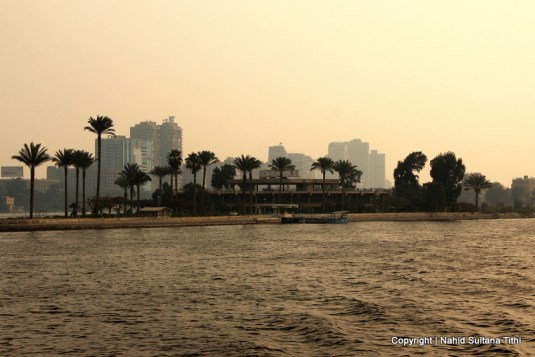
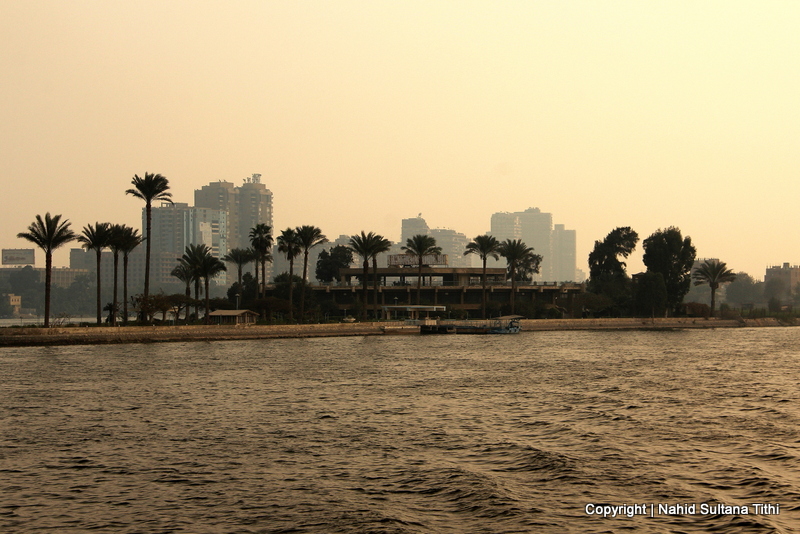
- River Nile and Cairo city…what a great combination
Some FYIs and tips for the travelers before visiting Cairo: Egypt made it really easy for US citizens to travel their country. We can get entry visa in the airport for 15 USD per person. About transportation, always ride white taxis with meters. Black cabs don’t have meters, therefore better to bargain a price before riding. Always carry tissue or napkins with you. Some public bathrooms don’t have tissues, even if they do they will expect some tips for that.
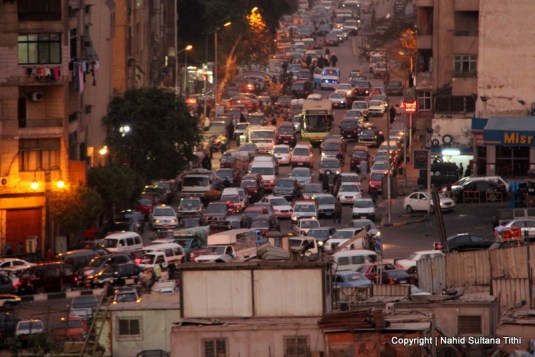
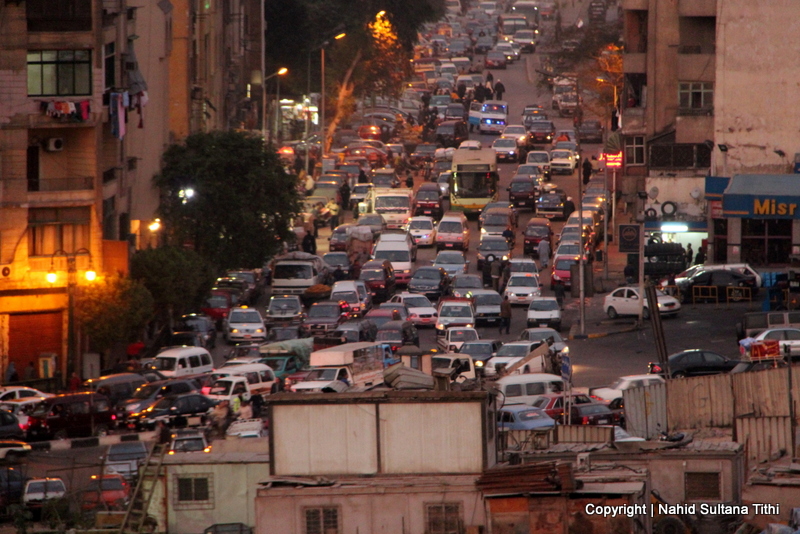
- Streets and traffic jam of Cairo during rush hour, a view from Al-Azhar Park
TIME of TRAVEL: We flew to Cairo from Belgium during the 2012 Christmas break. While it was freezing in Belgium, the weather in Cairo was just perfect. But carrying a sweater won’t be a bad idea when traveling here this time of the year.
OUR HOTEL: We stayed in Cairo Moon Hotel in the heart of Cairo, only 10 minutes’ of walk from Cairo Museum and Tahrir square. Honestly speaking this was a below average hotel with tiny (for only 3 people) and scary elevators, big red ants walking all over the floor, too much noise late at night, and few other problems. But the owner of this hotel, Mohamed, is an exceptionally friendly and helpful gentleman. All the staffs here are same way too which overcomes all the other problems of this hotel. Mohamed organized few trip for us here and there including the trip to Giza. It had free basic breakfast and free Wi-Fi. Pick up from or to airport can be arranged if you let them know ahead of time.
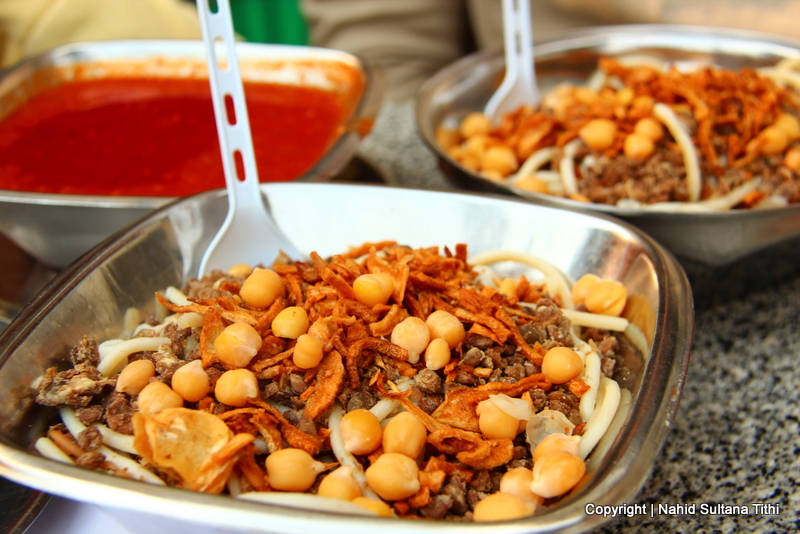
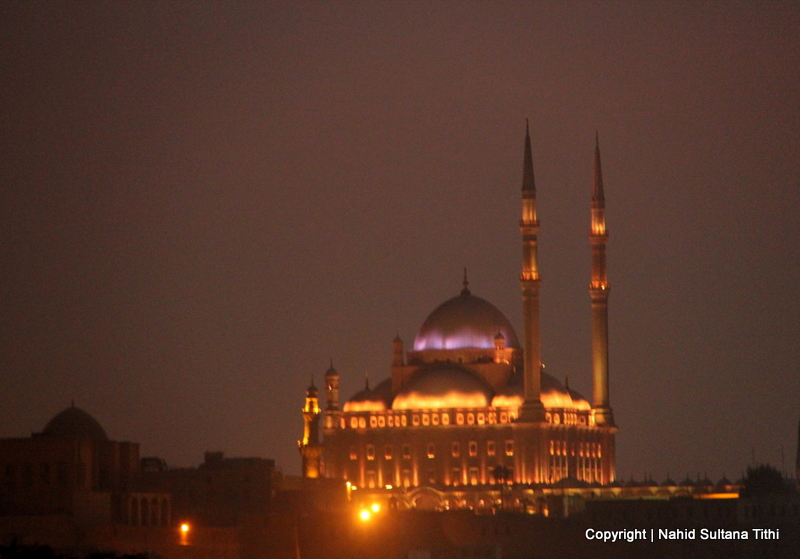
EATING and SHOPPING: Kushari is a famous cheap street-food in Egypt. This usually comes in different sizes. It may sound weird, but this combination of pasta, rice, spaghetti, lentils, white beans, and fried onions is very filling and tasty when you mix it with different types of sauces. We had dinner on 2 nights in a very popular restaurant in the heart of Cairo, called “Gad”. From the daily crowds of it, we could tell that this was going to be a great place to eat some local food. They have burgers and fast food menu as well as some traditional dishes, like Egyptian pancakes, spiced salad (the best), and burger with egg. One of the castle-like restaurants in Al-Azhar Park was a very fancy spot where we were taken to for a dinner by someone we knew. Night view of Ali Pasha Mosque in citadel as we were having dinner was gorgeous. I think this is where we had our best food in Cairo. Also try Egyptian pizza, falafel, and shwarma.
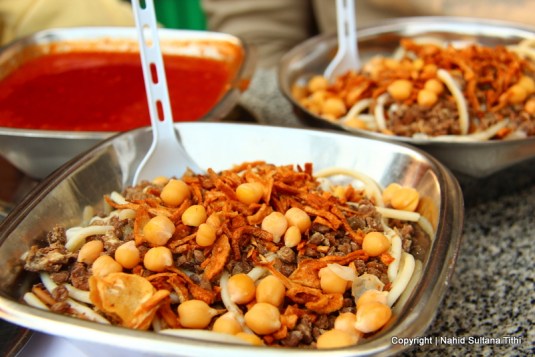
- Kushari, a yummy street food of Cairo
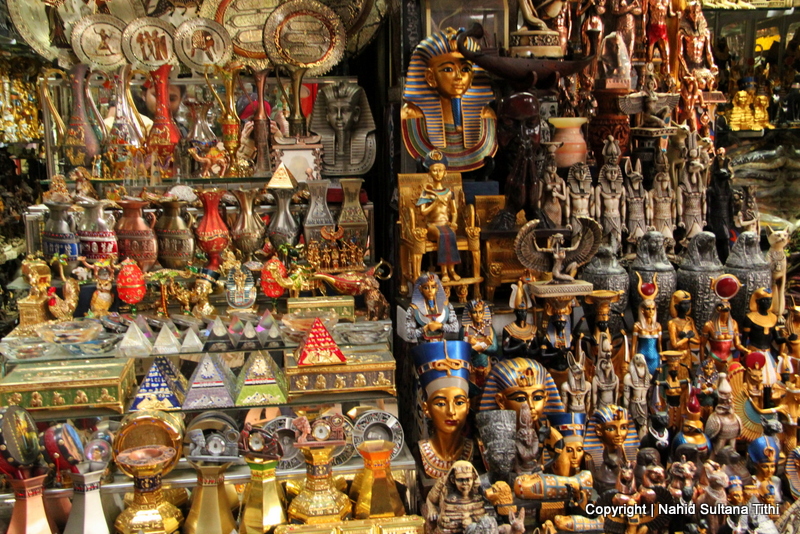
I can give you a whole list of things that you can buy from Cairo. Spices, papyrus, sphinx, pyramids (in different colors and materials), shawls/scarves, traditional clothes are just to name some. Khan-El-Khalili is more of an expensive place for tourists. Most of the tourist attractions have small stores or vendors nearby. When we took our Giza trip, our guide Haisam took us to a big showroom of papyrus, Golden Eagle Papyrus on Sakkara Road. This is a government approved store, and therefore you know you are buying the real thing. It has hundreds of papyrus wall decors to choose from at various price ranges and with different themes. The guy who was showing us around actually took 10 minutes to show us how a piece of papyrus was made from its trees…that was absolutely fascinating and very educational for our little ones. Here is their phone number if you need it – +2037719585.
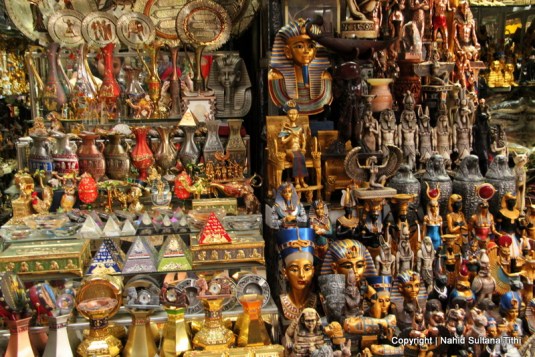
- Some souvenirs in Khan El-Khalili Bazar in Cairo, Egypt
PLACES WE’VE VISITED: Cairo is overloaded with many touristic places from really ancient wonders to modern and stylish sites. We spent about a week here and was pretty much done seeing most of old part of the city. We could have stayed longer to visit experience more of new areas, its night life, and thriving life of Cairo. Other than the following some other places that tourists can consider visiting (we couldn’t see these places) are Cairo Tower, which can be seen almost from any corner of the city and provides 360-view of Cairo including Giza. Also dropped off your list was Abdeen Palace which was home of the last king of Egypt the exiled King Farouk.
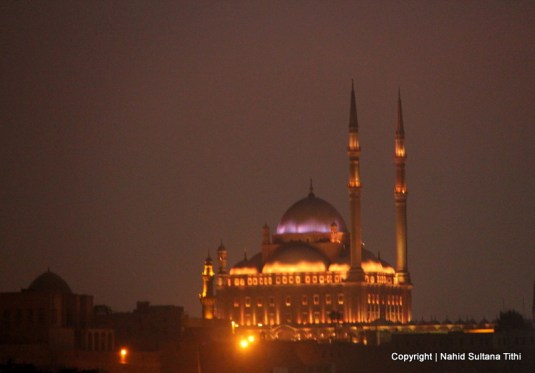
- Grand view of Ali Pasha Mosque at night from Al-Azhar Park, Cairo, Egypt
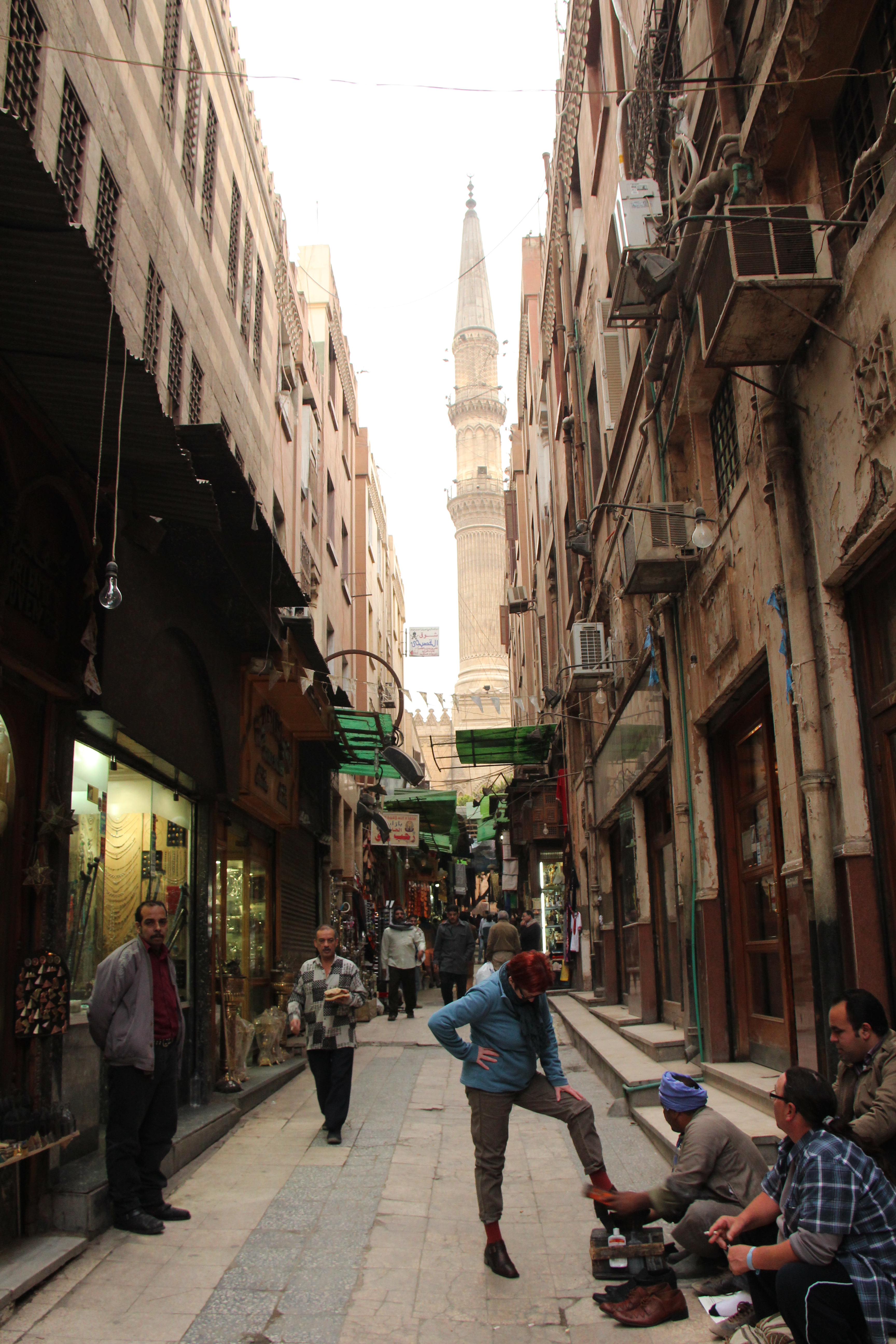
1) KHAN-EL-KHALILI BAZAR: Khan-El-Khalili Bazar is a tourist trap in Cairo for shopping. It’s a like big maze with winding small alleys and many small stores. You will find almost anything here including perfumes, spices, handcrafts, traditional clothes, gold, and many other things. I wouldn’t recommend buying papyrus paper from here as they may not be real Egyptian papyrus. But whatever you buy bargain is a must…not just here, in whole Cairo.
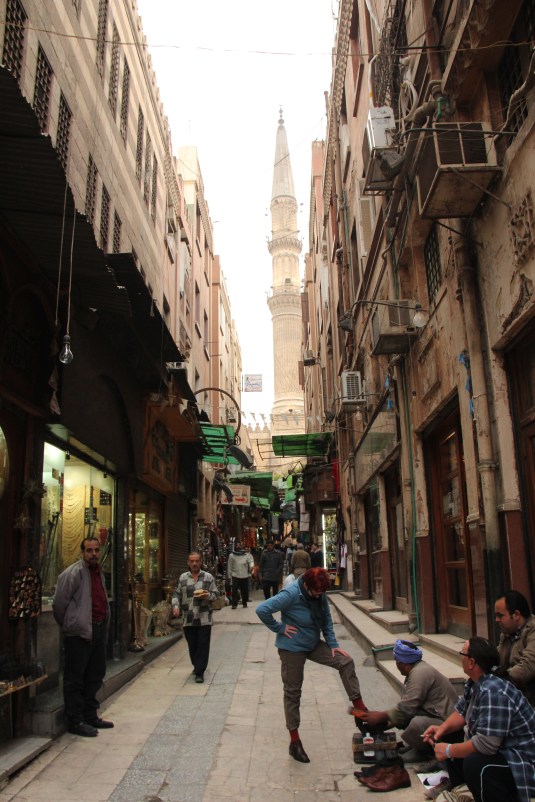
- A woman getting her shoes polished in Khan El-Khalili Bazar
2) NILE RIVER CRUISE: You can’t leave Egypt without experiencing Nile at night and the best way to do is to take a dinner-cruise. Our ship’s name was Lady Diana Nile Cruise Line. This was a unique experience for all of us and the kids loved it the most. Combination of Nile and Cairo looked more than just beautiful at night from the observation deck.
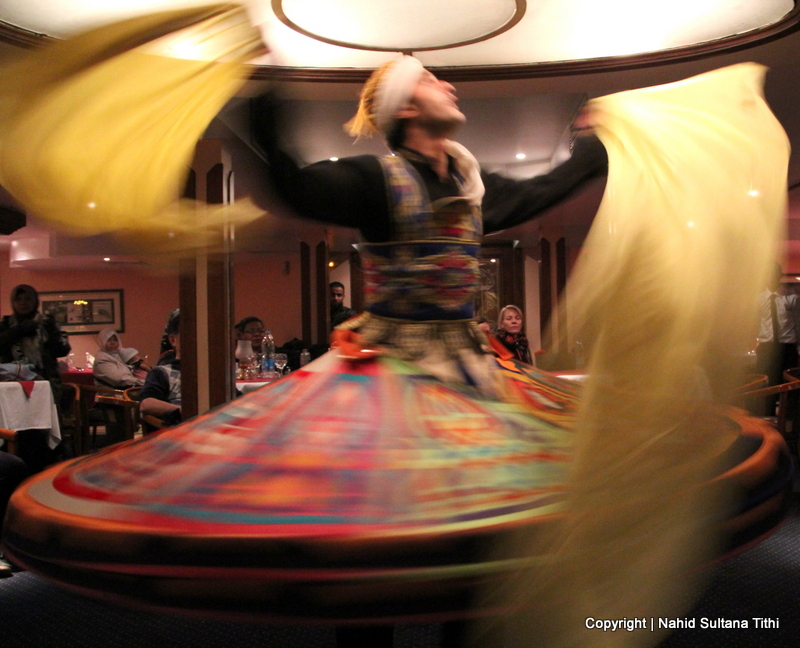
It was a cozy sitting area where we had dinner. Buffet trays were filled with absolutely fantastic food. The show started with karaoke songs during our meal but the real entertainment started after dinner. First it was belly dance, which we saw before…I think I enjoyed the fast Arabic music the most here. The final item was a man doing whirling Sufi performance. Now, that was something we have never seen before and it looked out of this world. The enthusiastic music, Dervish’s costume, his circling…everything about it made that place very mystical.
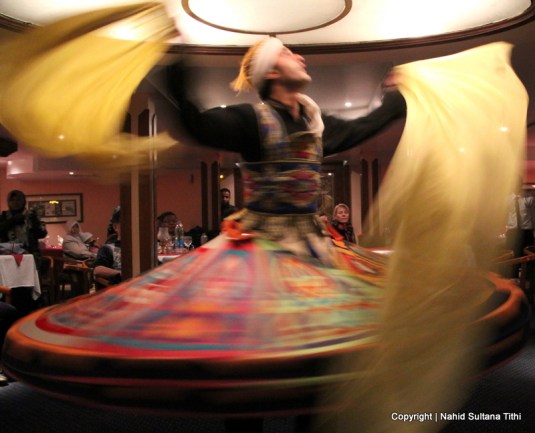
- A Dervish performing Sufi dance during our Nile River cruise
Our hotel arranged this trip for us. It was 90 USD for all 4 of us. The dinner started at 7:30 pm and by the time we were done with all the performances, it was about 9:30 pm.
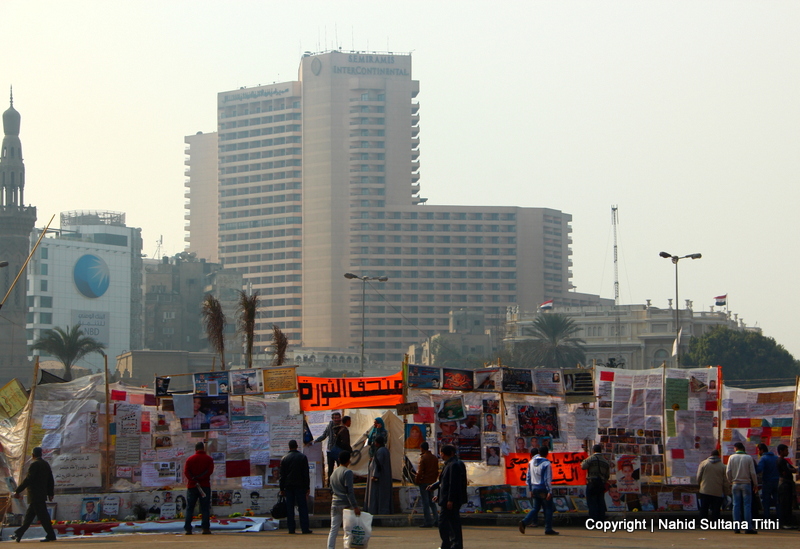
3) TAHRIR SQUARE: Also known as Midan Tahrir (meaning Liberation Square) is located in front of Egyptian Museum and was occupied by the demonstrators’ campsites and banners during our visit. This is where Egyptians gathered around during the uprising of the country before impeaching their President Hosni Mubarak. This large public square is a historic place for Cairo and Egypt and their history.
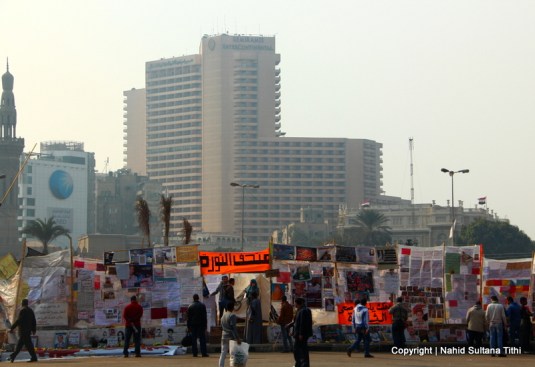
- Demonstrations in Tahrir Square, Cairo
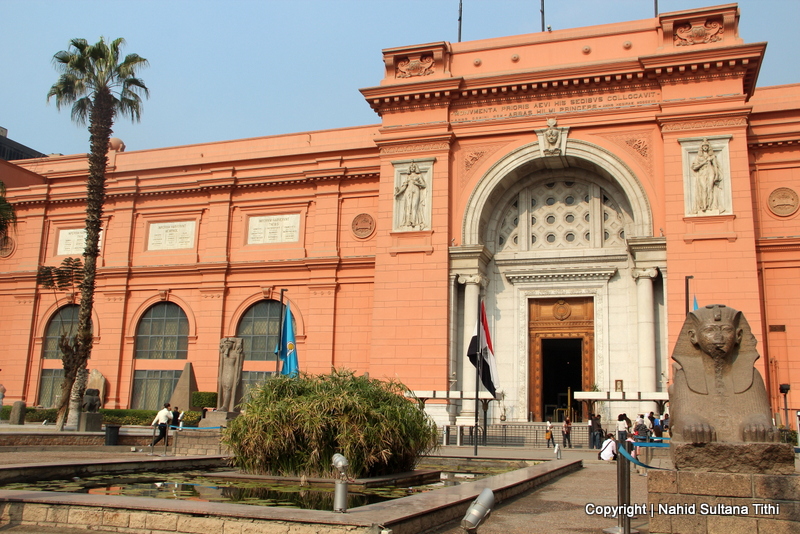
4) EGYPTIAN MUSEUM: Located in busy Tahrir Square, this is one of the greatest museums in the world and a must-see to acquire knowledge on real history of Egypt. Massive collections of ancient Egyptian antiquities can be found outside and inside of the building. I’ve heard that hundreds of items are added each year to this museum as more excavations and discoveries take place. More than 135,000 items of this museum display artifacts of pre-dynasty, Old-Kingdom, Middle-Kingdom, late periods, and from Greek and Roman periods.
Some of the highlights of this place are the 2 Royal Mummy rooms, pet/animal mummies, early jewelries, hundreds of beautifully carved coffins, stone-carved statues, hieroglyphics granites, and early manuscripts from different dynasties of Pharaonic periods from as early as 3200 BC. Finally many objects/treasures from Tomb of Tutankhamen, including his famous original mask is at display here. Royal Mummy room has mummies of ancient Egyptian kings, queens, and high priests. Seeing mummy of Pharaoh Ramses II really gave me goose bumps. Evidently, he is the Pharaoh who chased Moses (Prophet Musa AS) across Red Sea and drowned with his army in the ocean. His mummy is the best preserved mummy there… when you look at his teeth and hair, those don’t look like few thousand years old. The museum is a bit un-organized and many of its objects lack labels or information board. Some collections looked like they were just stacked without care. But the good news is that, the location of this museum is supposed to move somewhere in Giza which will have more space to accommodate these object of bygone days.
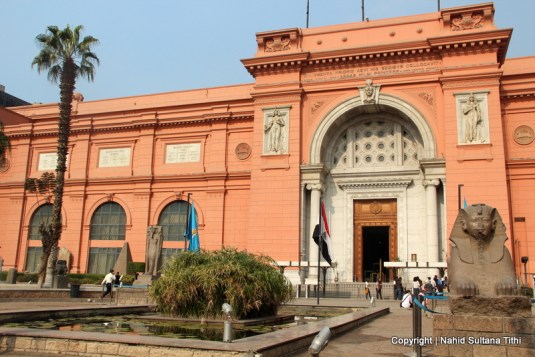
- Front of Egyptian Museum in Cairo
Ticket to enter the museum is 60 LE for adults and 30 LE for children. There is a separate fee to enter the section of Royal Mummies which you can purchase from the upper level. It’s 100 LE for adults and 60 for the kids. No camera or backpack is allowed inside the museum. We had to keep them in a locker near the ticket office. The museum has 2 levels and visiting it took us about 2 ½ hours.
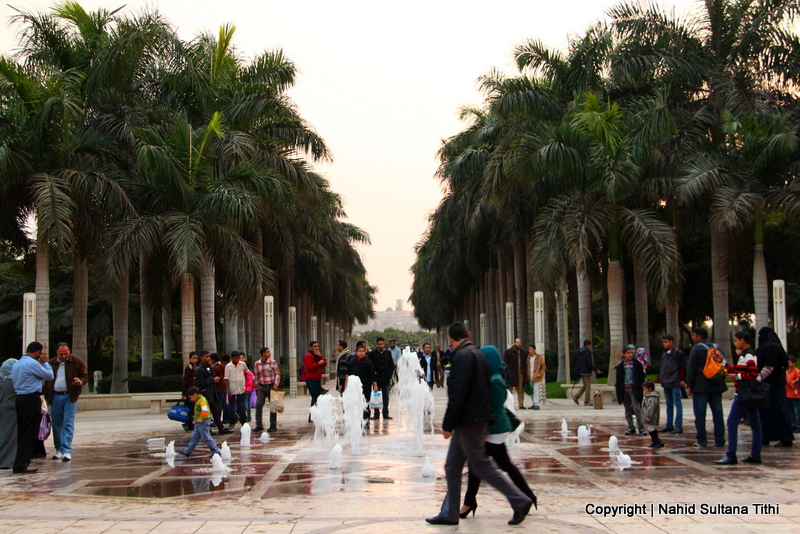
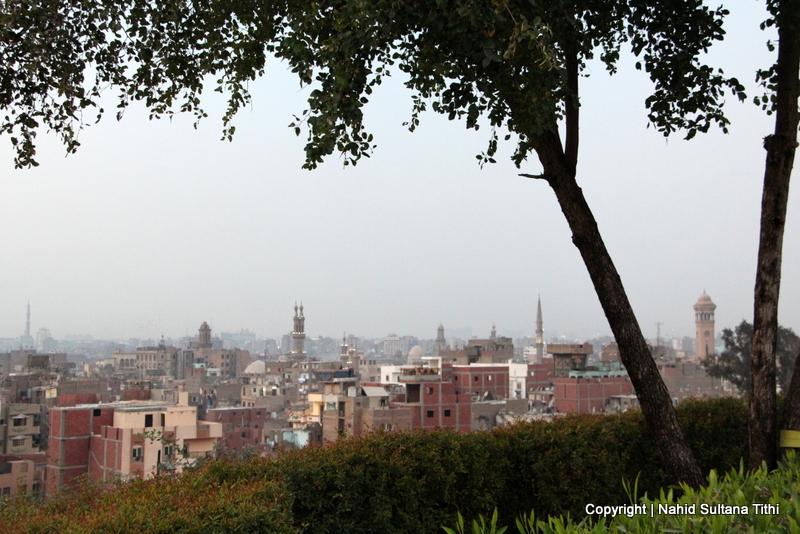
5) AL-AZHAR PARK: This is the best landscaped garden and park in Cairo for strolling and enjoying magnificent view of the city. It is known to the locals as the “lung of Cairo”. We went there right before sunset and saw the whole city lighting up as it was getting dark very slowly. Standing in Al-Azhar Park, you will realize why Cairo is known as “City of Thousand Minarets” … you can see many old and new minarets of mosques from here, creating a unique skyline. An uncle, my ex-colleague’s father, took us here and treated all of us to dinner in a restaurant inside the park name “The Citadel”. We had our best traditional Egyptian meal here while looking at lit-up Ali Pasha Mosque on the distance. The park looked ever nicer at night. 5 LE is the entry fee. It is very well maintained and absolutely safe. Park closes around 10pm and no one is allowed in afterwards.
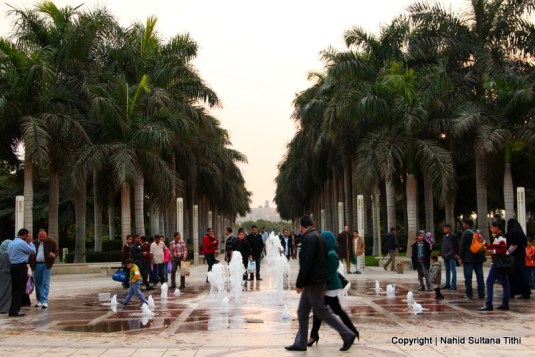
- Al-Azhar Park in Cairo, Egypt
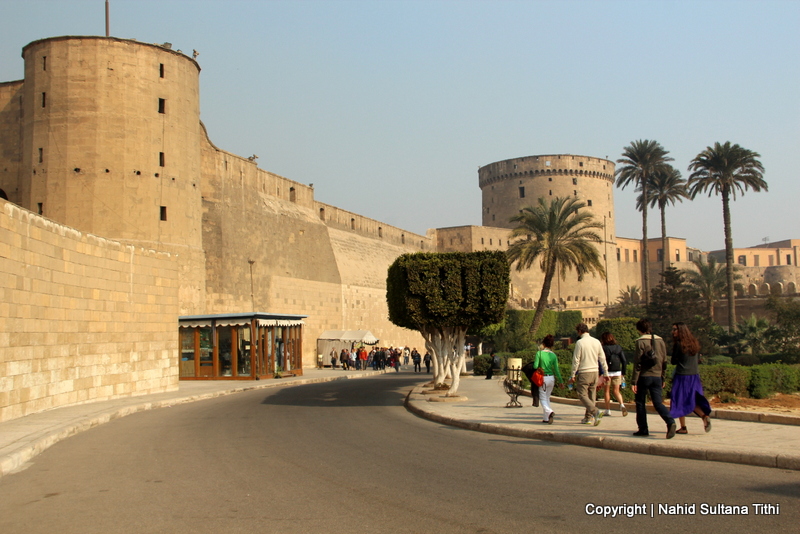
6) CITADEL and ALI PASHA MOSQUE: Locals know this place as Salahdin’s Citadel because it was built by the mighty Salahdin (Muslim caliph who defeated the Crusaders) in 1183 AD.
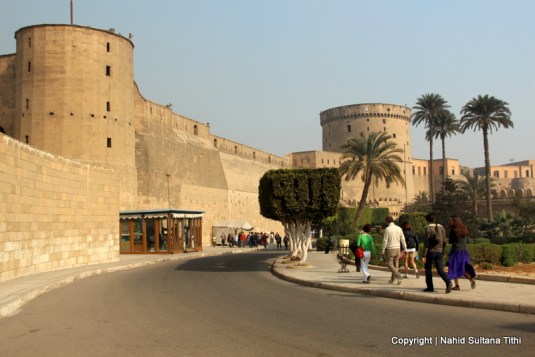
- Walking towards Cairo Citadel, also known as Salahdin’s Citadel in Cairo, Egypt
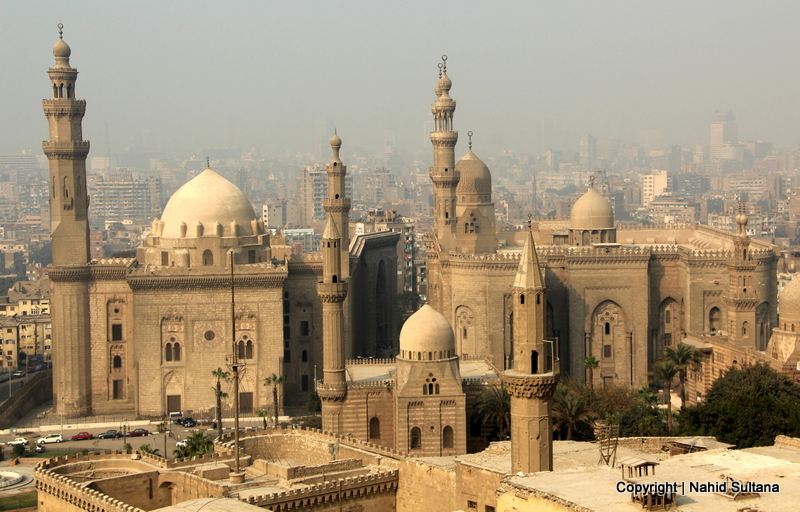
There are few old mosques and museums (like Police National Museum, Prison Museum, Al-Gawhara Palace Museum) inside the citadel. You can spend whole day roaming around and visiting them leisurely. The best part of being here is the view you get over Cairo. On a clear day, you can see as far as the Pyramids of Giza. Panoramic view of Sultan Hasan Mosque and Rifaii Mosque side by side looks great along with the other parts of Islamic Cairo.
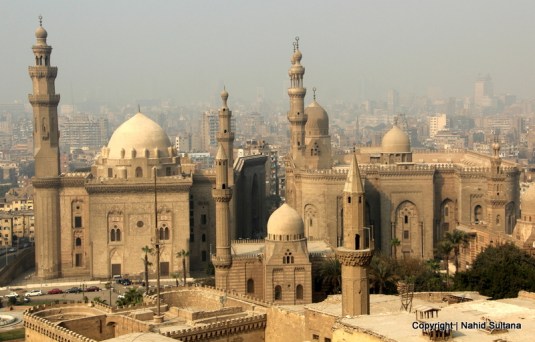
- View of Rifaii Mosque (right), Sultan Hasan Mosque (left), and other parts of Islamic Cairo in Cairo, Egypt
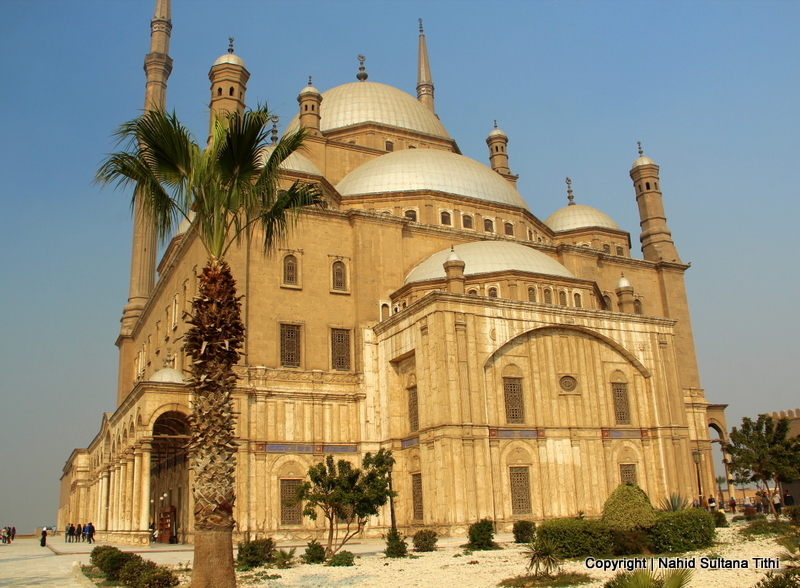
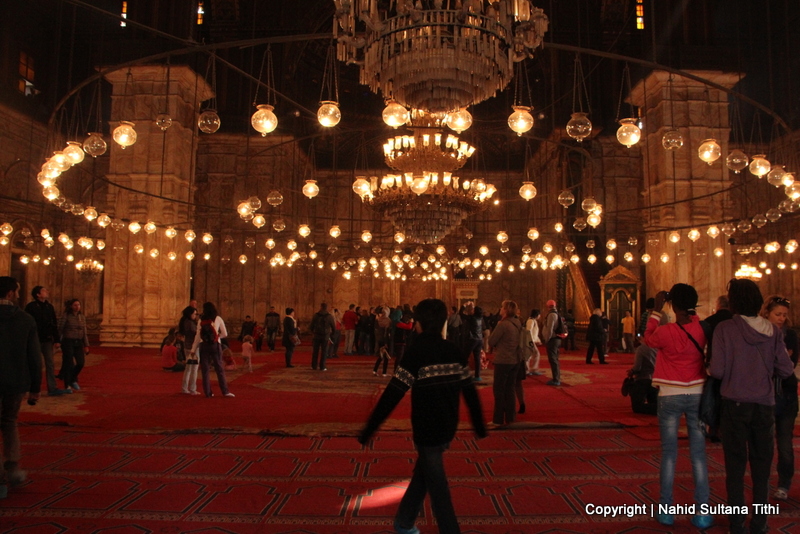
Ali Pasha Mosque, also known as Mohamed Ali Mosque, is an iconic structure of Egypt that can be spotted from almost anywhere in Cairo day or night. The mosque was built inside the Citadel in the mid-19th century. This old and grand mosque was established by Mohamed Ali Pasha, who is considered to be the founder of modern Egypt, and took about 18 years to build. From outside, the mosque looks more like the Blue Mosque of Istanbul. Courtyard is enormously spacious and beautiful. This big mosque is very beautiful inside with nice dome, vaulted ceiling, big chandelier, and old patterns on wall. Tomb of Mohamed Ali Pasha is also located inside the mosque. One thing that made me sad about this mosque was that it lacked maintenance outside and inside. A structure this massive and historical is country’s pride and deserves love and attention which was missing from this place.
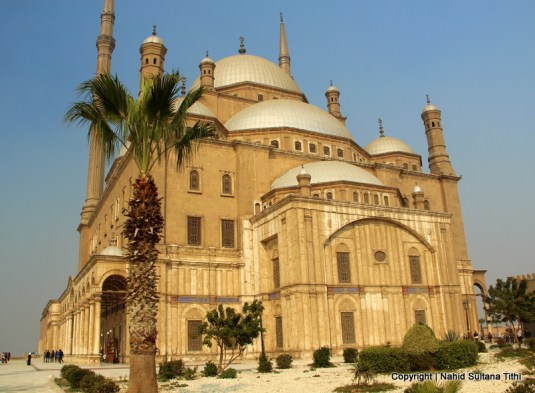
- Ali Pasha Mosque in Cairo, Egypt – an iconic landmark of Cairo
The citadel is located in Islamic Cairo. Entry fee to the citadel is 50 LE for adults and 25 LE for the kids and is open from 8 -5 pm. We didn’t go to any museums or mosques, other than Ali Pasha Mosque, that’s why we were done in few hours.
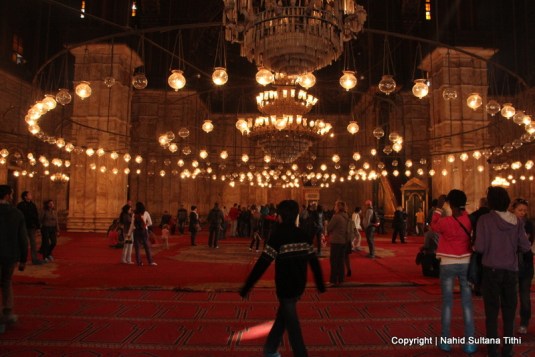
- Inside Ali Pasha Mosque in Cairo, Egypt
7) HISTORIC MOSQUES of CAIRO: Most of the mosques are located in Islamic Cairo and they are very old, dusty, and lack in maintenance. You will see many homeless and beggars lurking around these places. Please try to maintain right etiquettes of visiting these sacred places during your trip, it shows the local that you respect their culture and belief.
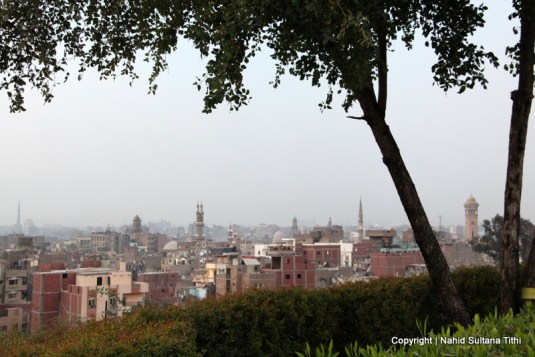
- Looking at Islamic Cairo and its many minarets from Al-Azhar Park…no wonder Cairo is known as the City of Thousand Minarets
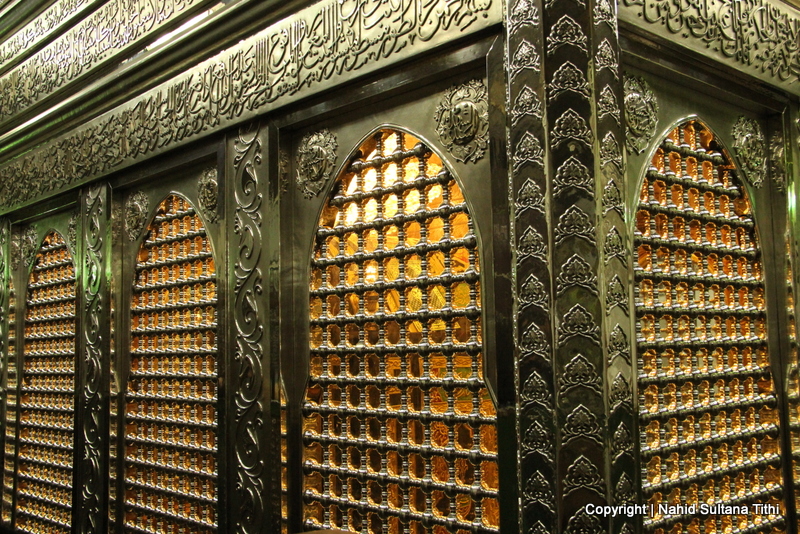
a) SAYYIDINA AL-HUSSEIN MOSQUE: The mosque is located in Midan Hussein and very close to Khan-El-Khalil souk. The original mosque was built-in the early 12th century. This is a very sacred site for Muslims all over the world since head of Ibn Al-Hussein, grandson of Prophet Muhammad (S.A.W), was buried here. The decorative rawdah or tomb can be viewed from both men and women side. It’s free to enter (have to pay 1 LE to store your shoes) but unfortunately, this in not accessible to non-Muslims.
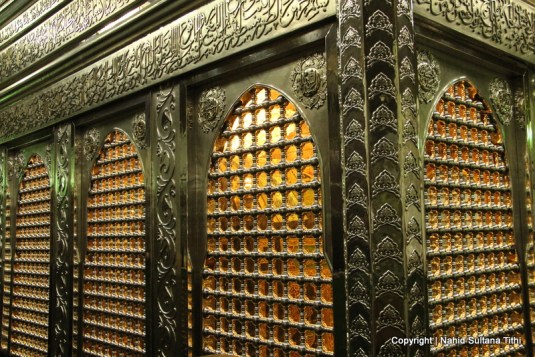
- Rawdah or tomb of Sayyidina Hussein AS (grandson of Prophet Muhammad SAW) inside Al-Hussein Mosque, Cairo, Egypt
b) AL-AZHAR MOSQUE: This is another historic site in Midan Hussein. Founded in 970 A.D., Al-Azhar Mosque is one of Cairo’s oldest mosques and nearby Al-Azhar University which is the world’s OLDEST OPERATING UNIVERSITY. Its big and open inner courtyard is very peaceful where you can spend some time appreciating its age and beauty. Inside the mosque is simple but very big. It’s free to enter but have to pay 1 LE to store your shoes in the entrance. Non-Muslims can access this mosque but not during prayer times.
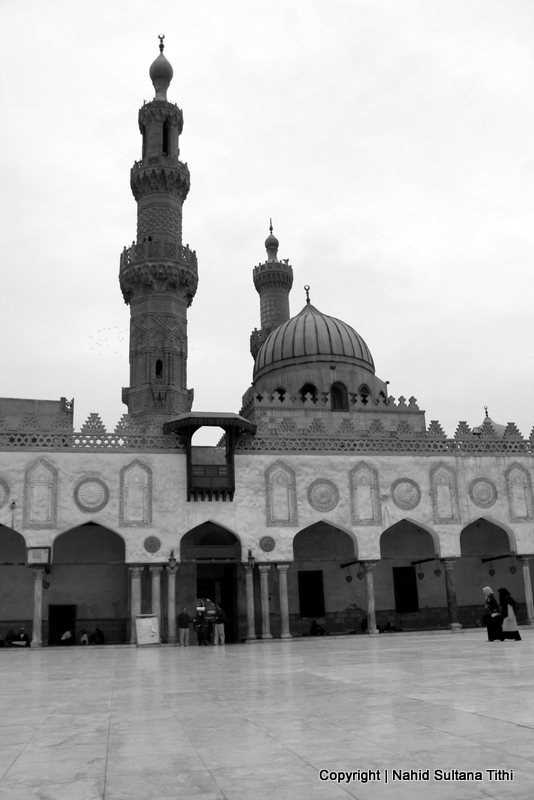
- Courtyard of Al-Azhar Mosque in Cairo, Egypt – standing there since 970 AD
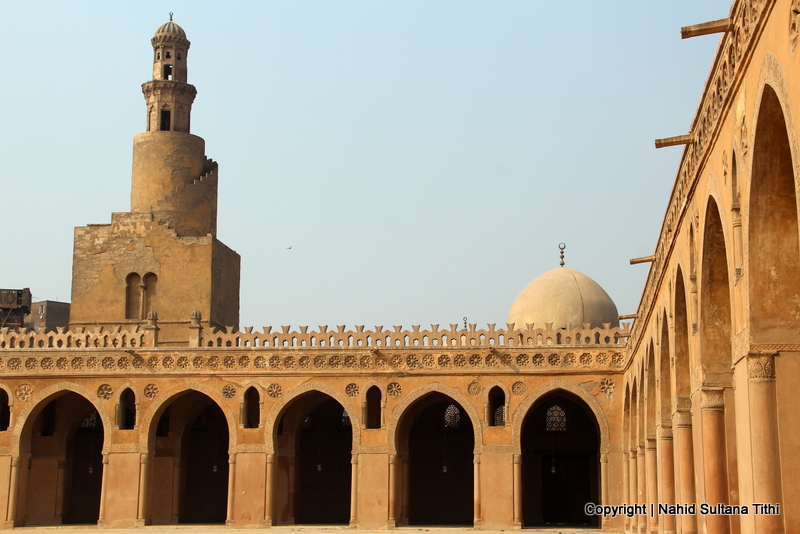
c) IBN-TULUN MOSQUE: Built in 879, this mosque is from early Islamic era. The minaret of Ibn-Tulun Mosque is said to be the oldest minaret in Egypt. The inner courtyard and the interior are huge, but lack care. It was free to enter and took us about 15-20 minutes to walk around the perimeter. The mosque is still active, therefore, they don’t allow any visitors during prayer times.
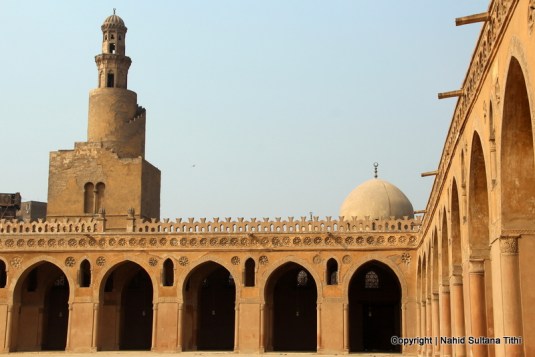
- Ibn-Tulun Mosque in Cairo, Egypt – minaret of this mosque is said to be the oldest in Egypt
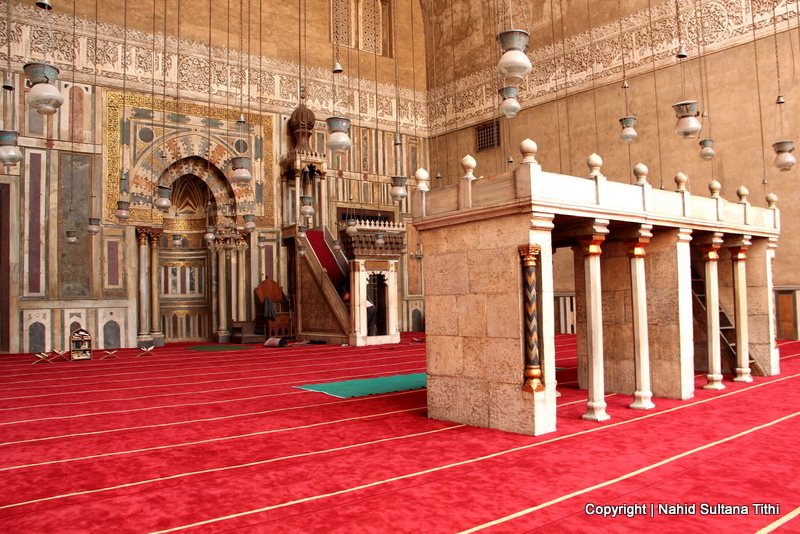
d) SULTANA HASAN MOSQUE: Located in Midan Salah ad-Din (Saladin Square) and lying at the foothill of the hill, this is a really old mosque from 1356 and is a great example of Mamluk dynasty. This is one of the biggest mosques in Egypt. This is actually a both mosque and madrassa (Islamic school) with very early Islamic architectural design. You can still see some of the original old mosaic floors here and there. The courtyard is notable for its elaborate marble flooring, a trademark of Mamluk art. It was under major renovation during our visit, therefore couldn’t visit some of the sections. Entry free to this mosque and Rifaii Mosque is 40 LE for adults and 20 LE for kids.
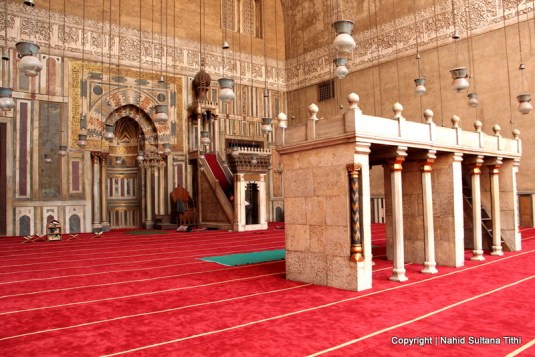
- Inside Sultan Hasan Mosque in Cairo, Egypt – a great example of Mamluk dynasty architecture
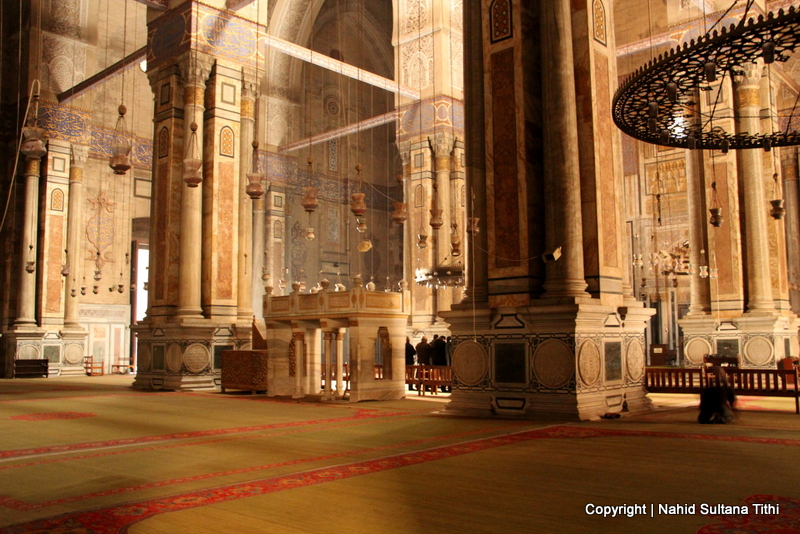
e)RIFAII MOSQUE: This mosque is located right opposite of Sultan Hasan Mosque and the same ticket covers both the mosques. This is probably the last large-scale mosque to be built-in pre-Republican Egypt. Several leading architects of that time took part in designing it. Replacing a smaller mosque, this early 20th century mosque is the final resting place of the last Shah of Iran (Mohammad Reza Shah Pahlavi). Many members of the Egyptian royal family were eventually buried in the mosque. Ironically, Egypt’s King Farouk, who was overthrown in 1952 and died in exile, has his tomb inside the mosque too. Both exterior and the interior of the building are elaborately decorated. High ceilings and big old chandelier are some of the highlights of this place.
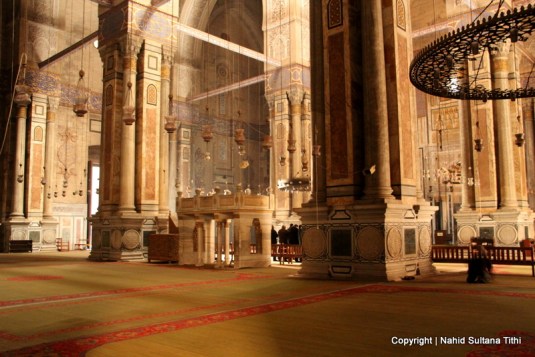
- Prayer hall of Rifaii Mosque in Egypt, final resting place of Egypt’s last king, King Farouq
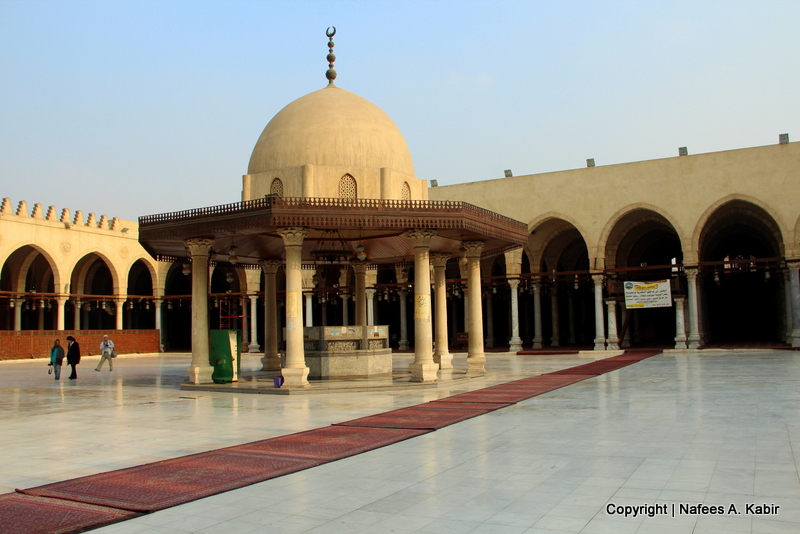
f) AMR IBN AL-AS MOSQUE: Built in 642, this is Cairo’s first mosque and is still an active place for the worshippers. The mosque looked very simple, dull, and not very nurtured by the authority. The mosque is free to enter for everyone, except during prayer times. Men and women have separate entrances.
The ladies have to wear a cloak and everyone must take off their shoes upon entering any of mosques.
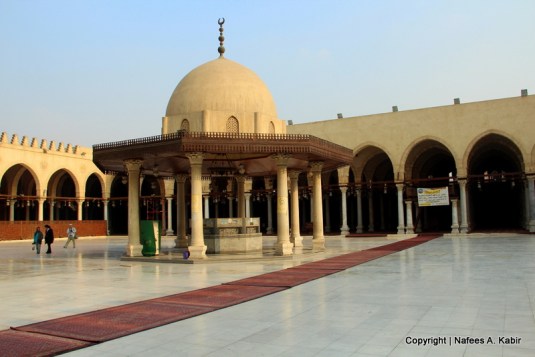
- Courtyard of Amr Ibn Al-As Mosque, the oldest mosque in Egypt from 642 AD
8) COPTIC CAIRO & ITS CHURCHES: This is part of Old Cairo and has been home of Cairo’s Christian community for centuries. You can actually walk from Amr Ibn Al-As Mosque to the boundary of Coptic Cairo. Old walls and the winding alleys of Coptic Cairo are amazing. Many old churches and monasteries still stand bold and beautiful here. One of the biggest and oldest churches (from the 7th century) of this community is The Hanging Church. It was under major renovation that time, so we couldn’t get an inside view.
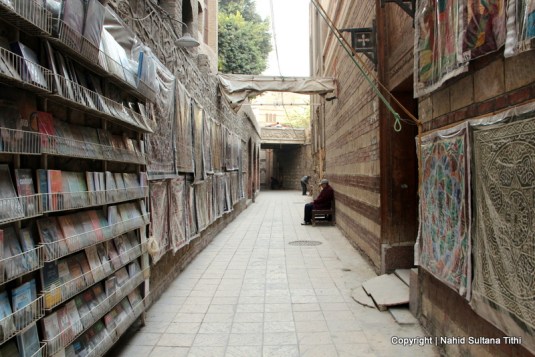
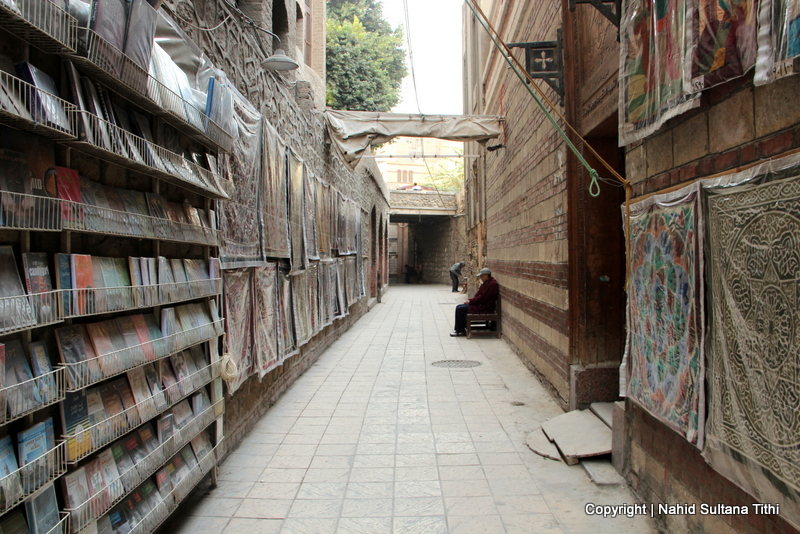
- One of many old and narrow alleys of Coptic Cairo, Egypt
Then we followed an old road of this neighborhood and stopped at in front of another underground ancient church, called Church of St. Sergius. Built in the 4th century, this church has been destroyed and renovated many times over and over again. This old style church is very small but beautiful inside. When we entered there was some kind of recitation going on inside the church and I must say it was a bit surprising listening to these recitation in Arabic, it sounded like I am in a mosque…lolz. Another interesting fact about the Christians here is that they celebrate Christmas on January 7th of each year and not on 25th of December.
9) PHARAONIC VILLAGE: This theme park was built by Dr. Ragab to teach the children of Egypt and the whole world about the 5000 year’s history of this country. This is a living museum and one of the best place for kids as well as adults to get a visual feeling of Egypt’s glorious past. There are four different packages that you can choose to fulfill visitor’s interests. Here they are:
***Village tour + 4 Museums = 95 LE
***Village tour + 8 Museums = 115 LE
***Village tour + 4 Museums + Nefertari Yacht Ride = 145 LE
***Village tour + 4 Museums + Nefertari Yacht Ride + Meal = 195 LE
We took 3rd package but for the lack of their organization and time management, we couldn’t visit all four museums. It’s better to come here in the morning and stay until they close. The “Village Tour” is done by a small engine boat that takes you to the “Mythological Canal” and gives you a ride thru the canal for 30 minutes. This was probably the best part for all of us. You actually see real people enacting ancient scenes of agriculture (like fishing, farming, and etc.) and ancient industries (like papyrus, cotton, wine, pottery, mummification, and a lot more). As the little boat passes by each station you feel like you are living in that era of ancient time.
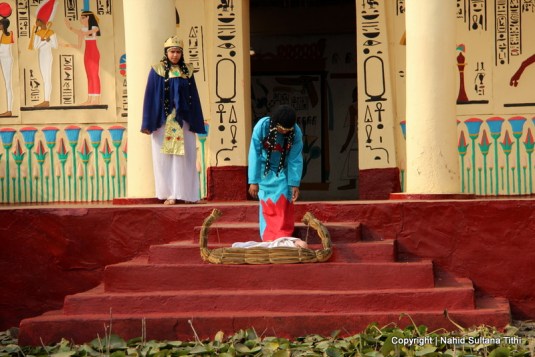
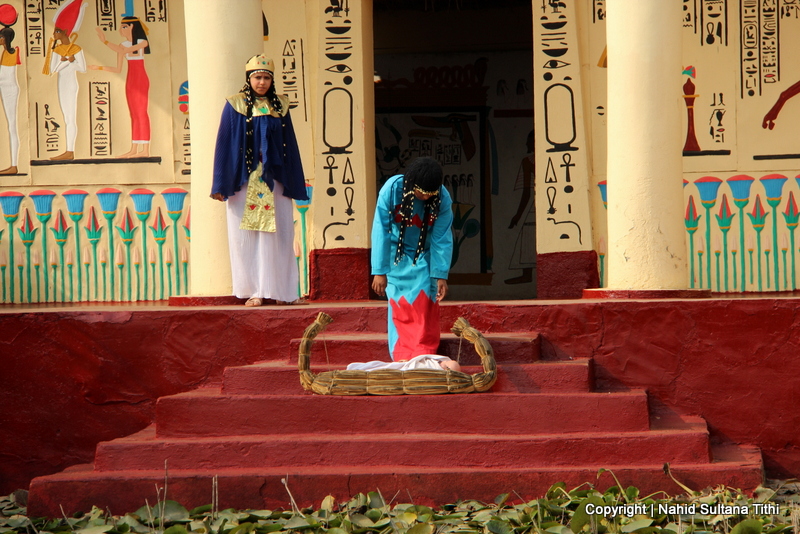
- Scene of baby Moses being picked up by Pharaoh Queen in Pharaonic Village, Egypt
After our boat stopped at the last stop, we met up with a young man who guided us thru the exact replica of Karnak Temple of Luxor. Even though not the real one, this architecture and its decoration are almost look-alike of the real temple. Leaving the temple behind, he showed us around the example of how rich men and peasants used to live thousands of years ago…model of their houses, real people acting out how fire was made, how rich man’s wife would live a lavish life, and how a poor man’s wife would have to work hard all day at home.
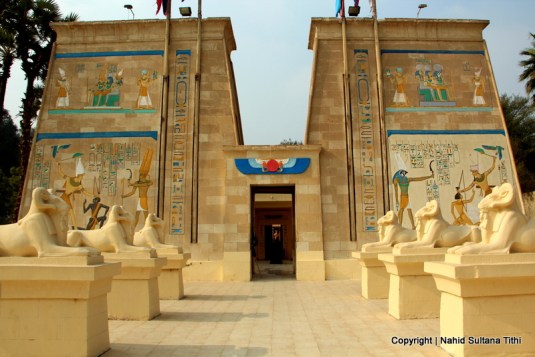
- A replica of the Temple of Abu Simbel in Pharaonic Village, Egypt
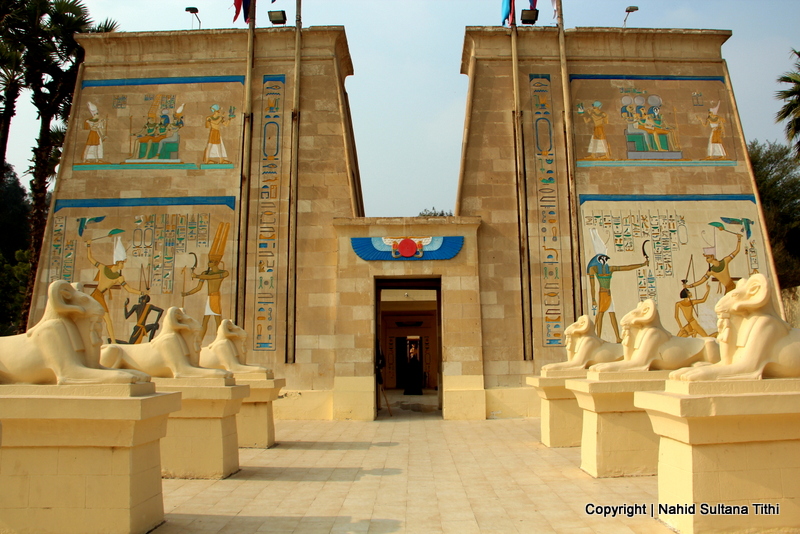
After a 10 minutes break, we headed towards “The Tomb of Tutankhamun”. This is another depiction of the actual tomb of Egypt’s most famous Pharaoh, King Tutankhamun found in Valley of the Kings in Luxor. You can visualize the exact way the tomb was discovered by Howard Carter in 1922. The tomb was filled with many treasures, furniture, couple layers of casket layers, mummified body of King Tutankhamun, and finally his musk, an iconic symbol of ancient Egypt. Our last attraction was Nefertari Yacht tour. The yacht took us to River Nile and gave us a chance to get a daytime view of the river for 45 minutes.
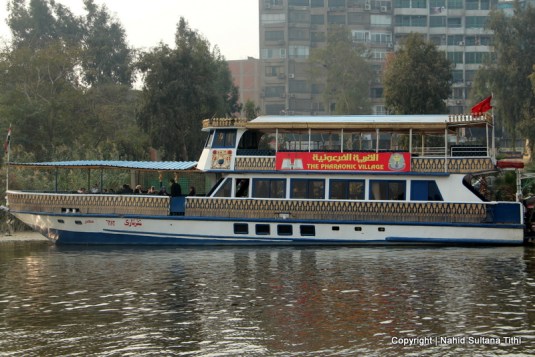
- Our Nefertari Yacht in Pharaonic Village, waiting to take us to River Nile
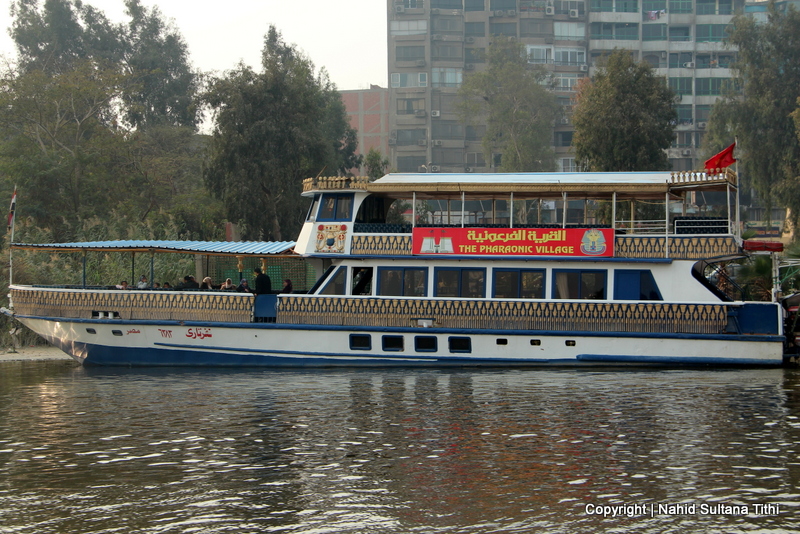
The park has few important museums, like Pyramid’s Museum, Cleopatra’s Museum, The Tomb of Tutankhamun, Mummification Museum, Boats Museum, Modern History Museum, Museum of Islamic History and Art, and couple other museums. Each of these museum doesn’t take more than 15-20 minutes but they are very informative. There are also few unique souvenir stores, cafes, and a photo studio.
Related articles
- Things to do in Cairo, Egypt (growingupbryce.wordpress.com)
- Cairo,Egypt : Several journalists attacked by Muslim Brotherhood members (cpnagasaki.wordpress.com)
- Al-Azhar Mosque (mightyturk.wordpress.com)
- Cairo,Luxor and Aswan 7 Days 6 Nights Tour (egypttraveltours.wordpress.com)
Share this:


The Rose-Red City of Petra, Jordan
PETRA, JORDAN: Without any doubt Petra is a world of wonder and the greatest tourist attraction in Jordan. Also known as “Rose-Red City”, this unique city was carved from sheer rock faces by the Nabataeans more than 2000 years ago. This Kingdom existed for centuries before the Romans annexed it. By the 14th century, Petra was completely lost to the West, until in 1812 a Swiss traveler, Johann Ludwig Burckhardt rediscovered it and noted on his diary “It seems very probably that the ruins at Wadi Musa are those of the ancient Petra.”
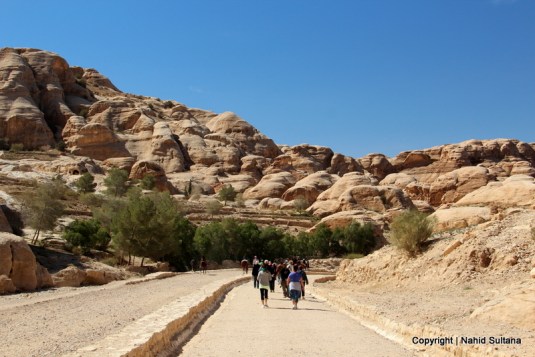
- Entering Rose-Red City of Petra in Jordan
Petra, also known as Wadi Musa or Valley of Moses, is like an open-air museum and the main attraction is the ruins itself. You need at least one day (or few days) to explore the major sites of it. Petra enchants travelers with its revealing appearance and bold history. It never fails to impress them. There is no place like this on earth and its beauty is beyond any expressions. I saw many images of Petra before traveling there, but they come nowhere close to what we experienced.
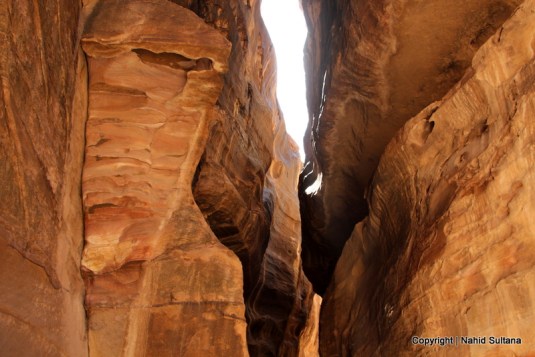
- Little piece of sky that you can see while walking thru Siq in Petra, Jordan
For the history of Petra, I will copy the information from the information board that I saw near the visitor center…I think that sums it up very well. “Petra, as the capital of the Nabataean Kingdom, thrived as an important trading post on the international Spice Route, serving as a crossroad between Arabia, Egypt, Palestine, Syria-Phoenicia, India, China, and the Mediterranean Basin. Nestled within intricate geological formation of mountains and gorges are the impressive tombs that the Nabataeans carved out of the sandstone rock faces. Nabataeans, Romans, and Byzantines built the city of Petra from the 2nd century BC to the 5th century AD. Whilst the architectural facades of the tombs are a harmonious blend of ancient Assyrian, Egyptian, Hellenistic, and Roman styles, archaeological excavation in Petra have brought to light that the city itself survived well into the Byzantine period.” — From information board of Visitors Center in Petra, Jordan.
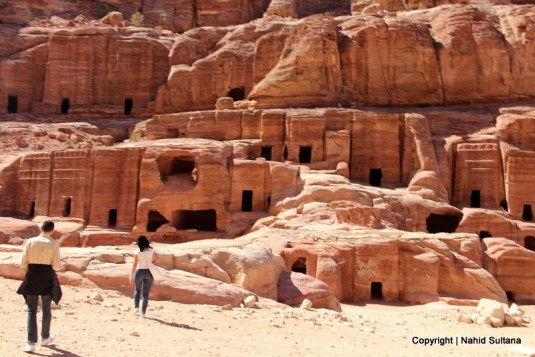
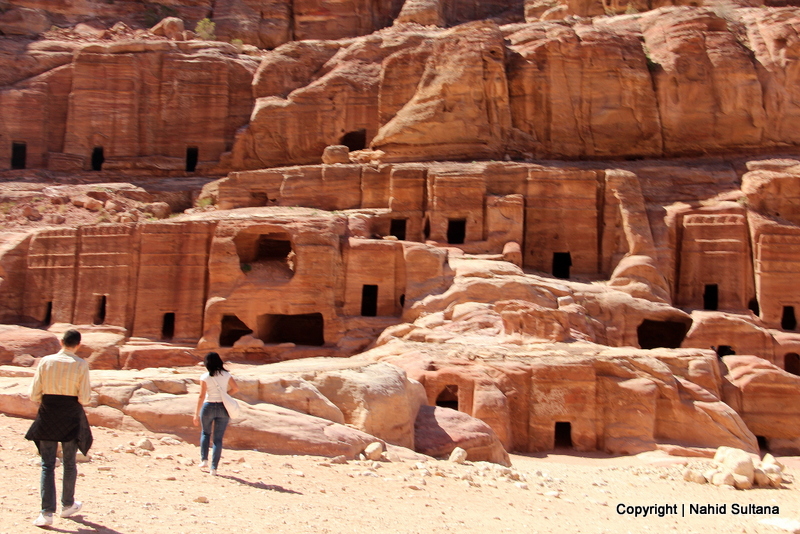
- Hundreds of caves and tombs of Nabataean Kingdom in Petra, Jordan. The picture came a bit out of focus because I was on a mule.
TIME of TRAVELING: We stayed in Jordan all together about a week. Out of that, we spent 2 nights in Petra and one full day exploring the valley and its ancient history. It was mid-February of 2013. Although we were prepared with our jackets the day we were in Petra (all the visitors were actually carrying jackets/sweaters) but when you have to walk few miles those jackets eventually end up either in your backpack or tied to your waist. That’s what happened to us too, but it did get a bit chilly in late afternoon when we were walking back to our hotel. Other than that it was a perfect day to do some outdoor hiking with kids.
OUR HOTEL: We stayed in Movenpick Resort in Petra, right outside the Visitors’ Center. I don’t think I need to say much about Movenpick, it’s a 5-star hotel…very luxurious rooms with excellent customer service. Wi-Fi wasn’t free but breakfast buffet, with variety of different items to choose from, was free for its customers.
EATING and SHOPPING: We had lunch after 4 pm the day we spent in Petra. We were dead tired and just went to the first place we saw, which was luckily next to our hotel. It was nothing fancy, but had some good soups and pizzas. There are many restaurants and cheaper places if you are willing to walk 10-15 minutes from the entrance of Petra. If you are hungry inside Petra, few restaurants/cafes are available after crossing Khazana and Roman Theater.
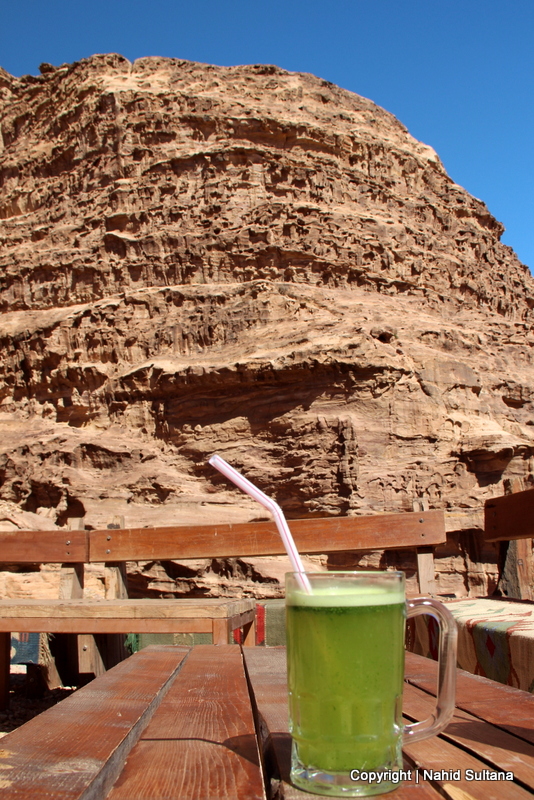
- My glass of lemonade with a hint of mint on top of the mountain on our way to the monastery in Petra, Jordan
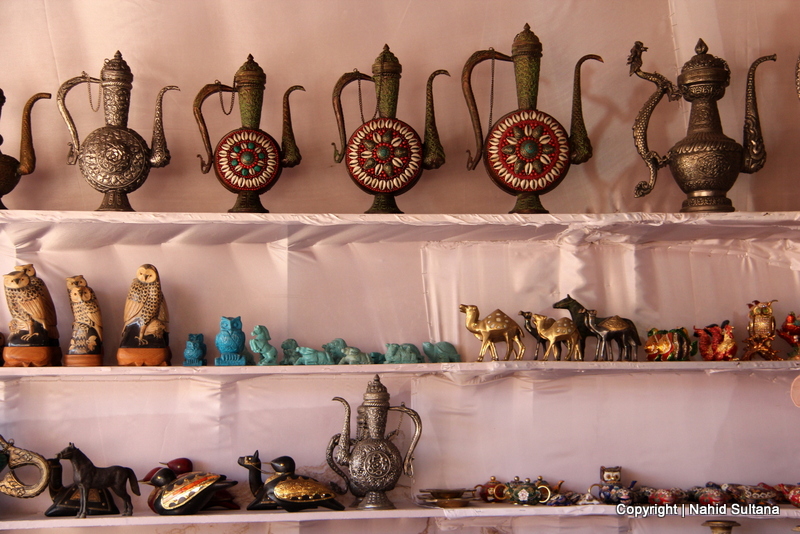
I didn’t see much of shops there, I guess I wasn’t looking at the right directions. I saw a souvenir shop on top of the mountains when we arrived there with our donkeys, and a mule to go to the monastery. Oh and also saw many Bedouin ladies selling local trinkets in the valley and on the mountains.
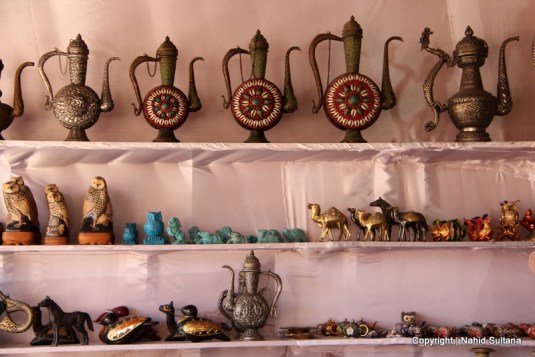
- A souvenir shop on the mountains selling local trinkets in Petra, Jordan
PLACES WE’VE VISITED: I tried to break our visit of Petra in few different segments to make it easy on me and my readers. We did rent 2 donkeys and a mule to help us climb more than 900 stairs to go to the monastery and then later a horse-drawn carriage from Khazana to the main entrance of Petra thru Siq. It just made it a whole lot easier on the kids and us…can you imagine climbing 900 stairs (they are not even stairs either) with a 7-yrs. and a 3- yrs. and then walk another 15-20 minutes to the monastery? By the way, both of my girls were still sick from our previous day-trips in other parts of Jordan, I truly appreciate their courage and support on this trip.
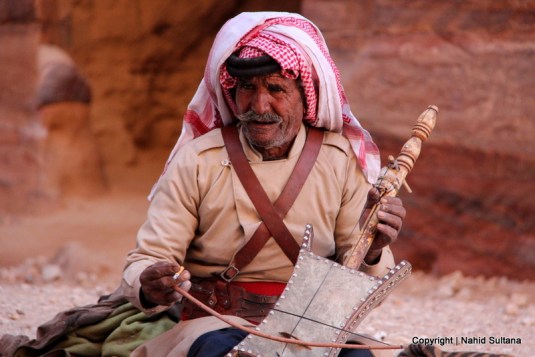
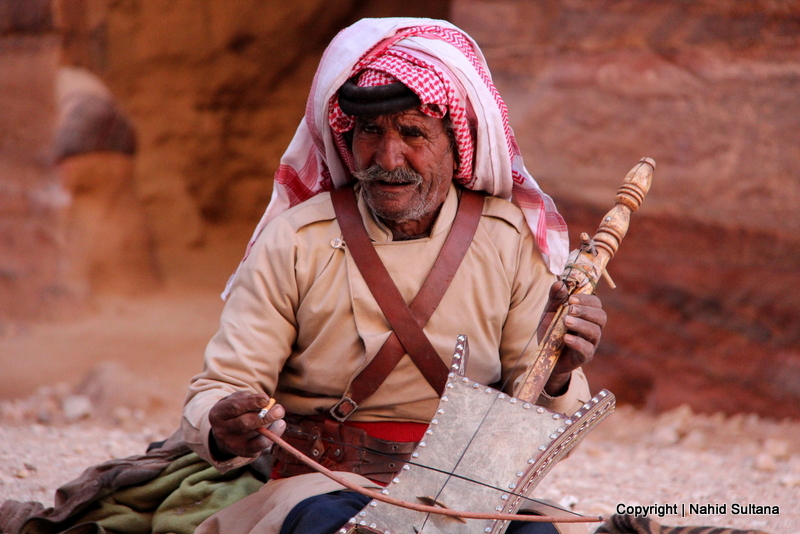
- Man playing a very old instrument, called Rebabh, near Khazana in Petra, Jordan
Here are the price information for our rides if any travelers find it useful:
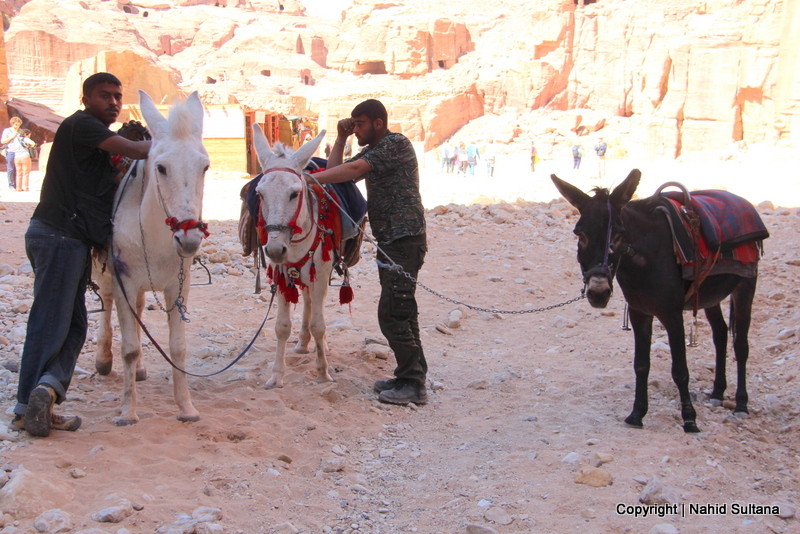
Rent for 2 donkeys and 1 mule (with 2 guides) – From Khazana to Monastery and return is 60 JD + my husband gave them 20 JD tips. 60 JD rent was bargained before we rode on the animals…very important that you do it. This portion of tour took only 2 hours…thanks to those lovely animals for doing the hard work.
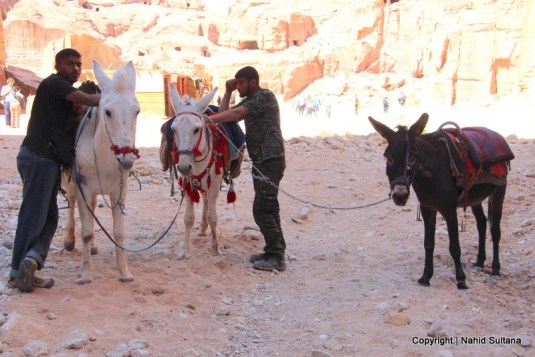
- Our guides and rides to the monastery in Petra, Jordan
Horse carriage ride for our whole family from Khazana to Visitors’ Center was 20 JD (no tipping). Disable visitors can rent horse carriage at the entry point for free, but be sure to decide on how much tip you are going to pay them beforehand to avoid any trouble. Right after entering the site, many people will try to get you to rent their horse or donkey and will tell you that it’s free. But remember, legally, it’s only free for disable, sick, or elderly people. Don’t fall for what they say…it’s just a way of making money. Here is the entry fees information: (Guided tour is available in the visitor center)
a) Overnight visitors to Jordan:
1 day – 50 JD
2 days – 55 JD
3 days – 60 JD
b) Day visitors to Jordan:
1 day – 90 JD
Tourists often come from Israel on day trips and hence the ticket category is different for them. You may have either to show your passports or your hotel keys (if staying overnight in Petra) to prove that you are not a day visitor in Jordan.
Okay, so here are some highlights from our Petra tour:
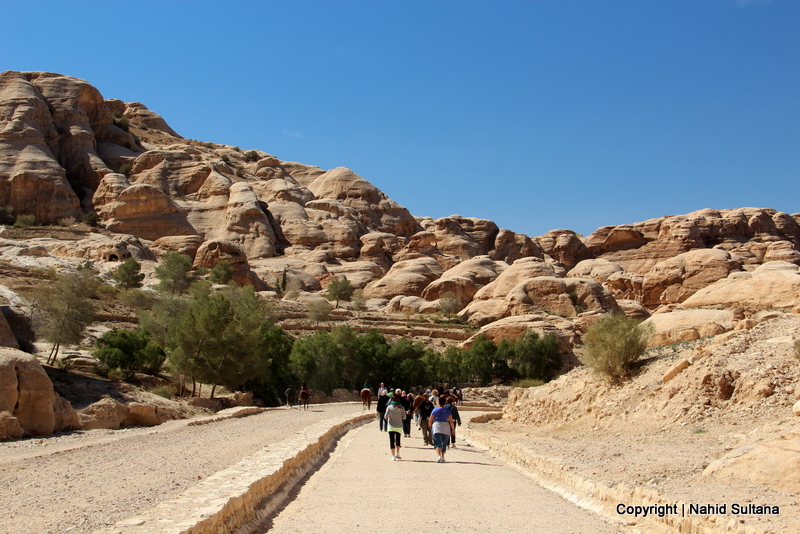
1) FROM VISITORS’ CENTER to BAB AL-SIQ: This walk was about 1 km long until we reached the entry point of Siq. This is just the appetizer for the main beauty of Petra…if appetizer is this good, you can only imagine what the main course would be like!! Both sides of the walkway are guarded by large and small hills and interesting natural rock-formations. We saw many natural and hand-cut caves on this stretch. This area also contains several rock-hewn monuments and memorials, including the distinctive tower tombs known as the Djinn Blocks, the rock-cut funerary complex of the “Obelisk Tomb” and the “Bab Al-Siq Triclinium.”
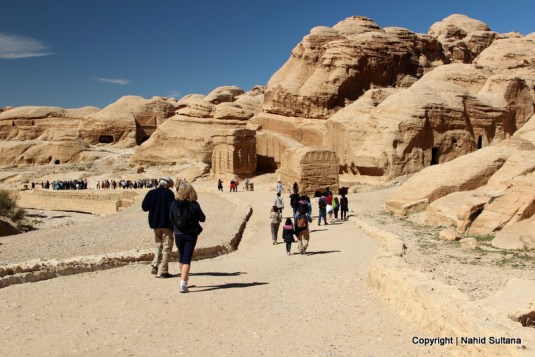
- Walking from Visitors’ Center to Bab Al-Siq in Petra, Jordan. You can see some Djinn Blocks (the square rocks) here
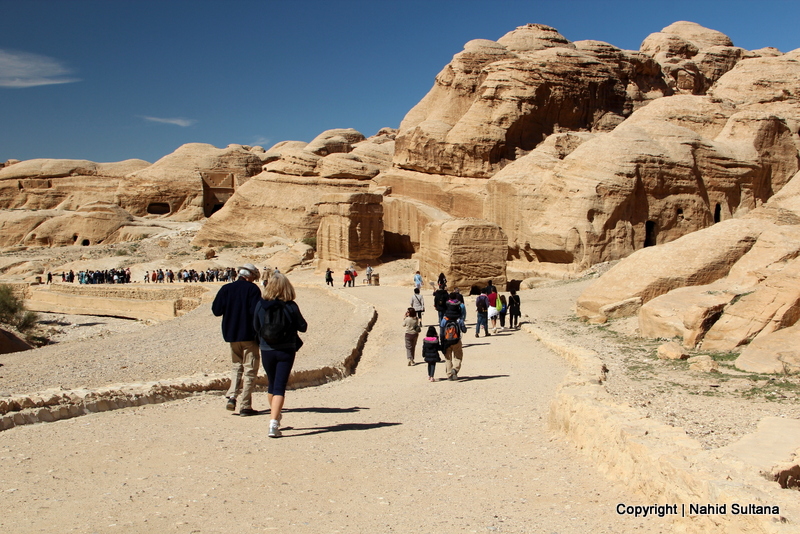
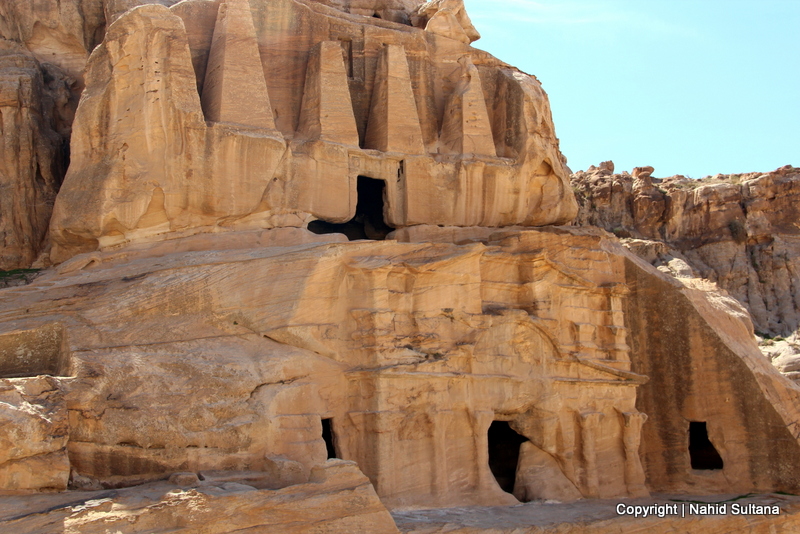
Djinn Blocks (Djinn is a type of spirit in Arab folklore) are free-standing cube-shaped monuments which served as tombs and memorials to the dead. There are only 3 or 4 of them near Bab Al-Siq but a total of 25 Djinn Blocks can be seen in whole Petra. These are some of the earliest tombs carved in Petra in around 2nd to beginning of 1st century BC. Obelisk Tomb and Bab Al-Siq Triclinium were carved from sandstone cliffs around 25 – 75 AD. Petra’s Bedouin inhabitants named the entrance of Siq “Bab Al-Siq” meaning Gate to the Siq in Arabic.
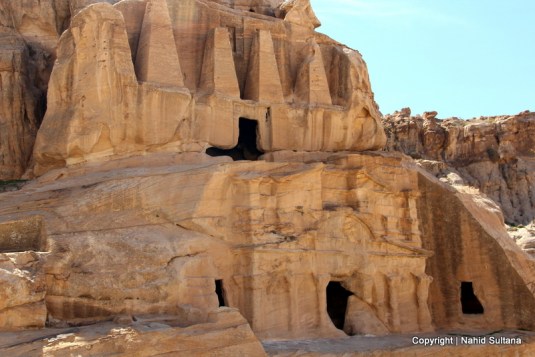
- A rock-cut funerary complex “Obelisk Tower” before entering Siq in Petra, Jordan
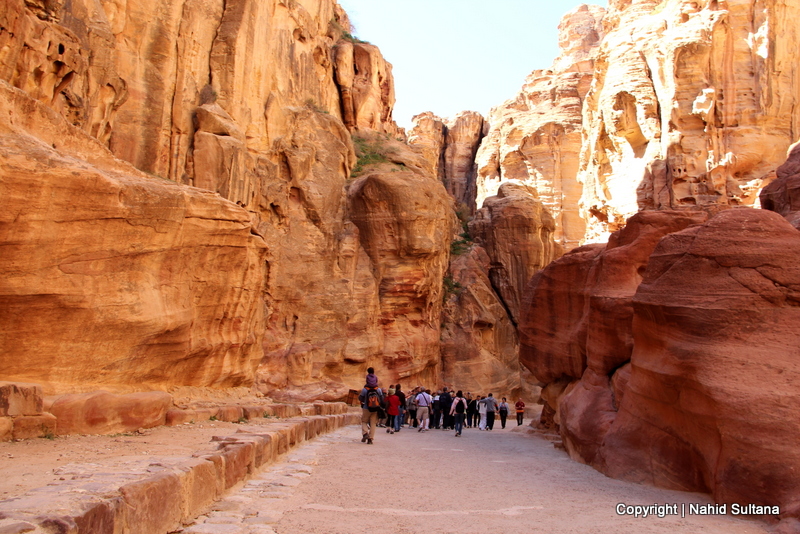
2) THE SIQ: The real beauty of Petra begins as soon as you enter Siq. You can’t imagine its grandness without being here physically. This narrow 2 km passageway takes you right in front of the most popular attraction of Petra, the Khazana (Treasury).
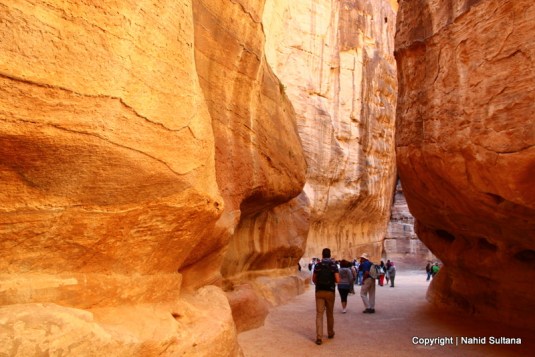
- The Siq – a natural gorge and main entrance to the City of Petra, Jordan
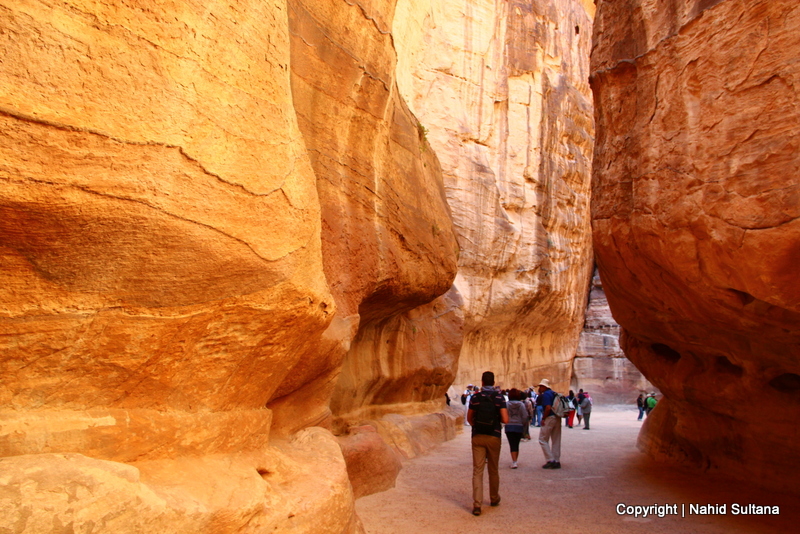
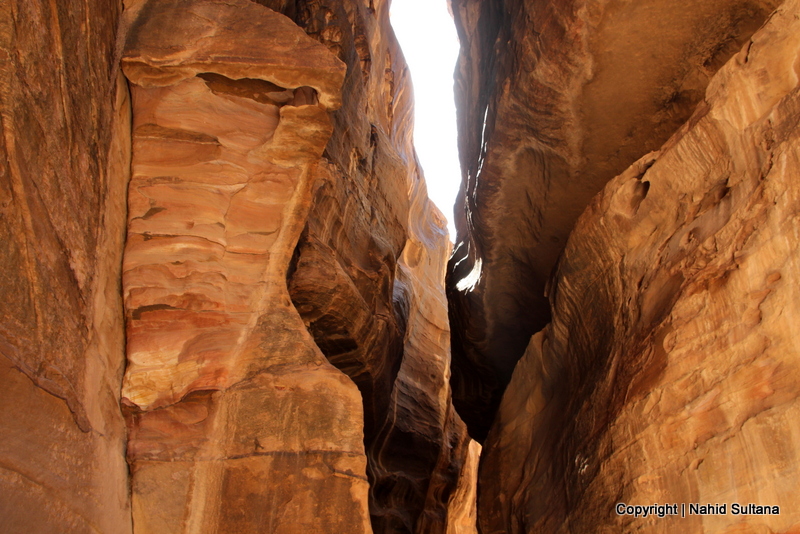
Siq is a natural sandstone gorge that gently winds towards the ancient city of Petra. This was once the main entrance to the city. In its day, Petra was a bustling city that witnessed a constant procession of travelers, visitors, and pilgrims, who passed along this same path. Many carved blocks and petroglyphs can be seen throughout the Siq. Different shades of colors of the canyon and fascinatingly beautiful shaped rocks give this place a different charm. I have never seen anything like this before. This is where natural wonders collide with ancient world.
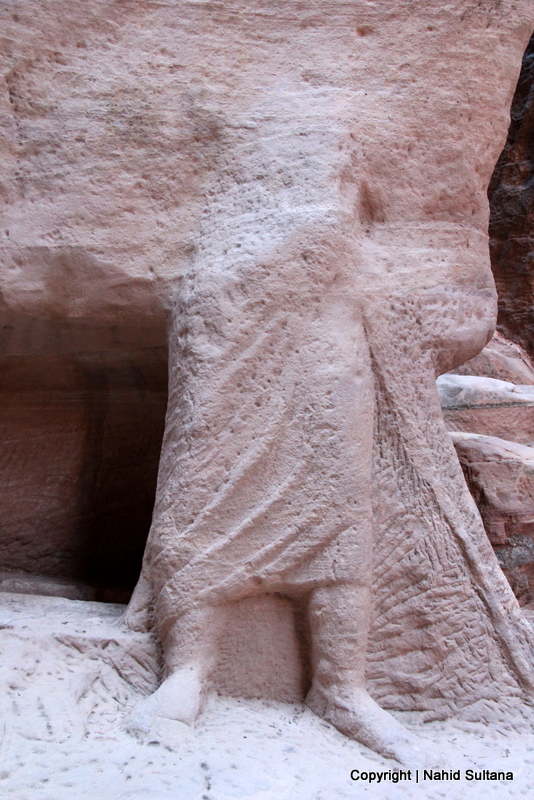
- A 2000 years old statue carved from stone by Nabataean inside Siq in Petra, Jordan
Many remnants of Nabataean history can be seen inside the Siq. Among these are the paved road and Nabataean sacred stone blocks. The paved road in the Siq was originally constructed by the Nabataeans, possibly towards the end of the 1st century BC. Limestone was used for the paving and portions of that road still exist in some areas of Siq.
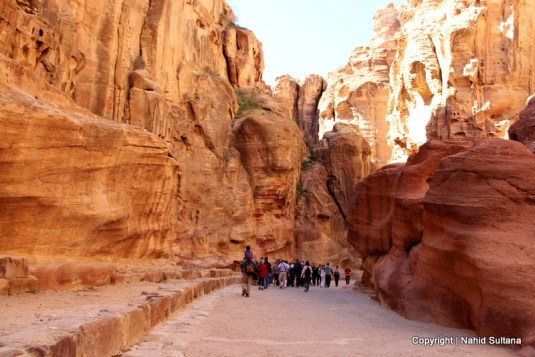
- Amazing colors and rock formations of Siq in Petra, Jordan
3) Al-KHAZANA (THE TREASURY): After 3 km of walk, Siq dramatically opens up to a magnificent view of the Khazana. This towering façade is the most spectacular monument carved by the Nabataeans from 60 BC – 50 AD. It was impressively carved out of a single block. The name, Khazana, comes from a local Bedouin legend that Pharaoh hid a treasure in the urn at the top. But in reality, it is a mausoleum and would have been used for funerary purposes.
Tourists are not allowed to go inside Khazana. So we rested in front of it for about half an hour while enjoying and appreciating the talented Nabataeans for Khazana’s imposing appearance. By the way, this is where Spielberg’s “Indiana Jones and the Last Crusade” was filmed starring Harrison Ford.
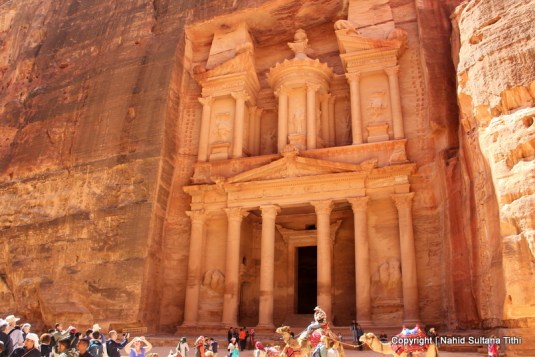
- Al-Khazana (The Treasury) in Petra, Jordan
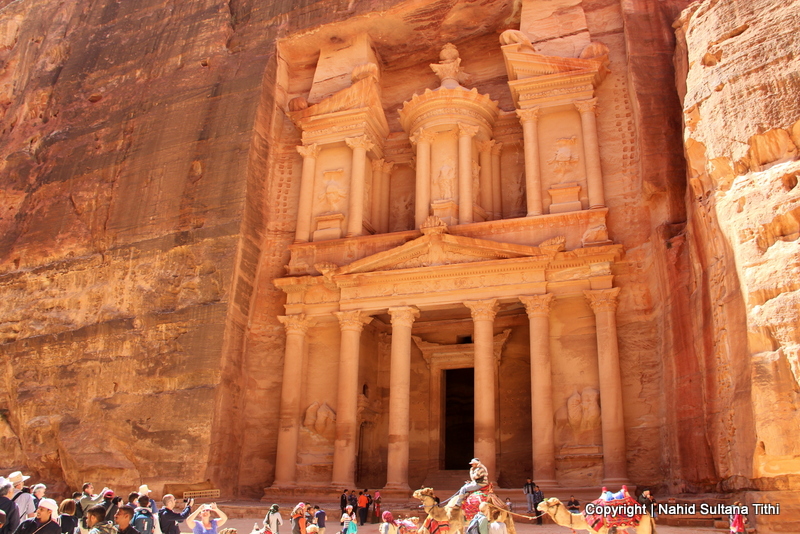
Most of visitors of Petra end their journey here, especially if they are with groups or on a day-trip from Amman or other cities. But this is just the half of Petra’s ancient secret. I would highly recommend travelers to pass this point and start going towards the monastery, otherwise you will miss out a lot of scenic sites that Petra has to offer to its guests.
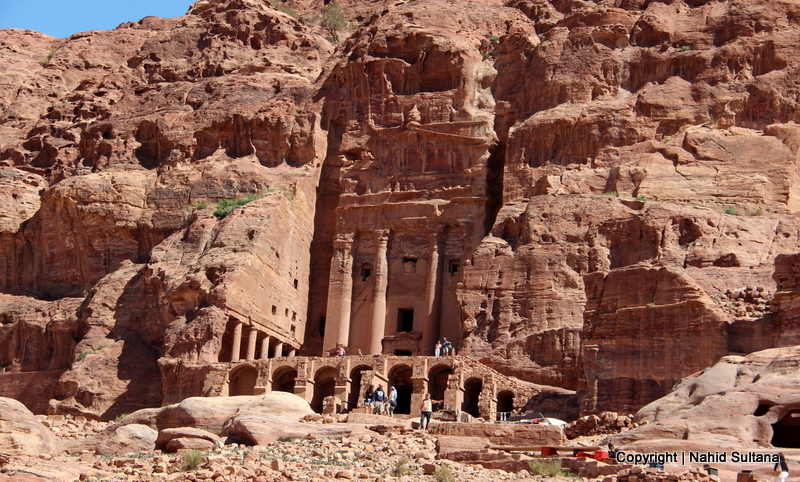
4) ROYAL TOMBS, CAVES, and RUINS: Leaving Khazana behind to our left, we walked thru another small natural passageway and came in front of a large valley. Some of the tombs here dates back to 200 BC. There is also a 3000-seat Roman Theater from the early 1st century AD in one side of the valley, a Roman style Palace Tomb, and many royal tombs to your right up on the hills. These caves, tombs, and carvings on mountains look like paintings of nature. The beauty doesn’t end anywhere…every corner has surprise, every rock of this valley has some uniqueness. Various walks and climbs reveal hundreds of rock carved tombs and temple façades, funerary halls, and rock reliefs…enough to keep your eyes busy for hours and days.
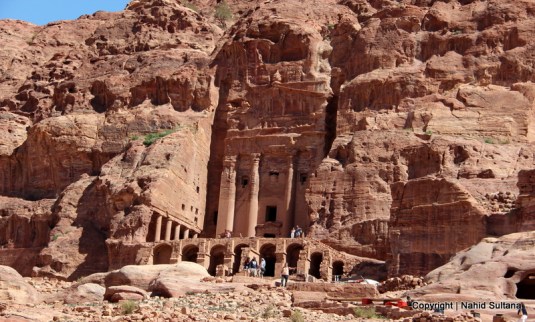
- Royal tombs and memorials of Nabataeans in Petra, Jordan
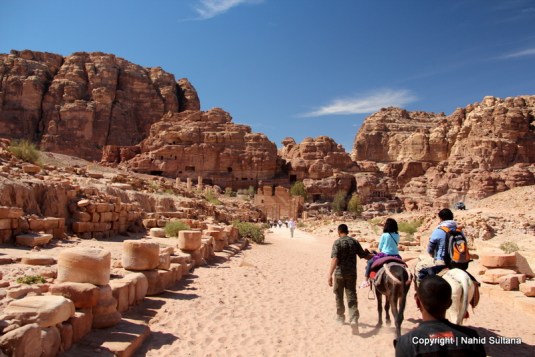
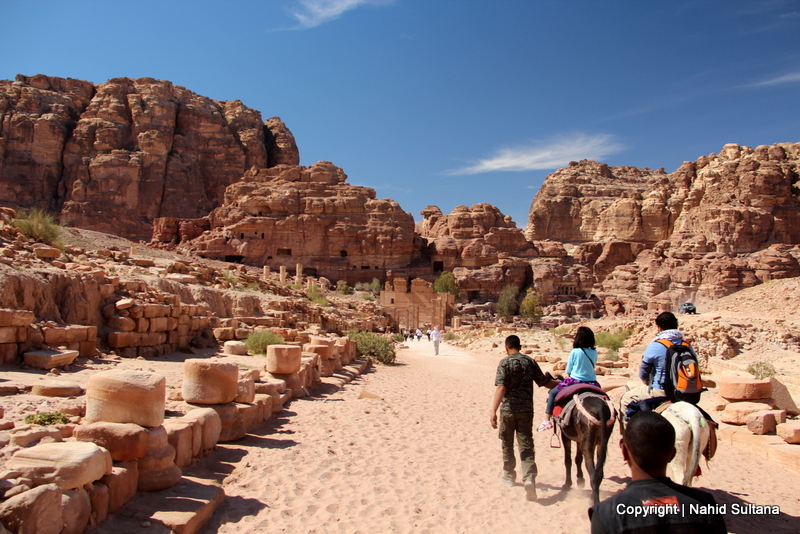
We rented our 2 donkeys and a mule from here. Now I was exploring Wadi Musa (Valley of Moses) riding on my mule. This was much easier than riding a camel (we rode on camels in our trip to Pyramids of Giza in Egypt). I felt much comfortable and was actually able to take pictures using my both hands…it felt so cool.
Many other Roman ruins can still be seen in this part of Petra. Massive columns and old limestone walls will take you back to those bygone days. This was a long way from Khazana before we actually started climbing the stairs to monastery.
- From my mule – riding thru the Roman ruins of Petra
5) WAY to MONASTERY: I think there are hundreds and thousands of caves and tombs in Petra, they are almost everywhere you look. Some of them are natural and some are hand-cut. Our guide with the animals were two Bedouins who reside in some nearby caves in Petra. They were saying in hot summer days these caves become very cool and pleasant while in winter they become very warm and cozy.
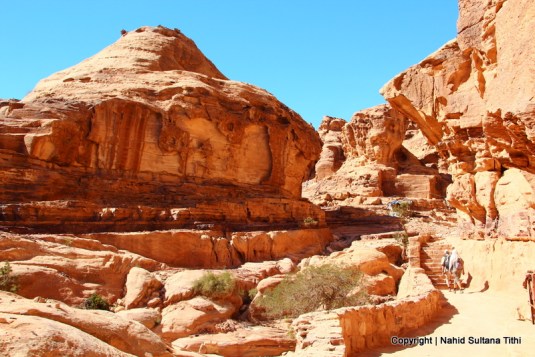
- Jabel Petra, mountains of Petra – on our way to the Monastery
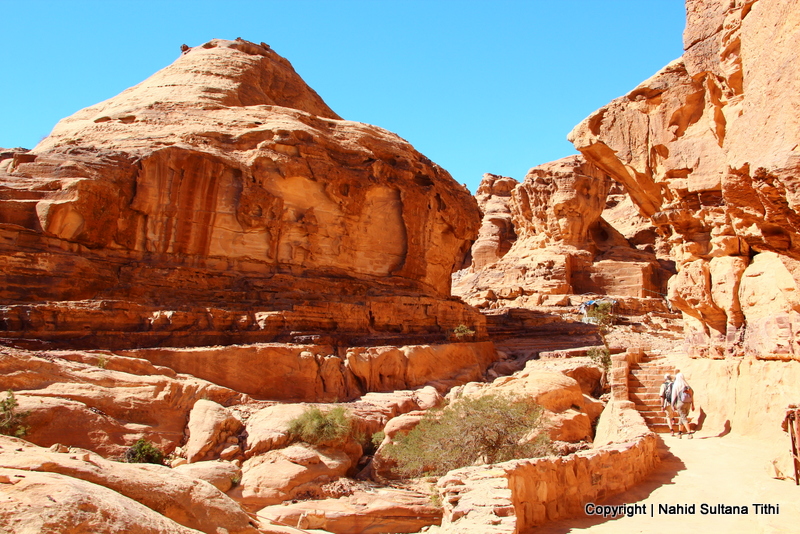
So, after all the ruins and royal tombs the climbing began. There are more than 900 unevenly cut steps to go all the way top to the monastery. The donkeys were very fast climbing although at times I thought he would drop me from his back to the deep down gorge. It was thrilling no doubt but kind of scary too. I scratched my one knee at one point since my mule decided to walk so close to the wall that it had forgotten my legs needed some space. But I would have done it again if I had to.
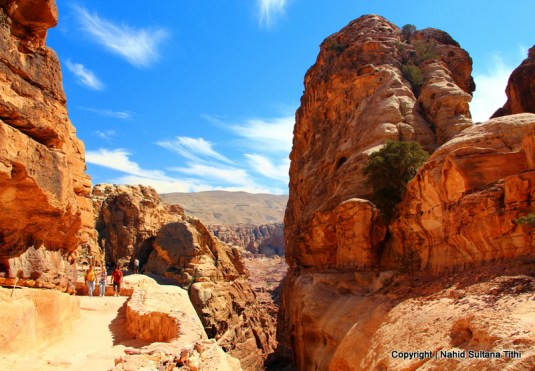
- A picture perfect place – Petra, Jordan
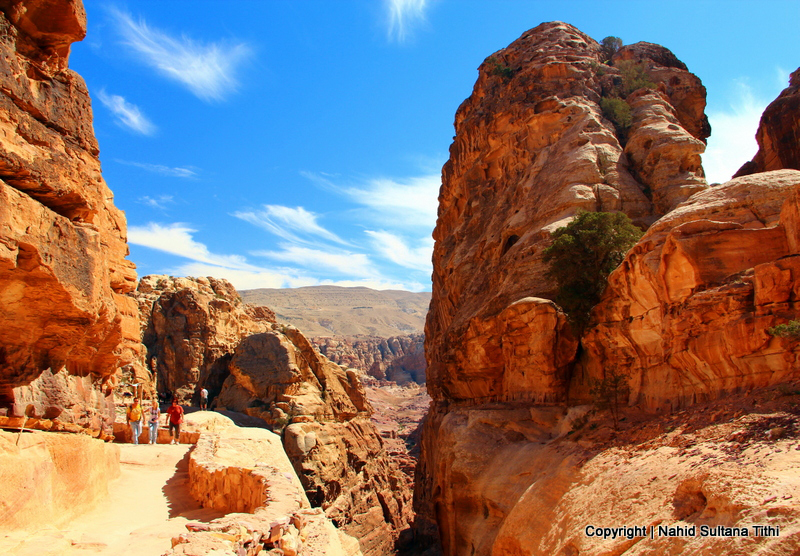
These animals can go up to a certain point of these mountains with tourists. After that the Bedouins and the animals stayed behind and we walked little bit and climbed another 50 steps before some more great views of the valley opened up to us.
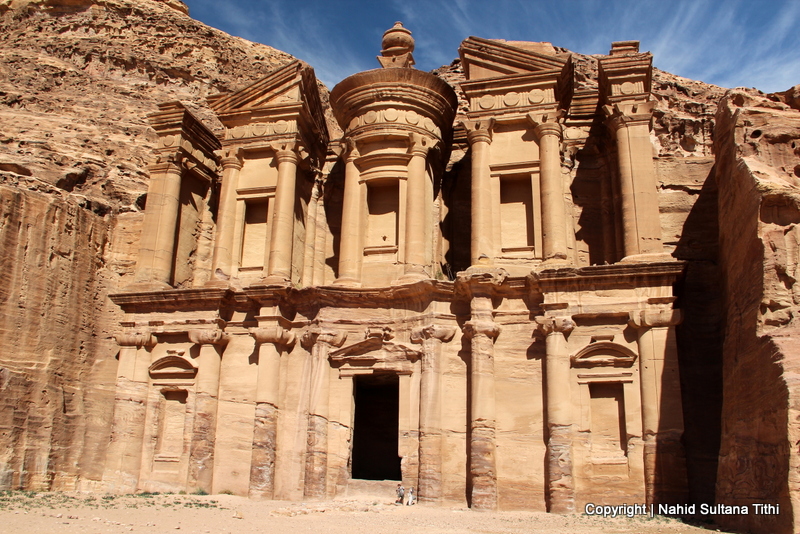
6) THE MONASTERY: Deeply carved into a cliff face of a mountain, known as Jabal ad-Dayr, the façade is traditionally known as “the Monastery”. Built in 85 BC, this is one of the largest monuments in Petra. It looks very similar to Khazana but bigger in size. There isn’t anything to see inside the monastery except for its 3 enclosed walls, but visitors are allowed to go in and take a look around.
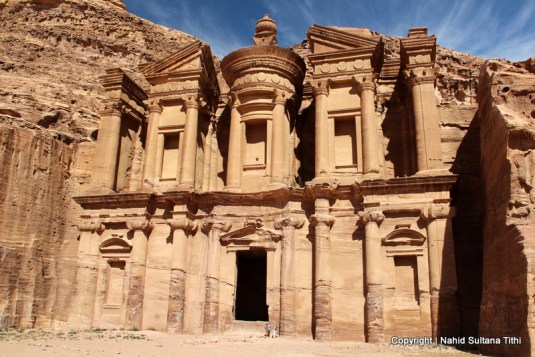
- Monastery in Petra, Jordan – carved by the Nabataeans in 85 BC
This was the end of our tour basically. There is a panoramic hill where people hike to see 360 degree view of the Petra city. But all of us were too exhausted to take anymore extra steps. From monastery we head back to our guides, went down some 900 steps, and back to Khazana where they picked us up from. From there, we rented a horse-drawn carriage to take us back to Visitors’ Center to avoid that 3km walk again. We were hungry, tired, sleepy, but absolutely satisfied with this journey. Petra is the most valuable treasure of Jordan. Thanks to the local authority for keeping this place so organized, clean, and safe for visitors. Every traveler must visit Jordan to see Petra, the “Lost City’, and its endless forget-me-not beauty.
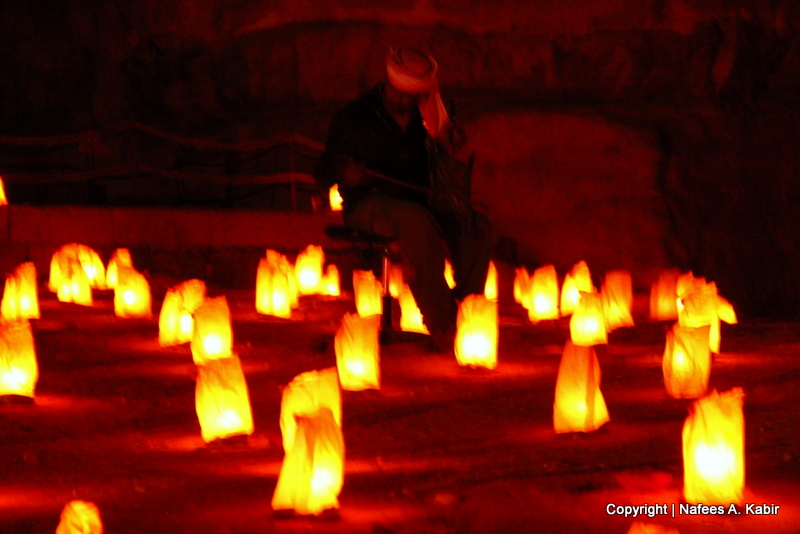
PETRA by NIGHT: This is the best way to experience Petra’s look at night, which I missed due to my high fever. My husband went with a big group. This can only be done as a guided tour with officials of Petra Visitors’ Center. Tourists first walk about 1 km from the Visitors’ Center to Siq, then 2 km from Siq all the way to Khazana following a candle-lit path. Here everyone sits down, rests, and drinks a cup of tea under the open sky, served by the Bedouins. As my husband said, while they were drinking tea, a man gave them some history on this place followed by musical performance by a Bedouin. This whole trip is magical because the whole Siq and in front of Khazana are decorated with hundreds of candles on both sides after dark. Although I didn’t go there, I can visualize the adventure of walking thru narrow passage of Siq at night surrounded by many many candles…must feel like you are in a different planet.
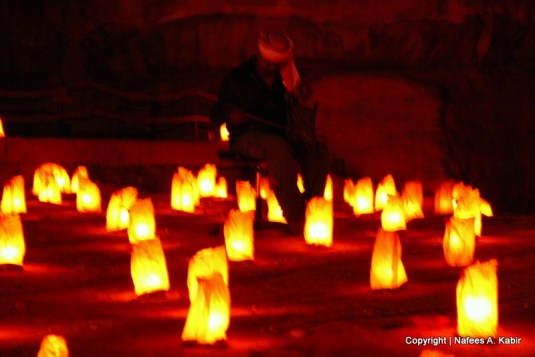
- Petra by Night – man telling history of Petra
The charge is 12 JD per person to take this walking tour at night. My husband bought the ticket from our hotel reception and just showed up in front of the visitor center of Petra 10 minutes before the tour started. The event takes place Mondays, Wednesdays, and Thursdays of every week. The tour started at 8:30 pm and took about 1 ½ hours to finish up.
Related articles
- Amman and Back (journeyaroundtheglobe.com)
- Know about Petra Jordan ‘The New Seven Wonders of World” (earmarkn.wordpress.com)
- Jordan Holidays Amazing Gateway to Petra (earmarkn.wordpress.com)
- Jordan Trip 2013 – Wadi Mujib, Karak, Dana, and Shobak (journeyaroundtheglobe.com)
- Petra – Journey To A Bygone Era (manjaribhatnagar.wordpress.com)
Share this:

Wallon capital of Belgium – Namur
NAMUR, BELGIUM: Namur, Namen in Flemish, is the capital of the Province of Namur and Wallonia region which is the French-speaking part of Belgium. Located by River Meuse (Mass), the city has its own heritage and unique look. This charming city can be a great getaway for tourists when visiting country’s capital, Brussels.
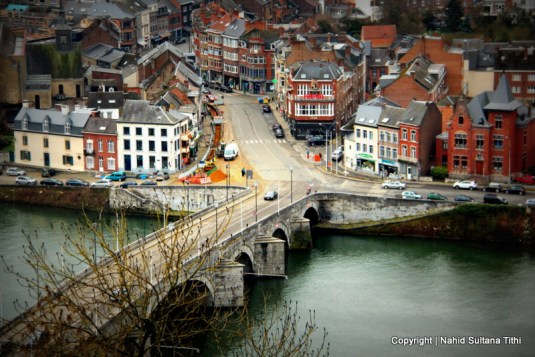
- City of Namur, Belgium
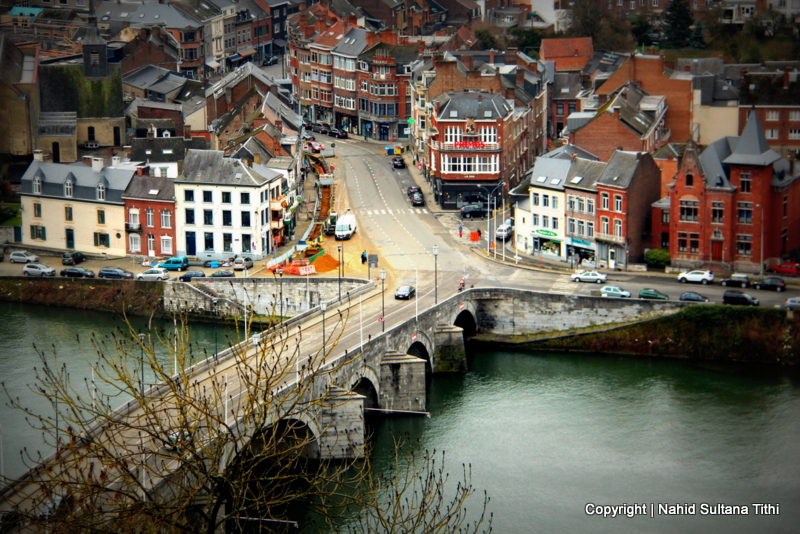
TIME of OUR TRAVEL: It was 2nd Saturday of March, 2013 when we visited Namur. We had a friend from Antwerp who accompanied us in this trip. The winter wasn’t over yet, but that day turned out to be a surprise for us. It was still cold and a bit gloomy in the morning, but luckily no rain (as predicted) and no bone-freezing cold. We left our home around 10:45 am and took us about an hour from Tervuren to reach the citadel of Namur.
EATING and SHOPPING: Most of the streets in old town near Cathedral St. Aubain are loaded with variety of cuisines and cafes. We had lunch in Express Asia on Rue de Fer. There are many bakeries and waffle house to treat your sweet tooth too. By the way, the smell of these waffles were divine…I thought I would have one before leaving, but forgot…hmmm.
Namur won’t disappoint you when it comes to shopping. In fact, I want to go back to Namur one day by myself only to do some crazy shopping spree. You will find almost every type of store on Rue de Fer and all the other small branches of alleys from or around Rue de Fer and close to the university. I wonder if this is the biggest shopping center in Wallonia!
PLACE WE’VE VISITED: We spent about a whole day in Namur, about 6/7 hours. We didn’t have any itinerary or a to-see list to follow. We knew we wanted to see the citadel, after that we just wandered around and went inside whatever looked good in our eyes. One thing that we didn’t see but should have seen was the Belfry of Namur which is an UNESCO World Heritage site. Here are the places we’ve seen and enjoyed:
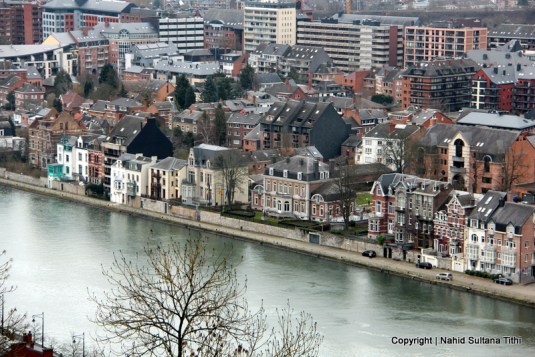
- Namur, Belgium – a view from the citadel
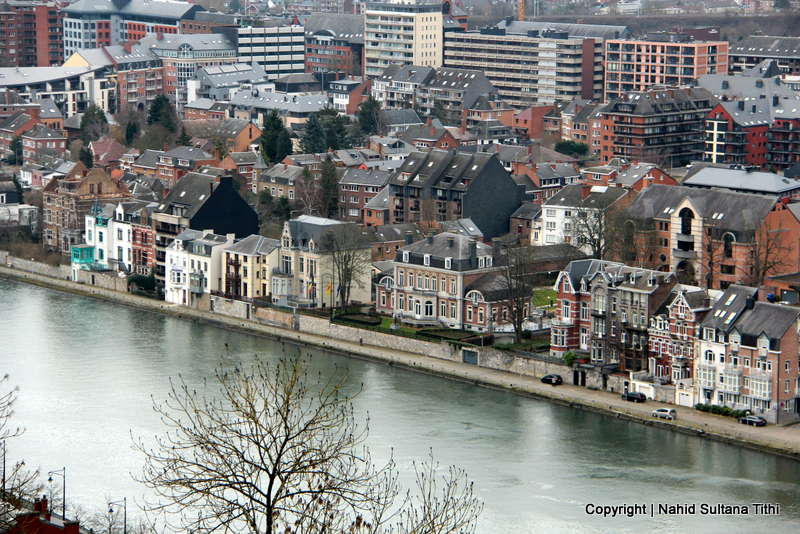
1) CITADELLE de NAMUR: The citadel is town’s most prominent sight. It is more like an open park for the public on top of the mountain. Many locals come here for jogging, walking, and biking. The best part of being on the top is that you get a fantastic view of the whole town. The scenic beauty of River Meuse with old buildings by the side is picture perfect.
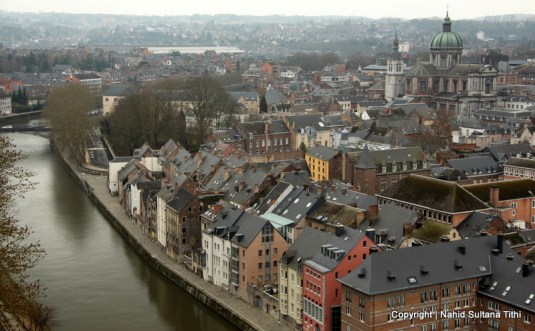
- View of Namur from the citadel in Belgium
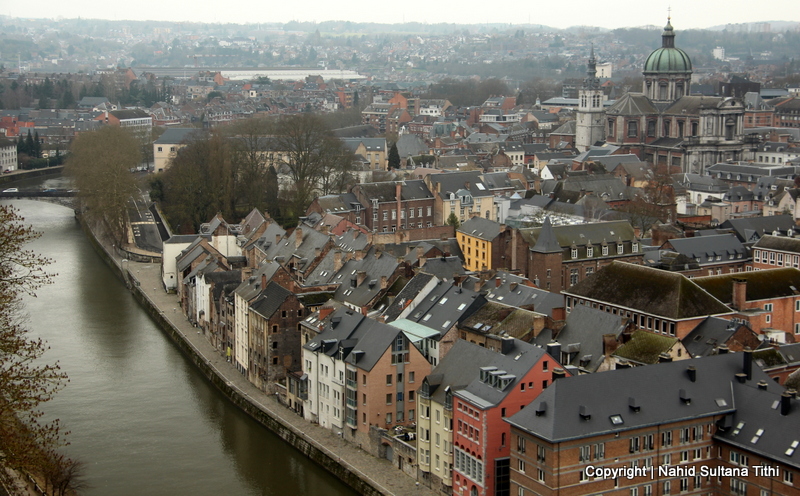
The hill where the citadel is located is called, Champeau hill. From 10th – 15th centuries, the castle was the residence of the earl of Namur. In the 16th century, a modern fortification called “Mediane” was built. Chateau de Namur was built in 1910 AD. There are some underground passages to take a walk but can only be done with a tour. Even though there are very few remains from the medieval period, some elements can still be seen, such as the general outline of the castle, 3 of its towers, and part of the foundations.
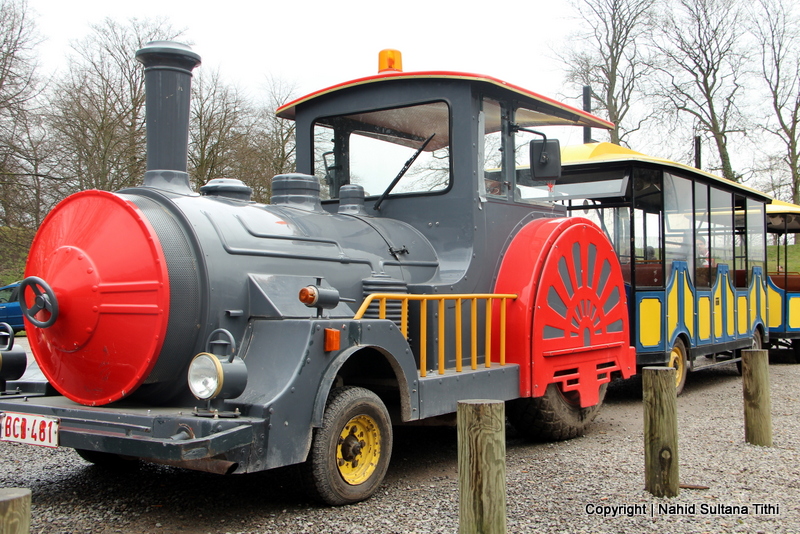
There is no fee to enter the citadel. Train ride costs 4 euros per person (4 years and below are free) and lasts for about 20 minutes. Another package which is available to the tourists costs 9 euros. This is with a guided tour and includes the train ride, underground passages, medieval part of the citadel, and a film. There is a big parking lot in front of reception where we parked for free.
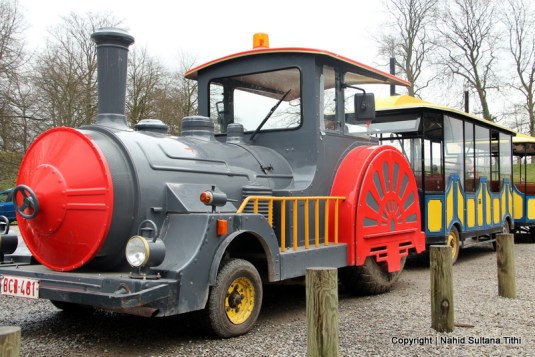
- Tourist train in Citadelle de Namur, Belgium
2) CATHEDRALE ST. AUBAIN: Turquoise dome of this cathedral can be seen from far distance and from top of the citadel. Outer Late-Baroque look of St. Aubain may not impress you as much but it’s a totally different story when you go inside. It’s very big in size but more than that the walls and vaulted ceilings are delightful. The highlights of this church are probably the richly carved dome, decorative main altar, and the huge organ in the back. It didn’t look like a typical Belgian church to me…has more of Italian/Roman touch to it.
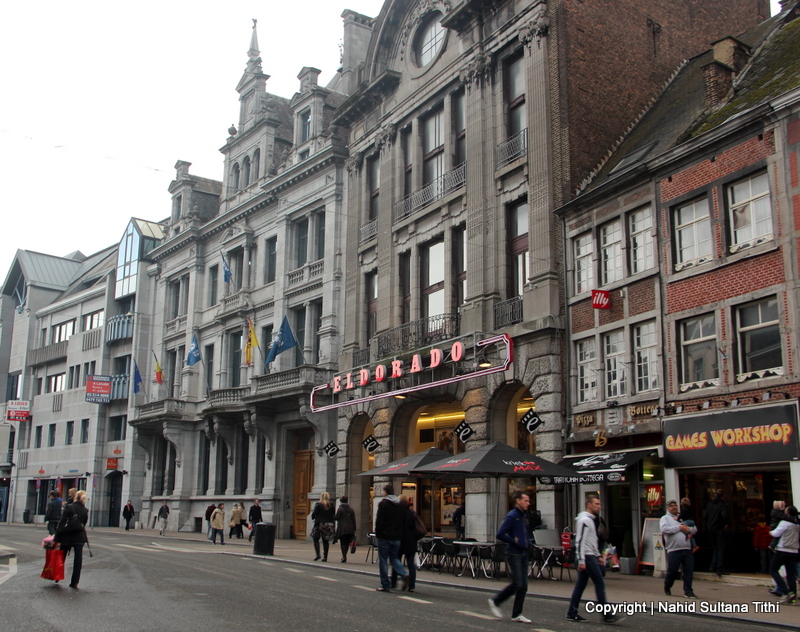
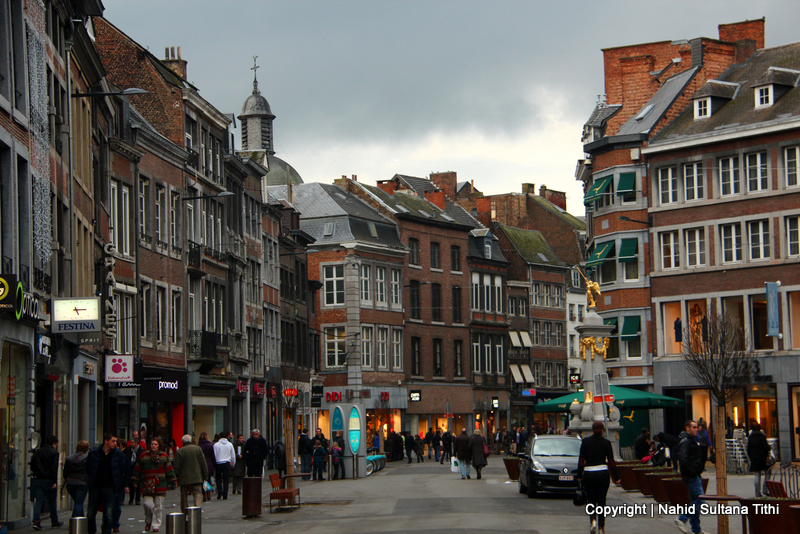
3) RUE de FER: This is probably one of the busiest streets of city where Namur Town Hall is located. The whole stretch of this street (partially pedestrian zone) has tons of shops, local boutiques, brand name places, chocolatiers, and etc…you can say this is the fashion street of the Walloons.
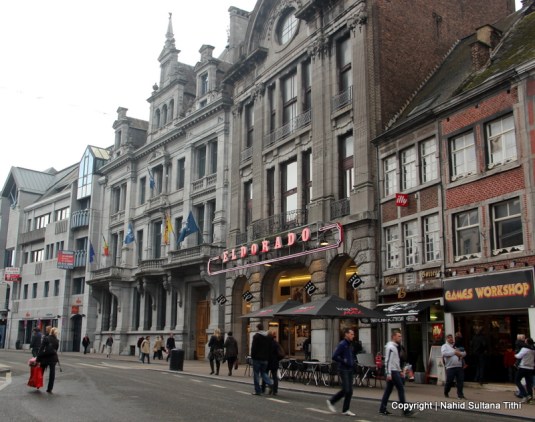
- One of the major shopping streets of Namur – Rue de Fer
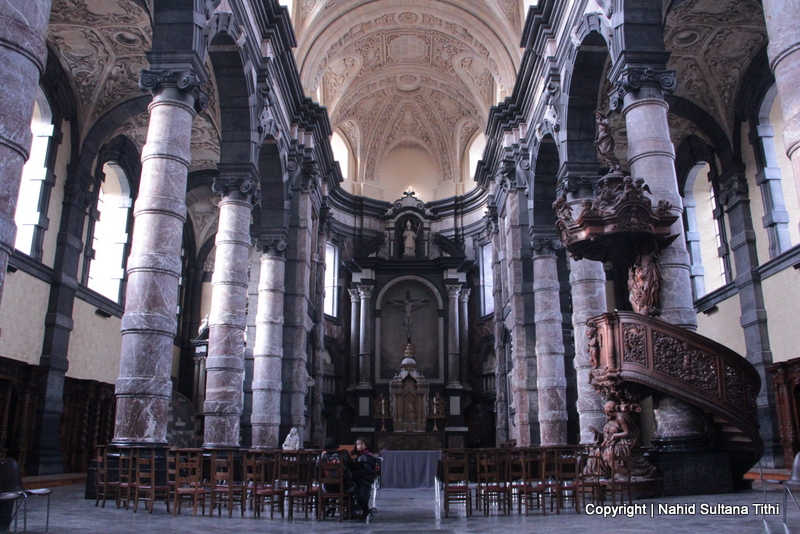
4) CHURCH of ST. LOUP: This is a very sophisticated looking church located in the old town/heart of Namur and very close to Cathedral St. Aubain. The interior of this Baroque style church is very gorgeous. The vaulted ceilings, main altar, the black and red marble naves and columns are remarkable. It is a small church but a must see in Namur.
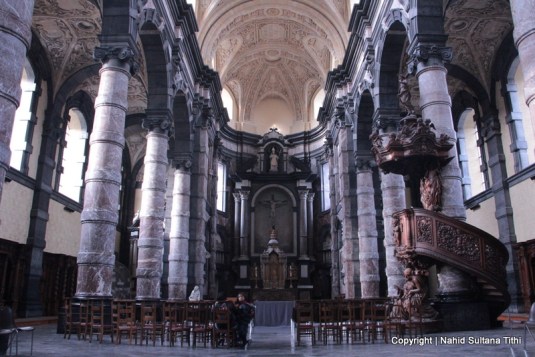
- Inside Church of St. Loup, Namur
5) PLACE de I’ANGE: As I said before, we really didn’t have any to-see list for Namur. We were doing some window shopping on Rue de la Croix (one of the alleys of old town and this big square sort of opened up at the end of the street to our surprise. This is a lively and lovely square with many shops and cafes along with an indoor shopping mall, Galerie Jardin D’harscamp. Most of it is pedestrian zone. We came here little bit before our parking meter was almost up…so could only spent little time here.
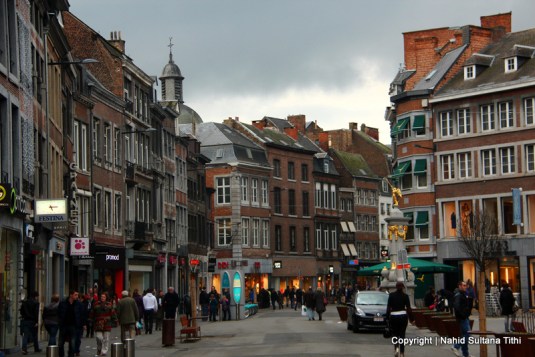
- Place de I’Ange in Namur, Belgium
Related articles
- Bucket list before moving back to America in summer of 2014 (journeyaroundtheglobe.com)
- A historic university town – Leuven, Belgium (journeyaroundtheglobe.com)
Share this:

Business Excellence Award 2020 from AI Global Media for The Most Entertaining Personal Travel Blog – Pacific Northwest USA

Top Posts & Pages


Authors
 Globe Runner
Business Excellence Award 2020 for The Most Entertaining Personal Travel Blog – Pacific Northwest USA

Business Excellence Award 2020 from AI Global Media


